


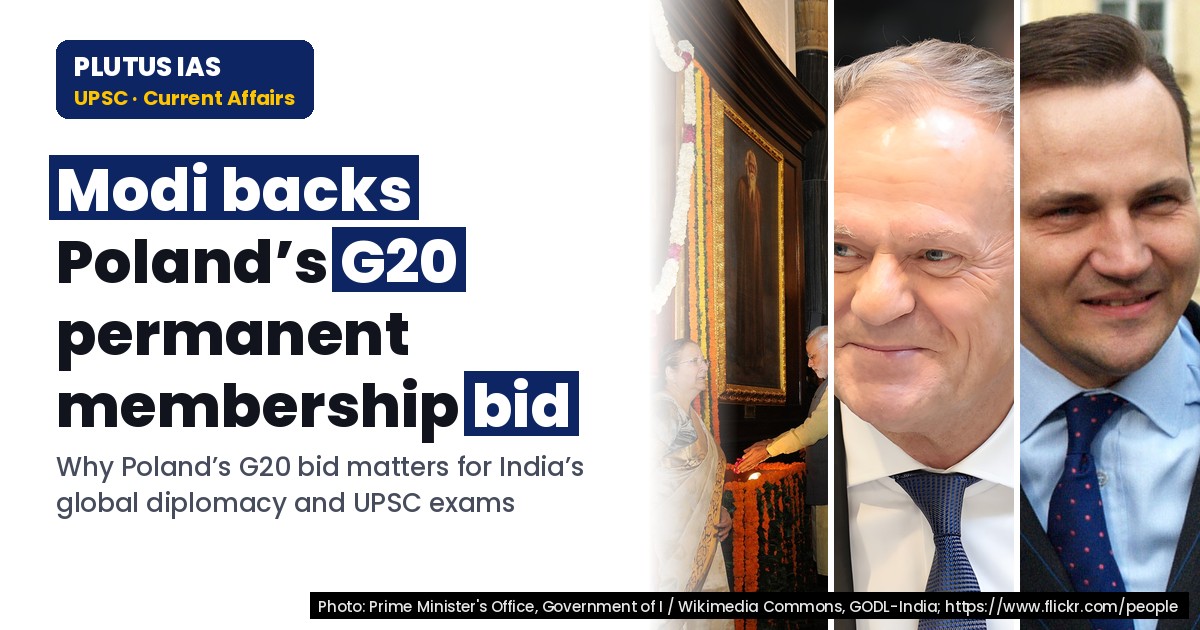
31 Oct Modi backs Poland’s G20 Permanent Membership Bid: Key for UPSC
✎ The G20 operates on a consensus-driven, rotating membership model, making bids for permanent membership contingent on political support from existing members.
Subject Relevance — Where This Topic Fits
- GS Paper II — International Relations — Global Groupings and Agreements involving India and/or affecting India’s interests | GS Paper II — International Relations — Bilateral, Regional and Global Groupings and Agreements involving India and/or affecting India’s interests
- Prelims: G20, Permanent Membership Criteria, Global Economic Governance, Plurilateralism, Multilateral Institutions, India’s Foreign Policy, Poland’s Geopolitical Position
- Essay: The evolving architecture of global governance: Challenges and opportunities for emerging powers, Multilateralism in the 21st century: Efficacy, legitimacy, and the role of middle powers
Quick Revision: The G20 operates on a consensus-driven, rotating membership model, making bids for permanent membership contingent on political support from existing members.
Why is this in the news?
The news highlights India’s formal endorsement of Poland’s bid for permanent membership in the G20, a significant development in the evolving dynamics of global economic governance. This endorsement, conveyed during a high-level bilateral engagement, underscores India’s strategic approach to expanding its diplomatic footprint while engaging with key European partners. The development also reflects broader trends in plurilateral institutional reform and the shifting calculus of middle-power diplomacy in multilateral forums.
Background
- The G20, established in 1999 in the aftermath of the Asian financial crisis, serves as a premier forum for international economic cooperation, comprising 19 countries and the European Union.
- Poland, a key Central European economy and member of the European Union, has been actively pursuing enhanced representation in global economic governance structures to amplify its voice in shaping international economic policies.
- India, as a founding member of the G20 and a major emerging economy, has historically advocated for reforms in global institutions to reflect contemporary geopolitical realities, including greater representation for developing nations.
- The bid for permanent membership by non-G20 members such as Poland reflects a broader trend of middle powers seeking expanded roles in global governance, particularly in forums traditionally dominated by major economies.
- The endorsement by India aligns with its broader foreign policy objective of strengthening ties with Central and Eastern European nations, as part of its ‘Act East’ and ‘Connect Central Asia’ policy frameworks.
- The G20’s decision-making process on membership expansion remains informal and consensus-driven, with no formalised criteria for permanent membership, making such bids contingent on political support from existing members.
What is the G20 and its Membership Framework?
- The Group of Twenty (G20) is an international forum established in 1999 to foster dialogue and cooperation among major developed and emerging economies on global economic and financial issues.
- Membership in the G20 is currently based on a rotating system, with 19 countries and the European Union participating.
- The G20 operates through a system of annual summits, ministerial meetings, and working groups, with decisions taken by consensus. It does not have a formal charter or treaty-based structure, making its governance flexible but less institutionalised.
- The G20’s agenda has expanded beyond macroeconomic coordination to include issues such as climate change, sustainable development, digital economy, and health, reflecting the evolving priorities of the global economy.
- However, invitations to non-member countries are extended for specific summits based on thematic relevance or geopolitical considerations.
- The G20’s legitimacy is often debated, with critics arguing that its composition lacks adequate representation of developing economies, particularly from Africa and smaller island states.
- Reforms in the G20’s membership framework have been proposed periodically, including calls for permanent seats for Africa, Latin America, and other regions, but no consensus has been reached on expansion.
- The G20’s presidency rotates annually among member countries, with the host country setting the agenda and priorities for the year. The presidency plays a crucial role in shaping the forum’s outcomes and global economic discourse.
Key Features
| Feature | Significance |
|---|---|
| G20 Membership Expansion | Expansion of the G20 to include new permanent members reflects efforts to enhance global economic governance by incorporating emerging economies and regional powers. |
| Multilateral Diplomacy | India’s support for Poland’s bid underscores its engagement in multilateral forums to strengthen strategic partnerships and global stability. |
| Bilateral Diplomacy | High-level exchanges between India and Poland, including the visit of Polish Prime Minister Donald Tusk, highlight deepening bilateral relations in trade, investment, and geopolitics. |
| EU-India Trade Relations | Poland’s advocacy for an India-European Union free trade agreement signals potential economic synergies and trade liberalisation between India and the EU. |
| Global South Initiatives | Reference to India’s and Turkey’s initiatives for ceasefire efforts in the Black Sea reflects India’s role in addressing regional conflicts and humanitarian crises. |
Why it Matters
Economic Significance
- Poland’s inclusion in the G20 could enhance the bloc’s representation of Central and Eastern European economies, diversifying its economic composition.
- An India-Poland strategic partnership may facilitate technology transfer, investment flows, and supply chain integration, particularly in sectors like manufacturing and IT.
- Progress toward an India-EU Free Trade Agreement (FTA) could reduce tariffs, boost trade volumes, and create jobs in both economies.
Geopolitical Significance
- India’s support for Poland’s G20 bid aligns with its broader strategy of balancing relations with major powers, including the US, EU, and Russia.
- Poland’s alignment with Western institutions (NATO, EU) strengthens India’s engagement with transatlantic partners, enhancing its diplomatic flexibility.
- The G20’s expansion may reflect shifting global power dynamics, with emerging economies seeking greater influence in multilateral decision-making.
Institutional Significance
- The G20’s role in global economic governance is being redefined, with discussions on permanent membership indicating a shift toward a more inclusive structure.
- India’s active participation in G20 processes, including supporting new members, reinforces its status as a key player in shaping global economic policies.
- Poland’s bid highlights the G20’s evolving criteria for membership, which may prioritise economic size, geopolitical influence, and regional representation.
Strategic Significance
- Poland’s strategic location in Central Europe makes it a potential gateway for India’s trade and investment into the EU market.
- Strengthening ties with Poland could provide India with an alternative supply chain route, reducing dependence on traditional partners.
- Poland’s support for India’s initiatives in conflict resolution (e.g., Black Sea ceasefire) may foster deeper security cooperation.
Challenges
1. G20 Membership Expansion Criteria
- The G20 lacks a formalised framework for permanent membership expansion, leading to ambiguity in the application process.
- Existing members may prioritise geopolitical alignment over economic criteria, complicating Poland’s bid.
- The US-led proposal for Poland’s membership may face resistance from other G20 members, delaying consensus.
UPSC Link: GS-II: International Institutions (G20)
2. India-EU Trade Negotiations
- Divergent interests between India and the EU on tariffs, intellectual property, and agricultural subsidies may stall FTA negotiations.
- Scepticism within the EU, particularly from Poland’s agricultural sector, could hinder consensus on trade liberalisation.
- Non-tariff barriers, such as regulatory standards and sanitary measures, may pose significant challenges.
UPSC Link: GS-II: India-EU Relations
3. Regional Conflicts and Diplomacy
- India’s initiatives for ceasefire in the Black Sea region face challenges due to entrenched geopolitical rivalries (e.g., Russia-Ukraine war).
- The effectiveness of such initiatives depends on multilateral coordination, which is often difficult to achieve.
- Humanitarian crises in the Global South require sustained diplomatic efforts, which may be constrained by limited resources.
UPSC Link: GS-II: Regional and Global Groupings
4. Bilateral Diplomacy Constraints
- High-level visits and commitments may not always translate into tangible outcomes without follow-up mechanisms.
- Differences in political systems and economic priorities between India and Poland could slow down cooperation.
- Public perception and domestic politics in both countries may influence the pace of bilateral engagement.
UPSC Link: GS-II: Bilateral Relations
5. Global Economic Governance Challenges
- The G20’s effectiveness is often limited by the lack of binding authority, reducing its ability to implement reforms.
- Divergent economic policies among G20 members, particularly on issues like climate change and trade, hinder collective action.
- The bloc’s expansion may dilute its decision-making efficiency if new members lack alignment with existing priorities.
UPSC Link: GS-II: International Economic Organisations
Challenges — UPSC Perspective
| Issue | Concern |
|---|---|
| G20 Membership Criteria | Lack of a formalised process for permanent membership expansion, leading to ambiguity and potential resistance. |
| India-EU FTA Negotiations | Divergent interests on tariffs, subsidies, and regulatory standards may stall progress. |
| Regional Conflicts (Black Sea) | Entrenched geopolitical rivalries and limited multilateral coordination hinder ceasefire efforts. |
| Bilateral Diplomacy | High-level commitments may not translate into tangible outcomes without sustained follow-up. |
| Global Economic Governance | Lack of binding authority and divergent policies reduce the G20’s effectiveness in implementing reforms. |
| Public Perception and Domestic Politics | Domestic pressures in India and Poland may influence the pace and direction of cooperation. |
Way Forward
- Conclude formal negotiations for the India-EU Free Trade Agreement (FTA) by addressing key divergences in tariffs, intellectual property, and agricultural subsidies.
- Establish a joint India-Poland working group to monitor the implementation of bilateral agreements and identify new areas of cooperation.
- Strengthen multilateral coordination with the G20 to develop a transparent framework for permanent membership expansion, ensuring criteria are based on economic and geopolitical contributions.
- Enhance diplomatic engagement with the US and EU to build consensus on Poland’s G20 membership bid, leveraging India’s strategic partnerships.
- Promote people-to-people ties through cultural exchanges, educational collaborations, and business delegations to deepen long-term bilateral relations.
- Address regional conflicts in the Black Sea through multilateral forums, aligning with India’s initiatives while ensuring neutrality and humanitarian focus.
- Expand trade and investment ties by identifying key sectors (e.g., IT, manufacturing, renewable energy) for joint ventures and technology transfer.
- Monitor domestic political developments in both countries to mitigate risks arising from public perception and electoral cycles.
UPSC Value Addition
Keywords for Mains Answer-Writing
G20 membership expansion · Permanent membership criteria for G20 · India’s foreign policy stance on multilateral institutions · G20 enlargement process · G20 governance reforms · Global economic governance architecture · India-Poland bilateral relations · G20 presidency and membership dynamics · Multilateralism and coalition-building in international organisations · G20’s evolving role in global governance
Concept Flow
Poland’s bid for G20 permanent membership → India’s support for the bid → India-Poland bilateral relations → Potential India-EU FTA negotiations → Enhanced trade and investment flows → Strengthened geopolitical alignment between India and the EU → Broader implications for global economic governance within the G20 → Impact on regional conflicts (e.g., Black Sea ceasefire efforts) → Long-term strategic partnership between India and Poland.
Prelims Practice Questions
Q1. Consider the following statements regarding the G20 membership expansion process:
1. The G20 currently operates with a permanent membership model.
2. The G20 membership can be expanded only by a unanimous decision of existing members.
3. The G20 presidency rotates annually among member states.
4. The G20 does not have a formal process for granting permanent membership to new countries.
How many of the above statements are correct?
- Only one
- Only two
- Only three
- All four
Answer: Only three — Statements 3 and 4 are correct. The G20 operates on a non-permanent membership model with rotating presidencies (Statement 3). It does not have a formal process for granting permanent membership, as membership is based on invitations to countries representing major global economic interests (Statement 4). Statements 1 and 2 are incorrect as the G20 does not have permanent membership and decisions are not required to be unanimous for expansion.
Q2. Assertion (A): The G20 was established as a permanent international organisation with a formal secretariat.
Reason (R): The G20 was created in response to the global financial crisis of 2008 to provide a platform for major economies to coordinate on economic policies.
Options:
A. Both A and R are true, and R is the correct explanation of A.
B. Both A and R are true, but R is not the correct explanation of A.
C. A is true, but R is false.
D. A is false, but R is true.
Answer: ? — Assertion (A) is false because the G20 is not a permanent international organisation and does not have a formal secretariat. Reason (R) is true as the G20 was indeed created in 2008 in response to the global financial crisis. Therefore, the correct option is D.
Q3. Match the following pairs related to international economic groupings:
Column I (Grouping) Column II (Description)
A. G20 1. A grouping of developed and developing countries focused on climate change and sustainable development.
B. G7 2. A forum of 19 countries and the EU representing major advanced economies.
C. BRICS 3. A coalition of five major emerging economies.
D. BASIC 4. A group of seven advanced economies with significant global influence.
Options:
A. A-2, B-4, C-3, D-1
B. A-1, B-2, C-3, D-4
C. A-3, B-4, C-2, D-1
D. A-4, B-1, C-2, D-3
Answer: ? — The correct matching is: A (G20) – 2 (A forum of 19 countries and the EU representing major advanced economies), B (G7) – 4 (A group of seven advanced economies with significant global influence), C (BRICS) – 3 (A coalition of five major emerging economies), D (BASIC) – 1 (A grouping of developed and developing countries focused on climate change and sustainable development).
Mains Practice Question
✍ The G20’s evolving membership dynamics reflect a broader shift towards inclusivity in global economic governance. Critically examine the criteria, processes, and implications of expanding the G20’s permanent membership, with particular reference to recent discussions on Poland’s bid. (15 Marks)
Approach: MODEL-ANSWER SKELETON:
1. **Introduction**: Define the G20, its origin (2008 financial crisis), and its current composition (19 countries + EU). Highlight its informal nature and lack of permanent membership.
2. **Membership Criteria**: Discuss the de facto criteria for G20 membership: economic size, systemic significance, and representation of diverse regions. Reference the G20’s self-described role as a ‘forum for international economic cooperation’.
3. **Process for Expansion**: Explain the lack of a formal process for permanent membership expansion. Emphasise that invitations are extended by consensus among existing members, often during summits. Cite the precedent of expansion (e.g., inclusion of the EU in 1999, invitation of Spain as a permanent invitee).
4. **Poland’s Bid**: Analyse Poland’s case: its economic size (largest economy in Central Europe), EU membership, and strategic importance. Discuss India’s role in supporting the bid and the broader geopolitical context (e.g., US sponsorship of the resolution).
5. **Implications of Expansion**:
– **Inclusivity vs. Effectiveness**: Argue whether expansion enhances representativeness or dilutes decision-making efficiency.
– **Regional Balance**: Discuss how expansion could address underrepresentation (e.g., Africa, Southeast Asia).
– **Geopolitical Dimensions**: Highlight tensions between inclusivity and the dominance of traditional powers (G7 members).
6. **Conclusion**: Take a balanced stance—acknowledge the need for reform in global governance but caution against ad-hoc expansion without clear criteria. Suggest alternatives like observer status or thematic coalitions within the G20 framework.
Source: orissapost.com
Generated by AanyaAi for educational purpose.
Related guides on our sites
- Best PSIR optional coaching for upsc
- Best PSIR optional teacher for upsc
- Best teacher of PSIR optional for upsc
- Best PSIR optional coaching in delhi for UPSC

- Modi backs Poland’s G20 Permanent Membership Bid: Key for UPSC - October 31, 2026
- जी20 बैठक: जयशंकर और काजा कallas ने यूक्रेन युद्ध और खाड़ी संकट पर चर्चा की - October 31, 2026
- Government Extends Cotton Import Duty Exemption Till 2026: UPSC Economy Analysis - October 31, 2026

No Comments