


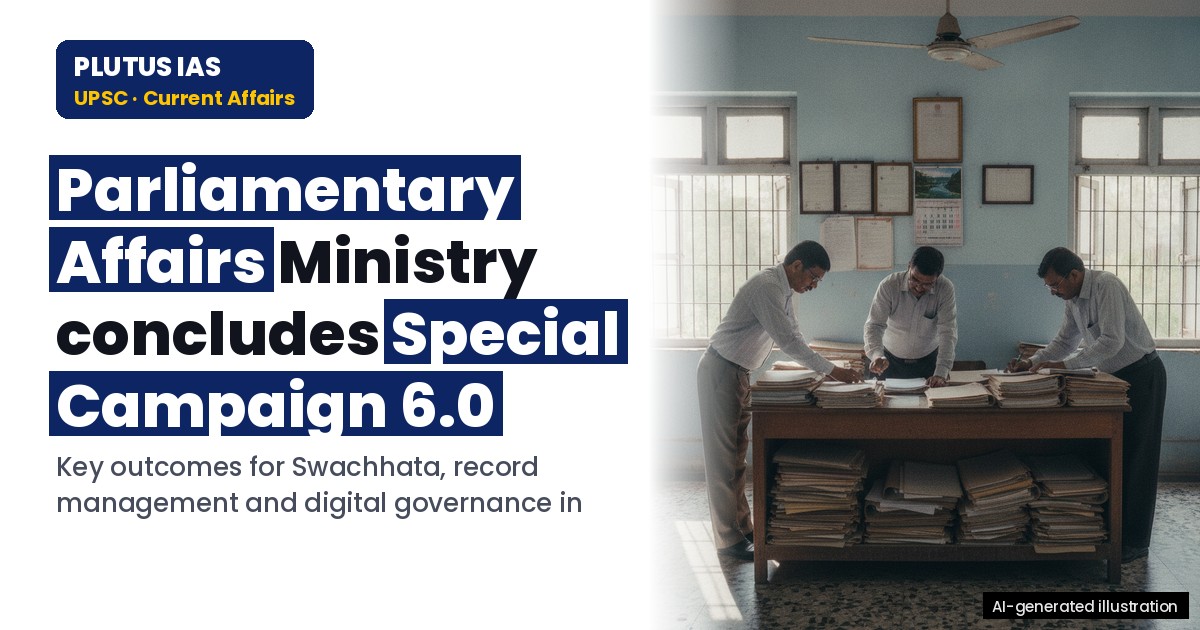
31 Oct Ministry of Parliamentary Affairs Concludes Special Campaign 6.0: Key Highlights for UPSC & State PCS
✎ Special Campaign 6.0 is a bi-annual government initiative focusing on Swachhata, Records Management, and Digital Governance, coordinated by the Ministry of Parliamentary Affairs to institutionalise administrative efficiency and…
Subject Relevance — Where This Topic Fits
- GS Paper II — Governance, Constitution, Polity, Social Justice and International Relations (Ministry of Parliamentary Affairs, Digital Governance) | GS Paper III — Science and Technology (Digital Governance, Records Management)
- Prelims: Special Campaign 2.0, 3.0, 4.0, 5.0, Swachh Bharat Mission 2.0, Digital India, e-Governance, Manual of Office Procedure (MOP), National Archives of India, Right to Information Act, 2005
- Essay: The role of administrative reforms in nation-building: Lessons from Special Campaigns, Digital governance as a catalyst for transparent and accountable administration
Quick Revision: Special Campaign 6.0 is a bi-annual government initiative focusing on Swachhata, Records Management, and Digital Governance, coordinated by the Ministry of Parliamentary Affairs to institutionalise administrative efficiency and transparency.
Why is this in the news?
The Ministry of Parliamentary Affairs has concluded Special Campaign 6.0, a time-bound, outcome-focused initiative aimed at enhancing cleanliness, records management, and digital governance across government ministries and departments. This campaign aligns with broader national efforts to institutionalise administrative efficiency, transparency, and citizen-centric service delivery through systematic reforms in record-keeping, digital transformation, and physical infrastructure management.
Background
- Special Campaigns are a flagship initiative of the Government of India, launched under the broader framework of ‘Swachhata Hi Seva’ and ‘Digital India’, to drive behavioural change and operational efficiency in government functioning.
- The campaigns are conducted twice annually—April and October—since 2021, with each iteration focusing on specific themes such as cleanliness, records management, digital governance, and service delivery improvements.
- Special Campaign 6.0 (October 2024) builds on the momentum of previous campaigns, which have reported measurable outcomes in reducing pendency, improving office hygiene, and accelerating digital adoption in government processes.
- The Ministry of Parliamentary Affairs serves as the nodal ministry for coordinating Special Campaigns, working closely with the Department of Administrative Reforms and Public Grievances (DARPG) and the National Informatics Centre (NIC) to ensure standardised implementation across ministries.
- The campaign is grounded in constitutional and statutory provisions, including Article 51A(g) of the Constitution (duty to improve the natural environment), the Manual of Office Procedure (MOP), and the Right to Information Act, 2005, which mandates efficient record management for transparency.
- Digital governance initiatives under the campaign are aligned with the Digital India programme, which aims to transform India into a digitally empowered society and knowledge economy.
What is Special Campaign 6.0?
- Special Campaign 6.0 is a time-bound, mission-mode initiative launched by the Government of India to drive administrative reforms in three key areas: Swachhata (cleanliness), Records Management, and Digital Governance across all central ministries, departments, and attached/subordinate offices.
- The campaign is conducted bi-annually—April and October—since 2021, with each edition building on the outcomes of the previous one. Special Campaign 6.0 was conducted in October 2024.
- The primary objectives of Special Campaign 6.0 include: (a) ensuring physical cleanliness and hygiene in government offices, (b) digitising and streamlining records management to reduce pendency and improve accessibility, and (c) accelerating the adoption of digital governance tools and platforms to enhance service delivery and transparency.
- The campaign is coordinated by the Ministry of Parliamentary Affairs in collaboration with the Department of Administrative Reforms and Public Grievances (DARPG), the National Informatics Centre (NIC), and the Ministry of Electronics and Information Technology (MeitY).
- Special Campaign 6.0 follows a structured approach, including: (i) identification of key areas for intervention in each ministry/department, (ii) formulation of action plans with measurable targets, (iii) regular monitoring and review by nodal officers, and (iv) public feedback mechanisms to ensure accountability.
- Key deliverables under the campaign include: elimination of physical file movement for routine matters, digitisation of legacy records, adoption of e-office systems, training of officials on digital tools, and implementation of waste segregation and recycling practices in government offices.
- The campaign also emphasises citizen-centric governance by improving the quality of services delivered to the public, such as faster processing of applications, reduced grievance redressal timelines, and enhanced transparency through digital platforms like CPGRAMS (Centralised Public Grievance Redress and Monitoring System).
- Special Campaign 6.0 is aligned with broader national missions such as Swachh Bharat Mission 2.0, Digital India, and the National e-Governance Plan (NeGP), ensuring coherence with existing policy frameworks.
Key Features
| Feature | Significance |
|---|---|
| Swachhata (Cleanliness) Drive | Enhances institutional hygiene, reduces health hazards, and fosters a culture of cleanliness within government offices, aligning with the broader ‘Swachh Bharat Mission’ objectives. |
| Record Management | Ensures systematic digitization and preservation of official records, improving transparency, accountability, and ease of access for stakeholders and citizens. |
| Digital Governance Initiatives | Promotes paperless workflows, reduces delays, and enhances service delivery efficiency by leveraging digital tools and platforms. |
| Special Campaign 6.0 Framework | A structured, time-bound campaign to drive administrative reforms, institutionalize best practices, and measure progress through quantifiable benchmarks. |
Why it Matters
Administrative Reforms
- Demonstrates the government’s commitment to institutionalizing cleanliness, record-keeping, and digital transformation as enduring governance practices rather than ad-hoc initiatives.
- Aligns with the broader ‘Minimum Government, Maximum Governance’ principle by reducing bureaucratic inefficiencies and promoting accountability.
- Strengthens the institutional capacity of the Ministry of Parliamentary Affairs to function as a model for other ministries in adopting similar reforms.
Citizen-Centric Governance
- Improves public trust by ensuring government offices are clean, records are accessible, and services are delivered through digital channels, reducing citizen grievances.
- Facilitates seamless access to parliamentary and administrative records, enhancing transparency and participatory democracy.
- Reduces the carbon footprint of government operations through paperless governance, contributing to environmental sustainability.
Institutional Synergy
- Encourages inter-ministerial collaboration by setting a precedent for systematic reform adoption across government departments.
- Provides a replicable model for other ministries to conduct similar campaigns, fostering a culture of continuous improvement in governance.
- Enhances the Ministry’s role in coordinating parliamentary functions by ensuring efficient record-keeping and administrative support.
Challenges
1. Legacy Data Digitization
- Physical records in government offices are often voluminous, unstructured, and prone to deterioration, making digitization a time-intensive and resource-heavy process.
- Ensuring data integrity and security during the transition from physical to digital formats poses significant challenges, particularly in safeguarding sensitive parliamentary records.
UPSC Link: GS-II: E-governance
2. Resistance to Digital Adoption
- Bureaucratic inertia and lack of digital literacy among staff may hinder the adoption of new technologies, requiring targeted training and change management strategies.
- Cybersecurity threats, including data breaches and ransomware attacks, necessitate robust IT infrastructure and periodic audits to mitigate risks.
UPSC Link: GS-III: Cybersecurity
3. Resource Allocation Constraints
- Limited financial and human resources may impede the scaling of digital governance initiatives, particularly in resource-constrained government departments.
- Balancing the costs of digitization with the need for immediate operational efficiency requires strategic prioritization and phased implementation.
UPSC Link: GS-III: Resource Mobilization
4. Interoperability Issues
- Fragmented digital systems across ministries and departments may lead to compatibility issues, hindering seamless data exchange and integration.
- Standardizing data formats and protocols across government agencies is essential but requires significant coordination and technical expertise.
UPSC Link: GS-II: Digital India
Challenges — UPSC Perspective
| Issue | Concern |
|---|---|
| Legacy Data Digitization | Time and resource-intensive process with risks of data loss or corruption. |
| Digital Literacy Gaps | Staff resistance and inefficiencies due to inadequate training in new technologies. |
| Cybersecurity Vulnerabilities | Exposure to data breaches, ransomware, and unauthorized access. |
| Resource Constraints | Limited budgets and manpower may delay or dilute the impact of reforms. |
| Interoperability Challenges | Lack of standardized systems across ministries hinders seamless data sharing. |
Way Forward
- Conduct comprehensive training programs for staff on digital tools, record-keeping protocols, and cybersecurity best practices to ensure smooth adoption.
- Establish a dedicated digital governance cell within the Ministry to oversee implementation, monitor progress, and address bottlenecks in real time.
- Develop a phased roadmap for digitizing legacy records, prioritizing high-value and frequently accessed documents to maximize efficiency gains.
- Collaborate with the National Informatics Centre (NIC) to integrate standardized data formats and interoperable systems across ministries.
- Institute periodic audits and third-party assessments to evaluate the effectiveness of reforms and identify areas for improvement.
- Launch a public awareness campaign to highlight the benefits of digital governance, fostering citizen participation and feedback mechanisms.
- Allocate dedicated funds for cybersecurity infrastructure, including encryption, firewalls, and regular vulnerability assessments.
- Encourage cross-ministerial knowledge-sharing workshops to replicate successful practices and foster a culture of continuous improvement.
UPSC Value Addition
Keywords for Mains Answer-Writing
Special Campaign 6.0 · Ministry of Parliamentary Affairs · Swachhata Abhiyan · Records Management · Digital Governance · Government of India · Administrative Reforms · e-governance · Institutional Efficiency · Constitutional Provisions for Records · Right to Information Act 2005 · National Archives of India · Digitisation of Records · Government Policy · Public Administration
Constitutional & Policy Linkages
- Article 74: Role of the Council of Ministers in aiding and advising the President.
- Article 75: Collective responsibility of the Council of Ministers to Parliament.
Concept Flow
Initiation of Special Campaign 6.0 by the Ministry of Parliamentary Affairs → Identification of key focus areas: Swachhata, Record Management, and Digital Governance → Implementation of cleanliness drives, digitization of records, and adoption of digital tools → Training and capacity-building for staff to ensure smooth transition → Monitoring and evaluation of progress through quantifiable benchmarks → Institutionalization of reforms to ensure sustainability and scalability → Enhanced transparency, accountability, and citizen-centric governance outcomes
Prelims Practice Questions
Q1. Consider the following statements regarding the Special Campaign 6.0 launched by the Ministry of Parliamentary Affairs:
1. It is a centrally sponsored scheme aimed at promoting cleanliness in government offices.
2. The campaign includes a focus on digital governance and record management.
3. The campaign is conducted exclusively by the Ministry of Housing and Urban Affairs.
How many of the above statements are correct?
- Only one
- Only two
- All three
- None
Answer: Only two — Statement 1 and 2 are correct as the campaign focuses on Swachhata, digital governance, and record management. Statement 3 is incorrect as the campaign is led by the Ministry of Parliamentary Affairs, not the Ministry of Housing and Urban Affairs.
Q2. Assertion (A): The Right to Information Act, 2005 mandates the digitisation of all government records within a specified timeframe.
Reason (R): The Act requires all public authorities to proactively disclose information in electronic format to enhance transparency and accountability.
Options:
A. Both A and R are true, and R is the correct explanation of A.
B. Both A and R are true, but R is not the correct explanation of A.
C. A is true, but R is false.
D. A is false, but R is true.
Answer: ? — Assertion (A) is false as the RTI Act does not explicitly mandate the digitisation of all records within a specific timeframe. Reason (R) is true as the Act encourages proactive disclosure of information in electronic format to promote transparency.
Q3. Match the following initiatives with their respective ministries:
Initiative:
1. Swachh Bharat Mission
2. Digital India
3. National e-Governance Plan
Ministry:
a. Ministry of Electronics and Information Technology
b. Ministry of Housing and Urban Affairs
c. Ministry of Personnel, Public Grievances and Pensions
Options:
A. 1-a, 2-b, 3-c
B. 1-b, 2-a, 3-c
C. 1-c, 2-b, 3-a
D. 1-b, 2-c, 3-a
Answer: ? — 1. Swachh Bharat Mission is under the Ministry of Housing and Urban Affairs (b). 2. Digital India is under the Ministry of Electronics and Information Technology (a). 3. National e-Governance Plan is under the Ministry of Personnel, Public Grievances and Pensions (c).
Mains Practice Question
✍ The Ministry of Parliamentary Affairs has recently concluded Special Campaign 6.0, emphasising Swachhata, record management, and digital governance. In this context, critically examine the significance of digital governance and record management in enhancing administrative efficiency and transparency in India. Also, discuss the constitutional and statutory provisions that govern the preservation and accessibility of government records. (15 Marks)
Approach: MODEL-ANSWER SKELETON:
1. **Introduction (2 marks)**
– Define digital governance and record management in the context of public administration.
– Briefly introduce Special Campaign 6.0 and its objectives.
2. **Significance of Digital Governance (4 marks)**
– **Efficiency**: Reduction in paperwork, faster decision-making, and improved service delivery (e.g., e-office, e-sansad).
– **Transparency**: Real-time tracking of government processes and citizen access to information (RTI Act, 2005).
– **Accountability**: Digital trails reduce corruption and enhance auditability.
– **Citizen-Centric Governance**: Platforms like UMANG, DigiLocker, and e-governance portals.
3. **Record Management and its Impact (4 marks)**
– **Preservation of Records**: Importance of maintaining authentic, accessible, and retrievable records (National Archives of India Act, 1993).
– **Challenges**: Physical record decay, lack of standardisation, and slow digitisation.
– **Benefits of Digitisation**: Space efficiency, disaster resilience, and ease of retrieval (e.g., National Digital Library of India).
4. **Constitutional and Statutory Provisions (3 marks)**
– **Article 14**: Right to equality and fair treatment in record access.
– **Article 19(1)(a)**: Right to information as a fundamental right.
– **Right to Information Act, 2005**: Provisions for proactive disclosure and digitisation of records.
– **Public Records Act, 1993**: Mandates preservation of public records and their transfer to the National Archives.
5. **Challenges and Way Forward (2 marks)**
– **Challenges**: Lack of uniform standards, resistance to change, and cybersecurity risks.
– **Way Forward**: Strengthening institutional capacity, promoting inter-ministerial coordination, and leveraging AI for record management.
**Balanced Conclusion**: Digital governance and record management are pivotal for modernising India’s administrative framework, but their success hinges on robust institutional support, legal compliance, and technological adoption.
Source: PIB (Press Information Bureau)
Generated by AanyaAi for educational purpose.
Related guides on our sites
- Current affairs for upsc 2026
- Best PSIR optional coaching for upsc
- Best PSIR optional teacher for upsc
- Best teacher of PSIR optional for upsc

- Ministry of Parliamentary Affairs Concludes Special Campaign 6.0: Key Highlights for UPSC & State PCS - October 31, 2026
- वायुसेना प्रमुख बने एयर चीफ मार्शल अशुतोष दीक्षित - October 31, 2026
- BIMSTEC Maritime Exercise 2024: Key Security Lessons for UPSC & State PCS - October 31, 2026

No Comments