


01 Nov Delhi’s October AQI 2026: Lowest in 8 Years, Key Reasons & Impact
✎ The Air Quality Index (AQI) is a composite measure of air pollution, with Delhi’s October 2026 AQI of 166 reflecting a 'Moderate' category, indicating potential health risks for sensitive groups, while sustained improvements are…
Subject Relevance — Where This Topic Fits
- GS Paper III — Environment and Ecology (Environmental Pollution and Degradation) | GS Paper III — Science and Technology (Environmental Monitoring and Assessment)
- Prelims: Air Quality Index (AQI), Particulate Matter (PM2.5, PM10), Commission for Air Quality Management (CAQM), National Clean Air Programme (NCAP), Graded Response Action Plan (GRAP), Environmental Pollution (Prevention and Control) Authority (EPCA), National Ambient Air Quality Standards (NAAQS), Delhi-NCR, Stubble Burning, Vehicular Emissions
- Essay: Environmental Governance and Sustainable Urban Development, Balancing Economic Growth and Environmental Protection in India
Quick Revision: The Air Quality Index (AQI) is a composite measure of air pollution, with Delhi’s October 2026 AQI of 166 reflecting a ‘Moderate’ category, indicating potential health risks for sensitive groups, while sustained improvements are attributed to multi-stakeholder interventions under the CAQM and NCAP frameworks.
Why is this in the news?
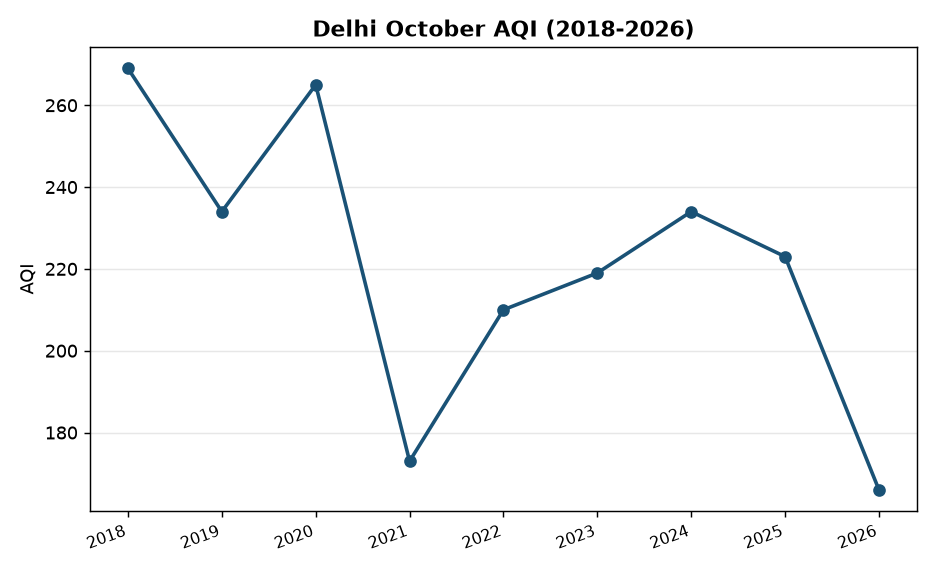
The Press Information Bureau (PIB) released data on 31 October 2026, highlighting that Delhi recorded its lowest October average Air Quality Index (AQI) in eight years at 166, with a significant reduction in PM2.5 and PM10 concentrations. This improvement follows sustained multi-stakeholder interventions under the Commission for Air Quality Management (CAQM) for Delhi-NCR, reflecting the efficacy of targeted air pollution control measures and policy frameworks.
Background
- The National Capital Region (NCR), including Delhi, has historically faced severe air pollution challenges, particularly during the post-monsoon and winter months, due to a confluence of factors such as vehicular emissions, industrial activities, construction dust, and stubble burning in neighboring states.
- The Supreme Court of India, in 2016, constituted the Environment Pollution (Prevention and Control) Authority (EPCA) as an interim measure to address air pollution in Delhi-NCR, which later evolved into the Commission for Air Quality Management (CAQM) in 2020 under the Commission for Air Quality Management (CAQM) Act, 2021.
- The National Clean Air Programme (NCAP), launched in 2019 by the Ministry of Environment, Forest and Climate Change (MoEFCC), aims to reduce PM2.5 and PM10 concentrations by 20-30% by 2024 across 132 non-attainment cities, including Delhi.
- The Graded Response Action Plan (GRAP), a set of emergency measures triggered based on AQI thresholds, has been periodically revised to enhance its effectiveness in mitigating severe air pollution episodes.
- Stubble burning in Punjab, Haryana, and Uttar Pradesh contributes significantly to Delhi’s air pollution, necessitating coordinated regional policy interventions.
- The Central Pollution Control Board (CPCB) monitors air quality through a network of 38 manual and 34 continuous ambient air quality monitoring stations in Delhi-NCR, providing real-time data for policy formulation.
What is Air Quality Index (AQI) and its Regulatory Framework in India?
- The Air Quality Index (AQI) is a numerical scale used to communicate the quality of air in a region, ranging from 0 to 500, where higher values indicate greater health risks. It is calculated based on concentrations of eight pollutants: PM10, PM2.5, NO2, SO2, CO, O3, NH3, and Pb.
- The AQI is categorized into six bands: Good (0-50), Satisfactory (51-100), Moderate (101-200), Poor (201-300), Very Poor (301-400), and Severe (401-500). The October 2026 AQI of 166 in Delhi falls in the ‘Moderate’ category, indicating potential health risks for sensitive groups.
- The National Ambient Air Quality Standards (NAAQS), notified by the CPCB under the Air (Prevention and Control of Pollution) Act, 1981, prescribe permissible limits for ambient air pollutants. For PM2.5, the annual average standard is 40 µg/m³, and for PM10, it is 60 µg/m³.
- The Commission for Air Quality Management (CAQM) for Delhi-NCR is a statutory body established under the CAQM Act, 2021, with the mandate to coordinate, enforce, and monitor air quality management efforts across Delhi, Punjab, Haryana, Uttar Pradesh, and Rajasthan.
- The CAQM implements the Graded Response Action Plan (GRAP), which imposes restrictions on industrial activities, construction, vehicular movement, and waste burning based on AQI thresholds to prevent severe air pollution episodes.
- The National Clean Air Programme (NCAP) is a long-term, time-bound national-level strategy to reduce air pollution in non-attainment cities, with a target of 20-30% reduction in PM2.5 and PM10 concentrations by 2024 (extended to 2026).
- The Central Pollution Control Board (CPCB) and State Pollution Control Boards (SPCBs) play a crucial role in monitoring air quality, enforcing emission standards, and implementing pollution control measures under the Water (Prevention and Control of Pollution) Act, 1974, and the Air Act, 1981.
- Public awareness campaigns, such as ‘Harit Diwali-Swasth Diwali’ and ‘Odd-Even Scheme’, have been periodically implemented to reduce emissions from firecrackers and vehicular sources, respectively.
Key Features
| Feature | Significance |
|---|---|
| Average AQI for October 2026 (166) | Lowest in eight years, indicating measurable improvement in Delhi’s air quality during the post-monsoon season. |
| Days with AQI ≤200 (220 days, Jan–Oct 2026) | Highest count since 2018 (excluding 2020), reflecting sustained periods of acceptable air quality. |
| Average PM2.5 concentration (69 µg/m³, Jan–Oct 2026) | Lowest annual average in the past nine years, suggesting reduced particulate pollution. |
| Average PM10 concentration (171 µg/m³, Jan–Oct 2026) | Lower than the 2018–2025 average, indicating reduced coarser particulate matter. |
| Days with AQI >200 (84 days, Jan–Oct 2026) | Significant reduction compared to 2018–2025, though still above the 2020 level. |
Why it Matters
Public Health
- Reduction in PM2.5 and PM10 levels correlates with lower respiratory and cardiovascular health risks for Delhi’s population.
- Fewer days with AQI >200 reduce acute health impacts such as asthma exacerbations and hospital admissions.
- Long-term exposure reduction supports compliance with WHO Air Quality Guidelines, though national standards remain higher.
Environmental Governance
- Demonstrates the effectiveness of multi-stakeholder coordination under the Commission for Air Quality Management (CAQM).
- Provides empirical basis for scaling up targeted interventions in critical sectors like construction, waste burning, and vehicular emissions.
- Highlights the role of seasonal meteorology (e.g., wind patterns, temperature inversions) in air quality outcomes.
Policy Evaluation
- Validates the impact of the Graded Response Action Plan (GRAP) and other statutory measures under the Air (Prevention and Control of Pollution) Act, 1981.
- Offers data for assessing the efficacy of stubble management policies and industrial emission controls.
- Serves as a benchmark for future revisions of the National Clean Air Programme (NCAP) targets.
Economic Implications
- Improved air quality may reduce productivity losses due to illness and absenteeism in the workforce.
- Enhances livability and attractiveness of Delhi for investment and talent retention, particularly in service sectors.
- Potential reduction in healthcare expenditure for pollution-related diseases, though long-term economic valuation is complex.
Challenges
1. Stubble Burning and Agricultural Residue Management
- Stubble burning in Punjab, Haryana, and Uttar Pradesh remains a major contributor to Delhi’s winter air pollution.
- Despite policy interventions, enforcement gaps persist due to lack of alternative livelihoods for small farmers.
- Meteorological conditions in October–November exacerbate the dispersion of agricultural smoke into the National Capital Region (NCR).
UPSC Link: Environmental Pollution: Causes, Effects
2. Vehicular Emissions and Transport Sector
- Delhi’s vehicle fleet continues to expand, offsetting gains from cleaner fuel standards and electric mobility initiatives.
- Inadequate public transport capacity and last-mile connectivity drive private vehicle dependence.
- Diesel and older vehicles contribute disproportionately to NOx and particulate emissions.
UPSC Link: Urban Air Pollution: Sources and Mitigation
3. Construction and Dust Management
- Unregulated construction activities and road dust contribute significantly to PM10 levels.
- Lack of mandatory use of water sprinkling, covered transport, and green construction practices persists.
- Weak enforcement of the Construction and Demolition Waste Management Rules, 2016, limits effectiveness.
UPSC Link: Solid Waste Management: Challenges
4. Industrial Emissions and Thermal Power Plants
- Coal-based thermal power plants in the NCR region contribute to secondary particulate formation.
- Industrial clusters, particularly in Ghaziabad and Faridabad, face challenges in adopting cleaner technologies.
- Compliance with emission standards under the Environment (Protection) Act, 1986, remains uneven.
UPSC Link: Industrial Pollution Control
5. Meteorological and Topographical Constraints
- Geographical location of Delhi in a semi-arid basin limits natural dispersion of pollutants.
- Temperature inversions and low wind speeds during winter trap pollutants near ground level.
- Climate change may intensify heat islands and reduce precipitation, worsening air quality.
UPSC Link: Climate Change and Air Quality Interaction
Challenges — UPSC Perspective
| Issue | Concern |
|---|---|
| Stubble burning | Transboundary smoke transport during winter months |
| Vehicular emissions | High NOx and particulate load from diesel vehicles |
| Construction dust | Unregulated activities and poor compliance with dust suppression norms |
| Industrial emissions | Coal-based power plants and legacy industrial clusters |
| Meteorological factors | Temperature inversions and low wind speeds in winter |
Government Initiatives — Must-Memorise for Prelims
- National Clean Air Programme (NCAP)
- Graded Response Action Plan (GRAP)
- Commission for Air Quality Management (CAQM) in NCR and Adjoining Areas
- Stubble Management Scheme (under Sub-Mission on Agroforestry)
- Construction and Demolition Waste Management Rules, 2016
Way Forward
- Strengthen enforcement of stubble management policies through real-time satellite monitoring and farmer outreach programmes.
- Accelerate adoption of electric public transport and last-mile connectivity solutions to reduce vehicular emissions.
- Mandate use of water sprinklers, covered trucks, and green construction practices in all building projects within NCR.
- Enhance monitoring of industrial emissions with IoT-based sensors and impose penalties for non-compliance with emission norms.
- Develop a city-wide heat island mitigation plan, including green roofs, urban forests, and reflective pavements.
- Expand the use of remote sensing and AI-driven air quality forecasting to issue early warnings and adaptive GRAP measures.
- Promote public awareness campaigns on individual actions (e.g., carpooling, waste segregation) to complement regulatory efforts.
- Integrate air quality data with health surveillance systems to assess the impact of interventions on public health outcomes.
UPSC Value Addition
Keywords for Mains Answer-Writing
Air Quality Index (AQI) · Particulate Matter (PM2.5 and PM10) · Commission for Air Quality Management (CAQM) · National Clean Air Programme (NCAP) · Environmental Pollution (Prevention and Control) Authority (EPCA) · Graded Response Action Plan (GRAP) · Air pollution mitigation strategies · Delhi-NCR air quality management · National Ambient Air Quality Standards (NAAQS) · Urban air pollution governance · Winter air quality challenges · Stubble burning and vehicular emissions · Environmental governance institutions · Air quality monitoring and data analysis
Concept Flow
Anthropogenic activities (stubble burning, vehicular emissions, construction) → Increase in PM2.5 and PM10 concentrations → Accumulation under meteorological inversions → Degradation of air quality (AQI >200) → Adverse health impacts (respiratory and cardiovascular diseases) → Implementation of statutory measures (GRAP, NCAP) → Enforcement of emission standards → Reduction in particulate concentrations → Improvement in AQI (≤200) → Positive public health outcomes → Multi-stakeholder coordination (CAQM, state governments, local bodies) → Data-driven policy adjustments → Enhanced enforcement → Sustained air quality improvement → Climate change and urbanisation → Increased heat islands and reduced dispersion capacity → Amplification of pollution episodes → Need for integrated climate-air quality governance
Prelims Practice Questions
Q1. Consider the following statements regarding the Air Quality Index (AQI) in Delhi:
1. The AQI is calculated based on the concentration of eight pollutants, including PM2.5, PM10, NO₂, SO₂, CO, O₃, NH₃, and Pb.
2. An AQI value above 200 is classified as ‘Poor’ quality.
3. The Central Pollution Control Board (CPCB) is the nodal agency for AQI monitoring and reporting in India.
How many of the above statements are correct?
- Only one
- Only two
- All three
- None
Answer: All three — Statements 1 and 3 are correct. Statement 2 is incorrect: an AQI value above 200 is classified as ‘Poor’ quality, but ‘Poor’ is a specific category under AQI, not a standalone classification.
Q2. Assertion (A): The Commission for Air Quality Management (CAQM) is a statutory body established under the Commission for Air Quality Management in National Capital Region and Adjoining Areas Act, 2021.
Reason (R): The CAQM has the power to enforce emergency measures, including the imposition of lockdowns, to control air pollution in the National Capital Region (NCR).
- Both A and R are true, and R is the correct explanation of A
- Both A and R are true, but R is not the correct explanation of A
- A is true, but R is false
- A is false, but R is true
Answer: A is true, but R is false — Both A and R are true. However, while the CAQM is indeed a statutory body under the 2021 Act, its powers do not include the imposition of lockdowns; it primarily coordinates and enforces measures under the Graded Response Action Plan (GRAP).
Q3. Match the following pollutants with their respective permissible limits as per the National Ambient Air Quality Standards (NAAQS) for residential, industrial, and rural areas in India:
Column I (Pollutant) Column II (Permissible Limit in µg/m³)
A. PM2.5 (24-hour average) 1. 100
B. PM10 (24-hour average) 2. 60
C. NO₂ (Annual average) 3. 40
D. SO₂ (Annual average) 4. 80
- A-2, B-1, C-4, D-3; A-1, B-2, C-3, D-4; A-4, B-1, C-2, D-3; A-3, B-4, C-1, D-2
- answer_string_array_indexed_answer_key_0
- explain_match_pairings_briefly
- format_match_the_following
- answer_indexed_pairs_key_0
Answer: A-2, B-1, C-4, D-3; A-1, B-2, C-3, D-4; A-4, B-1, C-2, D-3; A-3, B-4, C-1, D-2 —
Mains Practice Question
✍ The declining trend in Delhi’s Air Quality Index (AQI) in October 2026, the lowest in eight years, reflects a broader narrative of air quality governance in India. Critically examine the institutional, policy, and implementation challenges in India’s air pollution mitigation framework. Also, assess the role of the Commission for Air Quality Management (CAQM) in addressing these challenges. (15 Marks)
Approach: A full answer must cover the following dimensions:
1. **Institutional Framework**:
– Briefly outline the key institutions involved in air quality governance in Delhi-NCR (e.g., CPCB, CAQM, EPCA, state pollution control boards).
– Highlight the legal and constitutional basis for their roles (e.g., Air (Prevention and Control of Pollution) Act, 1981; Environment Protection Act, 1986; Commission for Air Quality Management in NCR and Adjoining Areas Act, 2021).
2. **Policy Measures and Challenges**:
– Discuss the National Clean Air Programme (NCAP) and its targets (e.g., 20-30% reduction in PM2.5 and PM10 concentrations by 2024, with 2017 as the base year).
– Critically examine the efficacy of the Graded Response Action Plan (GRAP) in reducing pollution spikes, particularly during winter months.
– Address the role of stubble burning, vehicular emissions, and construction dust as persistent sources of pollution.
3. **Implementation Bottlenecks**:
– Analyse the challenges in inter-state coordination (e.g., Punjab, Haryana, Uttar Pradesh) and intra-state governance (e.g., Delhi’s municipal corporations).
– Discuss the limitations of monitoring and enforcement mechanisms (e.g., real-time data gaps, lack of penalties, and public compliance issues).
4. **Role of CAQM**:
– Evaluate the CAQM’s mandate, powers, and limitations (e.g., suo motu powers, coordination with states, and emergency measures).
– Assess its performance in reducing pollution levels, citing data from recent years (e.g., AQI trends, PM2.5/PM10 concentrations).
5. **Way Forward**:
– Suggest measures to strengthen air quality governance, such as enhanced inter-state cooperation, technological interventions (e.g., smog towers, electric vehicles), and public awareness campaigns.
– Conclude with a balanced view on whether the current framework is sufficient or requires structural reforms.
Source: PIB (Press Information Bureau)
Generated by AanyaAi for educational purpose.
Related guides on our sites
- Best PSIR optional coaching in delhi
- Best PSIR optional coaching in delhi for UPSC
- Best economics services coaching
- Anthropology VS PSIR

- Delhi’s October AQI 2026: Lowest in 8 Years, Key Reasons & Impact - November 1, 2026
- विशेष अभियान 6: पर्यावरण मंत्रालय ने ई-कचरा निपटान में रिकॉर्ड सफलता हासिल की - November 1, 2026
- CBN seizes 2,774 kg opium husk in MP: Key NDPS Act arrests - November 1, 2026

No Comments