


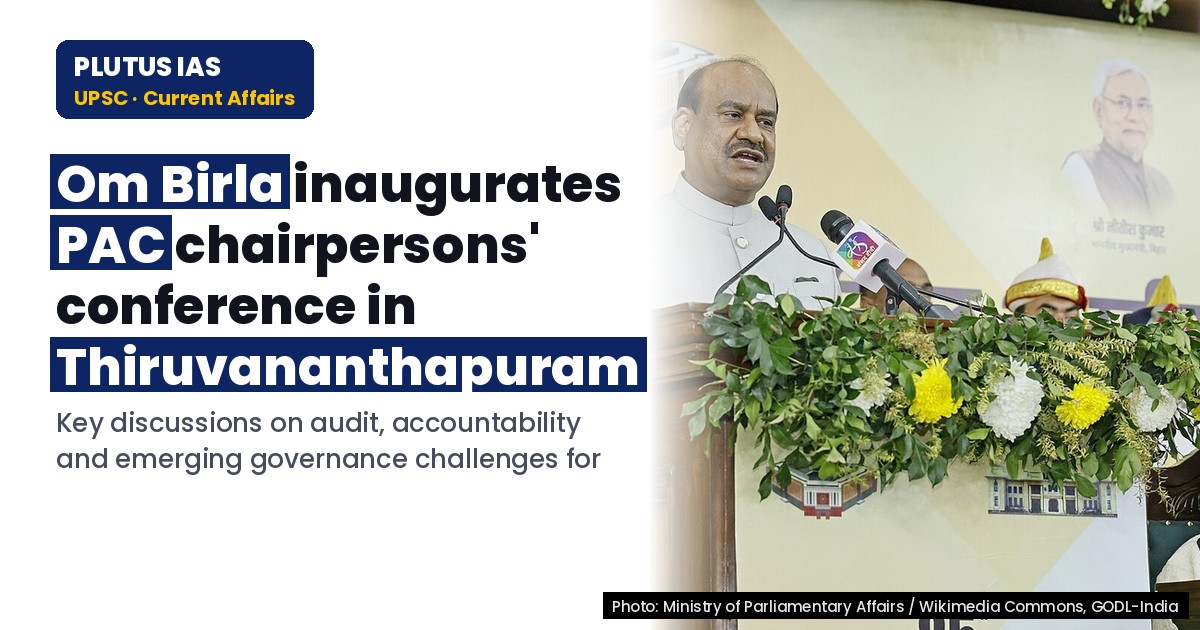
01 Nov Lok Sabha Speaker to Inaugurate PAC Chairpersons’ Conference in Kerala
✎ The Public Accounts Committee (PAC) is a parliamentary watchdog that scrutinises the CAG’s audit reports to ensure legislative oversight over public expenditure, promoting accountability and financial discipline in governance.
Subject Relevance — Where This Topic Fits
- GS Paper II — Constitutional and Non-Constitutional Bodies (Role of PACs) | GS Paper III — Public Finance, Accountability and Governance
- Prelims: Public Accounts Committee (PAC), Comptroller and Auditor General (CAG), Legislative oversight, Parliamentary Committees, Fiscal accountability, Union and State Legislatures
- Essay: The Role of Legislative Committees in Ensuring Fiscal Accountability and Good Governance, Parliamentary Democracy and the Challenge of Financial Scrutiny
Quick Revision: The Public Accounts Committee (PAC) is a parliamentary watchdog that scrutinises the CAG’s audit reports to ensure legislative oversight over public expenditure, promoting accountability and financial discipline in governance.
Why is this in the news?
The Lok Sabha Speaker will inaugurate a two-day national conference of Chairpersons of Public Accounts Committees (PACs) from Parliament and state/union territory legislatures in Thiruvananthapuram on 3 November 2026. The event, themed ‘Audit, Accountability and Good Governance – Emerging Role of Public Accounts Committees,’ aims to facilitate exchange of best practices, strengthen legislative scrutiny of public expenditure, and address evolving challenges in public financial management. The conference culminates on 4 November 2026 with a valedictory session addressed by the Lok Sabha Speaker.
Background
- Public Accounts Committees (PACs) are parliamentary committees mandated to examine the audit reports of the Comptroller and Auditor General (CAG) of India, ensuring legislative oversight over public expenditure.
- PACs exist at both the Union and state levels, with their composition, functions, and powers derived from the Constitution, Rules of Procedure, and conventions of parliamentary democracy.
- The CAG, as the supreme audit institution, submits audit reports to the President (Union) and Governors (States), which are then referred to PACs for detailed examination.
- PACs play a pivotal role in promoting transparency, accountability, and financial discipline by scrutinising government expenditure and ensuring alignment with legislative intent.
- The conference reflects a growing recognition of the need to adapt PACs to contemporary challenges such as digital governance, off-budget financing, and complex public-private partnerships.
- Kerala’s hosting of the event underscores the importance of state-level fiscal oversight and collaborative federalism in public financial management.
What is the Public Accounts Committee (PAC)?
- The PAC is a parliamentary committee constituted under the Rules of Procedure and Conduct of Business of the House in Parliament and State Legislatures.
- Its primary function is to examine the annual audit reports of the CAG, which highlight financial irregularities, inefficiencies, and non-compliance with legislative provisions.
- The PAC examines the ‘Appropriation Accounts’ and the ‘Finance Accounts’ of the Government, ensuring that public funds are utilised as authorised by the legislature.
- The committee comprises members from both the ruling and opposition parties, with a chairperson typically from the opposition to ensure non-partisan scrutiny.
- PACs have the power to summon officials, demand documents, and recommend corrective actions, though their recommendations are advisory and not binding on the executive.
- The PAC’s role is distinct from that of the Estimates Committee and the Committee on Public Undertakings, focusing exclusively on post-facto financial accountability.
- At the state level, PACs function similarly, examining the audit reports of the State CAG and ensuring fiscal discipline within the state’s financial management framework.
- The committee’s work is complemented by the CAG’s performance audits, which assess the efficiency and effectiveness of government programmes.
Key Features
| Feature | Significance |
|---|---|
| Inter-legislative forum for Public Accounts Committees (PACs) | Facilitates exchange of best practices among Parliament, state legislatures, and Union Territory legislatures to enhance legislative oversight of public expenditure. |
| Thematic focus: ‘Audit, Accountability, and Good Governance’ | Highlights evolving role of PACs in ensuring transparency, financial discipline, and adherence to legislative intent in public expenditure. |
| Two-day deliberative conference | Provides structured platform for sharing experiences, discussing emerging challenges in public financial management, and strengthening legislative scrutiny mechanisms. |
| Leadership engagement | Involves Lok Sabha Speaker, Rajya Sabha Deputy Chairman, state Chief Ministers, and legislative leaders, underscoring political and institutional commitment to accountability. |
| Outcome-oriented sessions | Focuses on strengthening transparency, accountability, and financial discipline through constructive dialogue and identification of actionable measures. |
Why it Matters
Institutional Strengthening
- Reinforces the constitutional mandate of legislatures to scrutinise public expenditure under Article 149 and Article 248(2) of the Constitution.
- Enhances coordination between central and state-level oversight bodies to prevent duplication and gaps in audit and accountability mechanisms.
- Promotes standardisation of audit practices across jurisdictions, improving comparability and effectiveness of legislative oversight.
- Encourages adoption of digital tools and data analytics in audit processes to improve efficiency and detect financial irregularities.
Governance & Accountability
- Serves as a mechanism to align public expenditure with legislative priorities, ensuring funds are utilised as intended by elected representatives.
- Facilitates peer learning among PACs to address common challenges such as delayed audits, weak follow-up on audit recommendations, and limited technical capacity.
- Provides a platform to discuss emerging risks in public financial management, including off-balance-sheet liabilities, contingent liabilities, and fiscal risks from climate change.
- Strengthens the role of PACs as guardians of fiscal federalism by fostering collaboration between Union and state governments on fiscal discipline.
Policy & Reform
- Identifies systemic bottlenecks in audit-follow-up cycles, enabling targeted reforms in administrative and legislative processes.
- Supports the implementation of recommendations from constitutional bodies like the CAG, whose reports are examined by PACs.
- Encourages the integration of performance audits alongside traditional financial audits to assess programme efficiency and effectiveness.
- Promotes transparency by making PAC reports and deliberations accessible to citizens, enhancing public trust in governance.
Challenges
1. Delayed Implementation of Audit Recommendations
- PACs often face delays in securing responses from executive agencies on audit findings, reducing the deterrent effect of oversight.
- Lack of statutory timelines for executive compliance with PAC recommendations undermines accountability.
- Solution: Legislative amendments to mandate time-bound responses and establish grievance redressal mechanisms for delayed compliance.
UPSC Link: Constitutional provisions on CAG and legislative committees
2. Limited Technical Capacity in State PACs
- Many state legislatures lack specialised staff or training in forensic auditing, data analytics, or programme evaluation.
- Dependence on external auditors (e.g., CAG) without internal capacity-building hampers independent scrutiny.
- Solution: Centralised training programmes, shared audit tools, and secondment of experts from national agencies to state PACs.
UPSC Link: Role of CAG and legislative committees under DPSP
3. Coordination Gaps Between Central and State PACs
- Overlapping jurisdictions and lack of standardised audit frameworks lead to fragmented oversight of centrally sponsored schemes.
- Example: Issues in tracking utilisation of funds under centrally sponsored schemes (CSS) due to poor inter-state data sharing.
- Solution: Unified digital platforms for real-time monitoring of fund flows and audit findings across jurisdictions.
UPSC Link: Fiscal federalism and cooperative federalism
4. Political Interference and Lack of Autonomy
- PACs may face pressure to dilute critical audit observations due to executive-legislative dynamics or electoral considerations.
- Risk of PACs being used as tools for political messaging rather than objective oversight.
- Solution: Strengthening the independence of PACs through constitutional safeguards, such as fixed tenures for chairpersons and secretarial autonomy.
UPSC Link: Parliamentary committees and constitutional bodies
5. Emerging Fiscal Risks and Complexity
- Growth of off-balance-sheet liabilities, public-private partnerships (PPPs), and climate-related fiscal risks complicates audit processes.
- Example: Underestimation of liabilities in PPP projects or contingent liabilities from climate adaptation programmes.
- Solution: Mandatory disclosure of fiscal risks in budget documents and integration of climate risk audits into PAC agendas.
UPSC Link: Fiscal responsibility and budget management
Challenges — UPSC Perspective
| Issue | Concern |
|---|---|
| Delayed compliance with audit findings | Reduces deterrent effect of oversight and erodes public trust in governance. |
| Limited technical capacity in state PACs | Hampers independent scrutiny and reduces effectiveness of legislative oversight. |
| Fragmented oversight of centrally sponsored schemes | Leads to inefficiencies, duplication, and gaps in fund utilisation tracking. |
| Political interference in PAC functioning | Undermines objectivity and autonomy of oversight bodies. |
| Complexity of emerging fiscal risks | Complicates audit processes and increases likelihood of fiscal misreporting. |
Way Forward
- Constitute a National Task Force on PAC Reforms to draft model guidelines for standardised audit practices across jurisdictions.
- Develop a unified digital platform for real-time tracking of fund flows and audit findings under centrally sponsored schemes.
- Introduce statutory timelines for executive responses to PAC recommendations, with penalties for non-compliance.
- Expand capacity-building programmes for state PACs, including training in forensic auditing, data analytics, and climate risk assessment.
- Strengthen the independence of PACs by amending parliamentary rules to ensure fixed tenures for chairpersons and secretarial autonomy.
- Integrate performance audits into PAC agendas to assess programme efficiency and effectiveness alongside financial compliance.
- Publish PAC reports and deliberations in accessible formats (e.g., open data portals) to enhance transparency and public engagement.
UPSC Value Addition
Keywords for Mains Answer-Writing
Public Accounts Committee (PAC) · legislative oversight · financial accountability · Comptroller and Auditor General (CAG) · public expenditure · legislative committees · audit mechanisms · governance reforms · transparency in administration · fiscal discipline · Parliamentary democracy · state legislatures · Union Territories · legislative accountability · audit reports · financial scrutiny · legislative-executive relations
Constitutional & Policy Linkages
- Article 149: Functions of the Comptroller and Auditor-General (CAG) in relation to audit of public accounts.
- Article 248(2): Residuary powers of Parliament to legislate on subjects not enumerated in the Union or Concurrent Lists.
- Article 108: Joint sitting of Parliament to resolve deadlocks between Houses, highlighting the role of Parliament in financial oversight.
- Article 266: Consolidated Funds of India and States, underpinning the constitutional basis for legislative scrutiny of public expenditure.
Concept Flow
Public expenditure -> Constitutional mandate (CAG audit) -> Legislative scrutiny (PAC examination) -> Accountability mechanisms (follow-up on recommendations) -> Governance outcomes (transparency, efficiency, fiscal discipline). → Emerging fiscal risks (e.g., climate change, PPPs) -> Increased complexity in audit processes -> Need for enhanced technical capacity in PACs -> Inter-legislative collaboration (e.g., this conference). → Delayed compliance with audit findings -> Weakened deterrent effect -> Reduced public trust -> Demand for stronger oversight mechanisms (e.g., statutory timelines). → Fragmented oversight of centrally sponsored schemes -> Inefficiencies in fund utilisation -> Need for unified digital platforms -> Cooperative federalism in audit processes. → Political interference in PAC functioning -> Undermined objectivity -> Demand for constitutional safeguards -> Strengthened independence of oversight bodies.
Prelims Practice Questions
Q1. Consider the following statements regarding the Public Accounts Committee (PAC) in India:
1. The PAC is a Parliamentary Committee that examines the audit reports of the Comptroller and Auditor General (CAG) of India.
2. The PAC is chaired by a member of the ruling party to ensure executive accountability.
3. The PAC examines the appropriation accounts relating to the expenditure of the Government of India.
4. The PAC can summon any government official or minister to give evidence.
How many of the above statements are correct?
- Only one
- Only two
- Only three
- All four
Answer: All four — Statements 1, 3, and 4 are correct. The PAC examines CAG audit reports (1), examines appropriation accounts (3), and has the power to summon officials (4). Statement 2 is incorrect as the PAC chair is traditionally from the opposition party to ensure impartial scrutiny.
Q2. Assertion (A): The Public Accounts Committee (PAC) in India plays a crucial role in ensuring financial accountability and transparency in public expenditure.
Reason (R): The PAC examines the audit reports of the Comptroller and Auditor General (CAG) and reports its findings to the Parliament.
Options:
A. Both A and R are true, and R is the correct explanation of A.
B. Both A and R are true, but R is not the correct explanation of A.
C. A is true, but R is false.
D. A is false, but R is true.
Answer: ? — Both Assertion (A) and Reason (R) are true, and Reason (R) correctly explains Assertion (A). The PAC’s role in examining CAG audit reports and reporting to Parliament directly contributes to financial accountability and transparency.
Q3. Match the following Parliamentary Committees with their primary functions:
Column I (Committee) Column II (Function)
A. Public Accounts Committee 1. Examination of demands for grants
B. Estimates Committee 2. Examination of CAG audit reports
C. Committee on Public Undertakings 3. Examination of public sector undertakings
D. Committee on Petitions 4. Examination of public petitions and representations
Options:
A. A-2, B-1, C-3, D-4
B. A-1, B-2, C-3, D-4
C. A-3, B-1, C-2, D-4
D. A-4, B-2, C-3, D-1
Answer: ? — The correct matching is: A-2 (PAC examines CAG audit reports), B-1 (Estimates Committee examines demands for grants), C-3 (Committee on Public Undertakings examines public sector undertakings), and D-4 (Committee on Petitions examines public petitions).
Mains Practice Question
✍ Discuss the evolving role of the Public Accounts Committee (PAC) in India with reference to its constitutional mandate, institutional mechanisms, and contemporary challenges in ensuring financial accountability and transparency. Also, examine how the PAC can further strengthen its effectiveness in the context of emerging fiscal governance paradigms. (15 Marks)
Approach: MODEL-ANSWER SKELETON:
1. **Constitutional and Statutory Basis**:
– Mention Article 148 (CAG) and Article 108 (PAC as a Parliamentary Committee).
– Role of CAG in auditing public expenditure and PAC’s function in examining CAG reports.
– Reference to Rules of Procedure and Conduct of Business in Parliament, 1952.
2. **Institutional Mechanisms**:
– Composition of PAC: Chairperson from opposition, members from both Houses.
– Powers: Summoning officials, examining appropriation accounts, reporting to Parliament.
– Interaction with CAG, Finance Ministry, and other stakeholders.
3. **Contemporary Challenges**:
– Increasing complexity of public expenditure (e.g., welfare schemes, infrastructure projects).
– Delays in PAC reports and implementation of recommendations.
– Need for digital tools and data analytics for real-time oversight.
– Coordination gaps between Parliament, state legislatures, and Union Territories.
4. **Strengthening Effectiveness**:
– Adoption of best practices from other jurisdictions (e.g., UK’s Public Accounts Committee).
– Leveraging technology for efficient scrutiny (e.g., AI-driven audit tools).
– Capacity building for PAC members and staff.
– Strengthening follow-up mechanisms for PAC recommendations.
5. **Balanced View**:
– Acknowledge PAC’s successes (e.g., exposing financial irregularities in 2G spectrum case).
– Critique limitations (e.g., lack of executive enforcement power, political interference).
6. **Conclusion**:
– PAC’s role is indispensable in a parliamentary democracy but requires modernization to address contemporary fiscal governance challenges.
Source: PIB (Press Information Bureau)
Kerala PCS (Kerala PSC (KAS)) — State PCS Practice
Prelims: Who among the following is scheduled to inaugurate the Conference of Chairpersons of Public Accounts Committees of Parliament and State/Union Territory Legislatures in Thiruvananthapuram?
- A. The President of India
- B. The Speaker of Lok Sabha
- C. The Chief Justice of India
- D. The Prime Minister of India
Answer: B. The Speaker of Lok Sabha — The Speaker of Lok Sabha is the constitutional authority responsible for presiding over such parliamentary conferences.
Mains: Discuss the significance of the Conference of Chairpersons of Public Accounts Committees of Parliament and State/Union Territory Legislatures in the context of fiscal accountability and governance in India. How does Kerala’s participation in such conferences contribute to its administrative reforms?
Generated by AanyaAi for educational purpose.
Related guides on our sites
- UPSC EPFO syllabus
- Best PSIR optional coaching for upsc
- Best PSIR optional teacher for upsc
- Best teacher of PSIR optional for upsc

- Lok Sabha Speaker to Inaugurate PAC Chairpersons’ Conference in Kerala - November 1, 2026
- क्यों नहीं हो सकता चीतों का सैटेलाइट कॉलर से लाइव ट्रैकिंग? कुनो निदेशक का स्पष्टीकरण - November 1, 2026
- Dinesh V. Ganvir Takes Charge as GSI Director General: Key Focus Areas - November 1, 2026

No Comments