


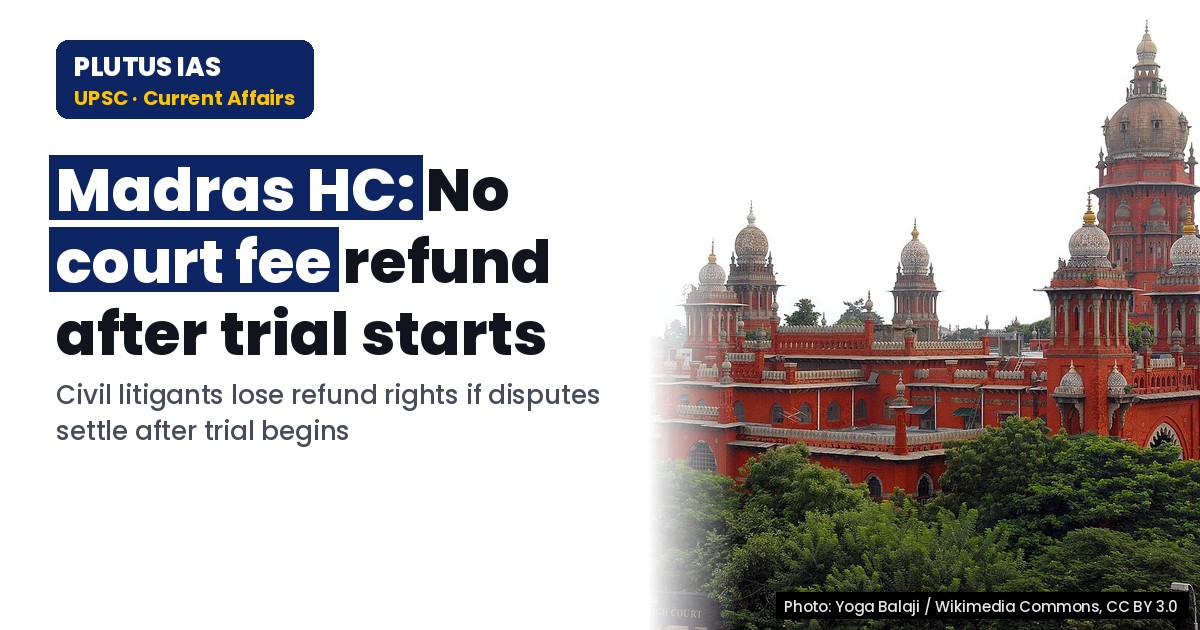
02 Nov Madras HC Rules: No Court Fee Refund After Trial Starts in Civil Cases
✎ Court fees in civil disputes are refundable only if settlements occur before evidence is recorded; post-trial settlements do not qualify for refund under the Tamil Nadu Court Fees and Suits Valuation Act, 1955, as clarified by…
Subject Relevance — Where This Topic Fits
- GS Paper II — Judiciary and Constitutional Framework | GS Paper II — Government Policies and Interventions for Development in various sectors
- Prelims: Code of Civil Procedure, 1908 (CPC) — Section 89, Tamil Nadu Court Fees and Suits Valuation Act, 1955 — Sections 69 and 69A, Alternative Dispute Resolution (ADR) mechanisms, Judicial precedents — Afcons Infrastructure case (2010), M.C. Subramaniam case (2021), Doctrine of Precedent and Binding Nature of Judgments, Court fees — purpose and refund provisions
- Essay: Judicial creativity vs. legislative intent in statutory interpretation, Role of courts in promoting alternative dispute resolution mechanisms
Quick Revision: Court fees in civil disputes are refundable only if settlements occur before evidence is recorded; post-trial settlements do not qualify for refund under the Tamil Nadu Court Fees and Suits Valuation Act, 1955, as clarified by the Madras High Court in alignment with the Afcons Infrastructure (2010) precedent.
Why is this in the news?
The Madras High Court, in a recent judgment, held that litigants are not entitled to a refund of court fees if civil disputes are settled out of court after the commencement of trial. The ruling clarifies the interpretation of Sections 69 and 69A of the Tamil Nadu Court Fees and Suits Valuation Act, 1955, and distinguishes between pre-trial and post-trial settlements, aligning with the Supreme Court’s stance in the Afcons Infrastructure case (2010) rather than the M.C. Subramaniam case (2021). This decision underscores the judiciary’s role in balancing procedural fairness with fiscal responsibility in the administration of justice.
Background
- The Tamil Nadu Court Fees and Suits Valuation Act, 1955, governs the payment and refund of court fees in civil suits within the state, ensuring revenue for judicial infrastructure and administration.
- Section 69 of the Act originally provided for a 50% refund of court fees if a suit was dismissed as settled out of court before any evidence was recorded on the merits of the claim.
- Section 69A was introduced in 2007 to allow a 100% refund of court fees if disputes were referred to alternative dispute resolution (ADR) mechanisms under Section 89 of the Code of Civil Procedure (CPC), such as arbitration, mediation, or Lok Adalat.
- In 2017, the Act was amended to extend the 100% refund provision under Section 69, but the legislature retained the condition that the settlement must occur before any evidence is recorded.
- The Supreme Court’s later judgment in M.C. Subramaniam v. Union of India (2021) was cited by litigants to argue for refunds in post-trial settlements, but the Madras High Court declined to follow it, preferring the Afcons Infrastructure precedent due to the doctrine of precedent.
- The ruling highlights the tension between judicial precedents, legislative intent, and the practical challenges of judicial administration, particularly in the context of ADR mechanisms.
What is the legal framework governing court fees and their refund in civil disputes?
- Court fees are statutory levies imposed on litigants to fund the judicial system, covering expenses such as infrastructure, salaries, and administrative costs. They are distinct from court costs or damages and are governed by state-specific legislation like the Tamil Nadu Court Fees and Suits Valuation Act, 1955.
- The Code of Civil Procedure, 1908 (CPC), empowers courts to refer disputes to alternative dispute resolution (ADR) mechanisms under Section 89, including arbitration, mediation, conciliation, and Lok Adalat, provided the referral occurs before the commencement of trial.
- Section 69 of the Tamil Nadu Act originally allowed a 50% refund of court fees if a suit was dismissed as settled out of court before any evidence was recorded. This was later amended to allow a 100% refund, but the condition of pre-evidence settlement remained.
- Section 69A of the Act provides for a 100% refund of court fees if disputes are referred to ADR mechanisms under Section 89 of the CPC, provided the referral is made before evidence is recorded.
- The doctrine of precedent in Indian jurisprudence requires lower courts to follow the ratio decidendi of higher courts of equal or superior strength. If a later bench disagrees with an earlier precedent, it must refer the matter to a larger bench rather than overrule it.
- The Supreme Court’s judgment in M.C. Subramaniam (2021) was cited by litigants to argue for refunds in post-trial settlements, but the Madras High Court declined to follow it, citing the binding nature of the Afcons Infrastructure precedent and the doctrine of precedent.
- The ruling underscores the importance of legislative intent in statutory interpretation, as the Tamil Nadu legislature consciously retained the condition of pre-evidence settlement in Section 69, despite the 2017 amendment allowing 100% refunds.
Key Features
| Feature | Significance |
|---|---|
| Section 69 of Tamil Nadu Court Fees and Suits Valuation Act, 1955 | Mandates refund of 50% court fees if suit is dismissed as settled out of court before recording evidence on merits. |
| Section 69A of the Act (2007) | Provides for 100% refund of court fees if dispute is referred to ADR mechanisms under Section 89 of CPC. |
| Amendment to Section 69 (2017) | Extended 100% refund to settlements before commencement of trial, but retained the clause ‘before any evidence has been recorded on the merits of the claim’. |
| Afcons Infrastructure v. Cherian Varkey Construction (2010) | Supreme Court held that civil courts can refer disputes to ADR mechanisms only before commencement of trial to prevent misuse. |
| M.C. Subramaniam v. Union of India (2021) | Supreme Court ruling that allowed refund of court fees even after commencement of trial, not followed by Madras High Court in this case. |
Why it Matters
Judicial Precedent and Legal Consistency
- The judgment reinforces the binding nature of coordinate bench decisions under the principle of judicial discipline, ensuring uniformity in judicial interpretation.
- Highlights the hierarchy of judicial decisions and the obligation of subordinate courts to follow earlier rulings unless referred to a larger bench.
- Demonstrates the interplay between statutory interpretation and judicial precedent in determining the refund of court fees.
Fiscal Implications for Judicial Administration
- Emphasises the revenue-generating purpose of court fees, which fund court infrastructure, staff salaries, and trial-related expenses.
- Clarifies that refunds are contingent on the stage of litigation, discouraging frivolous settlements post-trial to protect judicial resources.
- Reinforces the legislative intent behind Section 69 and 69A, which balance litigant convenience with fiscal responsibility.
Alternative Dispute Resolution (ADR) Mechanisms
- Reaffirms the Supreme Court’s stance that ADR referrals under Section 89 of CPC must occur before trial commencement to avoid procedural delays.
- Aligns with the policy objective of reducing court backlog by incentivising early settlements through full refunds.
- Underscores the role of ADR in promoting efficiency and reducing the burden on civil courts.
Statutory Interpretation and Legislative Intent
- Illustrates the importance of precise legislative drafting, as amendments to Section 69 retained the clause ‘before any evidence has been recorded,’ limiting refund eligibility.
- Demonstrates how judicial interpretation must align with legislative intent, particularly in fiscal statutes like the Court Fees Act.
Challenges
1. Judicial Consistency vs. Flexibility
- Risk of conflicting judgments if subordinate courts selectively follow or disregard coordinate bench rulings.
- Potential for litigants to exploit procedural gaps, such as delaying settlements to avoid refund ineligibility.
- Need for clarity in statutory language to prevent ambiguity in refund eligibility across jurisdictions.
UPSC Link: Judicial Review and Judicial Activism
2. Fiscal Sustainability of Judicial System
- Ensuring adequate revenue from court fees to maintain judicial infrastructure without unduly burdening litigants.
- Balancing refund policies to incentivise early settlements while preventing misuse of judicial resources.
- Addressing disparities in refund policies across states due to varying court fee statutes.
UPSC Link: Government Budgets and Fiscal Policy
3. Access to Justice and Litigation Costs
- High court fees may deter marginalised litigants from pursuing legitimate claims, despite refund provisions.
- Need for alternative mechanisms to reduce litigation costs, such as legal aid and pro bono services.
- Ensuring that refund policies do not inadvertently discourage out-of-court settlements post-trial.
UPSC Link: Legal Services Authorities Act, 1987
4. ADR Integration and Judicial Efficiency
- Challenges in promoting ADR mechanisms despite legislative support, including lack of awareness and resistance from litigants.
- Ensuring that ADR referrals are timely and effective, without being used as a delaying tactic.
- Monitoring and evaluating the impact of ADR on reducing court backlog and improving dispute resolution.
UPSC Link: Code of Civil Procedure, 1908
Challenges — UPSC Perspective
| Issue | Concern |
|---|---|
| Conflicting Judicial Precedents | Risk of inconsistent refund policies due to divergent interpretations of court fee statutes. |
| Fiscal Dependence on Court Fees | Ensuring court fees adequately fund judicial infrastructure without imposing undue financial burden on litigants. |
| Underutilisation of ADR Mechanisms | Low adoption of ADR despite incentives, due to lack of awareness or procedural complexities. |
| Statutory Ambiguity | Potential for misinterpretation of refund clauses, leading to litigation over eligibility. |
| Litigation Costs and Access to Justice | High court fees may disproportionately affect economically weaker sections, despite refund provisions. |
Way Forward
- Clarify statutory language in court fee acts across states to eliminate ambiguity in refund eligibility.
- Conduct awareness campaigns to educate litigants and lawyers about ADR mechanisms and their benefits.
- Strengthen judicial training on the principles of judicial discipline and the binding nature of coordinate bench rulings.
- Evaluate the fiscal impact of court fee refunds on judicial infrastructure and explore alternative funding mechanisms.
- Promote legal aid services to ensure equitable access to justice, particularly for marginalised litigants.
- Monitor and publish data on ADR referrals and settlements to assess their effectiveness in reducing court backlog.
- Encourage state governments to harmonise court fee statutes with the principles laid down in Afcons Infrastructure (2010).
UPSC Value Addition
Keywords for Mains Answer-Writing
Madras High Court judgment on court fees refund · Section 69 and 69A of Tamil Nadu Court Fees and Suits Valuation Act, 1955 · Afcons Infrastructure Ltd. vs. Cherian Varkey Construction Co. (2010) · M.C. Subramaniam vs. Union of India (2021) · Code of Civil Procedure, 1908 (Section 89) · Alternative Dispute Resolution (ADR) mechanisms · Commencement of trial and court fee refund policy · Judicial precedent and coordinate benches · Constitutional and statutory interpretation of court fee provisions · Judicial process and efficiency in civil litigation
Constitutional & Policy Linkages
- [‘Article 226: Writ Jurisdiction of High Courts’, ‘Empowers High Courts to issue directions for refund of court fees.’]
- [‘Article 227: Superintendence of High Courts’, ‘Ensures judicial discipline and consistency in rulings.’]
Concept Flow
Litigation commences with payment of court fees under Tamil Nadu Court Fees and Suits Valuation Act, 1955. → Dispute proceeds to trial unless settled out of court before commencement of evidence recording. → If settled before trial, refund provisions under Section 69 or 69A apply, incentivising early settlements. → Post-trial settlements do not qualify for refund under Section 69, as per Afcons Infrastructure (2010) principle. → Judicial interpretation aligns statutory provisions with legislative intent and judicial precedent. → Fiscal sustainability of courts is maintained while balancing litigant convenience and judicial efficiency.
Prelims Practice Questions
Q1. Consider the following statements regarding the refund of court fees under the Tamil Nadu Court Fees and Suits Valuation Act, 1955:
1. Section 69 provides for a 50% refund of court fees if a suit is dismissed as settled out of court before any evidence is recorded.
2. Section 69A was introduced in 2007 to provide a 100% refund of court fees if disputes are referred to ADR mechanisms under Section 89 of the CPC.
3. The 2017 amendment to Section 69 explicitly allows refunds even after the commencement of trial if a settlement is reached.
How many of the above statements are correct?
- Only one
- Only two
- All three
- None
Answer: Only two — Statement 1 is correct as per the original Section 69. Statement 2 is correct as Section 69A was introduced in 2007. Statement 3 is incorrect because the 2017 amendment did not alter the condition that refunds are only available if the suit is dismissed as settled out of court before any evidence is recorded.
Q2. Assertion (A): The Madras High Court, in its recent judgment, refused to follow the Supreme Court’s 2021 verdict in M.C. Subramaniam’s case.
Reason (R): The Madras High Court held that the 2021 verdict had not factored in the Supreme Court’s 2010 judgment in Afcons Infrastructure Ltd. vs. Cherian Varkey Construction Co., which is binding on coordinate benches.
- Both A and R are true, and R is the correct explanation of A
- Both A and R are true, but R is not the correct explanation of A
- A is true, but R is false
- A is false, but R is true
Answer: Both A and R are true, and R is the correct explanation of A — Both the assertion and reason are true. The Madras High Court explicitly refused to follow the 2021 verdict in M.C. Subramaniam’s case because it did not consider the binding 2010 judgment in Afcons Infrastructure, as explained in the reason.
Q3. Match the following provisions of the Tamil Nadu Court Fees and Suits Valuation Act, 1955 with their respective years of introduction or amendment:
Column I (Provision) | Column II (Year)
— | —
1. Section 69 (original provision for 50% refund) | A. 2017
2. Section 69A (introduced for 100% refund in ADR cases) | B. 2007
3. Amendment to Section 69 to allow 100% refund in specific cases | C. 1955
Choose the correct match:
- 1-C, 2-B, 3-A
- 1-A, 2-B, 3-C
- 1-B, 2-A, 3-C
- 1-C, 2-A, 3-B
Answer: 1-C, 2-B, 3-A — Section 69 was part of the original Act in 1955. Section 69A was introduced in 2007. The 2017 amendment did not alter Section 69’s core condition but introduced new refund provisions elsewhere.
Mains Practice Question
✍ Critically examine the legal and policy implications of the Madras High Court’s recent judgment on the refund of court fees in civil suits settled out of court after the commencement of trial. Also, analyse the balance between judicial efficiency and litigant rights in this context. (15 Marks)
Approach: MODEL-ANSWER SKELETON:
1. **Judicial Precedent and Binding Nature** (3 Marks):
– Explain the principle of judicial precedent and the binding nature of judgments by coordinate benches (Afcons Infrastructure Ltd. vs. Cherian Varkey Construction Co., 2010).
– Discuss the Madras High Court’s reasoning for refusing to follow M.C. Subramaniam’s case (2021) due to non-consideration of the 2010 judgment.
2. **Provisions of the Tamil Nadu Court Fees and Suits Valuation Act, 1955** (4 Marks):
– Outline Section 69 (original provision for 50% refund before evidence recording) and Section 69A (100% refund in ADR cases).
– Explain the 2017 amendment to Section 69 and its limitations (no refund after commencement of trial).
– Highlight the legislative intent behind non-refundability after trial commencement (avoiding misuse of ADR mechanisms).
3. **Judicial Efficiency vs. Litigant Rights** (5 Marks):
– Discuss the rationale for non-refundability: funding court infrastructure, avoiding protraction of trials, and discouraging frivolous litigation.
– Counter-arguments: Potential hardship to litigants who settle disputes post-trial commencement, and the need for equitable access to justice.
– Reference Section 89 of the CPC and the role of ADR mechanisms in reducing judicial burden.
4. **Broader Implications and Way Forward** (3 Marks):
– Suggest measures to balance judicial efficiency and litigant rights (e.g., time-bound settlements, incentives for early ADR, or partial refunds in exceptional cases).
– Reference global best practices in court fee refund policies.
– Conclude with a balanced view on the judgment’s alignment with constitutional principles of justice and efficiency.
Source: The Hindu
Generated by AanyaAi for educational purpose.
Related guides on our sites
- Best PSIR optional coaching for upsc
- Best PSIR optional teacher for upsc
- Best teacher of PSIR optional for upsc
- Best PSIR optional coaching in delhi for UPSC

- Bengaluru-Mumbai Vande Bharat Sleeper: UPSC & State PCS - November 2, 2026
- केरल के जनजातीय अध्ययन केंद्रों का संख्या से परे मूल्यांकन क्यों आवश्यक है? - November 2, 2026
- Fiscal Watchdogs Funding Crisis: UPSC Economy Analysis - November 2, 2026

No Comments