

02 Nov India’s Draft National Steel Policy: Protection vs. Competition
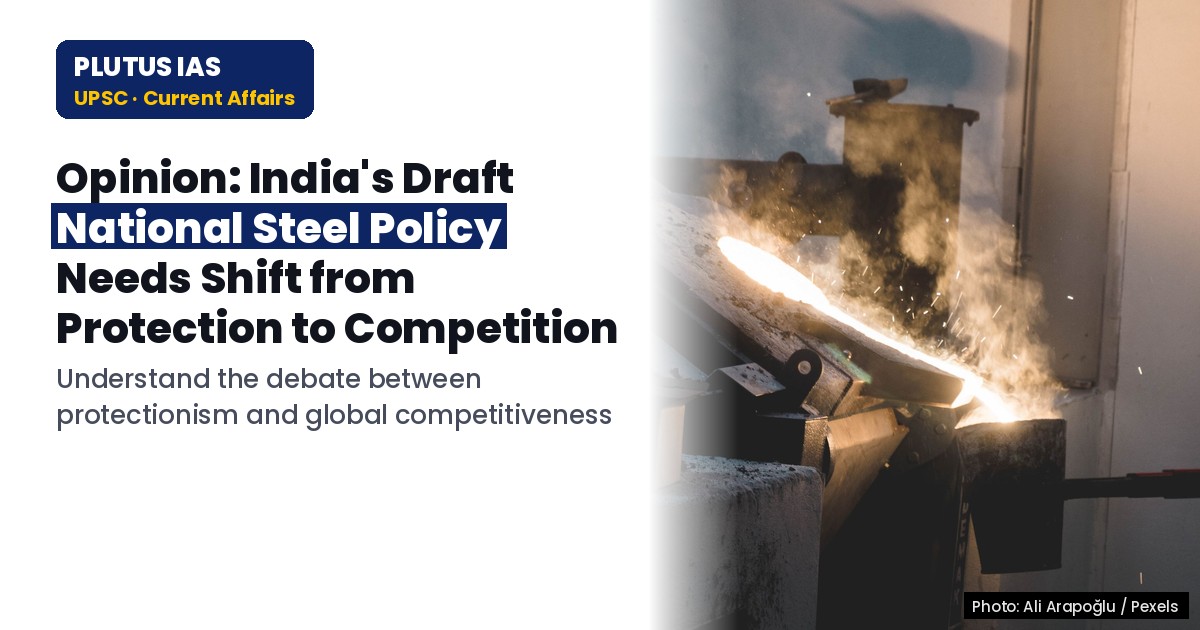
✎ The Draft National Steel Policy: Vision 2047 seeks to enhance India's global steel competitiveness, necessitating a strategic shift from protectionist measures to policies fostering competition and efficiency.
Subject Relevance — Where This Topic Fits
- GS Paper III — Economy | GS Paper III — Industrial Policy | GS Paper III — Infrastructure
- Prelims: National Steel Policy, Iron ore export duty, Import tariffs on steel, Safeguard duty, Quality Control Orders (QCOs), Global competitiveness, Downstream industries
- Essay: The role of industrial policy in fostering economic growth and global competitiveness., Balancing protectionism with free trade principles for sustainable industrial development.
Quick Revision: The Draft National Steel Policy: Vision 2047 seeks to enhance India’s global steel competitiveness, necessitating a strategic shift from protectionist measures to policies fostering competition and efficiency.
Why is this in the news?
The Ministry of Steel has released the Draft National Steel Policy: Vision 2047, aiming to enhance India’s global competitiveness in steel production and increase exports. Recent discussions highlight a critical need to re-evaluate the existing policy framework, particularly the reliance on protectionist measures, and shift towards policies that promote competition and efficiency to achieve these objectives.
Background
- India has emerged as the world’s second-largest steel producer, significantly increasing its share in global production since 2000.
- The Indian steel industry has historically exhibited higher profitability compared to other manufacturing sectors, with top firms outperforming global counterparts.
- Existing policy mechanisms include a 30% export duty on high-grade iron ore, which effectively lowers domestic iron ore prices.
- Tariff protection for the steel industry involves a 7.5% import tariff, supplemented by an 11.5% safeguard duty, resulting in a combined duty rate of 18%.
- Non-tariff barriers, such as Quality Control Orders (QCOs) on numerous steel products, further restrict imports.
- These protective measures contribute to domestic steel prices being higher than international benchmarks, impacting downstream industries like construction and automobiles.
Understanding India’s Steel Policy and its Implications
- The National Steel Policy aims to guide the development of the Indian steel industry, setting targets for production, exports, and global competitiveness.
- Protectionist measures, such as export duties on raw materials like iron ore, are intended to ensure domestic availability and provide cost advantages to local steel manufacturers.
- Import tariffs and safeguard duties are imposed to protect domestic industries from cheaper imports, thereby supporting local production and employment.
- Quality Control Orders (QCOs) are technical regulations mandating specific quality standards for products, often serving as non-tariff barriers to trade.
- While protectionism can foster initial growth and profitability, it may disincentivize efficiency improvements and innovation, potentially hindering long-term global competitiveness.
- High domestic steel prices, a consequence of protectionist policies, can adversely affect downstream industries by increasing their input costs, thereby impacting their own competitiveness and export potential.
- A shift towards competition-oriented policies would involve reducing tariffs and non-tariff barriers, encouraging domestic steel producers to become more efficient and cost-effective through market forces.
- The balance between protecting domestic industries and promoting global competitiveness is a critical aspect of industrial policy, requiring careful consideration of economic impacts across various sectors.
Key Features
| Feature | Significance |
|---|---|
| India’s Steel Production Growth | Evolved from less than 5% of global output in 2000 to become the world’s second-largest producer at 170 Mt, indicating substantial industrial expansion. |
| Profitability of Indian Steel Firms | Average profitability (EBITDA over sales) for 2000-25 was approximately 15%, exceeding the rest of Indian manufacturing by 3-4 percentage points, and surpassing major global counterparts. |
| Export Duty on Iron Ore | A 30% export duty on iron ore with >58% iron content maintains domestic iron ore prices 30-40% lower than global benchmarks, benefiting the steel industry. |
| Import Tariffs on Steel | Indian steel benefits from a 7.5% import tariff, supplemented by an 11.5% safeguard duty, resulting in an effective duty rate of 18%, significantly higher than ASEAN’s 3-4%. |
| Quality Control Orders (QCOs) | Non-tariff barriers in the form of QCOs apply to 228 steel products, with only 59 products having been suspended from the list, despite recommendations for further removal. |
| Domestic Steel Price Premium | Domestic firms sell hot-rolled coil steel at a 6-7% premium compared to prices in high-cost countries like Japan, indicating a lack of price competitiveness. |
Why it Matters
Economic Implications
- The current policy framework, characterized by export duties on iron ore and high import tariffs on steel, artificially inflates the profitability of the domestic steel industry.
- This protectionist approach leads to higher input costs for downstream industries such as construction and automobiles, potentially hindering their competitiveness and export potential.
- Subsidizing the steel industry through undervalued iron ore exports results in economic losses for mineral-rich regions due to underpayment for their resources and reduced mining incentives.
Industrial Competitiveness
- While Indian steel firms exhibit high profitability, this may be a consequence of protection rather than genuine efficiency or global competitiveness.
- The existing tariff and non-tariff barriers insulate domestic producers from international competition, potentially disincentivizing innovation and cost reduction.
- A shift from protection to competition is crucial for achieving the objective of making Indian steel globally competitive and increasing exports to 45 million tonnes by 2047.
Policy Formulation
- The Draft National Steel Policy: Vision 2047 aims for global competitiveness and increased exports, necessitating a critical review of existing protectionist measures.
- The impact assessment of tariff reductions and removal of export duties on iron ore highlights the significant potential reduction in steel firms’ profitability, requiring careful policy calibration.
- The experience of other industries like pharmaceuticals and auto components suggests that reduced protection can foster competitiveness without necessarily harming the industry.
Challenges
1. Maintaining Steel Industry Profitability
- Withdrawal of protectionist measures, such as reduced tariffs and removal of iron ore export duties, is projected to significantly decrease the profitability of major steel firms.
- Balancing the need for global competitiveness with the financial viability of domestic steel producers presents a complex policy challenge.
UPSC Link: Industrial policy and its effects
2. Ensuring Global Competitiveness
- The current high domestic steel prices, sustained by protection, hinder the industry’s ability to compete effectively in international markets.
- Achieving the target of 45 million tonnes in steel exports by 2047 requires a strategic shift towards efficiency-driven competitiveness rather than protection-driven profitability.
UPSC Link: Indian economy and issues relating to planning
3. Impact on Downstream Industries
- High domestic steel prices increase input costs for critical downstream sectors like construction and automobiles, affecting their overall cost-effectiveness.
- Small and medium-scale industries, vital for exports, face particular challenges due to elevated raw material costs, potentially impeding their growth and export capabilities.
UPSC Link: Effects of liberalization on the economy
4. Resource Allocation and Economic Efficiency
- The policy of keeping iron ore prices low through export duties results in underpayment for mineral resources, causing economic loss for mining regions.
- This distorts market signals and reduces incentives for efficient resource extraction and utilization, impacting overall economic efficiency.
UPSC Link: Resource mobilization
5. Addressing Non-Tariff Barriers
- The existence of extensive Quality Control Orders (QCOs) on numerous steel products acts as a non-tariff barrier, impeding trade and potentially limiting competition.
- The slow pace of removing products from the QCO list, despite recommendations, indicates challenges in streamlining regulatory frameworks.
UPSC Link: Trade policy and its impact
Challenges — UPSC Perspective
| Issue | Concern |
|---|---|
| High Profitability of Steel Firms | Profitability may stem from protectionist policies rather than genuine efficiency, potentially masking underlying inefficiencies. |
| Export Duty on Iron Ore | Depresses domestic iron ore prices, underpaying mineral-rich regions and reducing incentives for mining, leading to economic loss. |
| High Import Tariffs on Steel | An 18% effective duty rate (7.5% tariff + 11.5% safeguard duty) insulates domestic producers, hindering global competitiveness. |
| Non-Tariff Barriers (QCOs) | Quality Control Orders on 228 steel products act as trade barriers, with limited progress in their rationalization. |
| Domestic Steel Price Premium | Indian hot-rolled coil steel is sold at a 6-7% premium over international prices, adversely affecting downstream industries. |
| Impact on Downstream Industries | Higher input costs for sectors like construction and automobiles, and particularly for small and medium-scale exporters, reduce their competitiveness. |
Way Forward
- Gradually reduce import tariffs on steel to foster greater competition and incentivize efficiency improvements within the domestic industry.
- Eliminate or significantly reduce export duties on iron ore to ensure fair value for mineral resources and promote market-based pricing.
- Expedite the review and rationalization of Quality Control Orders (QCOs) to remove unnecessary non-tariff barriers and streamline trade.
- Implement targeted support mechanisms for the steel industry to enhance productivity, technological upgradation, and energy efficiency, rather than relying on price protection.
- Promote research and development in steel manufacturing to develop high-value products and reduce production costs, thereby improving global competitiveness.
- Encourage backward and forward integration within the steel value chain to optimize resource utilization and reduce overall production expenses.
- Foster a competitive environment that drives innovation and cost reduction, enabling Indian steel to compete effectively in international markets without artificial support.
UPSC Value Addition
Keywords for Mains Answer-Writing
National Steel Policy · Global Competitiveness · Protectionism · Tariff Barriers · Non-Tariff Barriers · Export Duties · Downstream Industries · Economic Efficiency · Industrial Policy · Resource Allocation · Manufacturing Sector · Trade Policy
Concept Flow
Protectionist policies (export duties, high tariffs, QCOs) → Artificially low iron ore prices & high domestic steel prices → High profitability for domestic steel firms (not necessarily efficient) → Increased input costs for downstream industries & reduced export competitiveness → Hindrance to achieving global competitiveness for Indian steel → Need for policy shift towards competition for sustainable growth
Prelims Practice Questions
Q1. Consider the following statements regarding India’s steel industry and related policies:
1. India is currently the world’s largest producer of steel.
2. Export duties on iron ore with high iron content are intended to keep domestic iron ore prices lower for the steel industry.
3. Quality Control Orders (QCOs) are a form of non-tariff barrier.
How many of the above statements are correct?
- Only one
- Only two
- Only three
- None
Answer: Only two — Statement 1 is incorrect: India is the world’s second-largest steel producer, not the largest. Statement 2 is correct: Export duties on iron ore reduce its international competitiveness, thereby making it cheaper for domestic steel producers. Statement 3 is correct: QCOs mandate certain quality standards for products, which can restrict imports and are thus considered non-tariff barriers.
Q2. Which of the following best describes the primary objective of imposing an export duty on a raw material like iron ore?
- To increase the global price of the raw material.
- To generate revenue for the government from exports.
- To ensure adequate domestic supply and lower prices for downstream industries.
- To promote the export of the raw material.
Answer: To ensure adequate domestic supply and lower prices for downstream industries. — Export duties on raw materials like iron ore typically aim to make them less attractive for export, thereby increasing their availability and reducing their prices for domestic industries that use them as inputs. This policy often supports domestic manufacturing at the expense of raw material producers.
Mains Practice Question
✍ Critically examine the argument that protectionist measures, while seemingly beneficial for the domestic steel industry’s profitability, may hinder its global competitiveness and adversely impact downstream sectors. Discuss with reference to the proposed National Steel Policy: Vision 2047. (15 Marks)
Approach: MODEL-ANSWER SKELETON:
1. Introduction: Briefly introduce the Draft National Steel Policy: Vision 2047 and its objective of global competitiveness.
2. Argument for Protectionism (initial benefits): Explain how measures like import tariffs (7.5% basic + 11.5% safeguard duty) and export duties on iron ore (30% on >58% Fe content) contribute to high profitability (15% EBITDA over sales) for domestic steel firms and India’s rise as the second-largest producer.
3. Critique of Protectionism (hindrances to competitiveness):
a. Lack of efficiency incentive: High protection reduces pressure for technological upgrades and cost efficiency.
b. Distorted resource allocation: Underpayment for iron ore (30-40% lower than global prices) distorts market signals and disincentivizes mining investment.
c. Non-tariff barriers: Role of Quality Control Orders (QCOs) on 228 steel products, and the slow pace of their removal (e.g., Gauba Committee recommendations).
d. Higher domestic prices: Domestic steel (hot-rolled coil) sold at 6-7% premium over international benchmarks (e.g., Japan).
4. Adverse Impact on Downstream Industries:
a. Increased input costs for sectors like construction (steel ~15% of project cost) and automobile (~5% of raw material cost).
b. Reduced competitiveness for MSMEs crucial for exports.
5. Policy Shift for Vision 2047: Emphasize the need for the National Steel Policy to transition from protection to fostering competition, aligning with the stated goal of increasing steel exports to 45 Mt and achieving true global competitiveness.
6. Conclusion: Summarize the trade-off between short-term profitability through protection and long-term sustainable competitiveness, advocating for policy reforms that promote efficiency and fair pricing across the value chain.
Source: The Indian Express
Generated by AanyaAi for educational purpose.
Related guides on our sites
- Best PSIR optional coaching for upsc
- Best economics optional coaching for upsc
- Best PSIR optional teacher for upsc
- Best teacher of PSIR optional for upsc

- मध्यप्रदेश स्वामित्व योजना: ग्रामीण संपत्ति अधिकार और चुनौतियाँ - November 2, 2026
- Lord Buddha Relics Arrive at Tawang Monastery: Significance for UPSC - November 2, 2026
- वाणिज्य सचिव की यूरोपीय आयोग के अधिकारियों संग उच्च-स्तरीय बैठकें - November 2, 2026

No Comments