


02 Nov Bengaluru-Mumbai Vande Bharat Sleeper: UPSC & State PCS
✎ The Vande Bharat Sleeper Express is an indigenous, semi-high-speed train designed for comfortable overnight travel, enhancing connectivity between major economic hubs and contributing to India's railway modernisation efforts.
Subject Relevance — Where This Topic Fits
- GS Paper III — Infrastructure: Railways | GS Paper III — Economy: Growth and Development
- Prelims: Vande Bharat Sleeper Express, Indian Railways, National Rail Plan, High-speed rail corridors, Infrastructure development, Economic corridors
- Essay: Infrastructure as a Catalyst for Economic Growth and Regional Development, Modernising India’s Transportation Network: Challenges and Opportunities
Quick Revision: The Vande Bharat Sleeper Express is an indigenous, semi-high-speed train designed for comfortable overnight travel, enhancing connectivity between major economic hubs and contributing to India’s railway modernisation efforts.
Why is this in the news?
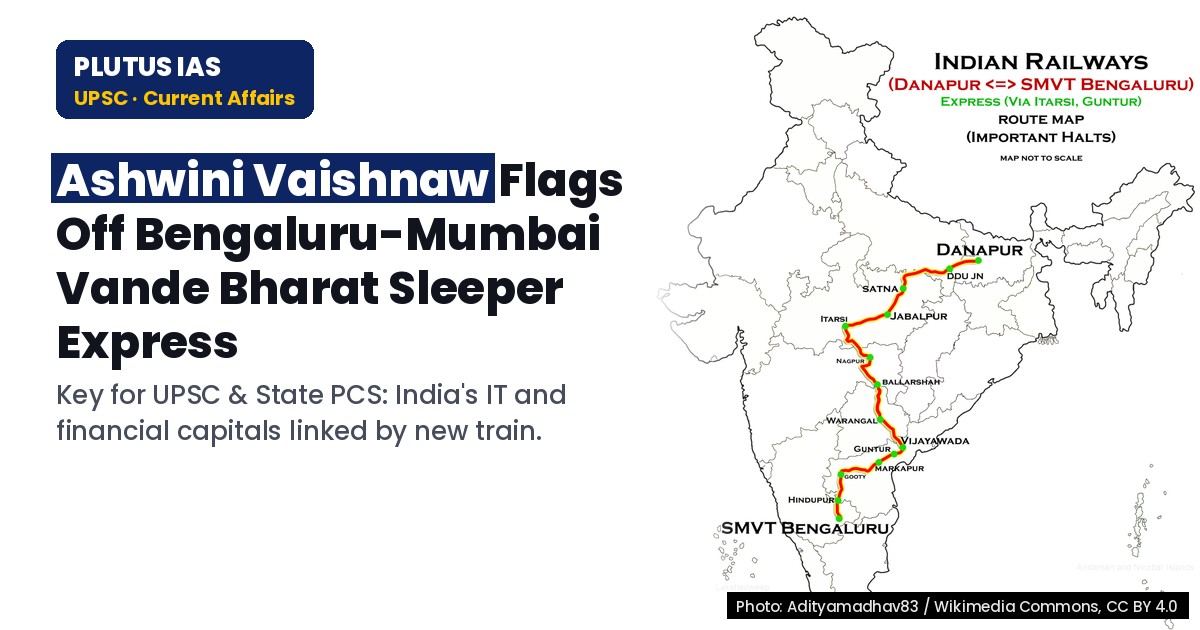
The Union Minister of Railways recently flagged off the Bengaluru-Mumbai Vande Bharat Sleeper Express train, a significant step towards bolstering modern overnight rail connectivity between India’s prominent metropolitan and economic centres. This initiative aims to provide an advanced, comfortable, and efficient travel option for passengers, benefiting professionals, entrepreneurs, students, and tourists, while also strengthening rail links across key regional hubs in Karnataka, Andhra Pradesh, and Maharashtra.
Background
- The Vande Bharat Express series represents a new generation of semi-high-speed, self-propelled electric multiple-unit trains, designed and manufactured in India under the ‘Make in India’ initiative.
- Initially launched as chair car services, the Vande Bharat network is progressively expanding to include sleeper variants to cater to long-distance overnight travel requirements.
- The introduction of sleeper services on key corridors, such as Howrah-Guwahati and Varanasi-New Delhi, precedes the Bengaluru-Mumbai route, signifying a strategic expansion of modern rail travel options.
- Indian Railways is undertaking extensive infrastructure upgrades, including electrification of routes and development of new rail corridors, to enhance speed, safety, and efficiency across its network.
- The government’s vision for railway modernisation includes connecting major economic hubs and improving regional connectivity to foster economic development and integration.
- The Vande Bharat project aligns with the broader objective of providing world-class rail services, reducing travel times, and enhancing passenger experience across the country.
What is the Vande Bharat Sleeper Express?
- The Vande Bharat Sleeper Express is a state-of-the-art, indigenously designed and manufactured train set, specifically configured for overnight journeys.
- It represents an evolution of the Vande Bharat platform, incorporating sleeper berths to provide comfortable accommodation for longer distances, unlike the original chair car versions.
- These trains are equipped with modern amenities, aiming to offer a superior travel experience comparable to international standards, including enhanced safety features and passenger comfort.
- The Vande Bharat Sleeper trains are designed for semi-high-speed operations, contributing to reduced travel times between major cities and economic centres.
- Their introduction is part of Indian Railways’ strategy to modernise its passenger services, improve connectivity, and cater to the growing demand for efficient and comfortable long-distance travel.
- The routes for Vande Bharat Sleeper Express services are strategically chosen to connect significant economic, industrial, and tourist hubs, thereby facilitating trade, commerce, and tourism.
- The expansion of Vande Bharat services, including the sleeper variants, is a key component of the National Rail Plan, which aims to create a future-ready railway system by 2030.
Key Features
| Feature | Significance |
|---|---|
| Vande Bharat Sleeper Express Train | Introduction of modern overnight rail connectivity between major economic hubs, offering enhanced comfort and efficiency for long-distance travel. |
| Bengaluru-Mumbai Corridor | Connects India’s ‘IT and Startup Capital’ (Bengaluru) with its ‘Financial Capital’ (Mumbai), facilitating business, professional, and tourist movement. |
| Route Expansion | Extends through significant regional centres in Karnataka (Raichur, Yadgir, Kalaburagi), Andhra Pradesh (Anantapur, Guntakal), and Maharashtra (Solapur, Pune, Kalyan), improving connectivity for previously underserved areas. |
| Modern Night Travel Network | Part of a broader initiative, following services on Howrah-Guwahati and Varanasi-New Delhi corridors, to expand high-quality overnight rail options across the nation. |
| Future Connectivity | Plans for additional Vande Bharat Sleeper services from Bengaluru to the Hubballi region, extending towards Pune and Mumbai, and a Bengaluru-Mangaluru Vande Bharat service, enhancing intra-state and coastal connectivity. |
Why it Matters
Economic Integration and Development
- Strengthens economic ties between Bengaluru and Mumbai, critical for the movement of professionals, entrepreneurs, and goods, thereby fostering economic growth.
- Enhances regional connectivity for tier-2 cities and towns along the route, potentially stimulating local economies through increased accessibility and trade.
- Facilitates business travel and tourism, contributing to service sector growth and job creation in connected regions.
Infrastructure Modernisation
- Represents a significant upgrade in India’s railway infrastructure, offering world-class travel experiences comparable to global standards.
- Supports the broader national objective of developing high-speed rail corridors and modernising existing networks, crucial for future economic competitiveness.
- Improves the efficiency and speed of passenger transport, reducing travel times between key urban centres.
Social and Regional Equity
- Provides premium rail services to regions in North Karnataka and other states that previously lacked such facilities, promoting more equitable access to modern transportation.
- Benefits diverse demographic groups including students, business travellers, and tourists by offering a comfortable and efficient travel alternative.
- Enhances inter-state mobility, fostering cultural exchange and strengthening social cohesion across different regions.
Challenges
1. Infrastructure Capacity Constraints
- Integrating high-speed Vande Bharat services on existing mixed-traffic lines can pose challenges related to track capacity and scheduling.
- Upgrading track infrastructure, signalling systems, and electrification across extensive routes requires substantial investment and time.
- Ensuring seamless operations without impacting the punctuality and frequency of other essential train services remains a complex task.
UPSC Link: Infrastructure: Railways
2. Funding and Resource Allocation
- The development and deployment of advanced train sets and associated infrastructure necessitate significant financial outlays.
- Balancing investment in high-speed corridors with the need for upgrading conventional rail networks and ensuring last-mile connectivity is a continuous challenge.
- Optimising resource allocation to achieve widespread modernisation while maintaining financial sustainability of Indian Railways.
UPSC Link: Government Budgeting; Infrastructure
3. Maintenance and Operational Efficiency
- Maintaining the advanced technology and high standards of Vande Bharat trains requires specialised skills and infrastructure for maintenance.
- Ensuring consistent operational efficiency, including punctuality, cleanliness, and passenger safety, across an expanding network.
- Addressing potential technical glitches and ensuring rapid response mechanisms to minimise service disruptions.
UPSC Link: Infrastructure: Railways; Science and Technology
4. Land Acquisition and Environmental Clearances
- Expansion of railway corridors and development of new lines often face complexities related to land acquisition, particularly in densely populated areas.
- Obtaining timely environmental clearances for large-scale infrastructure projects can be a protracted process.
- Managing social impacts and ensuring fair rehabilitation and resettlement for affected populations during project implementation.
UPSC Link: Infrastructure: Railways; Environmental Impact Assessment
Challenges — UPSC Perspective
| Issue | Concern |
|---|---|
| Track Utilisation | Optimising the use of existing tracks for both high-speed and conventional trains to prevent congestion and delays. |
| Technological Integration | Ensuring compatibility and seamless integration of new rolling stock and signalling systems with legacy railway infrastructure. |
| Passenger Demand Management | Effectively forecasting and managing passenger demand for premium services, especially in new corridors, to ensure optimal utilisation and revenue. |
| Skill Development | Training railway personnel in operating and maintaining advanced Vande Bharat train sets and associated modern infrastructure. |
| Safety Standards | Upholding and continuously enhancing safety protocols and technologies to meet the demands of higher operating speeds and passenger volumes. |
Way Forward
- Prioritise dedicated high-speed rail corridors to maximise the operational efficiency and speed potential of Vande Bharat trains, reducing reliance on mixed-traffic lines.
- Invest in advanced signalling systems, such as Kavach, and track upgrades to enhance safety and allow for higher speeds on existing routes.
- Develop a robust maintenance ecosystem with specialised training for personnel and state-of-the-art workshops to ensure the longevity and reliability of modern rolling stock.
- Promote public-private partnerships (PPPs) for funding and executing railway infrastructure projects, leveraging private sector expertise and capital.
- Integrate multimodal transport solutions at key railway stations to provide seamless last-mile connectivity for passengers, enhancing the overall travel experience.
- Conduct comprehensive feasibility studies for new routes, considering passenger demand, economic viability, and environmental impact, to ensure sustainable expansion.
- Focus on indigenisation of railway technology and manufacturing to reduce import dependence and boost domestic industrial capabilities.
- Implement dynamic pricing models and value-added services to optimise revenue generation and ensure the financial sustainability of premium train services.
UPSC Value Addition
Keywords for Mains Answer-Writing
Vande Bharat Express · Indian Railways Modernisation · High-Speed Rail Connectivity · Regional Economic Integration · Infrastructure Development · Make in India Initiative · Public-Private Partnership (PPP) · Sustainable Transportation · National Rail Plan · Logistics Efficiency
Concept Flow
Modernisation of Railway Infrastructure → Introduction of Vande Bharat Sleeper Trains → Enhanced Connectivity between Economic Hubs → Improved Passenger Experience and Efficiency → Stimulation of Regional Economic Growth
Prelims Practice Questions
Q1. Consider the following statements regarding the Vande Bharat Express trains in India:
1. Vande Bharat trains are manufactured under the ‘Make in India’ initiative.
2. These trains are designed for speeds up to 160 km/h, significantly reducing travel time on operational routes.
3. The recent Bengaluru-Mumbai Vande Bharat Sleeper Express is the first sleeper variant introduced in the Vande Bharat series.
How many of the above statements are correct?
- Only one
- Only two
- All three
- None
Answer: Only two — Statement 1 is correct: Vande Bharat trains are indeed manufactured domestically under the ‘Make in India’ initiative, showcasing indigenous engineering capabilities. Statement 2 is correct: These trains are designed for operational speeds up to 160 km/h, contributing to faster inter-city travel. Statement 3 is incorrect: The news mentions previous Vande Bharat Sleeper services on the Howrah-Guwahati and Varanasi-New Delhi corridors, indicating that the Bengaluru-Mumbai service is not the first sleeper variant.
Q2. Match the following railway initiatives with their primary objectives:
List I (Initiative)
1. Vande Bharat Express
2. Dedicated Freight Corridors (DFCs)
3. National Rail Plan (NRP) 2030
List II (Primary Objective)
A. Enhancing passenger comfort and reducing travel time on key routes.
B. Segregating freight and passenger traffic for improved efficiency and speed.
C. Developing future-ready railway system to meet demand till 2030.
Which of the following pairs is correctly matched?
- 1-A, 2-B, 3-C
- 1-B, 2-A, 3-C
- 1-C, 2-B, 3-A
- 1-A, 2-C, 3-B
Answer: 1-A, 2-B, 3-C — 1-A: Vande Bharat Express trains are primarily aimed at enhancing passenger comfort and significantly reducing travel time on various routes across India. 2-B: Dedicated Freight Corridors are crucial for segregating freight and passenger traffic, which improves the efficiency, speed, and reliability of freight movement. 3-C: The National Rail Plan (NRP) 2030 is a long-term vision document aimed at developing a future-ready railway system capable of meeting the country’s demand for rail transport up to 2030.
Mains Practice Question
✍ The introduction of advanced rail services like the Vande Bharat Express is pivotal for fostering regional economic integration and enhancing logistical efficiency. Examine this statement in the context of India’s broader infrastructure development goals. (15 Marks)
Approach: Introduction: Briefly define Vande Bharat Express and its significance as a modern rail service. Part 1: Discuss how Vande Bharat trains foster regional economic integration. Mention improved connectivity between economic hubs (e.g., IT capital Bengaluru and financial capital Mumbai), benefits for professionals, entrepreneurs, students, and tourists, and the stimulation of economic activities in connected regions. Part 2: Explain how these services contribute to enhancing logistical efficiency. Focus on reduced travel times, improved reliability, and the potential for better movement of people and high-value goods (though Vande Bharat is passenger-centric, its impact on overall network decongestion and efficiency can be discussed). Part 3: Connect these points to India’s broader infrastructure development goals. Refer to the National Rail Plan 2030, ‘Make in India’ initiative, Gati Shakti Master Plan, and the vision for a ‘New India’ with world-class infrastructure. Conclusion: Summarise the transformative potential of such projects for sustainable development and national progress.
Source: PIB (Press Information Bureau)
Karnataka PCS (KPSC) — State PCS Practice
Prelims: Which of the following pairs of cities will be connected by the recently flagged-off Vande Bharat Sleeper Express train?
- A. Bengaluru and Chennai
- B. Bengaluru and Mumbai
- C. Mysuru and Hyderabad
- D. Hubballi and Pune
Answer: B. Bengaluru and Mumbai — The Union Railway Minister flagged off the Bengaluru-Mumbai Vande Bharat Sleeper Express train, connecting these two major cities.
Mains: Analyze the potential socio-economic impact of the new Bengaluru-Mumbai Vande Bharat Sleeper Express on Karnataka, considering aspects like trade, tourism, and regional connectivity within the state and with Maharashtra.
Generated by AanyaAi for educational purpose.
Related guides on our sites
- How to prepare for GS paper 1 for UPSC CSE mains exam
- Best UPSC coaching for IFOS exam
- Best ias coaching in mumbai
- Best mentorship programme for upsc

- Bengaluru-Mumbai Vande Bharat Sleeper: UPSC & State PCS - November 2, 2026
- केरल के जनजातीय अध्ययन केंद्रों का संख्या से परे मूल्यांकन क्यों आवश्यक है? - November 2, 2026
- Fiscal Watchdogs Funding Crisis: UPSC Economy Analysis - November 2, 2026

No Comments