


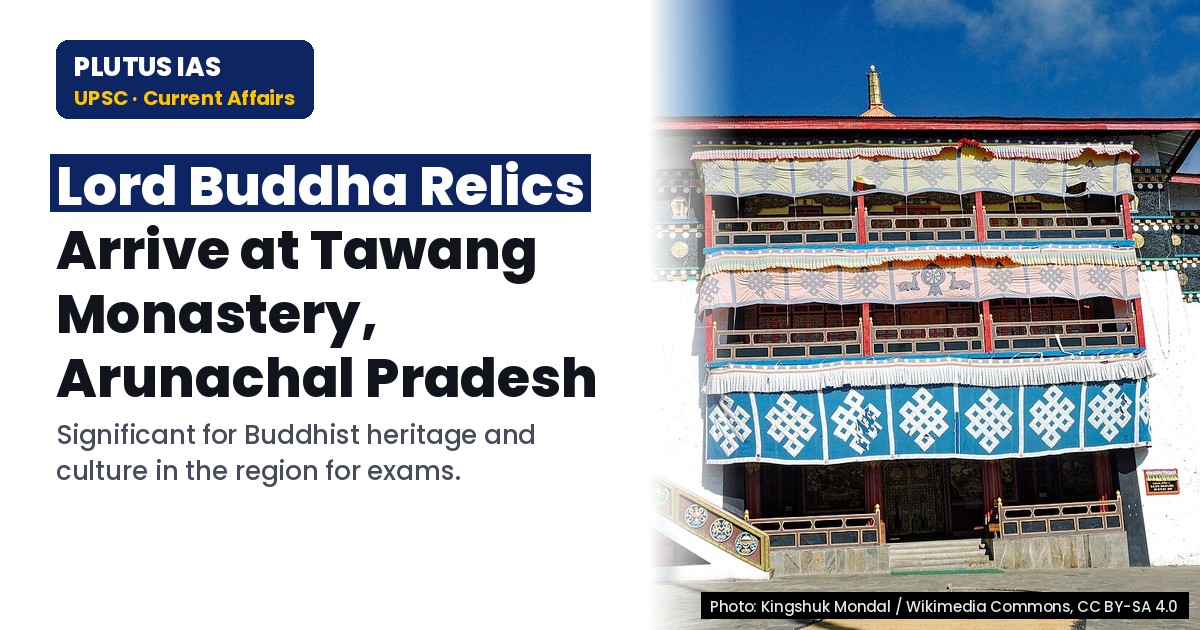
02 Nov Lord Buddha Relics Arrive at Tawang Monastery: Significance for UPSC
✎ The exposition of Lord Buddha's 'Kapilvastu' relics at Tawang Monastery underscores India's profound Buddhist heritage and its commitment to preserving and promoting these sacred artifacts.
Subject Relevance — Where This Topic Fits
- GS Paper I — Indian Heritage and Culture | GS Paper I — History of India | GS Paper II — Government Policies and Interventions for Development in various sectors and Issues arising out of their Design and Implementation
- Prelims: Lord Buddha relics, Tawang Monastery, Arunachal Pradesh Buddhist heritage, Buddhist pilgrimage sites, Mahaparinirvana Stupa, Ministry of Culture, International Buddhist Confederation
- Essay: The enduring legacy of Buddhism in shaping India’s cultural and spiritual landscape., Cultural diplomacy and the role of shared heritage in fostering international relations.
Quick Revision: The exposition of Lord Buddha’s ‘Kapilvastu’ relics at Tawang Monastery underscores India’s profound Buddhist heritage and its commitment to preserving and promoting these sacred artifacts.
Why is this in the news?
Sacred relics of Lord Buddha, specifically the ‘Kapilvastu’ relics, were recently transported to the Tawang Monastery in Arunachal Pradesh for public exposition. This event, organised by the Ministry of Culture and the International Buddhist Confederation, marks a significant moment for the Buddhist community in the region, providing an opportunity for devotees to pay homage and reinforcing the cultural and spiritual ties associated with Buddhist heritage in India.
Background
- The ‘Kapilvastu’ relics are among the most revered Buddhist relics, believed to be bone fragments of Lord Buddha himself, discovered in 1898 in Piprahwa, Uttar Pradesh, which is identified with ancient Kapilvastu.
- These relics are typically housed at the National Museum in New Delhi and are periodically taken for exposition to various Buddhist sites both within India and internationally, facilitating access for devotees.
- Tawang Monastery, located in Tawang, Arunachal Pradesh, is the largest monastery in India and the second largest in the world, after the Potala Palace in Lhasa. It is a significant centre for Gelug school of Mahayana Buddhism.
- The exposition of these relics serves to strengthen cultural bonds, promote religious tourism, and highlight India’s role as the birthplace of Buddhism and a custodian of its sacred heritage.
- Such events are often part of broader cultural diplomacy initiatives, showcasing India’s rich spiritual traditions and fostering goodwill with Buddhist-majority nations.
- The Ministry of Culture, in collaboration with organisations like the International Buddhist Confederation, plays a pivotal role in preserving, promoting, and disseminating India’s Buddhist heritage.
What are Sacred Buddhist Relics?
- Sacred Buddhist relics, known as ‘Sarira’ in Pali and Sanskrit, refer primarily to the bodily remains of Gautama Buddha and other Buddhist masters, often found after cremation.
- These relics are highly venerated in Buddhism and are considered objects of worship, representing the Buddha’s enlightened mind and serving as a focal point for devotion and meditation.
- The most significant relics are the ‘bone relics’ or ‘Kapilvastu relics,’ believed to be fragments of the Buddha’s bones, which were distributed among eight kingdoms after his Mahaparinirvana (passing away).
- According to Buddhist tradition, these original relics were later enshrined in various stupas across India by Emperor Ashoka, who is credited with further disseminating Buddhism.
- The discovery of the Piprahwa stupa in 1898, containing an inscription mentioning ‘Kapilvastu’ and a casket with bone fragments, provided archaeological evidence supporting the historical accounts of these relics.
- Relics are housed in stupas and monasteries globally, serving as pilgrimage sites and symbols of the enduring presence of the Buddha’s teachings.
- Their exposition is a rare and significant event, allowing devotees to connect with the historical Buddha and his spiritual legacy, reinforcing faith and cultural identity.
Key Features
| Feature | Significance |
|---|---|
| Sacred Relics of Lord Buddha | These are physical remains or objects associated with Lord Buddha, revered as highly sacred in Buddhist traditions. Their presence is believed to confer blessings and spiritual merit. |
| Tawang Monastery | The largest monastery in India and the second largest in the world, Tawang Monastery is a pivotal centre of Gelug school of Tibetan Buddhism. It holds immense cultural, religious, and historical importance for the Buddhist community, particularly in the Himalayan region. |
| Exposition Event | A public display of the sacred relics, allowing devotees and the general public to pay homage. Such events are significant religious occasions, fostering spiritual devotion and community cohesion. |
| Arunachal Pradesh’s Buddhist Heritage | The event underscores the deep-rooted Buddhist traditions and cultural identity of Arunachal Pradesh, especially in districts like Tawang and West Kameng, which are predominantly inhabited by Monpa people following Tibetan Buddhism. |
| Cultural Diplomacy | The sharing and exposition of sacred relics can serve as a form of cultural exchange and diplomacy, strengthening ties between Buddhist communities globally and promoting inter-faith understanding. |
Why it Matters
Cultural and Religious Significance
- The exposition of Lord Buddha’s sacred relics at Tawang Monastery represents a profound spiritual moment for the Buddhist community, particularly the Monpa people of Arunachal Pradesh, reinforcing their faith and cultural identity.
- It serves to highlight and preserve the rich Buddhist heritage of the Himalayan region, drawing attention to the historical and ongoing role of monasteries like Tawang in propagating Buddhist philosophy and practices.
- Such events foster a sense of unity and shared heritage among diverse Buddhist traditions and communities, both within India and internationally.
Tourism and Regional Development
- The event is likely to attract a significant number of pilgrims and tourists to Tawang, thereby boosting local tourism and contributing to the regional economy through increased demand for accommodation, transport, and local goods.
- Enhanced visibility of Tawang as a prominent Buddhist pilgrimage site can lead to improved infrastructure development, including roads, communication networks, and hospitality services, benefiting the local populace.
- Promotion of cultural tourism can create employment opportunities for local communities, particularly in sectors related to hospitality, handicrafts, and cultural services.
Geopolitical and Strategic Implications
- The event subtly reinforces India’s cultural influence and soft power in the Himalayan region, particularly in areas bordering neighbouring countries, by showcasing its rich spiritual heritage.
- It underscores the Indian government’s commitment to preserving and promoting the cultural and religious traditions of its diverse population, including indigenous communities in sensitive border regions.
- Such cultural engagements can contribute to regional stability by fostering a sense of belonging and cultural pride among communities in strategically important areas.
Challenges
1. Preservation of Cultural Heritage
- Ensuring the long-term conservation and security of ancient relics and historical monastic complexes requires specialized expertise and significant financial resources.
- Balancing the need for public access and religious observances with the imperative of protecting fragile artifacts from environmental degradation, theft, or damage during expositions.
UPSC Link: Art and Culture; Conservation
2. Infrastructure Development in Remote Areas
- The remote and mountainous terrain of Tawang poses significant challenges for developing robust infrastructure, including all-weather roads, reliable power supply, and modern communication networks, essential for supporting increased tourism and pilgrimage.
- Ensuring sustainable development that respects the ecological fragility of the Himalayan region while meeting the demands of growing visitor numbers.
UPSC Link: Infrastructure; Regional Planning
3. Socio-Economic Integration of Border Communities
- Ensuring that the benefits of increased tourism and cultural promotion equitably reach the local Monpa community, preventing exploitation and preserving their unique cultural practices amidst external influences.
- Addressing potential challenges related to cultural commodification and maintaining the authenticity of traditional practices in the face of commercialization.
UPSC Link: Social Justice; Tribal Affairs
Challenges — UPSC Perspective
| Issue | Concern |
|---|---|
| Logistics of Relic Transport | Ensuring the safe and secure transportation of invaluable and fragile sacred relics across challenging terrains, mitigating risks of damage or loss. |
| Crowd Management | Managing large congregations of devotees and tourists during expositions to ensure safety, maintain order, and prevent damage to the monastery or relics. |
| Environmental Impact | Increased footfall and associated activities can exert pressure on the local ecosystem, requiring careful waste management and sustainable tourism practices. |
| Authenticity vs. Commercialization | Risk of diluting the spiritual essence of the event and the cultural integrity of the local community due to excessive commercialization of religious tourism. |
Government Initiatives — Must-Memorise for Prelims
- PRASAD Scheme (Pilgrimage Rejuvenation and Spiritual Augmentation Drive)
- Swadesh Darshan Scheme
Way Forward
- Develop a comprehensive cultural tourism policy for the Himalayan region that integrates spiritual tourism with sustainable development goals, ensuring local community participation and benefit.
- Invest in upgrading critical infrastructure, including all-weather road connectivity, digital communication networks, and healthcare facilities, to support increased visitor influx to remote pilgrimage sites.
- Implement robust conservation strategies for monastic heritage sites, utilizing advanced scientific techniques for preservation and ensuring the security of sacred artifacts.
- Promote responsible tourism practices among visitors, emphasizing respect for local culture, traditions, and the pristine Himalayan environment.
- Establish skill development programs for local youth in hospitality, guiding, and heritage management to ensure equitable economic opportunities from tourism.
- Foster inter-ministerial coordination between Ministries of Culture, Tourism, and DoNER (Development of North Eastern Region) for holistic development and promotion of such significant cultural events.
- Encourage academic research and documentation of the unique Buddhist traditions and art forms prevalent in the Tawang region to enhance global understanding and appreciation.
UPSC Value Addition
Keywords for Mains Answer-Writing
Buddhist heritage · Tawang Monastery · Arunachal Pradesh culture · Sacred relics · Cultural diplomacy · Monastic traditions · Intangible cultural heritage · Religious tourism · Himalayan Buddhism · Cultural preservation
Constitutional & Policy Linkages
- Article 25: Freedom of conscience and free profession, practice and propagation of religion.
- Article 26: Freedom to manage religious affairs.
- Article 29: Protection of interests of minorities (cultural rights).
- Article 49: Protection of monuments and places and objects of national importance.
Concept Flow
Sacred Relics of Lord Buddha arrive at Tawang Monastery. → Public exposition of relics for devotees and tourists. → Reinforcement of Buddhist heritage and cultural identity of Arunachal Pradesh. → Increased spiritual tourism and pilgrimage to Tawang. → Boost to local economy and potential for infrastructure development. → Strengthening of India’s cultural diplomacy and soft power in the Himalayan region.
Prelims Practice Questions
Q1. Consider the following statements regarding Tawang Monastery:
1. It is the largest monastery in India.
2. It belongs to the Gelug school of Tibetan Buddhism.
3. It is located in the state of Sikkim.
How many of the above statements are correct?
- Only one
- Only two
- Only three
- None
Answer: Only two — Statement 1 is correct: Tawang Monastery is indeed the largest monastery in India. Statement 2 is correct: It belongs to the Gelug school of Tibetan Buddhism. Statement 3 is incorrect: Tawang Monastery is located in Arunachal Pradesh, not Sikkim.
Q2. Which of the following terms best describes the practice of displaying sacred objects for public veneration, as seen with the Lord Buddha’s relics?
- Consecration
- Exposition
- Pilgrimage
- Anointing
Answer: Exposition — Exposition refers to the public display of sacred objects for veneration. Consecration is the act of making something sacred. Pilgrimage is a journey to a sacred place. Anointing is the application of oil as part of a religious ceremony.
Mains Practice Question
✍ Discuss the significance of preserving and promoting Buddhist heritage sites in India, particularly in the Himalayan regions. How do such initiatives contribute to cultural diplomacy and regional development? (15 Marks)
Approach: MODEL-ANSWER SKELETON:
1. **Introduction:** Briefly introduce Buddhist heritage in India, its historical depth, and the concentration in Himalayan regions.
2. **Significance of Preservation:**
* **Cultural Identity:** Link to India’s pluralistic cultural fabric and ancient civilisational values.
* **Historical and Archaeological Value:** Mention sites like Sarnath, Bodh Gaya, Nalanda, and their importance for understanding ancient Indian history and intellectual traditions.
* **Religious and Spiritual Importance:** For Buddhists globally, and for local communities.
* **Intangible Heritage:** Preservation of monastic traditions, art forms, languages, and rituals.
* **Environmental Conservation:** Many sites are in ecologically sensitive areas, linking heritage with environmental protection.
3. **Contribution to Cultural Diplomacy:**
* **Soft Power:** India’s role as the birthplace of Buddhism and a custodian of its heritage enhances its global standing.
* **Bilateral Relations:** Strengthening ties with Buddhist-majority nations (e.g., Sri Lanka, Thailand, Japan, South Korea, Bhutan, Mongolia).
* **International Cooperation:** Collaboration on conservation projects, academic exchanges.
* **People-to-People Connect:** Facilitating cultural understanding and goodwill.
4. **Contribution to Regional Development:**
* **Tourism:** Promoting religious and cultural tourism, leading to economic benefits for local communities (employment, infrastructure development).
* **Infrastructure:** Development of roads, accommodation, and facilities around heritage sites.
* **Local Economy:** Support for local crafts, hospitality, and services.
* **Community Empowerment:** Involving local populations in heritage management and tourism.
* **Sustainable Development:** Balancing tourism with environmental and cultural preservation.
5. **Challenges (Briefly):** Mention challenges like infrastructure gaps, climate change impact, and need for sustainable tourism practices.
6. **Conclusion:** Reiterate the multifaceted benefits of heritage preservation for national identity, international relations, and regional prosperity, emphasizing the role of initiatives like the exposition of relics.
Source: PIB (Press Information Bureau)
Generated by AanyaAi for educational purpose.
Related guides on our sites
- Current affairs for upsc 2026
- UPSC History optional
- Is history a good optional for upsc exam
- Best history optional teacher for UPSC

- Lord Buddha Relics Arrive at Tawang Monastery: Significance for UPSC - November 2, 2026
- वाणिज्य सचिव की यूरोपीय आयोग के अधिकारियों संग उच्च-स्तरीय बैठकें - November 2, 2026
- Bengaluru-Mumbai Vande Bharat Sleeper: UPSC & State PCS - November 2, 2026

No Comments