


02 Nov Tribal Healers’ Public Health Role: National Orientation
✎ The National Orientation Programme for Tribal Healers aims to integrate traditional healing practices with modern public health strategies to improve healthcare access and outcomes in tribal communities.
Subject Relevance — Where This Topic Fits
- GS Paper II — Government Policies and Interventions for Development in various sectors and Issues arising out of their Design and Implementation (Health, Tribal Affairs) | GS Paper II — Welfare Schemes for Vulnerable Sections of the Population by the Centre and States and the Performance of these Schemes; Mechanisms, Laws, Institutions and Bodies constituted for the Protection and Betterment of these Vulnerable Sections | GS Paper I — Salient Features of Indian Society; Diversity of India (Tribal Communities)
- Prelims: Tribal healers, Traditional medicine systems, Public health initiatives, Ministry of Tribal Affairs, Ministry of AYUSH, National Health Policy, Sustainable Development Goals (SDGs) — Health, Community health workers
- Essay: The synergy between traditional knowledge systems and modern development paradigms for inclusive growth., Achieving universal health coverage in India: Challenges and opportunities through community engagement.
Quick Revision: The National Orientation Programme for Tribal Healers aims to integrate traditional healing practices with modern public health strategies to improve healthcare access and outcomes in tribal communities.
Why is this in the news?
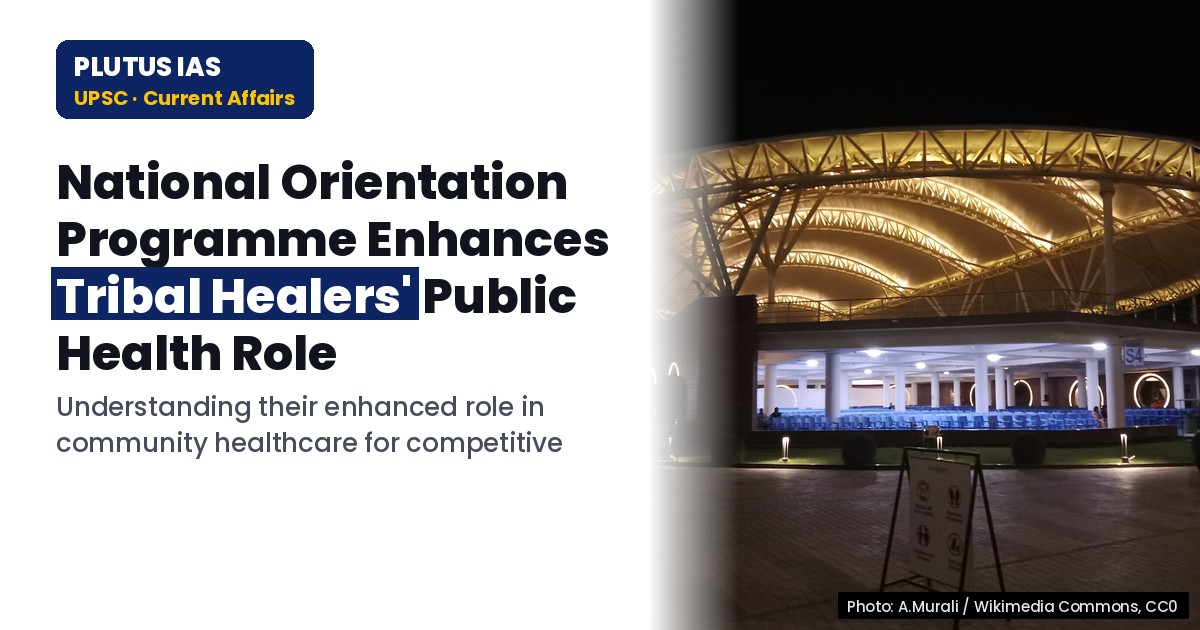
A National Orientation Programme for Tribal Healers on Public Health was recently organised at Kanha Shanti Vanam, Hyderabad. This initiative aims to integrate the traditional healing practices of tribal communities with contemporary public health strategies, thereby enhancing healthcare accessibility and outcomes in remote and underserved regions. The programme signifies a governmental recognition of the intrinsic value of indigenous knowledge in addressing community health needs.
Background
- India possesses a rich heritage of traditional medicine systems, including Ayurveda, Yoga, Unani, Siddha, and Homoeopathy (AYUSH), which are widely practised alongside modern allopathic medicine.
- Tribal communities, often residing in geographically isolated areas, predominantly rely on their traditional healers and indigenous medical practices for primary healthcare.
- The National Health Policy (2017) advocates for mainstreaming AYUSH systems and integrating them into national health programmes to achieve universal health coverage.
- There is a growing global recognition of the importance of traditional medicine in achieving Sustainable Development Goal 3 (Good Health and Well-being), as highlighted by the World Health Organization (WHO).
- Previous governmental efforts have focused on documenting, validating, and promoting traditional healing practices, while also addressing the need for standardisation and quality control.
- The Ministry of Tribal Affairs and the Ministry of AYUSH have been instrumental in formulating policies and programmes to support tribal health and traditional medicine.
National Orientation Programme for Tribal Healers on Public Health
- The programme is designed to familiarise tribal healers with modern public health concepts, disease prevention strategies, and referral mechanisms.
- It seeks to bridge the gap between traditional healing practices and contemporary healthcare delivery systems, fostering a collaborative approach to community health.
- Key objectives include enhancing the capacity of tribal healers to identify common health issues, promote health education, and facilitate early detection and referral of complex cases to formal healthcare facilities.
- The curriculum typically covers topics such as maternal and child health, nutrition, communicable and non-communicable diseases, sanitation, hygiene, and the ethical aspects of healthcare provision.
- The initiative aims to empower tribal healers as vital community health workers, leveraging their deep understanding of local culture, traditions, and trust within their communities.
- Such programmes contribute to the preservation and promotion of traditional knowledge while simultaneously improving health outcomes for tribal populations.
- The integration of traditional healers into the public health framework can significantly enhance the reach and effectiveness of healthcare services in remote tribal areas, where formal healthcare infrastructure may be limited.
Key Features
| Feature | Significance |
|---|---|
| National Orientation Programme | A structured initiative to integrate traditional healthcare knowledge with contemporary public health practices, enhancing the reach and efficacy of healthcare services. |
| Target Beneficiaries: Tribal Healers | Acknowledges and leverages the traditional knowledge systems prevalent within tribal communities, which are often the primary healthcare providers in remote areas. |
| Focus: Public Health | Aims to equip traditional healers with modern public health principles, including hygiene, disease prevention, and referral mechanisms, thereby improving community health outcomes. |
| Venue: Kanha Shanti Vanam, Hyderabad | Suggests a dedicated, conducive environment for learning and exchange, facilitating focused engagement and knowledge transfer. |
| Inter-sectoral Collaboration | Implies coordination between traditional medicine systems (AYUSH) and mainstream public health, fostering a holistic approach to healthcare. |
Why it Matters
Social Significance
- Promotes the recognition and integration of indigenous healthcare practices, thereby preserving cultural heritage and traditional knowledge systems.
- Enhances healthcare access and equity for tribal populations, who often face geographical and socio-economic barriers to conventional medical services.
- Empowers tribal communities by validating the role of their traditional healers as legitimate contributors to public health, fostering self-reliance and community participation.
Health Significance
- Strengthens primary healthcare delivery in remote and tribal areas by leveraging existing community trust in traditional healers.
- Facilitates early detection and management of common ailments and communicable diseases through enhanced awareness and training of traditional healers.
- Reduces the burden on formal healthcare infrastructure by integrating traditional practices for preventive and basic curative care.
Governance Significance
- Reflects a policy shift towards inclusive healthcare models that acknowledge and incorporate diverse medical traditions.
- Supports the objectives of national health policies aimed at achieving Universal Health Coverage by reaching underserved populations.
- Promotes evidence-based integration of traditional medicine into the public health framework, ensuring safety and efficacy through structured orientation.
Challenges
1. Standardisation and Validation
- Ensuring the scientific validation and standardisation of traditional healing practices to integrate them effectively and safely into modern public health protocols.
- Developing appropriate methodologies for documenting and evaluating the efficacy of diverse traditional remedies and diagnostic techniques.
UPSC Link: Health; Science & Technology
2. Ethical Considerations
- Addressing potential ethical dilemmas related to informed consent, patient safety, and the scope of practice for traditional healers within a public health context.
- Establishing clear guidelines to prevent exploitation or misrepresentation of traditional knowledge while promoting its responsible application.
UPSC Link: Ethics in Public Administration; Health
3. Infrastructure and Resource Gaps
- Providing adequate infrastructure, resources, and ongoing support for traditional healers to implement modern public health practices effectively.
- Ensuring access to essential medical supplies, diagnostic tools, and referral networks in remote tribal areas.
UPSC Link: Health; Social Justice
4. Cultural Sensitivity and Trust
- Navigating cultural differences and ensuring that the integration process respects the autonomy and belief systems of tribal communities.
- Building and maintaining trust between traditional healers, modern medical practitioners, and the communities they serve to foster collaborative healthcare.
UPSC Link: Social Justice; Indian Society
Challenges — UPSC Perspective
| Issue | Concern |
|---|---|
| Lack of Formal Recognition | Traditional healers often operate outside formal healthcare systems, leading to challenges in regulation, quality control, and integration. |
| Knowledge Gap | Traditional healers may lack formal training in modern public health concepts, disease epidemiology, and evidence-based practices, limiting their ability to address contemporary health challenges. |
| Resource Scarcity | Tribal areas frequently suffer from inadequate healthcare infrastructure, limited access to medicines, and a shortage of trained personnel, impacting the effectiveness of both traditional and modern healthcare. |
| Intellectual Property Rights | Protecting the intellectual property rights of tribal communities regarding their traditional knowledge while promoting its wider application in public health. |
| Sustainability of Practices | Ensuring the long-term viability and transmission of traditional healing knowledge across generations amidst changing socio-economic landscapes and external influences. |
Government Initiatives — Must-Memorise for Prelims
- National AYUSH Mission (NAM)
- Tribal Sub-Plan (TSP)
Way Forward
- Develop a comprehensive national policy for the integration of traditional tribal healing practices into the mainstream public health system, ensuring ethical considerations and intellectual property rights protection.
- Establish standardised training modules and certification processes for tribal healers, focusing on public health, hygiene, disease prevention, and referral mechanisms, while respecting traditional knowledge.
- Create a robust referral system that links tribal healers with primary health centres and higher-level medical facilities, ensuring seamless patient care and appropriate interventions.
- Invest in research and documentation of traditional tribal healing practices, employing scientific methodologies to validate efficacy and safety, and to preserve this invaluable knowledge.
- Promote inter-sectoral collaboration between the Ministry of AYUSH, Ministry of Tribal Affairs, and Ministry of Health and Family Welfare to ensure coordinated efforts and resource allocation.
- Launch awareness campaigns to educate both tribal communities and modern healthcare providers about the benefits and limitations of integrated healthcare approaches, fostering mutual respect and understanding.
- Strengthen local governance structures to support the integration of traditional healers, empowering them to participate in community health planning and implementation.
UPSC Value Addition
Keywords for Mains Answer-Writing
Tribal health · Traditional healers · Public health integration · AYUSH systems · Healthcare access · Cultural sensitivity · Sustainable Development Goals · National Health Policy · Community health workers · Ethnomedicine
Constitutional & Policy Linkages
- Article 46: Promotion of educational and economic interests of Scheduled Castes, Scheduled Tribes and other weaker sections.
- Article 243G: Powers, authority and responsibilities of Panchayats (including health and sanitation).
Concept Flow
Recognition of Traditional Tribal Healers’ Role → National Orientation Programme for Skill Enhancement → Integration of Traditional and Modern Public Health Practices → Improved Healthcare Access and Outcomes for Tribal Communities → Preservation and Validation of Indigenous Knowledge Systems
Prelims Practice Questions
Q1. Consider the following statements regarding traditional tribal healers in India:
1. Traditional tribal healers primarily utilise modern allopathic medicines for treatment.
2. The National Health Policy 2017 advocates for the integration of AYUSH systems into mainstream healthcare.
3. The Ministry of Tribal Affairs is the sole government body responsible for initiatives related to tribal health.
How many of the above statements are correct?
- Only one
- Only two
- Only three
- None
Answer: Only one — Statement 1 is incorrect; traditional tribal healers primarily use indigenous knowledge, medicinal plants, and traditional practices. Statement 2 is correct; the National Health Policy 2017 indeed promotes the integration of AYUSH systems. Statement 3 is incorrect; while the Ministry of Tribal Affairs plays a crucial role, other ministries like Health and Family Welfare, and AYUSH are also involved in tribal health initiatives.
Q2. Which of the following best describes the objective of a National Orientation Programme for Tribal Healers on Public Health?
- To replace traditional healing practices with modern medical techniques.
- To provide financial incentives for tribal healers to abandon their traditional roles.
- To sensitise tribal healers to public health principles and facilitate their collaboration with the formal healthcare system.
- To establish separate healthcare infrastructure exclusively for tribal healers.
Answer: To sensitise tribal healers to public health principles and facilitate their collaboration with the formal healthcare system. — The primary objective of such a programme is to bridge the gap between traditional healing and modern public health, fostering collaboration and enhancing health outcomes in tribal communities by integrating their knowledge with public health principles, rather than replacing or isolating them.
Mains Practice Question
✍ Critically examine the significance of integrating traditional tribal healers into the mainstream public health system in India. Discuss the challenges encountered in this integration process and suggest measures for effective collaboration. (15 Marks)
Approach: MODEL-ANSWER SKELETON:
1. **Introduction**: Briefly define traditional tribal healers and their role in indigenous communities.
2. **Significance of Integration**:
* **Enhanced Healthcare Access**: Reaching remote tribal populations where formal healthcare is scarce.
* **Cultural Sensitivity**: Respecting indigenous knowledge and practices, building trust.
* **Cost-effectiveness**: Utilisation of local resources and traditional remedies.
* **Holistic Approach**: Addressing physical, mental, and spiritual well-being.
* **Preservation of Ethnomedicine**: Documenting and validating traditional knowledge.
* **Alignment with NHP 2017**: Reference to policy advocating AYUSH integration.
3. **Challenges in Integration**:
* **Lack of Standardisation**: Absence of uniform protocols for traditional practices.
* **Skepticism and Trust Deficit**: Between formal medical practitioners and traditional healers.
* **Regulatory Frameworks**: Absence of clear legal and ethical guidelines for integration.
* **Training and Capacity Building**: Bridging knowledge gaps without undermining traditional wisdom.
* **Resource Constraints**: Limited funding and infrastructure for such programmes.
* **Documentation and Validation**: Scientific validation of traditional remedies.
4. **Measures for Effective Collaboration**:
* **Orientation and Training Programmes**: Sensitising healers to public health, hygiene, referral systems (e.g., the programme in the news).
* **Development of Standard Operating Procedures (SOPs)**: For common conditions where traditional methods are effective.
* **Community Health Worker Model**: Utilising healers as frontline health workers.
* **Research and Documentation**: Scientific validation and patenting of traditional medicines.
* **Policy Support**: Clear guidelines from Ministries of Health, AYUSH, and Tribal Affairs.
* **Inter-sectoral Convergence**: Collaboration between different government departments and NGOs.
* **Ethical Guidelines**: Ensuring patient safety and informed consent.
5. **Conclusion**: Reiterate the potential for a synergistic approach, leveraging traditional wisdom for improved public health outcomes in tribal areas.
Source: PIB (Press Information Bureau)
Telangana PCS (TGPSC (TSPSC)) — State PCS Practice
Prelims: The National Orientation Programme for Tribal Healers on Public Health was recently organized at which of the following locations in Telangana?
- Warangal Fort, Warangal
- Kanha Shanti Vanam, Hyderabad
- Bhongir Fort, Yadadri Bhuvanagiri
- Kuntala Waterfalls, Adilabad
Answer: Kanha Shanti Vanam, Hyderabad — The National Orientation Programme for Tribal Healers on Public Health was held at Kanha Shanti Vanam, Hyderabad.
Mains: Discuss the significance of the National Orientation Programme for Tribal Healers on Public Health, held in Hyderabad, in integrating traditional tribal healing practices with modern public health initiatives, particularly in the context of Telangana’s tribal communities.
Generated by AanyaAi for educational purpose.
Related guides on our sites
- Best sociology optional coaching for upsc
- Which is best sociology optional coaching for upsc
- Best teacher of sociology optional for upsc
- How to prepare for GS paper 1 for UPSC CSE mains exam

- Tribal Healers’ Public Health Role: National Orientation - November 2, 2026
- मध्यप्रदेश स्वामित्व योजना: ग्रामीण संपत्ति अधिकार और चुनौतियाँ - November 2, 2026
- Lord Buddha Relics Arrive at Tawang Monastery: Significance for UPSC - November 2, 2026

No Comments