


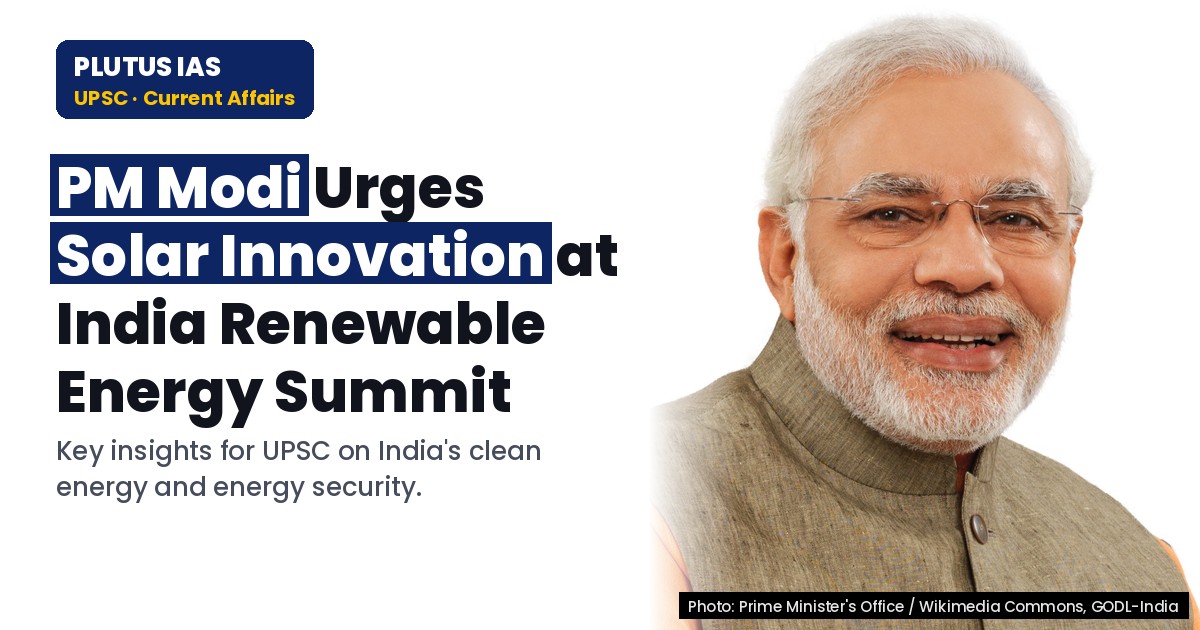
03 Nov India’s Renewable Energy Summit: PM Modi Urges Solar Innovation
✎ India's renewable energy strategy is centered on achieving energy security, fostering economic growth, and promoting self-reliance through innovation and widespread adoption of clean energy technologies.
Subject Relevance — Where This Topic Fits
- GS Paper III — Economy | GS Paper III — Infrastructure: Energy | GS Paper III — Environment: Climate Change | GS Paper II — Government Policies and Interventions
- Prelims: Renewable Energy, International Solar Alliance (ISA), Green Hydrogen, Energy Security, PM-Surya Sarovar Yojana, Green Energy Corridor, Non-fossil fuel capacity, Rooftop Solar
- Essay: The imperative of sustainable energy for India’s economic growth and environmental stewardship., Innovation and self-reliance as cornerstones of India’s energy transition.
Quick Revision: India’s renewable energy strategy is centered on achieving energy security, fostering economic growth, and promoting self-reliance through innovation and widespread adoption of clean energy technologies.
Why is this in the news?
The ‘India Renewable Energy Summit and Expo 2026’ was inaugurated by the Prime Minister in New Delhi, highlighting the nation’s commitment to renewable energy amidst global energy challenges. The summit, co-located with the 9th Assembly of the International Solar Alliance and a conference on Green Hydrogen, underscored the critical role of clean energy in ensuring energy security and fostering economic resilience.
Background
- Global energy landscape is currently experiencing significant disruptions, emphasizing the strategic importance of diversified and sustainable energy sources.
- India’s economic growth trajectory, projected at 7% for 2026-27 by the IMF, necessitates a corresponding increase in energy supply, making renewable energy crucial for sustainable development.
- The inherent volatility and geopolitical concentration of fossil fuel reserves underscore the need for a transition to domestically available and limitless clean energy options.
- India’s non-fossil fuel-based installed capacity exceeded 200 GW by September 2024, demonstrating substantial progress in its renewable energy targets.
- The government has consistently promoted renewable energy through various initiatives, including the International Solar Alliance and domestic schemes, to accelerate adoption and innovation.
India’s Renewable Energy Initiatives and Vision
- The ‘India Renewable Energy Summit and Expo 2026’ serves as a platform for stakeholders to discuss advancements and foster collaborations in the renewable energy sector.
- The summit’s co-occurrence with the 9th Assembly of the International Solar Alliance (ISA) highlights India’s leadership in promoting solar energy globally.
- Discussions on ‘Green Hydrogen’ emphasize its potential as a future clean fuel and India’s strategic focus on developing a robust green hydrogen ecosystem.
- The ‘PM-Surya Sarovar Yojana’ (Prime Minister’s Solar Lake Scheme) is a significant initiative with an outlay of over ₹5,000 crore, aiming to develop 5,000 MW of floating solar capacity.
- The ‘Green Energy Corridor Phase-III’ project, approved with an investment of ₹1.86 lakh crore, is designed to facilitate the evacuation of large-scale renewable energy from generation-rich regions to demand centers.
- Emphasis is placed on innovation in solar models, urging startups and innovators to develop solutions for 24×7, all-weather solar applications, including rooftop solar cooking and home solar charging for electric vehicles.
- The vision extends to making every household’s energy needs predominantly met by solar power, aiming to reduce dependence on imported fuels and provide economic benefits to middle-class families.
Key Features
| Feature | Significance |
|---|---|
| India Renewable Energy Summit and Expo 2026 | A significant forum for stakeholders in the renewable energy sector, fostering collaboration and showcasing advancements, particularly in the context of global energy challenges. |
| Co-occurrence with International Solar Alliance (ISA) 9th Assembly | Enhances the summit’s international reach and collaborative potential, aligning national efforts with global solar energy initiatives. |
| Inclusion of 4th Conference on Green Hydrogen | Broadens the scope of discussions to include emerging and critical clean energy technologies, emphasizing India’s commitment to diverse renewable pathways. |
| Emphasis on Innovation and Adoption | Highlights the dual imperative of technological advancement and widespread implementation for achieving energy security and sustainability. |
| Focus on ‘Round-the-clock and All-weather’ Solar Models | Addresses the intermittency challenge of solar power, promoting solutions for consistent energy supply and greater household self-sufficiency. |
| Promotion of ‘Rooftop Solar Cooking’ and ‘Home Solar Charging’ | Targets specific household energy consumption areas, aiming to reduce dependence on imported fuels and provide direct economic benefits to middle-class families. |
Why it Matters
Economic Implications
- Reduction in fossil fuel import dependency, leading to foreign exchange savings and enhanced energy security.
- Stimulation of domestic manufacturing, innovation, and job creation within the renewable energy sector.
- Potential for significant cost savings for households through adoption of solar solutions, thereby boosting disposable income and economic resilience.
Environmental Sustainability
- Mitigation of climate change through reduced greenhouse gas emissions from fossil fuel combustion.
- Promotion of cleaner air quality by shifting towards non-polluting energy sources.
- Contribution to India’s nationally determined contributions (NDCs) under the Paris Agreement.
Energy Security
- Diversification of the energy mix, reducing vulnerability to global energy price shocks and geopolitical instability.
- Harnessing abundant domestic renewable resources, ensuring a stable and predictable energy supply.
- Decentralization of energy generation through rooftop solar, enhancing grid resilience and local energy self-sufficiency.
Technological Advancement
- Encouragement of research and development in solar technology, battery storage, and green hydrogen.
- Fostering a culture of innovation among startups, IITs, and entrepreneurs to develop advanced energy solutions.
- Integration of smart grid technologies and digital platforms for efficient energy management and distribution.
Challenges
1. Intermittency of Renewable Energy
- Solar and wind power generation are dependent on weather conditions, leading to fluctuations in supply.
- Ensuring grid stability and continuous power availability requires robust energy storage solutions and efficient grid management.
UPSC Link: Energy Infrastructure; Grid Management
2. High Capital Costs
- Initial investment for renewable energy projects, particularly storage technologies and green hydrogen, can be substantial.
- Accessibility of affordable financing and incentives is crucial for widespread adoption and project viability.
UPSC Link: Investment Models; Public-Private Partnerships
3. Land Availability and Acquisition
- Large-scale solar parks and wind farms require significant land areas, which can lead to challenges in acquisition and potential social impacts.
- Developing floating solar capacity and rooftop solar can mitigate some land-related constraints.
UPSC Link: Land Use Policy; Environmental Impact Assessment
4. Grid Integration Challenges
- Integrating a high proportion of variable renewable energy into the existing grid infrastructure requires upgrades and smart grid technologies.
- Ensuring reliable transmission and distribution of renewable power across diverse geographical regions.
UPSC Link: Power Sector Reforms; Infrastructure Development
5. Technological Gaps and Innovation
- While progress has been made, continuous innovation is needed for more efficient, durable, and cost-effective renewable energy technologies.
- Developing indigenous manufacturing capabilities and reducing reliance on imported components remains a challenge.
UPSC Link: Science and Technology Development; Make in India
Challenges — UPSC Perspective
| Issue | Concern |
|---|---|
| Energy Storage Solutions | Lack of sufficient, cost-effective, and long-duration energy storage to address renewable energy intermittency. |
| Grid Modernization | Existing grid infrastructure requires significant upgrades to effectively integrate and manage high volumes of renewable energy. |
| Financing Mechanisms | Ensuring accessible and attractive financing options for renewable energy projects, especially for small-scale and household installations. |
| Supply Chain Resilience | Developing robust domestic supply chains for renewable energy components to reduce import dependence and geopolitical risks. |
| Public Awareness and Adoption | Overcoming initial resistance and promoting widespread adoption of new renewable energy technologies among consumers. |
Government Initiatives — Must-Memorise for Prelims
- Pradhan Mantri Surya Sarovar Yojana
- Green Energy Corridor Phase-III
Way Forward
- Prioritize investment in advanced energy storage technologies, including battery storage and pumped hydro, to enhance grid stability and reliability.
- Accelerate research and development in ’round-the-clock’ solar solutions and green hydrogen production to achieve greater energy independence.
- Implement robust policy frameworks and financial incentives to encourage private sector investment and innovation in renewable energy.
- Strengthen the national grid infrastructure through smart grid technologies and inter-state transmission systems to facilitate efficient renewable energy evacuation.
- Promote decentralized renewable energy solutions, such as rooftop solar and community microgrids, to empower local communities and reduce transmission losses.
- Foster international collaborations and technology transfer to leverage global expertise and accelerate the deployment of cutting-edge renewable energy solutions.
- Launch targeted public awareness campaigns to educate citizens about the economic and environmental benefits of adopting renewable energy technologies at the household level.
UPSC Value Addition
Keywords for Mains Answer-Writing
Renewable energy · Energy security · Green Hydrogen · International Solar Alliance · Sustainable development · Energy transition · Climate change mitigation · Energy independence · Technological innovation · Economic growth
Concept Flow
Global energy shocks highlight fossil fuel dependency. → Renewable energy emerges as a critical solution for energy security. → Government initiatives and policies promote renewable energy adoption. → Innovation in solar models and green hydrogen is encouraged. → Increased renewable energy capacity leads to reduced fossil fuel reliance. → Enhanced energy security and environmental sustainability are achieved.
Prelims Practice Questions
Q1. Consider the following statements regarding India’s renewable energy initiatives:
1. The ‘Pradhan Mantri Surya Sarovar Yojana’ aims to develop floating solar capacity.
2. The ‘Green Energy Corridor Phase-III’ project focuses on enhancing transmission infrastructure for renewable energy.
3. India’s non-fossil fuel-based installed capacity exceeded 200 GW in September 2024.
How many of the above statements are correct?
- Only one
- Only two
- All three
- None
Answer: All three — Statement 1 is correct: The ‘Pradhan Mantri Surya Sarovar Yojana’ has been approved with an outlay of over ₹5,000 crore to develop 5,000 MW of floating solar capacity. Statement 2 is correct: The ‘Green Energy Corridor Phase-III’ has been approved with an investment of ₹1.86 lakh crore, primarily for strengthening and expanding the transmission network for renewable energy. Statement 3 is correct: As per the press release, India’s non-fossil fuel-based installed capacity exceeded 200 GW in September 2024.
Q2. Which of the following international organizations, mentioned in the context of the ‘India Renewable Energy Summit and Expo 2026’, is dedicated to the promotion of solar energy globally?
- International Energy Agency (IEA)
- International Solar Alliance (ISA)
- Renewable Energy Policy Network for the 21st Century (REN21)
- United Nations Environment Programme (UNEP)
Answer: International Solar Alliance (ISA) — The ‘India Renewable Energy Summit and Expo 2026’ is being held concurrently with the ninth assembly of the International Solar Alliance (ISA), an organization specifically dedicated to the promotion of solar energy.
Mains Practice Question
✍ Examine the critical role of renewable energy in ensuring India’s energy security and achieving its sustainable development goals. Discuss the key government initiatives and technological innovations required to accelerate this transition. (15 Marks)
Approach: Introduction: Define energy security and sustainable development goals, linking them to India’s context.
Body 1: Role of Renewable Energy in Energy Security:
– Reducing reliance on fossil fuel imports (e.g., crude oil, natural gas).
– Mitigating geopolitical risks associated with concentrated fossil fuel reserves.
– Enhancing energy independence and resilience.
– Stabilizing energy prices in the long term.
Body 2: Role of Renewable Energy in Sustainable Development Goals (SDGs):
– SDG 7 (Affordable and Clean Energy): Universal access to modern energy services.
– SDG 13 (Climate Action): Reducing greenhouse gas emissions.
– SDG 11 (Sustainable Cities and Communities): Promoting sustainable urbanization through clean energy.
– Economic benefits: Job creation, ‘green growth’.
Body 3: Key Government Initiatives:
– ‘Pradhan Mantri Surya Sarovar Yojana’ (floating solar).
– ‘Green Energy Corridor Phase-III’ (transmission infrastructure).
– National Green Hydrogen Mission.
– International Solar Alliance (ISA) leadership.
– Production Linked Incentive (PLI) schemes for solar PV manufacturing.
Body 4: Technological Innovations Required:
– Advanced battery storage solutions (e.g., Li-ion, flow batteries).
– Smart grid technologies for efficient integration of renewables.
– Hybrid renewable energy systems (solar-wind).
– Innovations in rooftop solar and home charging solutions.
– Research and development in green hydrogen production and applications.
Conclusion: Summarize the imperative for a robust renewable energy transition, emphasizing its multi-faceted benefits for India’s future.
Source: PIB (Press Information Bureau)
Generated by AanyaAi for educational purpose.
Related guides on our sites
- Current affairs for upsc 2026
- Best PSIR optional coaching for upsc
- Best PSIR optional teacher for upsc
- Best teacher of PSIR optional for upsc

- India’s Renewable Energy Summit: PM Modi Urges Solar Innovation - November 3, 2026
- दिल्ली प्रदूषण: कारण, GRAP चरण II और प्रभाव - November 3, 2026
- US Strikes in Strait of Hormuz: Geopolitical Impact - November 3, 2026

No Comments