


03 Nov AI’s Impact on Digital Advertising: Meta vs. Google Analysis
✎ Artificial Intelligence is fundamentally reshaping digital advertising, enabling enhanced user engagement and more precise ad targeting for platforms like Meta, while simultaneously presenting monetisation challenges for…
Subject Relevance — Where This Topic Fits
- GS Paper III — Economy | GS Paper III — Science and Technology
- Prelims: Artificial Intelligence (AI), Digital Advertising, Monetisation, Algorithm, Machine Learning, User Engagement
- Essay: The transformative potential of Artificial Intelligence across economic sectors, Digital economy and its implications for market competition and innovation
Quick Revision: Artificial Intelligence is fundamentally reshaping digital advertising, enabling enhanced user engagement and more precise ad targeting for platforms like Meta, while simultaneously presenting monetisation challenges for AI-powered search experiences such as Google’s.
Why is this in the news?
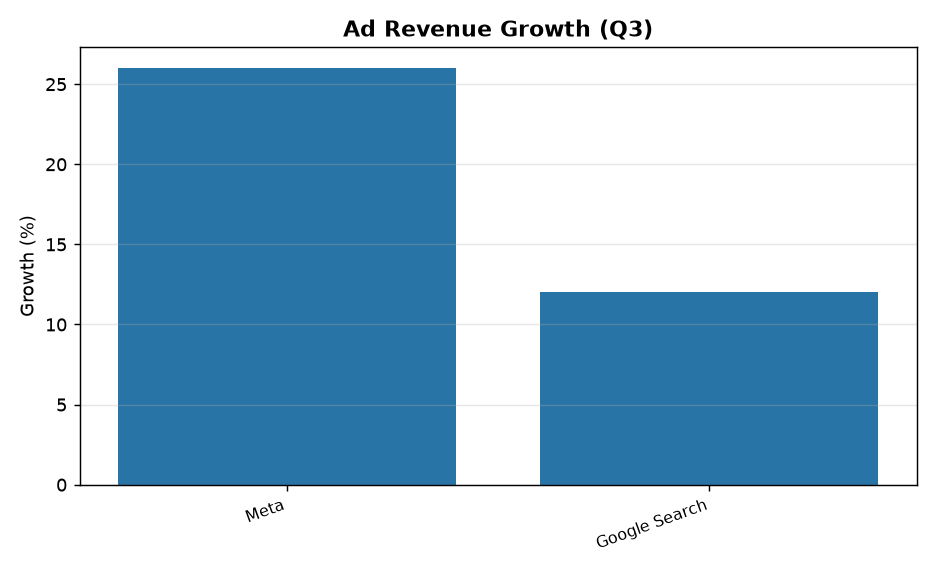
Recent quarterly earnings reports from major technology companies have highlighted a divergent impact of Artificial Intelligence (AI) on their digital advertising revenues. While Meta has leveraged AI to significantly boost its advertising income through enhanced user engagement and more effective ad targeting, Google is encountering challenges in monetising its rapidly expanding AI-powered search experience, which currently generates less advertising revenue than traditional search methods.
Background
- The digital advertising market is a significant component of the global economy, with major technology companies like Google and Meta holding substantial market shares.
- Artificial Intelligence (AI) refers to the simulation of human intelligence in machines that are programmed to think like humans and mimic their actions, encompassing machine learning, deep learning, and natural language processing.
- Advertising revenue models in the digital sphere typically rely on user data, engagement metrics, and sophisticated algorithms to deliver targeted advertisements.
- Meta (formerly Facebook) operates a vast network of social media platforms, including Facebook and Instagram, which are heavily reliant on advertising for revenue generation.
- Google’s primary revenue stream historically has been its search advertising business, where ads are displayed alongside search results based on user queries.
- The integration of AI into digital platforms is a continuous process, aiming to improve user experience, content recommendations, and advertising efficacy.
Artificial Intelligence in Digital Advertising
- Artificial Intelligence (AI) in digital advertising involves the application of machine learning algorithms to analyse vast datasets of user behaviour, preferences, and demographics.
- For platforms like Meta, AI-powered recommendation systems predict content users are most likely to engage with, thereby increasing time spent on the platform and opportunities for ad exposure.
- AI also enhances ad targeting by identifying specific user segments most receptive to particular advertisements, leading to higher conversion rates for advertisers.
- Generative AI models, such as Meta’s Generative Ads Recommendation Model (GEM), can analyse user and advertising signals to predict engagement likelihood, optimising ad delivery.
- AI tools assist advertisers in creating ad content, managing campaigns, and optimising spending by providing data-driven insights and automated solutions.
- In search advertising, AI is used to understand user intent more accurately and deliver highly relevant search results and accompanying advertisements.
- The monetisation challenge for AI-powered search arises when the AI-generated answers reduce the need for users to click through multiple links, potentially decreasing ad impressions.
- Conversion in advertising refers to a desired action taken by a user after viewing an advertisement, such as a purchase, download, or sign-up, which AI aims to maximise.
Key Features
| Feature | Significance |
|---|---|
| AI-powered Recommendation Systems | Enhance user engagement by predicting content and advertisements most likely to resonate with individuals, leading to increased time spent on platforms. |
| Generative Ads Recommendation Model (GEM) | An AI system that analyses user behaviour and advertising signals to predict ad engagement, thereby improving targeting and conversion rates for advertisers. |
| AI Business Assistant | Provides advertisers with AI-driven recommendations for campaign creation, management, and optimisation, leading to improved advertising efficiency and return on investment. |
| Increased Advertising Impressions | AI’s ability to deliver more relevant ads leads to a higher number of advertisements being displayed to users, expanding reach. |
| Higher Average Price Per Advertisement | Improved targeting and conversion rates driven by AI allow platforms to command higher prices for advertising slots due to their enhanced effectiveness. |
Why it Matters
Economic Implications
- Artificial Intelligence is fundamentally reshaping the digital advertising landscape, influencing revenue generation models for major technology companies.
- The divergence in AI’s impact on different business models (e.g., social media vs. search) highlights varied monetisation strategies and potential shifts in market dominance.
- Enhanced advertising effectiveness through AI can lead to increased revenue for platforms and improved return on investment for advertisers, stimulating digital economic activity.
Technological Advancement
- The application of AI in recommendation engines and generative advertising models represents significant progress in machine learning and data analytics.
- Continuous innovation in AI-powered tools for advertisers democratises sophisticated marketing capabilities, potentially benefiting small and medium-sized enterprises (SMEs).
- The development of AI for personalised content delivery and advertisement targeting underscores the growing sophistication of user experience optimisation.
Market Dynamics
- AI’s differential impact could lead to a reordering of market leadership in the digital advertising sector, challenging established positions.
- Increased competition driven by AI capabilities compels technology companies to invest heavily in research and development to maintain or gain market share.
- The evolving landscape necessitates adaptability from businesses and advertisers to leverage new AI tools effectively for competitive advantage.
Challenges
1. Monetisation of AI-powered Search
- Integrating AI into search experiences can enhance user satisfaction but poses challenges in maintaining or increasing advertising revenue compared to conventional search models.
- The format of AI-generated search results may reduce the prominence or necessity of traditional paid advertisements, impacting revenue streams.
UPSC Link: Economy: Digital Economy, Business Models
2. Data Privacy and Ethical AI
- AI’s reliance on extensive user data for personalisation raises concerns regarding data privacy, security, and potential misuse of personal information.
- Ethical considerations in AI development, such as algorithmic bias and transparency, are crucial to ensure fair and equitable advertising practices.
UPSC Link: Science & Tech: AI Ethics, Data Protection
3. Algorithmic Transparency and Accountability
- The complex nature of AI algorithms can make it difficult to understand how advertising decisions are made, raising questions about transparency and accountability.
- Ensuring that AI systems are free from unintended biases that could lead to discriminatory advertising practices is a significant challenge.
UPSC Link: Science & Tech: AI Governance, Transparency
4. Regulatory Frameworks
- Existing regulatory frameworks may not be adequately equipped to address the novel challenges posed by advanced AI in digital advertising, necessitating policy evolution.
- Balancing innovation with consumer protection and fair competition in the AI-driven digital advertising space requires careful regulatory consideration.
UPSC Link: Governance: Regulatory Bodies, Digital Policy
Challenges — UPSC Perspective
| Issue | Concern |
|---|---|
| AI-powered Search Monetisation | Difficulty in generating comparable advertising revenue from AI-enhanced search experiences as from traditional search results. |
| Data Privacy and Security | Extensive collection and analysis of user data by AI for advertising purposes raise significant privacy and security concerns. |
| Algorithmic Bias | Potential for AI algorithms to perpetuate or amplify existing societal biases in ad targeting and content recommendations. |
| Market Dominance and Competition | AI’s impact could lead to increased concentration of power among a few dominant technology firms, potentially stifling competition. |
| Regulatory Lag | The rapid pace of AI development outstrips the ability of regulatory bodies to establish comprehensive and effective governance frameworks. |
Way Forward
- Invest in responsible AI development, prioritising ethical guidelines, transparency, and accountability in algorithmic design and deployment.
- Develop innovative monetisation strategies for AI-powered search experiences that integrate advertisements seamlessly without compromising user experience.
- Strengthen data governance frameworks to ensure user privacy and data security while enabling the beneficial use of AI in advertising.
- Foster a competitive environment by supporting smaller players and encouraging diverse AI applications in the digital advertising sector.
- Promote public awareness and digital literacy regarding AI’s role in online advertising and data usage.
- Encourage cross-sectoral collaboration between industry, academia, and government to address the complex challenges and opportunities presented by AI.
- Continuously evaluate and adapt regulatory policies to keep pace with technological advancements in AI and its implications for digital markets.
UPSC Value Addition
Keywords for Mains Answer-Writing
Artificial Intelligence (AI) · Digital Advertising · Algorithmic Recommendations · User Engagement · Data Monetisation · Economic Impact of AI · Technological Disruption · Business Models · Targeted Advertising · Generative AI
Concept Flow
AI enhances recommendation systems and ad targeting. → Improved ad relevance leads to higher user engagement. → Increased user engagement drives more ad impressions and conversions. → Higher conversions and effectiveness allow for increased ad pricing. → Resultant growth in advertising revenue for platforms leveraging AI.
Prelims Practice Questions
Q1. Consider the following statements regarding Artificial Intelligence (AI) in the context of digital advertising:
1. AI-powered recommendation systems primarily aim to increase user engagement by predicting content preferences.
2. Generative AI models can assist advertisers in creating and optimising advertising campaigns.
3. Increased advertising impressions on a platform directly correlate with higher average price per advertisement.
How many of the above statements are correct?
- Only one
- Only two
- All three
- None
Answer: All three — Statement 1 is correct: AI-powered recommendation systems analyse user behaviour to predict preferences, thereby increasing engagement. Statement 2 is correct: Generative AI tools are being deployed to assist advertisers in content creation and campaign management. Statement 3 is incorrect: While both can contribute to revenue, an increase in impressions does not automatically lead to a higher average price per advertisement; pricing can depend on various factors like bidding, ad quality, and market demand.
Q2. Which of the following best describes a ‘conversion’ in digital advertising?
- The total number of times an advertisement is displayed to users.
- The cost incurred by an advertiser for each click on their advertisement.
- A desired action taken by a user after seeing an advertisement, such as a purchase or app download.
- The process of an AI system analysing user data to predict ad engagement.
Answer: A desired action taken by a user after seeing an advertisement, such as a purchase or app download. — A conversion refers to a specific, desired action completed by a user after interacting with an advertisement, such as making a purchase, signing up for a service, or downloading an application. It represents a successful outcome for the advertiser beyond mere viewing or clicking.
Mains Practice Question
✍ Artificial Intelligence is significantly reshaping business models across various sectors. Examine how AI is transforming the digital advertising landscape and discuss the ethical implications associated with its pervasive use in targeted advertising. (15 Marks)
Approach: MODEL-ANSWER SKELETON:
1. **Introduction:** Briefly define AI and its growing influence, specifically in digital advertising.
2. **Transformation of Digital Advertising by AI (First Part):**
* **Enhanced Targeting and Personalisation:** AI algorithms analyse vast datasets (user behaviour, demographics, interests) to deliver highly relevant ads, increasing efficiency and conversion rates (e.g., Meta’s AI-powered recommendation systems, GEM model).
* **Optimised Ad Placement and Bidding:** AI predicts optimal times and platforms for ad display, and manages real-time bidding to maximise ROI for advertisers.
* **Content Creation and Campaign Management:** Generative AI tools assist in creating ad copy, visuals, and managing complex campaigns, reducing human effort.
* **Improved User Engagement:** AI-driven recommendations lead to more relevant content, increasing time spent on platforms (e.g., Instagram Reels engagement).
* **Data Monetisation:** AI enables platforms to better monetise user data by offering sophisticated advertising tools.
3. **Ethical Implications of AI in Targeted Advertising (Second Part):**
* **Privacy Concerns:** Extensive data collection and analysis raise questions about user privacy and data security. Potential for misuse of personal information.
* **Algorithmic Bias:** AI systems can perpetuate or amplify existing societal biases if trained on biased data, leading to discriminatory ad targeting (e.g., excluding certain demographics from housing or employment ads).
* **Manipulation and Persuasion:** Highly personalised ads can be perceived as manipulative, potentially exploiting psychological vulnerabilities or creating ‘filter bubbles’ and echo chambers.
* **Transparency and Accountability:** Lack of transparency in how AI algorithms make decisions (black box problem) makes it difficult to understand why certain ads are shown or why certain targeting decisions are made, hindering accountability.
* **Data Governance and Regulation:** The need for robust regulatory frameworks (e.g., GDPR, India’s proposed Digital Personal Data Protection Bill) to address these ethical challenges, ensuring fair and responsible AI use.
4. **Conclusion:** Summarise the dual nature of AI in advertising – immense economic potential alongside significant ethical responsibilities, emphasising the need for a balanced approach that prioritises innovation with robust ethical guidelines and regulatory oversight.
Source: The Indian Express
Generated by AanyaAi for educational purpose.
Related guides on our sites
- Best economics optional coaching for upsc
- Best economics optional teacher for upsc
- How to prepare for GS paper 1 for UPSC CSE mains exam
- Best UPSC coaching for IFOS exam

- Bihar Municipal Act Amendment: Mayor Powers & Online Services - November 3, 2026
- आरबीआई ने सेवा निर्यातकों के लिए ईडीएफ अनुपालन मानदंडों को स्पष्ट किया - November 3, 2026
- AI’s Impact on Digital Advertising: Meta vs. Google Analysis - November 3, 2026

No Comments