


05 Nov Delhi’s ‘Very Poor’ AQI: UPSC & PCS Environment Update
✎ The Air Quality Index (AQI) serves as a critical indicator of air pollution levels, with Delhi's recent 'very poor' to 'severe' readings necessitating stringent implementation of measures like the Graded Response Action Plan…
Subject Relevance — Where This Topic Fits
- GS Paper I — Geography (Environmental Geography) | GS Paper III — Environment (Environmental Pollution & Degradation, Conservation) | GS Paper III — Disaster Management (Environmental Disasters)
- Prelims: Air Quality Index (AQI), Particulate Matter (PM2.5, PM10), Graded Response Action Plan (GRAP), Commission for Air Quality Management (CAQM), National Clean Air Programme (NCAP), Stubble Burning, Vehicular Pollution, Industrial Emissions, Meteorological Factors, Health Impacts of Air Pollution
- Essay: Environmental Sustainability and Developmental Imperatives in India, The Challenge of Urbanization: Balancing Growth with Environmental Protection
Quick Revision: The Air Quality Index (AQI) serves as a critical indicator of air pollution levels, with Delhi’s recent ‘very poor’ to ‘severe’ readings necessitating stringent implementation of measures like the Graded Response Action Plan (GRAP) by the Commission for Air Quality Management (CAQM) to address the multifaceted challenge of vehicular emissions, industrial pollution, and stubble burning.
Why is this in the news?
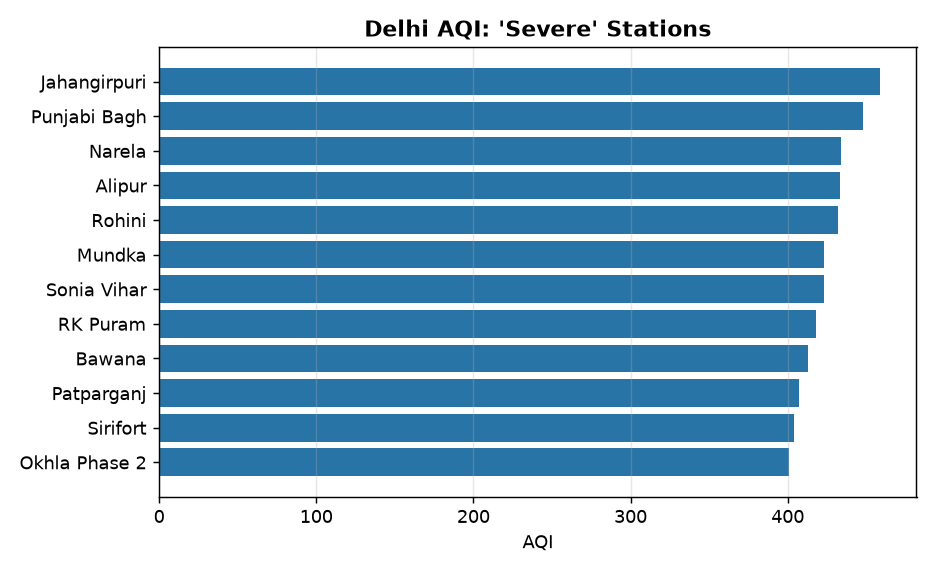
Delhi’s Air Quality Index (AQI) has significantly deteriorated, recording an overall AQI of 370, placing it in the ‘very poor’ category. Several monitoring stations across the National Capital Region (NCR) have registered ‘severe’ pollution levels, with Jahangirpuri reporting the highest AQI at 459. This decline is attributed to a combination of meteorological conditions and anthropogenic factors, with forecasts indicating a potential further worsening of air quality in the coming days.
Background
- Air pollution in Delhi and the NCR is a recurring annual phenomenon, particularly during the post-monsoon and winter months, exacerbated by specific meteorological conditions such as low wind speeds and temperature inversions.
- The primary sources of pollution include vehicular emissions, industrial discharges, construction dust, biomass burning (including stubble burning in neighbouring states), and domestic heating.
- The Central Pollution Control Board (CPCB) categorises air quality based on the AQI, ranging from ‘Good’ (0-50) to ‘Severe’ (401-500), with ‘Very Poor’ indicating potential respiratory illness on prolonged exposure and ‘Severe’ affecting healthy people and seriously impacting those with existing diseases.
- Government agencies, including the Commission for Air Quality Management (CAQM) and the CPCB, implement measures such as the Graded Response Action Plan (GRAP) to mitigate pollution levels based on the severity of the AQI.
- Despite various policy interventions and legal frameworks, sustained improvement in air quality remains a significant environmental and public health challenge for the region.
- The Indian Institute of Tropical Meteorology (IITM) and the Air Quality Early Warning System provide forecasts and real-time data to inform public health advisories and policy responses.
Understanding Air Quality Index (AQI) and Related Governance Mechanisms
- The Air Quality Index (AQI) is a tool for effectively communicating air quality status to the public in a simple, understandable manner, indicating how clean or polluted the air is and what associated health effects might be a concern.
- AQI considers eight major pollutants: Particulate Matter (PM2.5 and PM10), Ozone (O3), Carbon Monoxide (CO), Sulphur Dioxide (SO2), Nitrogen Dioxide (NO2), Ammonia (NH3), and Lead (Pb).
- The Graded Response Action Plan (GRAP) is a set of emergency measures implemented in the NCR to combat air pollution, categorised into four stages based on AQI levels: Poor, Very Poor, Severe, and Severe+.
- The Commission for Air Quality Management (CAQM) in NCR and Adjoining Areas was established to coordinate activities for air quality improvement, undertaking research, identifying pollution sources, and implementing mitigation strategies.
- The National Clean Air Programme (NCAP) is a long-term, time-bound national-level strategy to tackle the air pollution problem across the country in a comprehensive manner, aiming to achieve a 20%–30% reduction in PM2.5 and PM10 concentrations by 2024, with 2017 as the base year.
- Stubble burning, a practice of setting fire to crop residue after harvest, particularly in states like Punjab, Haryana, and Uttar Pradesh, is a significant contributor to air pollution in the NCR during specific seasons.
- Vehicular emissions, stemming from the combustion of fossil fuels in automobiles, contribute substantially to the release of pollutants such as nitrogen oxides, carbon monoxide, and particulate matter.
- Meteorological factors, including wind speed, direction, temperature, and humidity, play a crucial role in the dispersion or accumulation of pollutants, influencing the overall air quality.
Key Features
| Feature | Significance |
|---|---|
| Air Quality Index (AQI) | A numerical scale used to communicate air quality levels to the public, indicating potential health effects. |
| Category ‘Very Poor’ | AQI values between 301 and 400, signifying respiratory illness on prolonged exposure. |
| Category ‘Severe’ | AQI values between 401 and 500, indicating that healthy people may be affected and those with existing diseases may experience severe impacts. |
| Air Quality Early Warning System (AQEWS) | A predictive tool that forecasts air quality, enabling proactive measures and public advisories. |
| Ventilation Index | A meteorological parameter that combines wind speed and mixing height, indicating the atmosphere’s capacity to disperse pollutants. |
Why it Matters
Environmental Significance
- Elevated AQI levels denote significant atmospheric pollution, primarily from particulate matter and gaseous contaminants, impacting ecological balance and natural resource health.
- Persistent ‘severe’ and ‘very poor’ air quality categories underscore the failure of existing environmental management strategies to mitigate pollution effectively.
- The phenomenon highlights the complex interplay of meteorological conditions, such as low wind speeds and reduced ventilation, with anthropogenic emissions in exacerbating air pollution.
Public Health Significance
- High concentrations of air pollutants, particularly PM2.5 and PM10, are directly linked to increased incidence of respiratory and cardiovascular diseases, premature mortality, and reduced life expectancy.
- Vulnerable populations, including children, the elderly, and individuals with pre-existing health conditions, face disproportionately higher health risks from prolonged exposure to severe air pollution.
- The recurring nature of severe air quality episodes necessitates robust public health advisories and the implementation of emergency response protocols to protect citizens.
Governance and Policy Significance
- The consistent deterioration of air quality in urban centers like Delhi reflects challenges in inter-state coordination and the implementation of comprehensive pollution control policies.
- It underscores the imperative for evidence-based policy formulation, integrating scientific forecasts from systems like the AQEWS into actionable governance strategies.
- The issue highlights the need for a multi-sectoral approach involving urban planning, industrial regulation, agricultural practices, and transportation management to address pollution sources holistically.
Challenges
1. Source Attribution and Control
- Identifying and quantifying the precise contributions of various pollution sources (vehicular emissions, industrial discharge, stubble burning, construction dust, domestic biomass combustion) remains a complex task.
- Implementing effective control measures for diffuse and geographically varied sources, especially those spanning multiple administrative jurisdictions, presents significant logistical and political hurdles.
UPSC Link: Environmental Pollution & Degradation
2. Inter-State Coordination
- Air pollution is a transboundary issue, with emissions from surrounding states significantly impacting Delhi’s air quality, necessitating robust and sustained cooperation mechanisms.
- Achieving consensus and coordinated action on policies such as stubble burning prevention or industrial emission standards across different states is challenging due to varying priorities and enforcement capacities.
UPSC Link: Federalism; Environmental Governance
3. Technological and Infrastructural Gaps
- The adoption of cleaner technologies in industries, transportation, and agriculture is often hindered by high costs, lack of incentives, and insufficient infrastructure for alternatives.
- Upgrading public transport, promoting electric vehicles, and ensuring widespread availability of cleaner fuels require substantial investment and policy support.
UPSC Link: Infrastructure; Science & Technology
4. Public Awareness and Behavioural Change
- Despite widespread awareness of air pollution, translating this into sustained behavioural changes among citizens and industries (e.g., waste management, vehicle maintenance, energy consumption) is difficult.
- The public’s understanding of the long-term health impacts and the collective responsibility in mitigating pollution needs continuous reinforcement through targeted campaigns.
UPSC Link: Social Impact; Public Policy
Challenges — UPSC Perspective
| Issue | Concern |
|---|---|
| Recurrent ‘Severe’ Air Quality | Indicates systemic failures in pollution control and management, leading to chronic public health crises and economic losses. |
| Variations in AQI Reporting | Discrepancies between official and private monitoring data can create confusion and undermine public trust in official advisories and policy effectiveness. |
| Meteorological Vulnerability | Delhi’s geographical and meteorological conditions (landlocked, low wind speeds, temperature inversions) exacerbate pollution, making it highly susceptible to pollutant accumulation. |
| Economic Costs of Pollution | Air pollution imposes significant economic burdens through healthcare expenditures, lost productivity, and impacts on tourism and investment. |
| Enforcement Gaps | Despite existing regulations and policies, their effective implementation and stringent enforcement remain a persistent challenge across various sectors. |
Way Forward
- Strengthen the Graded Response Action Plan (GRAP) by ensuring timely implementation of measures based on AQI forecasts, with clear accountability mechanisms.
- Promote cleaner energy sources and technologies across all sectors, including industrial processes, power generation, and domestic use, through fiscal incentives and regulatory mandates.
- Enhance inter-state cooperation and coordination mechanisms, particularly with states in the National Capital Region (NCR), to address transboundary pollution sources like stubble burning.
- Invest in upgrading public transportation infrastructure, promoting electric vehicles, and improving last-mile connectivity to reduce reliance on private vehicles.
- Implement stringent dust control measures at construction sites and on roads, coupled with regular mechanical street sweeping and water sprinkling.
- Develop and deploy advanced air quality monitoring networks with real-time data dissemination and integrate them with robust epidemiological studies to better understand health impacts.
- Launch comprehensive public awareness campaigns to educate citizens on the sources of pollution, health risks, and individual actions for mitigation, fostering a sense of collective responsibility.
- Encourage research and development into innovative, cost-effective solutions for pollution control, including air purification technologies and sustainable urban planning models.
UPSC Value Addition
Keywords for Mains Answer-Writing
Air Quality Index (AQI) · Air Pollution · National Clean Air Programme (NCAP) · Graded Response Action Plan (GRAP) · Central Pollution Control Board (CPCB) · Pollutant Sources · Public Health Impacts · Environmental Governance · Sustainable Urban Development · Inter-state Cooperation · Technological Solutions · Climate Change Mitigation
Constitutional & Policy Linkages
- Article 21: Right to Life and Personal Liberty (includes right to a clean environment)
- Article 48A: Protection and Improvement of Environment (Directive Principle of State Policy)
- Article 51A(g): Fundamental Duty to Protect and Improve Natural Environment
- Seventh Schedule: List III (Concurrent List) – Forests, Protection of Wild Animals and Birds, Population Control and Family Planning, Economic and Social Planning
Concept Flow
Anthropogenic Emissions (Vehicular, Industrial, Agricultural) → Accumulation of Pollutants (PM2.5, PM10, NOx, SO2) → Adverse Meteorological Conditions (Low Winds, Temperature Inversion) → Elevated Air Quality Index (AQI) Categories (‘Very Poor’, ‘Severe’) → Public Health Impacts (Respiratory, Cardiovascular Diseases) → Environmental Degradation (Reduced Visibility, Ecosystem Damage) → Socio-Economic Consequences (Healthcare Costs, Productivity Loss)
Prelims Practice Questions
Q1. Consider the following statements regarding the Air Quality Index (AQI) in India:
1. The AQI categorises air quality into six categories, ranging from ‘Good’ to ‘Severe’.
2. An AQI value between 301 and 400 is classified as ‘Very Poor’.
3. The primary pollutants monitored for AQI calculation include PM2.5, PM10, Ozone, Carbon Monoxide, Sulphur Dioxide, Nitrogen Dioxide, Ammonia, and Lead.
How many of the above statements are correct?
- Only one
- Only two
- All three
- None
Answer: All three — Statement 1 is correct: The AQI indeed has six categories: Good, Satisfactory, Moderate, Poor, Very Poor, and Severe. Statement 2 is correct: An AQI value from 301-400 is designated as ‘Very Poor’. Statement 3 is correct: These eight pollutants are indeed the key parameters monitored for AQI calculation in India.
Q2. Which of the following bodies is primarily responsible for the overall coordination of air quality monitoring and enforcement of environmental standards in India?
- Ministry of Environment, Forest and Climate Change (MoEFCC)
- Central Pollution Control Board (CPCB)
- National Green Tribunal (NGT)
- Indian Institute of Tropical Meteorology (IITM)
Answer: Central Pollution Control Board (CPCB) — The Central Pollution Control Board (CPCB) is a statutory organisation under the Ministry of Environment, Forest and Climate Change, responsible for the prevention and control of air pollution, and for monitoring air quality across the country. While MoEFCC is the parent ministry, CPCB is the primary implementing and coordinating agency for these specific functions. NGT is a judicial body, and IITM is a research institution.
Mains Practice Question
✍ Delhi’s persistent struggle with ‘severe’ air quality during specific periods highlights significant challenges in environmental governance and public health. Examine the multi-faceted causes contributing to such high levels of air pollution in the National Capital Region. Further, critically analyse the effectiveness of existing policy interventions and suggest comprehensive measures for sustainable improvement. (15 Marks)
Approach: MODEL-ANSWER SKELETON:
1. **Introduction:** Briefly state the context of Delhi’s recurring severe air pollution, citing the AQI levels and health implications.
2. **Multi-faceted Causes:**
* **Geographical and Meteorological Factors:** Landlocked nature, low wind speed, temperature inversion during winter.
* **Vehicular Pollution:** Rapid urbanisation, increasing vehicle density, outdated emission norms, traffic congestion.
* **Industrial Emissions:** Proximity of industrial units, non-compliance with emission standards.
* **Biomass Burning:** Stubble burning in neighbouring states (Punjab, Haryana, Uttar Pradesh) – mention its seasonal impact.
* **Dust Pollution:** Construction and demolition activities, unpaved roads, open waste burning.
* **Domestic Sources:** Use of solid fuels for cooking and heating in certain areas.
3. **Effectiveness of Existing Policy Interventions (Critical Analysis):**
* **Graded Response Action Plan (GRAP):** Explain its tiered approach (Emergency, Severe+, Severe, Very Poor, Moderate-Poor) and its implementation challenges (e.g., enforcement, economic impact, short-term nature).
* **National Clean Air Programme (NCAP):** Discuss its long-term goals (20-30% reduction in PM2.5 and PM10 by 2024), city-specific action plans, and funding mechanisms. Critically evaluate its progress and limitations.
* **BS-VI Emission Norms:** Mention their introduction and impact on vehicular emissions.
* **Odd-Even Scheme:** Discuss its temporary nature and limited long-term effectiveness.
* **Peripheral Expressways:** Role in diverting non-destined commercial vehicles.
* **Smog Towers/Anti-smog Guns:** Evaluate their localised impact and scalability.
* **Inter-state Coordination:** Highlight challenges in addressing transboundary pollution sources like stubble burning.
4. **Comprehensive Measures for Sustainable Improvement:**
* **Source-specific Interventions:** Stricter enforcement of industrial emission norms, promoting electric vehicles, sustainable agricultural practices (e.g., Pusa decomposer, ex-situ stubble management).
* **Urban Planning and Infrastructure:** Green infrastructure development, improved public transport, dust management protocols for construction.
* **Technological Solutions:** Advanced air quality monitoring, early warning systems, research into cleaner technologies.
* **Legal and Institutional Reforms:** Strengthening CPCB/SPCBs, ensuring judicial oversight (NGT role), inter-state compacts.
* **Public Awareness and Participation:** Behavioural change campaigns, citizen science initiatives.
* **Regional Cooperation:** Enhanced dialogue and joint action plans with neighbouring states.
5. **Conclusion:** Summarise the need for a sustained, multi-sectoral, and regionally coordinated approach, emphasising the balance between environmental protection and economic development for long-term air quality improvement.
Source: The Indian Express
Generated by AanyaAi for educational purpose.
Related guides on our sites
- Current affairs for upsc 2026
- Best PSIR optional coaching in delhi for UPSC
- How to prepare for GS paper 1 for UPSC CSE mains exam
- Best UPSC coaching for IFOS exam

- Delhi’s ‘Very Poor’ AQI: UPSC & PCS Environment Update - November 5, 2026
- हिमाचल पटवारी व पंचायत सचिव भर्ती परीक्षा तिथियाँ घोषित - November 5, 2026
- MANAGE Hyderabad: Skill Excellence Center for Agriculture - November 5, 2026

No Comments