


05 Nov DFPD’s Special Campaign 6 Concludes: Key Outcomes & Governance
✎ Special Campaign 6, led by the Department of Food and Public Distribution, successfully addressed pending administrative matters and promoted cleanliness across its offices, enhancing governance and public service delivery.
Subject Relevance — Where This Topic Fits
- GS Paper II — Governance, Transparency & Accountability | GS Paper II — Government Policies and Interventions | GS Paper IV — Ethics in Public Administration
- Prelims: Special Campaign 6, Department of Food and Public Distribution (DFPD), Administrative Reforms and Public Grievances (DARPG), Public Grievance Redressal, Swachhta Abhiyan, Record Management
- Essay: Good Governance as a Cornerstone of National Development, The Role of Administrative Efficiency in Public Service Delivery
Quick Revision: Special Campaign 6, led by the Department of Food and Public Distribution, successfully addressed pending administrative matters and promoted cleanliness across its offices, enhancing governance and public service delivery.
Why is this in the news?
The Department of Food and Public Distribution (DFPD), along with its Public Sector Undertakings (PSUs) and subordinate offices, successfully concluded Special Campaign 6, which was implemented from October 2 to October 31, 2026. This initiative aimed at the systematic disposal of pending matters and the promotion of cleanliness within office premises, demonstrating a commitment to enhancing administrative efficiency and public service delivery.
Background
- Special Campaigns are periodic initiatives undertaken by various government departments and ministries in India to improve internal administration, enhance public service delivery, and promote a clean working environment.
- These campaigns are typically structured in two phases: a preparatory phase for identification of pending issues and areas for improvement, and an implementation phase for their resolution and execution of cleanliness drives.
- The Department of Administrative Reforms and Public Grievances (DARPG) often provides guidelines and oversight for such campaigns, ensuring a standardized approach across government entities.
- Key objectives frequently include the disposal of parliamentary references, public grievances, appeals related to public grievances, weeding out physical files, closing e-files, and managing scrap/e-waste.
- The emphasis on cleanliness (Swachhta) aligns with broader national initiatives aimed at promoting hygiene and a conducive work environment in public offices.
- Regular monitoring and reporting of achievements on dedicated portals are integral to these campaigns, ensuring transparency and accountability in their implementation.
What is Special Campaign 6?
- Special Campaign 6 was an administrative initiative spearheaded by the Department of Food and Public Distribution (DFPD) and its associated organisations.
- The campaign’s primary objectives were the expeditious resolution of pending administrative matters and the comprehensive promotion of cleanliness within government office premises.
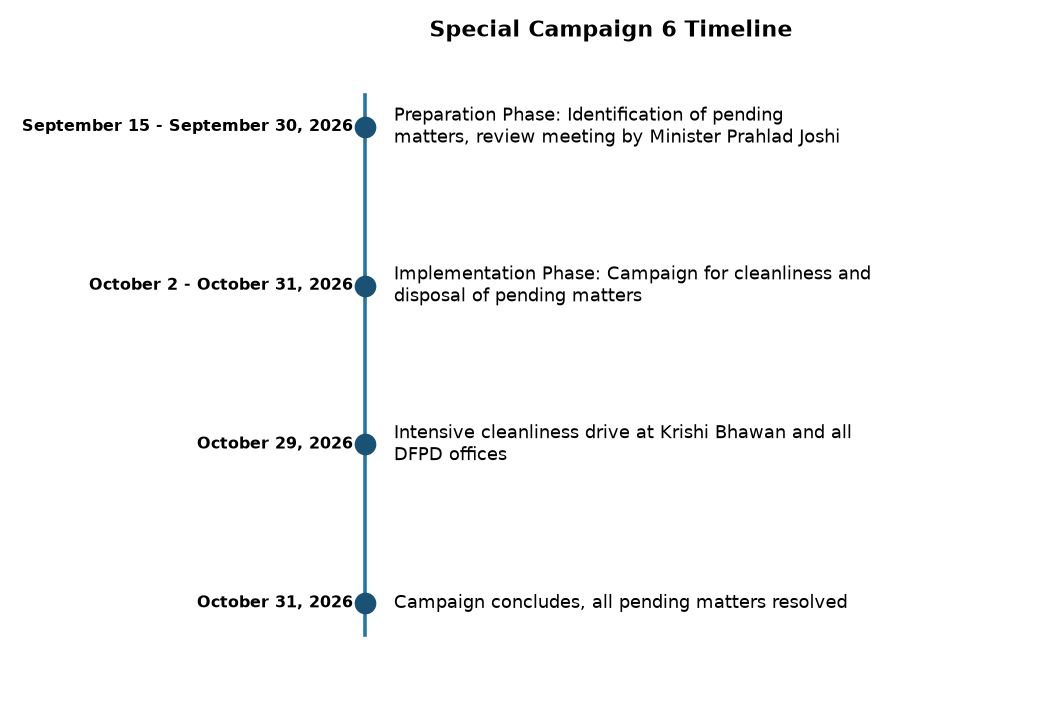
- It was executed in two distinct phases: a preparatory phase from September 15 to September 30, 2026, for identifying areas of focus, and an implementation phase from October 2 to October 31, 2026, for executing planned activities.
- Identified pending matters included references from Members of Parliament and State Governments, public grievances, appeals concerning public grievances, and the systematic weeding out of physical and e-files.
- The cleanliness component involved extensive Swachhta drives, freeing up office space, and the disposal of scrap and e-waste, generating revenue from discarded materials.
- Participating entities included the Food Corporation of India (FCI), Central Warehousing Corporation (CWC), Warehousing Development and Regulatory Authority (WDRA), National Sugar Institute (NSI, Kanpur), Indian Grain Management and Research Institute (IGMRI), Quality Control Cell (QCC), Central Grain Analysis Laboratory (CGAL), and Directorate of Sugar and Vegetable Oil (DSVO).
- The campaign’s progress and achievements were regularly updated on a dedicated portal and disseminated through public information channels, including tweets and Press Information Bureau (PIB) releases.
- The initiative underscored the government’s commitment to enhancing administrative efficiency, promoting good governance, and fostering a clean and productive work environment.
Key Features
| Feature | Significance |
|---|---|
| Special Campaign 6 | A focused initiative by the Department of Food and Public Distribution (DFPD) and its associated entities to enhance administrative efficiency and workplace hygiene. |
| Two-Phase Implementation | Comprised a preparatory phase (September 15-30, 2026) for identification of issues and an implementation phase (October 2-31, 2026) for resolution and execution, ensuring systematic approach. |
| Comprehensive Scope | Addressed a wide array of administrative matters including parliamentary references, public grievances, physical and e-file management, and extensive sanitation drives. |
| Inter-departmental Coordination | Involved DFPD’s Public Sector Undertakings (PSUs) and subordinate offices like FCI, CWC, WDRA, NSI, IGMRI, QCC, CGAL, and DSVO, demonstrating a unified governmental effort. |
| Performance Monitoring | Progress and achievements were regularly updated on a dedicated portal and disseminated through official channels like PIB releases and tweets, ensuring transparency and accountability. |
| Revenue Generation | Disposal of scrap and e-waste resulted in revenue generation, highlighting the economic aspect of efficient resource management. |
Why it Matters
Governance and Administration
- Enhances administrative efficiency by systematically addressing pending matters, thereby improving the responsiveness of government departments.
- Promotes a culture of cleanliness and orderliness within government offices, contributing to a more conducive working environment and better public perception.
- Strengthens accountability and transparency through regular monitoring and public reporting of campaign progress and achievements.
Public Service Delivery
- Expeditious resolution of public grievances and appeals directly improves citizen satisfaction and trust in government mechanisms.
- Streamlining file management, including both physical and e-files, leads to faster decision-making and more efficient service provision.
- Addresses references from Members of Parliament and State Governments, ensuring timely responses to legislative and inter-governmental communications.
Resource Management
- Optimizes utilization of office space by clearing clutter and disposing of obsolete materials, potentially reducing operational costs.
- Generates revenue from the disposal of scrap and e-waste, demonstrating prudent financial management within governmental operations.
- Encourages sustainable practices within government by promoting responsible waste management and recycling.
Challenges
1. Sustaining Momentum
- Ensuring that the improvements in administrative efficiency and cleanliness achieved during the campaign are maintained beyond the campaign period.
- Integrating the practices of timely file disposal and grievance redressal into the routine functioning of departments to prevent accumulation of pending cases.
UPSC Link: Governance, Public Administration
2. Digital Transformation Integration
- Effectively transitioning from physical file management to e-file systems, ensuring data security, accessibility, and interoperability across departments.
- Addressing challenges related to digital literacy and infrastructure in implementing comprehensive e-governance solutions for grievance redressal and file management.
UPSC Link: E-governance, Digital India
3. Behavioral Change Management
- Cultivating a permanent culture of proactive administrative hygiene and efficiency among government employees, rather than a campaign-driven approach.
- Overcoming resistance to change in established work practices and encouraging adoption of new, more efficient methodologies.
UPSC Link: Ethics in Public Administration
4. Resource Allocation and Training
- Ensuring adequate human resources and training for staff to effectively manage new systems for file disposal, grievance handling, and digital record-keeping.
- Allocating sufficient financial resources for ongoing maintenance, technology upgrades, and sustained cleanliness initiatives.
UPSC Link: Public Finance, Human Resource Management
Challenges — UPSC Perspective
| Issue | Concern |
|---|---|
| Accumulation of Pending Cases | Leads to delays in decision-making, reduced public service delivery, and potential erosion of public trust in government efficacy. |
| Inefficient File Management | Results in loss of important documents, difficulty in retrieving information, and increased administrative burden, hindering smooth operations. |
| Workplace Untidiness | Contributes to an unproductive work environment, potential health hazards, and a negative perception of governmental professionalism. |
| E-waste Management | Improper disposal of electronic waste poses environmental risks and health hazards, requiring systematic and responsible handling. |
| Lack of Continuous Monitoring | Without sustained oversight, the gains from special campaigns may be temporary, leading to a reversion to previous inefficient practices. |
| Inter-Departmental Coordination Gaps | Challenges in synchronizing efforts across various departments and their subordinate offices can impede the holistic success of such campaigns. |
Way Forward
- Institutionalize a continuous monitoring and evaluation framework for administrative efficiency and cleanliness, rather than relying solely on periodic campaigns.
- Integrate digital tools and e-governance platforms more extensively for file management and grievance redressal to enhance speed and transparency.
- Conduct regular training and capacity-building programs for government employees on modern administrative practices, digital literacy, and waste management.
- Establish clear performance indicators and accountability mechanisms for departments regarding the timely resolution of public grievances and maintenance of office hygiene.
- Promote inter-departmental collaboration and knowledge sharing of best practices in administrative reforms and cleanliness drives.
- Develop a robust policy for sustainable waste management, including e-waste, ensuring environmental compliance and resource recovery.
- Encourage citizen feedback mechanisms to continuously improve public service delivery and address administrative bottlenecks.
UPSC Value Addition
Keywords for Mains Answer-Writing
Special Campaign 6.0 · Department of Food and Public Distribution · Public grievance redressal · Office efficiency · Swachhta Abhiyan · Administrative reforms · Government accountability · Digital governance · Waste management · Record management
Concept Flow
Identification of pending administrative matters and cleanliness requirements. → Ministerial review and directive for effective implementation of the campaign. → Systematic resolution of public grievances, parliamentary references, and file management. → Execution of extensive cleanliness drives and disposal of scrap/e-waste. → Regular updating of progress on a dedicated portal and public dissemination. → Achievement of administrative efficiency, improved public service delivery, and revenue generation.
Prelims Practice Questions
Q1. Consider the following statements regarding the ‘Special Campaign 6.0’ initiated by the Department of Food and Public Distribution:
1. The campaign primarily focused on the disposal of pending matters and promoting cleanliness within office premises.
2. It was implemented in two phases: a preparatory phase and an implementation phase.
3. The campaign aimed to address public grievances, references from Members of Parliament, and state governments.
How many of the above statements are correct?
- Only one
- Only two
- Only three
- None
Answer: Only three — Statement 1 is correct as the primary objectives were disposal of pending matters and promoting cleanliness. Statement 2 is correct, as it had a preparatory phase (September 15-30, 2026) and an implementation phase (October 2-31, 2026). Statement 3 is correct, as the campaign specifically identified and addressed these categories of pending matters.
Q2. Which of the following bodies is NOT an attached/subordinate office or PSU under the Department of Food and Public Distribution (DFPD) that participated in the Special Campaign 6.0?
- Food Corporation of India (FCI)
- Central Warehousing Corporation (CWC)
- National Cooperative Development Corporation (NCDC)
- Warehousing Development and Regulatory Authority (WDRA)
Answer: National Cooperative Development Corporation (NCDC) — The National Cooperative Development Corporation (NCDC) is under the Ministry of Cooperation, not the Department of Food and Public Distribution. FCI, CWC, and WDRA are indeed under DFPD and participated in the campaign.
Mains Practice Question
✍ Examine the significance of initiatives like the ‘Special Campaign 6.0’ in enhancing administrative efficiency and public service delivery within government departments. How do such campaigns contribute to the broader goals of good governance in India? (15 Marks)
Approach: MODEL-ANSWER SKELETON:
1. Introduction: Briefly define ‘Special Campaign 6.0’ (DFPD, focus on pending matters, cleanliness, specific dates).
2. Significance for Administrative Efficiency:
a. Expedited disposal of pending cases (MP references, state references, public grievances, appeals).
b. Improved record management (physical and e-files).
c. Enhanced workplace environment and resource optimization (cleanliness, space recovery, e-waste disposal).
d. Digitalization and transparency (campaign portal, regular updates).
e. Accountability and monitoring (Ministerial review, DARP&G instructions).
3. Contribution to Good Governance:
a. Citizen-centric administration (redressal of public grievances).
b. Transparency and accountability (proactive disclosure, timely resolution).
c. Rule of Law (adherence to timelines, systematic approach).
d. Efficiency and effectiveness (optimal resource utilization, streamlined processes).
e. Participatory governance (involvement of various offices and PSUs).
f. Swachh Bharat Abhiyan principles (cleanliness as a core value).
4. Challenges/Limitations (briefly): Sustainability, institutionalization beyond campaigns, resource allocation.
5. Conclusion: Reiterate the positive impact on governance and the need for continuous efforts.
Source: PIB (Press Information Bureau)
Generated by AanyaAi for educational purpose.
Related guides on our sites
- Best PSIR optional coaching for upsc
- Best PSIR optional teacher for upsc
- Best teacher of PSIR optional for upsc
- Best PSIR optional coaching in delhi for UPSC

- DFPD’s Special Campaign 6 Concludes: Key Outcomes & Governance - November 5, 2026
- एमवाई भारत का ‘अपना वोट जानें’ अभियान: युवाओं में चुनावी जागरूकता - November 5, 2026
- Delhi’s ‘Very Poor’ AQI: UPSC & PCS Environment Update - November 5, 2026

No Comments