


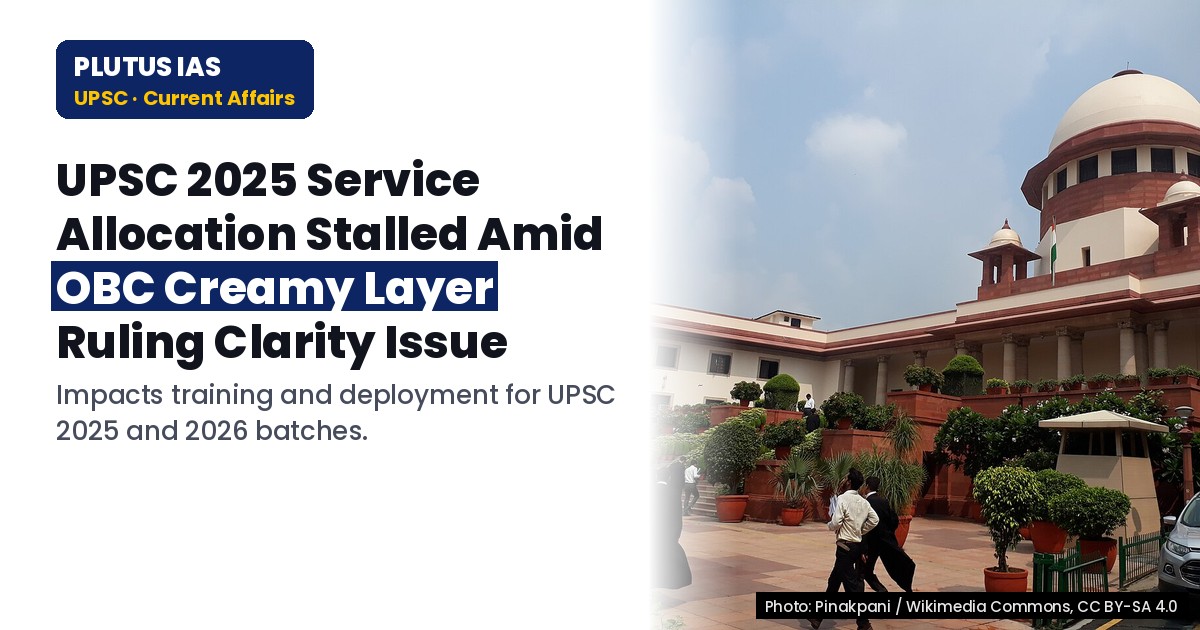
06 Nov UPSC Service Allocation Delay: OBC Creamy Layer Impact
✎ The delay in Civil Services Examination service allocation stems from ambiguity in implementing a Supreme Court ruling on the OBC 'creamy layer', which redefines exclusion criteria based on parental social status rather than…
Subject Relevance — Where This Topic Fits
- GS Paper II — Governance, Constitution, Polity, Social Justice | GS Paper IV — Ethics, Integrity, and Aptitude (Probity in Governance)
- Prelims: UPSC, Civil Services Examination (CSE), OBC Creamy Layer, Reservation Policy, Supreme Court Judgments, Department of Personnel and Training (DoPT), Foundation Course (FC), All India Services
- Essay: The Role of Judiciary in Shaping Governance and Social Justice in India, Balancing Meritocracy and Affirmative Action: Challenges in Public Service Recruitment
Quick Revision: The delay in Civil Services Examination service allocation stems from ambiguity in implementing a Supreme Court ruling on the OBC ‘creamy layer’, which redefines exclusion criteria based on parental social status rather than specific income sources.
Why is this in the news?
The allocation of services for successful candidates of the Civil Services Examination (CSE) 2025 has been significantly delayed, with eight months having passed since the final results were declared without service allocation. This unprecedented delay is primarily attributed to a lack of clarity regarding the implementation of a Supreme Court judgment, dated March 11, concerning the ‘creamy layer’ within the Other Backward Classes (OBC) category, which has complicated the finalisation of service allotments and the commencement of foundational training.
Background
- The Civil Services Examination (CSE) is conducted annually by the Union Public Service Commission (UPSC) for recruitment to various Civil Services of the Government of India, including the All India Services (IAS, IPS, IFS) and Central Group ‘A’ and ‘B’ Services.
- Following the declaration of final results, successful candidates are typically allocated services based on their rank and preferences, followed by a mandatory four-month Foundation Course (FC) at institutions like the Lal Bahadur Shastri National Academy of Administration (LBSNAA).
- The ‘creamy layer’ concept within the OBC reservation policy aims to exclude affluent individuals from the benefits of reservation, ensuring that the most deserving within the backward classes receive affirmative action.
- The Supreme Court, in its March 11 judgment, clarified that income from salaries in Public Sector Undertakings (PSUs) or the private sector, or agricultural income, should not be the sole criterion for identifying the ‘creamy layer’ among OBC candidates.
- The Court emphasised that the primary basis for identifying the ‘creamy layer’ should be the social status of the parents, rather than their income from specific sources.
- The Department of Personnel and Training (DoPT), the nodal agency for recruitment and training, sought clarification from the Supreme Court in September regarding the precise methodology for implementing this judgment, citing concerns over potential litigation from affected candidates.
What is the ‘Creamy Layer’ Concept in OBC Reservation?
- The ‘creamy layer’ refers to the relatively affluent and advanced sections within the Other Backward Classes (OBCs) who are excluded from the benefits of reservation, ensuring that affirmative action reaches the most disadvantaged within the community.
- The concept was introduced based on the recommendations of the S.R. Sinho Commission and subsequently affirmed by the Supreme Court in the landmark Indra Sawhney & Ors. v. Union of India (1992) case, commonly known as the ‘Mandal Commission case’.
- The objective is to prevent the benefits of reservation from being monopolised by a few privileged individuals or families within the OBC category, thereby promoting equitable distribution of opportunities.
- Criteria for identifying the ‘creamy layer’ generally include factors such as income, occupational status, and possession of certain assets, though the precise definitions and thresholds have been subject to review and judicial interpretation.
- The Department of Personnel and Training (DoPT) is responsible for issuing guidelines and clarifications regarding the identification of the ‘creamy layer’ for central government services and admissions to educational institutions.
- The recent Supreme Court judgment has sought to refine the criteria, particularly concerning the inclusion of salary income from PSUs/private sector and agricultural income, by emphasising the social status of parents as a primary determinant.
- Exclusion from the ‘creamy layer’ is a prerequisite for OBC candidates to avail reservation benefits in central government jobs and higher education.
Key Features
| Feature | Significance |
|---|---|
| Delayed Service Allocation | Eight-month delay in allocating services to successful UPSC CSE 2025 candidates, impacting career progression and administrative planning. |
| Impact on Foundation Course (FC) | Postponement of the mandatory Foundation Course, crucial for imparting essential skills and fostering inter-service camaraderie among new recruits. |
| Supreme Court Ruling on OBC Creamy Layer | The 11th March Supreme Court decision regarding the exclusion criteria for OBC creamy layer, specifically concerning income from Public Sector Undertakings (PSUs), private sector employment, or agriculture. |
| Uncertainty for Future Batches | Potential disruption to the training and deployment schedules for subsequent batches of All India Services, including IAS, IPS, IFS, and other Group-A services. |
| DoPT’s Apprehension | The Department of Personnel and Training’s concern regarding potential litigation from new OBC successful candidates if the Supreme Court’s 11th March ruling is implemented without clear guidelines. |
Why it Matters
Administrative Efficiency
- The delay in service allocation and commencement of foundational training directly impedes the timely induction of new officers into the administrative machinery, potentially affecting governance and policy implementation.
- Disruption to the structured training schedule, including the Foundation Course and subsequent professional training phases, can compromise the preparedness and operational readiness of civil servants.
Social Justice and Equity
- The Supreme Court’s clarification on the ‘creamy layer’ criteria for OBC reservation aims to ensure that the benefits of affirmative action reach the genuinely disadvantaged sections, preventing their appropriation by the affluent within the reserved categories.
- Clarity in implementing reservation policies is crucial for upholding the constitutional mandate of social justice and ensuring fair opportunities for all eligible candidates.
Legal and Policy Framework
- The ongoing legal ambiguity surrounding the Supreme Court’s judgment necessitates a clear policy directive from the government to ensure consistent and legally sound implementation of reservation norms.
- The situation highlights the intricate interplay between judicial pronouncements and executive action in shaping public policy, particularly in sensitive areas like reservations.
Challenges
1. Judicial Interpretation and Implementation
- Lack of clarity in implementing the Supreme Court’s 11th March ruling on OBC ‘creamy layer’ criteria, specifically regarding income from PSUs, private sector, and agriculture.
- The need for a definitive interpretation to avoid potential misapplication and subsequent legal challenges.
UPSC Link: GS-II: Government policies and interventions
2. Impact on Civil Service Training
- Delay in commencing the Foundation Course, which is vital for instilling administrative ethos, developing essential skills, and fostering inter-service cohesion.
- Disruption to the entire training cycle, including Phase-I professional training, district training, and Phase-II, affecting the readiness of new officers.
UPSC Link: GS-II: Role of Civil Services in a Democracy
3. Administrative Uncertainty and Morale
- Prolonged uncertainty for successful candidates of CSE 2025 regarding their service allocation and training commencement, potentially impacting morale and future planning.
- Risk of cascading delays affecting subsequent batches and the overall recruitment calendar of the Union Public Service Commission.
UPSC Link: GS-II: Governance, Administration
4. Risk of Litigation
- Apprehension within the Department of Personnel and Training (DoPT) regarding potential lawsuits from new OBC successful candidates if the Supreme Court’s judgment is implemented without clear, universally accepted guidelines.
- The need for a robust legal framework to mitigate future legal challenges and ensure policy stability.
UPSC Link: GS-II: Judiciary, Government policies
Challenges — UPSC Perspective
| Issue | Concern |
|---|---|
| OBC Creamy Layer Definition | Ambiguity in applying the Supreme Court’s ruling on income sources (PSU, private sector, agriculture) for creamy layer exclusion, leading to implementation paralysis. |
| Service Allocation Delay | Eight-month delay for CSE 2025 candidates, impacting their career commencement and the government’s ability to fill critical administrative positions. |
| Foundation Course Postponement | Non-commencement of essential foundational training, hindering skill development and inter-service integration among probationers. |
| Training Schedule Disruption | Potential ripple effect on subsequent training modules (Phase-I, district training, Phase-II) and the ultimate deployment of officers to their respective cadres. |
| Legal Vulnerability | Government’s fear of fresh litigation from OBC candidates if the Supreme Court’s directives are not implemented with absolute clarity and legal certainty. |
| Impact on Future Batches | The current delay could disrupt the training and deployment timelines for the CSE 2026 batch and beyond, creating a systemic backlog. |
Way Forward
- Seek immediate clarification from the Supreme Court on the precise application of its 11th March judgment concerning OBC creamy layer criteria, particularly regarding income from PSUs, private sector, and agriculture.
- Convene an inter-ministerial committee involving DoPT, Ministry of Social Justice and Empowerment, and legal experts to formulate clear guidelines for implementing the Supreme Court’s ruling.
- Expedite the service allocation process for CSE 2025 successful candidates based on a provisional framework, subject to final clarity on the creamy layer issue, to mitigate further delays.
- Initiate the Foundation Course for CSE 2025 batch promptly, potentially with a contingency plan for any adjustments necessitated by future legal clarifications.
- Develop a robust legal strategy to address potential litigation, ensuring that any policy implementation is legally sound and minimizes future challenges.
- Establish a transparent communication channel with successful candidates to keep them informed about the progress and expected timelines.
- Review and streamline the overall recruitment and training calendar for civil services to build resilience against unforeseen delays and legal challenges.
UPSC Value Addition
Keywords for Mains Answer-Writing
OBC creamy layer · Supreme Court judgment · Civil Services Examination · Service allocation delay · Foundation Course training · DoPT · All India Services · Reservation policy · Judicial interpretation · Administrative efficiency
Constitutional & Policy Linkages
- {‘article’: ‘Article 16’, ‘note’: ‘Equality of opportunity in public employment’}
- {‘article’: ‘Article 335’, ‘note’: ‘Claims of SCs and STs to services’}
Concept Flow
Supreme Court ruling on OBC creamy layer → Lack of clarity in implementation by DoPT → Delay in service allocation for CSE 2025 → Postponement of Foundation Course (FC) → Disruption to civil service training schedule → Uncertainty for new recruits and future batches
Prelims Practice Questions
Q1. Consider the following statements regarding the ‘creamy layer’ concept in Other Backward Classes (OBC) reservation:
1. The creamy layer criterion aims to exclude affluent individuals from OBC reservation benefits.
2. Income from salaries and agricultural land is generally excluded when determining the creamy layer status for OBCs.
3. The Supreme Court has consistently held that social backwardness, not merely economic status, should be the primary determinant for OBC reservation eligibility.
How many of the above statements are correct?
- Only one
- Only two
- Only three
- None
Answer: Only three — Statement 1 is correct: The creamy layer concept, introduced by the Supreme Court, seeks to ensure that reservation benefits reach the most deserving among the backward classes by excluding those who have achieved a certain level of economic and social advancement. Statement 2 is correct: As per existing government guidelines and Supreme Court pronouncements, income from salaries and agricultural land is typically not considered for determining the creamy layer status for OBCs. Statement 3 is incorrect: While social backwardness is crucial, the Supreme Court’s stance has evolved, and recent judgments, including the one mentioned in the news, have emphasized that income from certain sources (like salary and agriculture) should not be the sole basis for exclusion, implying a more nuanced approach to social and economic status.
Q2. Which of the following bodies is the nodal agency of the Government of India for recruitment, training, and cadre management of All India Services and Central Services?
- Union Public Service Commission (UPSC)
- Ministry of Home Affairs (MHA)
- Department of Personnel and Training (DoPT)
- Cabinet Secretariat
Answer: Department of Personnel and Training (DoPT) — The Department of Personnel and Training (DoPT) is the nodal agency under the Ministry of Personnel, Public Grievances and Pensions, responsible for personnel management, including recruitment, training, and cadre control of the All India Services and Central Services. UPSC is a constitutional body responsible for conducting examinations, while MHA deals with internal security and policing, and the Cabinet Secretariat assists the Cabinet.
Mains Practice Question
✍ Examine the implications of judicial pronouncements on the implementation of reservation policies in India, with particular reference to the ‘creamy layer’ concept for Other Backward Classes (OBCs). Discuss the administrative challenges that arise from such interpretations. (15 Marks)
Approach: INTRODUCTION: Briefly define reservation policy and the ‘creamy layer’ concept for OBCs. BODY PART 1: Examine the implications of judicial pronouncements. Mention key Supreme Court judgments (e.g., Indra Sawhney case, recent judgments on creamy layer income exclusion). Discuss how these judgments refine the scope of reservation, ensure equity, and prevent ‘reverse discrimination’. Highlight the principle of ‘social backwardness’ as the primary criterion. BODY PART 2: Discuss administrative challenges. Focus on the practical difficulties in implementing complex judicial interpretations, such as defining and verifying ‘creamy layer’ criteria, potential for litigation, delays in service allocation and training, and the need for clear guidelines from nodal agencies like DoPT. CONCLUSION: Offer a balanced perspective on the role of judiciary in upholding constitutional principles and the need for administrative clarity and efficiency in policy implementation.
Source: hindi.theprint.in
Generated by AanyaAi for educational purpose.
Related guides on our sites
- Current affairs for upsc 2026
- Best sociology optional coaching for upsc
- Which is best sociology optional coaching for upsc
- Best teacher of sociology optional for upsc

- DARE-ICAR Special Campaign 6.0: Governance & Cleanliness - November 6, 2026
- ओबीसी क्रीमी लेयर: सुप्रीम कोर्ट ने केंद्र की अर्जी खारिज की - November 6, 2026
- UPSC Service Allocation Delay: OBC Creamy Layer Impact - November 6, 2026

No Comments