


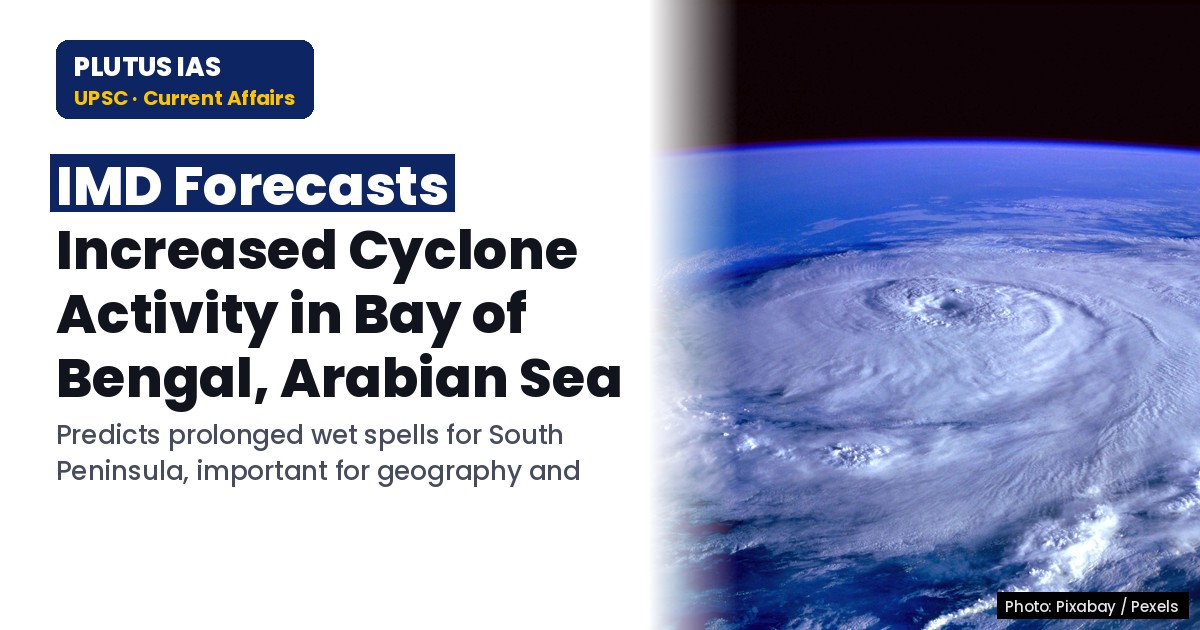
07 Nov IMD Forecasts Cyclone Activity in Bay of Bengal, Arabian Sea
✎ Tropical cyclones are intense low-pressure systems forming over warm tropical oceans, with the Bay of Bengal and Arabian Sea being significant basins for India, necessitating robust forecasting by IMD and comprehensive disaster…
Subject Relevance — Where This Topic Fits
- GS Paper I — Climatology, Important Geophysical Phenomena | GS Paper III — Disaster Management, Environmental Degradation
- Prelims: Tropical Cyclones, Bay of Bengal, Arabian Sea, India Meteorological Department (IMD), Cyclone formation conditions, Disaster preparedness
- Essay: The increasing frequency and intensity of extreme weather events: Challenges and solutions for India, Technological advancements in disaster management and their role in mitigating climate change impacts
Quick Revision: Tropical cyclones are intense low-pressure systems forming over warm tropical oceans, with the Bay of Bengal and Arabian Sea being significant basins for India, necessitating robust forecasting by IMD and comprehensive disaster management strategies.
Why is this in the news?
The reported signs of renewed tropical storm/cyclone activity over the Bay of Bengal and the Arabian Sea, supported by global weather models, suggest a prolonged spell of heavy rainfall and potential cyclonic development, particularly impacting the South Peninsula of India, necessitating heightened vigilance and preparedness.
Background
- Tropical cyclones are intense low-pressure systems originating over warm tropical oceans, characterised by strong winds and heavy rainfall.
- The North Indian Ocean basin, comprising the Bay of Bengal and the Arabian Sea, is one of the six major cyclone-forming regions globally.
- The post-monsoon season (October-December) is a period of increased cyclonic activity in this basin, alongside the pre-monsoon season (April-June).
- The Bay of Bengal experiences a higher frequency and intensity of cyclones compared to the Arabian Sea, primarily due to warmer sea surface temperatures and specific atmospheric circulation patterns.
- India’s extensive coastline is highly vulnerable to tropical cyclones, leading to significant socio-economic impacts and necessitating robust disaster management frameworks.
- The India Meteorological Department (IMD) is the primary agency responsible for meteorological observations, weather forecasting, and seismology in India, including cyclone warnings.
Understanding Tropical Cyclones and India’s Preparedness
- Tropical cyclones form under specific conditions: sea surface temperatures above 26.5°C, sufficient Coriolis force, low vertical wind shear, pre-existing weak low-pressure area or disturbance, and upper-level divergence.
- The IMD classifies cyclones based on maximum sustained surface wind speed, ranging from ‘Depression’ (17-27 knots) to ‘Super Cyclonic Storm’ (120 knots or more).
- Cyclone warnings are issued in multiple stages, starting with ‘Pre-Cyclone Watch’ and progressing to ‘Cyclone Alert’, ‘Cyclone Warning’, and ‘Post-landfall Outlook’, providing crucial time for disaster response.
- The National Disaster Management Authority (NDMA) and State Disaster Management Authorities (SDMAs) are responsible for coordinating disaster response and mitigation efforts, including cyclone preparedness.
- Technological advancements, such as satellite imagery, Doppler weather radars, and numerical weather prediction models, have significantly improved cyclone forecasting accuracy and lead time.
- Community-based disaster preparedness, including early warning dissemination, evacuation drills, and construction of cyclone shelters, plays a vital role in reducing human casualties and property damage.
- Climate change is projected to influence tropical cyclone characteristics, potentially leading to an increase in the intensity of cyclones, changes in their tracks, and enhanced rainfall, posing new challenges for coastal communities.
Key Features
| Feature | Significance |
|---|---|
| Renewed Tropical Storm/Cyclone Activity | Indicates the potential for the formation of low-pressure systems, depressions, or cyclones in the Bay of Bengal and Arabian Sea, impacting coastal regions. |
| Prolonged Rainfall Spell | Forecasted for parts of the South Peninsula, suggesting extended periods of precipitation, potentially leading to waterlogging or localized flooding. |
| Isolated Heavy Rainfall | Specific regions like Coastal Andhra Pradesh, Yanam, Tamil Nadu, Puducherry, Karaikal, Keralam, and Mahe are expected to receive intense, localized downpours. |
| Widespread Rain Belt | The expansive nature of the rain belt implies that multiple states and union territories in South India will experience varying degrees of rainfall. |
| Associated Weather Phenomena | Thunderstorms, lightning, and gusty winds are predicted to accompany the rainfall, increasing the risk of damage and disruption. |
| Global Model Forecasts | The convergence of predictions from global models and the India Meteorological Department (IMD) enhances the reliability of the weather outlook. |
Why it Matters
Disaster Management and Preparedness
- The forecast of potential cyclonic activity and heavy rainfall necessitates proactive disaster preparedness measures by state and central agencies.
- Early warnings from IMD are crucial for activating emergency response protocols, including evacuation plans and resource pre-positioning.
- Enhances the importance of robust infrastructure and resilient housing in coastal and flood-prone areas to mitigate damage.
Agriculture and Livelihoods
- Excessive rainfall and cyclonic events can severely impact agricultural crops, leading to yield losses and economic hardship for farmers.
- Fisherfolk are directly affected by adverse sea conditions, impacting their livelihoods and requiring restrictions on fishing activities.
- The timing and intensity of rainfall are critical for rain-fed agriculture, with both deficits and excesses posing significant challenges.
Infrastructure and Public Services
- Heavy rainfall and strong winds can disrupt transportation networks, including roads, railways, and air travel, affecting connectivity.
- Potential for power outages due to damage to electrical infrastructure, impacting essential services and daily life.
- Ensuring the continuity of public services such as healthcare, sanitation, and communication becomes paramount during extreme weather events.
Climate Change Implications
- The increasing frequency and intensity of extreme weather events, including cyclones and heavy rainfall, are consistent with projections of climate change.
- Highlights the need for long-term climate adaptation strategies and investments in climate-resilient development.
- Emphasizes the role of scientific research and advanced meteorological forecasting in understanding and responding to evolving weather patterns.
Challenges
1. Accurate Forecasting and Dissemination
- Despite advancements, precise prediction of cyclone intensity, track, and landfall remains a challenge, impacting preparedness.
- Ensuring timely and effective dissemination of warnings to the last mile, especially in remote or vulnerable communities, is critical.
UPSC Link: Disaster Management
2. Infrastructure Vulnerability
- Existing infrastructure in coastal regions may not be adequately resilient to withstand severe cyclonic winds, storm surges, and heavy rainfall.
- Damage to roads, bridges, power lines, and communication networks can impede relief efforts and recovery.
UPSC Link: Infrastructure; Disaster Management
3. Agricultural and Economic Losses
- Crop damage, livestock losses, and disruption to fishing activities can lead to significant economic setbacks for affected populations.
- Rehabilitation and compensation mechanisms need to be robust and efficient to support recovery.
UPSC Link: Agriculture; Economy; Disaster Management
4. Public Awareness and Compliance
- Ensuring that the public understands the risks and complies with evacuation orders or safety advisories can be challenging.
- Misinformation or complacency can hinder effective response efforts.
UPSC Link: Disaster Management; Governance
5. Resource Mobilization and Coordination
- Mobilizing adequate resources, including personnel, equipment, and relief materials, in a timely manner can be complex.
- Effective coordination among various government agencies, NGOs, and local communities is essential for integrated response.
UPSC Link: Disaster Management; Governance
Challenges — UPSC Perspective
| Issue | Concern |
|---|---|
| Forecasting Accuracy | Difficulty in precisely predicting the genesis, intensification, and trajectory of tropical cyclones, leading to potential under or over-preparation. |
| Coastal Vulnerability | High population density and critical infrastructure along coastlines are susceptible to storm surges, high winds, and inundation. |
| Agricultural Impact | Extensive damage to standing crops and agricultural land due to heavy rainfall and flooding, affecting food security and farmer incomes. |
| Disruption of Livelihoods | Fisherfolk and other coastal communities face immediate loss of income and damage to assets during severe weather events. |
| Infrastructure Damage | Roads, power grids, communication networks, and housing are vulnerable to damage, hindering relief operations and long-term recovery. |
| Public Health Risks | Increased risk of water-borne diseases, vector-borne diseases, and injuries in the aftermath of floods and storms. |
Government Initiatives — Must-Memorise for Prelims
- National Cyclone Risk Mitigation Project (NCRMP)
- National Disaster Response Fund (NDRF)
- State Disaster Response Fund (SDRF)
- Integrated Coastal Zone Management (ICZM) Project
Way Forward
- Enhance the capabilities of the India Meteorological Department (IMD) through advanced satellite technology, radar systems, and computational models for improved forecasting accuracy.
- Strengthen early warning dissemination mechanisms, including multi-channel communication systems (SMS, radio, TV, social media), to reach all vulnerable populations promptly.
- Invest in climate-resilient infrastructure development in coastal and flood-prone areas, including cyclone shelters, elevated roads, and robust drainage systems.
- Promote community-based disaster preparedness programs, focusing on training local volunteers, conducting regular drills, and establishing local emergency response teams.
- Implement sustainable agricultural practices that are resilient to extreme weather events, such as crop diversification, drought-resistant varieties, and improved irrigation techniques.
- Develop comprehensive post-disaster recovery and rehabilitation plans, ensuring timely financial assistance, psychological support, and livelihood restoration for affected communities.
- Integrate climate change adaptation strategies into urban and rural planning, considering future projections of sea-level rise and increased frequency of extreme weather events.
- Foster inter-agency coordination and collaboration among central, state, and local governments, as well as NGOs and international organizations, for effective disaster management.
UPSC Value Addition
Keywords for Mains Answer-Writing
Tropical cyclones · Bay of Bengal · Arabian Sea · India Meteorological Department (IMD) · Monsoon patterns · Climate change impacts · Disaster management · Early warning systems · Coastal vulnerability · Weather forecasting models · South Peninsula rainfall · Cyclogenesis
Constitutional & Policy Linkages
- Article 246: Distribution of legislative powers (Union List, State List, Concurrent List for disaster management)
- Seventh Schedule: Entry 23 (Social security and social insurance), Entry 56 (Inter-State rivers), Entry 6 (Public health and sanitation)
- Article 282: Union and States may make grants for public purposes (including disaster relief)
- Article 355: Duty of the Union to protect States against external aggression and internal disturbance (implicitly includes natural disasters)
Concept Flow
Oceanic Warming and Atmospheric Conditions → Formation of Low-Pressure Systems → Intensification into Tropical Storms/Cyclones → Heavy Rainfall and Associated Weather → Impact on Coastal and Inland Regions → Disaster Management and Response → Recovery and Rehabilitation Efforts
Prelims Practice Questions
Q1. Consider the following statements regarding tropical cyclones in the North Indian Ocean:
1. Tropical cyclones generally form over warm ocean waters with sea surface temperatures of at least 26.5°C.
2. The Bay of Bengal experiences fewer tropical cyclones compared to the Arabian Sea due to its geographical characteristics.
3. The India Meteorological Department (IMD) is the nodal agency for cyclone forecasting and warning in India.
How many of the above statements are correct?
- Only one
- Only two
- Only three
- None
Answer: Only two — Statement 1 is correct. Warm sea surface temperatures are a crucial prerequisite for tropical cyclone formation. Statement 2 is incorrect. The Bay of Bengal is historically more prone to tropical cyclones than the Arabian Sea, accounting for a higher number and intensity of systems. Statement 3 is correct. IMD is indeed the designated nodal agency for meteorological services, including cyclone forecasting and warning, in India.
Q2. Which of the following conditions is NOT essential for the formation of a tropical cyclone?
- Large ocean area with sea surface temperature higher than 26.5°C.
- Presence of Coriolis force.
- Pre-existing low-pressure area or disturbance.
- Strong vertical wind shear.
Answer: Strong vertical wind shear. — Strong vertical wind shear is detrimental to tropical cyclone formation and intensification, as it tends to tear apart the vertical structure of the storm. The other three conditions are essential for cyclogenesis.
Q3. Assertion (A): The India Meteorological Department (IMD) utilizes various global weather models for its cyclone forecasts.
Reason (R): Integrating data from multiple global models enhances the accuracy and reliability of tropical cyclone predictions.
- Both A and R are true and R is the correct explanation of A.
- Both A and R are true but R is not the correct explanation of A.
- A is true but R is false.
- A is false but R is true.
Answer: Both A and R are true and R is the correct explanation of A. — Assertion (A) is true as IMD indeed incorporates inputs from various global models. Reason (R) is also true, as combining different model outputs helps in reducing uncertainties and improving the overall forecast skill, thereby making R the correct explanation of A.
Mains Practice Question
✍ Examine the factors contributing to the increased frequency and intensity of tropical cyclones in the Bay of Bengal and Arabian Sea in recent decades. Discuss the challenges faced by India in managing the escalating risks associated with these extreme weather events. (15 Marks)
Approach: The answer should first identify and explain the key factors driving the observed changes in cyclone activity, such as rising sea surface temperatures, ocean heat content, and altered monsoon patterns, linking them to climate change. The second part should delve into the multifaceted challenges in disaster management, including limitations in early warning systems for rapid intensification, coastal zone management issues, infrastructure vulnerability, displacement and rehabilitation, and the need for enhanced community resilience. Specific examples of recent cyclones or policy initiatives could be cited to substantiate arguments. The discussion should also touch upon the role of IMD and NDMA.
Source: BusinessLine
Generated by AanyaAi for educational purpose.
Related guides on our sites
- Best geography optional coaching
- Best geography optional coaching
- Best geography optional teacher
- Best geography optional teacher

- IMD Forecasts Cyclone Activity in Bay of Bengal, Arabian Sea - November 7, 2026
- आरबीआई के नए स्वर्ण ऋण नियम: पात्रता, मूल्यांकन और चुकौती में बदलाव - November 7, 2026
- Karnataka HC: ED Not ‘Super Cop’, PMLA Powers Derivative - November 7, 2026

No Comments