


08 Nov Strait of Hormuz & Gulf of Oman Incidents: UPSC Geography
✎ The Strait of Hormuz is a critical global maritime chokepoint for oil and gas transit, frequently impacted by geopolitical tensions and naval operations, underscoring its pivotal role in international energy security.
Subject Relevance — Where This Topic Fits
- GS Paper II — International Relations | GS Paper III — Economy, Security Challenges
- Prelims: Strait of Hormuz, Gulf of Oman, IRGC, CENTCOM, Naval Blockade, Maritime Chokepoints, UNCLOS
- Essay: Geopolitical Dynamics of Maritime Trade Routes, Impact of Regional Conflicts on Global Energy Security
Quick Revision: The Strait of Hormuz is a critical global maritime chokepoint for oil and gas transit, frequently impacted by geopolitical tensions and naval operations, underscoring its pivotal role in international energy security.
Why is this in the news?
Recent incidents involving oil tankers in the Strait of Hormuz and a commercial vessel in the Gulf of Oman have highlighted escalating maritime tensions. The Islamic Revolutionary Guard Corps (IRGC) reported two tankers hitting naval mines in the Strait of Hormuz, while US Central Command (CENTCOM) confirmed disabling a vessel in the Gulf of Oman for violating a naval blockade against Iran. These events underscore the critical importance of these waterways for global trade and energy security, amidst ongoing geopolitical rivalries and enforcement of international sanctions.
Background
- The Strait of Hormuz is a strategically vital waterway connecting the Persian Gulf to the Arabian Sea and the broader Indian Ocean.
- Approximately one-fifth of the world’s total oil consumption and a significant portion of global liquefied natural gas (LNG) transits through this strait.
- The United States has imposed a naval blockade against Iran, citing various geopolitical and security concerns.
- Iran has asserted its right to control passage through certain routes in the Strait of Hormuz, particularly for vessels deemed to be cooperating with adversarial forces.
- Previous incidents in the region have included attacks on oil tankers, seizures of vessels, and heightened military patrols by various naval forces.
- International maritime law, particularly the United Nations Convention on the Law of the Sea (UNCLOS), governs navigation rights and responsibilities in such international straits.
The Strait of Hormuz and its Geopolitical Significance
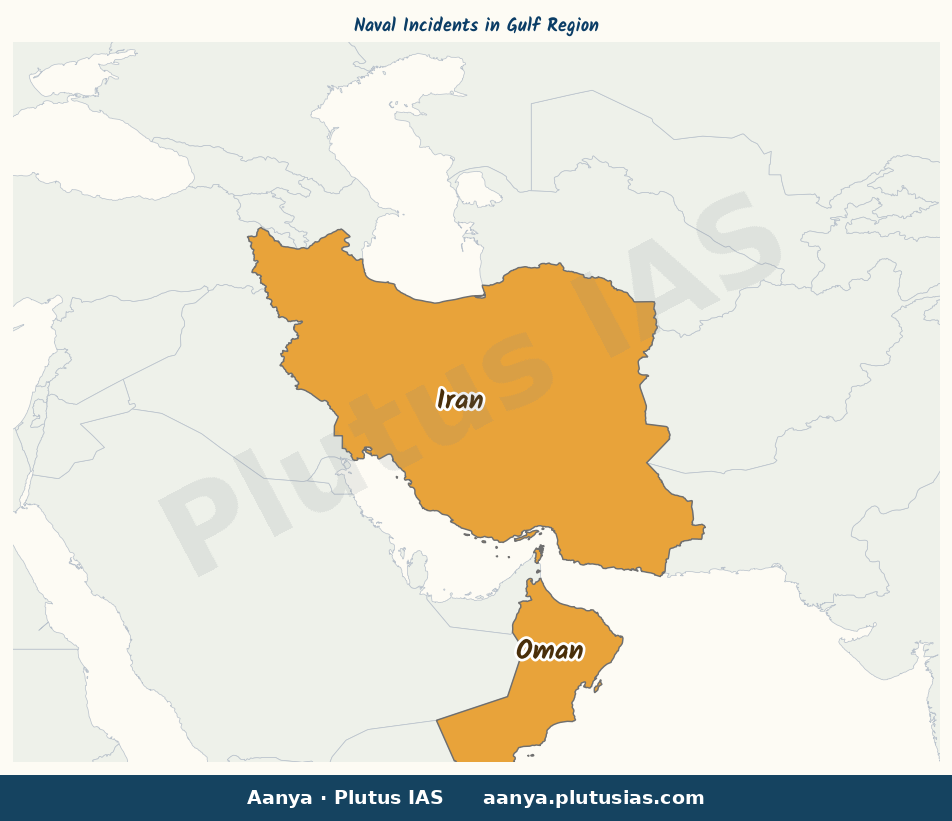
- The Strait of Hormuz is a narrow sea passage, approximately 39 kilometres wide at its narrowest point, separating Iran from the United Arab Emirates and Oman.
- It serves as the sole maritime outlet from the Persian Gulf for oil-exporting countries such as Saudi Arabia, Iran, Iraq, Kuwait, Qatar, and the UAE.
- The strait is considered one of the world’s most critical maritime chokepoints, essential for global energy supply chains.
- Its strategic importance makes it a frequent flashpoint for geopolitical tensions and military confrontations, particularly between Iran and Western powers.
- The United Nations Convention on the Law of the Sea (UNCLOS) establishes the right of transit passage through international straits, allowing continuous and expeditious navigation.
- Naval blockades, while a tool of statecraft, are subject to international law and can have significant implications for freedom of navigation and global trade.
- The Gulf of Oman, located outside the Strait of Hormuz, is also a critical maritime area, serving as a gateway to the Arabian Sea and the Indian Ocean.
- Incidents in these waters directly impact global crude oil prices, insurance premiums for shipping, and overall maritime security.
- The Islamic Revolutionary Guard Corps (IRGC) is a major military, political, and economic force in Iran, operating its own naval forces in the Persian Gulf and Strait of Hormuz.
- US Central Command (CENTCOM) is a unified combatant command of the U.S. armed forces responsible for security interests in a vast area including the Middle East, Central Asia, and parts of South Asia.
Key Features
| Feature | Significance |
|---|---|
| Strait of Hormuz | A critical chokepoint for global oil transit, connecting the Persian Gulf to the Arabian Sea and beyond. |
| Naval Mines | Weaponry deployed to deny access or inflict damage on vessels, posing significant risks to maritime navigation and international trade. |
| Naval Blockade | A military tactic to prevent goods or personnel from entering or leaving an area, often used to enforce sanctions or exert pressure. |
| Freedom of Navigation | A principle of international law asserting that vessels have the right to travel through international waters without impediment. |
| Unauthorised Routes | Designated maritime passages that deviate from established international shipping lanes, potentially indicating attempts to circumvent regulations or surveillance. |
Why it Matters
Geopolitical Significance
- The Strait of Hormuz is a vital maritime chokepoint, through which a substantial portion of the world’s seaborne oil passes, making any disruption a matter of international concern.
- Incidents in this region can escalate regional tensions, potentially drawing in multiple international actors and impacting global security dynamics.
- The interplay of naval blockades and freedom of navigation assertions highlights the complex legal and strategic challenges in international waters.
Economic Implications
- Disruptions to shipping in the Strait of Hormuz can lead to increased insurance premiums for vessels, higher shipping costs, and potential delays in energy supplies.
- Any perceived threat to oil transit routes can cause volatility in global crude oil prices, affecting energy-importing nations like India.
- The use of naval mines and the disabling of commercial vessels introduce significant risks to maritime trade, potentially impacting global supply chains.
International Law and Maritime Security
- The incidents raise questions regarding the application of international maritime law, including the United Nations Convention on the Law of the Sea (UNCLOS), concerning innocent passage and freedom of navigation.
- The deployment of naval mines and the enforcement of blockades by state actors in international waterways present challenges to established norms of maritime security and international commerce.
- The actions of naval forces, such as disabling vessels, necessitate careful consideration of the principles of proportionality and the protection of civilian shipping.
Challenges
1. Maintaining Freedom of Navigation
- Ensuring unimpeded passage for commercial vessels through international straits, particularly critical chokepoints like the Strait of Hormuz, is crucial for global trade and energy security.
- The presence of naval mines and the enforcement of blockades by state actors pose direct threats to the principle of freedom of navigation, as enshrined in international maritime law.
UPSC Link: International Relations; Maritime Security
2. De-escalation of Regional Tensions
- The incidents reflect heightened geopolitical tensions in the Persian Gulf region, necessitating diplomatic efforts to prevent further escalation and ensure regional stability.
- The risk of miscalculation or accidental engagement between naval forces operating in close proximity remains a significant concern.
UPSC Link: International Relations; Conflict Resolution
3. Protection of Global Energy Supply Chains
- Disruptions in the Strait of Hormuz directly threaten the stability of global oil markets and the energy security of nations heavily reliant on imported crude oil.
- Ensuring the safe passage of oil tankers is paramount for maintaining predictable energy supplies and mitigating economic shocks.
UPSC Link: Economy; Energy Security
4. Adherence to International Maritime Law
- The actions of state and non-state actors in deploying mines or enforcing blockades must strictly adhere to the provisions of international law, including UNCLOS.
- Clarification and consensus on the legality of certain actions in international waters are essential to prevent arbitrary interpretations and ensure predictable maritime conduct.
UPSC Link: International Law; Maritime Governance
Challenges — UPSC Perspective
| Issue | Concern |
|---|---|
| Naval Mine Incidents | Direct threat to commercial shipping, potential for environmental damage, and risk of escalating military confrontation. |
| Unauthorised Routes and Navigation Systems | Circumvention of international maritime regulations, hindering transparency and increasing risks of accidents or illicit activities. |
| Naval Blockades | Infringement on freedom of navigation, potential for humanitarian impact, and violation of international trade norms. |
| Targeting of Commercial Vessels | Risk to civilian lives and property, disruption of global supply chains, and erosion of trust in maritime security. |
| Regional Military Buildup | Increased potential for miscalculation, accidental conflict, and a general destabilisation of the geopolitical environment. |
Way Forward
- Promote diplomatic dialogue among regional and international stakeholders to de-escalate tensions and foster a cooperative security framework for the Persian Gulf.
- Reinforce adherence to international maritime law, particularly UNCLOS, to ensure freedom of navigation and the safe passage of commercial vessels through critical waterways.
- Strengthen international cooperation on maritime security, including intelligence sharing and coordinated patrols, to deter illicit activities and enhance safety.
- Establish clear communication channels and de-confliction mechanisms between naval forces operating in the region to prevent accidental encounters and reduce the risk of escalation.
- Invest in alternative energy sources and diversify supply routes to reduce global reliance on single chokepoints and enhance energy security resilience.
- Support international efforts to clear naval mines and other hazards from shipping lanes, ensuring the unimpeded flow of maritime commerce.
- Encourage transparency in maritime activities, including the consistent use of navigation and GPS systems by all commercial vessels, to enhance safety and accountability.
UPSC Value Addition
Keywords for Mains Answer-Writing
Strait of Hormuz · Maritime Security · International Shipping Lanes · Naval Blockade · Freedom of Navigation · Geopolitical Chokepoints · Energy Security · UNCLOS · Law of the Sea · Regional Stability
Concept Flow
Geopolitical tensions escalate in a maritime region. → Naval forces deploy mines and enforce blockades. → Commercial vessels are impacted, either by mines or interdiction. → Freedom of navigation is challenged, and maritime trade is disrupted. → Global energy security and supply chains face uncertainty. → International calls for de-escalation and adherence to maritime law emerge.
Prelims Practice Questions
Q1. Consider the following statements regarding the Strait of Hormuz:
1. It is a strategically vital waterway connecting the Persian Gulf with the Arabian Sea and the Indian Ocean.
2. Approximately one-fifth of the world’s total oil consumption passes through this strait.
3. The strait is bordered by Iran to the north and Oman and the United Arab Emirates to the south.
How many of the above statements are correct?
- Only one
- Only two
- Only three
- None
Answer: Only three — Statement 1 is correct: The Strait of Hormuz is indeed a crucial maritime chokepoint linking the Persian Gulf to the Arabian Sea and the broader Indian Ocean, facilitating global trade and energy transit. Statement 2 is correct: It is estimated that a significant portion, roughly one-fifth, of global oil consumption is transported through the Strait of Hormuz, underscoring its importance for energy security. Statement 3 is incorrect: The strait is bordered by Iran to the north and Oman’s Musandam Governorate (an exclave) to the south, not the entire UAE.
Q2. Which of the following international legal frameworks primarily governs the rights and responsibilities of nations with respect to their use of the world’s oceans, including navigation through straits?
- The Geneva Conventions
- The Kyoto Protocol
- The United Nations Convention on the Law of the Sea (UNCLOS)
- The Treaty on the Non-Proliferation of Nuclear Weapons (NPT)
Answer: The United Nations Convention on the Law of the Sea (UNCLOS) — The United Nations Convention on the Law of the Sea (UNCLOS) is the primary international treaty that establishes a comprehensive legal regime for the world’s oceans and seas. It defines coastal states’ rights and duties, including those related to navigation through international straits.
Mains Practice Question
✍ Examine the geopolitical significance of the Strait of Hormuz in the context of international energy security and maritime trade. Discuss the implications of recent maritime incidents in such strategic chokepoints for global stability. (15 Marks)
Approach: The answer should first delineate the geopolitical significance of the Strait of Hormuz, detailing its role as a critical chokepoint for global oil and gas transit, connecting major energy producers with consumers. Mention its narrow width and the volume of maritime traffic. Subsequently, the discussion should shift to the implications of recent maritime incidents, such as those involving mines or blockades, for international energy markets, shipping insurance, freedom of navigation, and regional security dynamics. Reference to the United Nations Convention on the Law of the Sea (UNCLOS) and the principle of ‘transit passage’ would be pertinent. The answer should also touch upon the potential for escalation of tensions and its impact on global supply chains and economic stability.
Source: orissapost.com
Generated by AanyaAi for educational purpose.
Related guides on our sites
- Best PSIR optional coaching for upsc
- Best PSIR optional teacher for upsc
- Best teacher of PSIR optional for upsc
- Best PSIR optional coaching in delhi for UPSC

- Strait of Hormuz & Gulf of Oman Incidents: UPSC Geography - November 8, 2026
- स्वच्छ सर्वेक्षण 2025-26: छत्तीसगढ़ के तीन शहरों को राष्ट्रीय पुरस्कार - November 8, 2026
- Siddi Tribe: African-Origin Gujaratis & Their Sporting Excellence - November 8, 2026

No Comments