


11 Nov Cabinet Approves Rabi 2026-27 NBS Rates for P&K Fertilizers
✎ The Nutrient Based Subsidy (NBS) scheme provides a fixed per-nutrient subsidy on Phosphatic and Potassic (P&K) fertilizers to promote balanced fertilization and ensure affordability for farmers.
Subject Relevance — Where This Topic Fits
- GS Paper III — Economy: Indian Economy and issues relating to planning, mobilization of resources, growth, development and employment; Government Budgeting; Major crops-cropping patterns in various parts of the country, different types of irrigation and irrigation systems storage, transport and marketing of agricultural produce and issues and related constraints; e-technology in the aid of farmers; Issues related to direct and indirect farm subsidies and minimum support prices; Public Distribution System- objectives, functioning, limitations, revamping; issues of buffer stocks and food security; Technology missions; Economics of animal-rearing. | GS Paper III — Agriculture: Subsidies related to agriculture, their implications and impact on agricultural practices and farmer welfare.
- Prelims: Nutrient Based Subsidy (NBS) Scheme, Phosphatic and Potassic (P&K) fertilizers, Rabi season, Department of Fertilizers, Cabinet Committee on Economic Affairs (CCEA), Fertilizer subsidy, Urea subsidy, Micronutrients in fertilizers
- Essay: The role of government subsidies in ensuring agricultural sustainability and food security in India., Balancing economic growth with environmental concerns: The case of fertilizer subsidies and soil health.
Quick Revision: The Nutrient Based Subsidy (NBS) scheme provides a fixed per-nutrient subsidy on Phosphatic and Potassic (P&K) fertilizers to promote balanced fertilization and ensure affordability for farmers.
Why is this in the news?
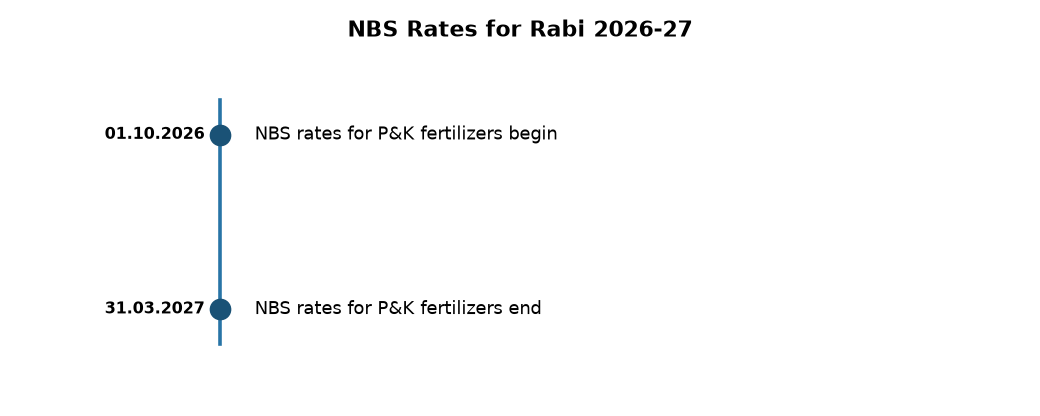
The Union Cabinet has recently approved the Nutrient Based Subsidy (NBS) rates for Phosphatic and Potassic (P&K) fertilizers for the Rabi season of 2026-27, spanning from October 1, 2026, to March 31, 2027. This decision underscores the government’s ongoing commitment to supporting agricultural productivity and ensuring the availability of essential nutrients to farmers at affordable prices, thereby contributing to food security and farmer welfare.
Background
- The Nutrient Based Subsidy (NBS) Policy was introduced in India in April 2010 by the Department of Fertilizers, under the Ministry of Chemicals and Fertilizers.
- The primary objective of the NBS policy is to ensure the availability of P&K fertilizers to farmers at subsidized prices, thereby encouraging balanced fertilization.
- Under the NBS scheme, a fixed amount of subsidy, decided on an annual basis, is provided on each grade of subsidized P&K fertilizers, based on their nutrient content (Nitrogen, Phosphorus, Potash, Sulphur).
- The subsidy is aimed at promoting the consumption of P&K fertilizers to correct the N:P:K imbalance in soil, which often results from excessive urea (Nitrogen) application.
- The Cabinet Committee on Economic Affairs (CCEA) is responsible for approving the NBS rates for each cropping season (Kharif and Rabi).
What is the Nutrient Based Subsidy (NBS) Scheme?
- The Nutrient Based Subsidy (NBS) Scheme is a government initiative in India that provides financial support for Phosphatic and Potassic (P&K) fertilizers.
- Unlike urea, which has a fixed Maximum Retail Price (MRP) and a variable subsidy, P&K fertilizers are subject to a fixed per-nutrient subsidy, allowing manufacturers to determine their own MRPs.
- The scheme aims to encourage balanced fertilization by making P&K fertilizers more accessible and affordable to farmers, thereby promoting soil health and agricultural productivity.
- Under NBS, the subsidy amount is determined by the nutrient content (N, P, K, S) in a particular fertilizer grade, rather than a blanket subsidy per tonne.
- The Department of Fertilizers, under the Ministry of Chemicals and Fertilizers, is the nodal agency for implementing the NBS policy.
- The subsidy is provided to fertilizer manufacturers and importers, who then pass on the benefit to farmers through reduced retail prices.
- The policy also encourages the use of secondary and micronutrients along with NPK fertilizers to address specific soil deficiencies.
- The NBS rates are reviewed and approved by the Cabinet Committee on Economic Affairs (CCEA) for each cropping season (Kharif and Rabi) to adjust to market dynamics and international prices of raw materials.
Key Features
| Feature | Significance |
|---|---|
| Nutrient Based Subsidy (NBS) Scheme | A policy framework implemented by the Department of Fertilizers, Ministry of Chemicals and Fertilizers, to ensure the availability of Phosphatic and Potassic (P&K) fertilizers to farmers at subsidized prices. |
| Rabi 2026-27 Approval | The Union Cabinet’s approval of NBS rates for the specified period (October 1, 2026, to March 31, 2027) provides long-term clarity and stability in fertilizer pricing for farmers and manufacturers. |
| Phosphatic and Potassic (P&K) Fertilizers | These are crucial macronutrients essential for plant growth, crop yield, and soil health, distinct from nitrogenous fertilizers which are under separate subsidy mechanisms. |
| Fixed Subsidy per Nutrient | Under NBS, a fixed amount of subsidy is provided on each grade of subsidized P&K fertilizers, determined annually by the government based on international prices and domestic availability. |
| Farmer Price Stability | The scheme aims to insulate farmers from the volatility of international fertilizer prices by ensuring that P&K fertilizers are available at reasonable and affordable rates. |
| Promoting Balanced Fertilization | By subsidizing P&K fertilizers, the NBS scheme indirectly encourages balanced nutrient application, reducing over-reliance on urea and improving soil health. |
Why it Matters
Economic Implications
- Ensures predictable input costs for farmers, contributing to agricultural stability and food security.
- Mitigates the impact of global price fluctuations of raw materials on domestic fertilizer prices, thereby protecting farmer incomes.
- Supports the domestic fertilizer industry by providing a clear policy environment and ensuring demand for P&K fertilizers.
Agricultural Productivity and Sustainability
- Promotes balanced nutrient application, which is vital for maintaining soil fertility and enhancing crop yields.
- Reduces the risk of nutrient deficiencies in crops, leading to healthier plants and improved agricultural output.
- Contributes to sustainable agricultural practices by encouraging the judicious use of essential plant nutrients.
Government Policy and Governance
- Demonstrates the government’s commitment to supporting the agricultural sector through targeted subsidies.
- Provides a framework for long-term planning in fertilizer production, import, and distribution.
- Aims to optimize subsidy expenditure by linking it to nutrient content rather than product type, encouraging efficiency.
Challenges
1. Fiscal Burden
- The substantial expenditure on fertilizer subsidies can strain government finances, especially with rising international prices of raw materials.
- Balancing the need for farmer support with fiscal prudence remains a continuous challenge for the government.
UPSC Link: Government Budgeting; Fiscal Policy
2. International Price Volatility
- India is significantly dependent on imports for raw materials and finished P&K fertilizers, making the subsidy budget vulnerable to global price fluctuations.
- Geopolitical events and supply chain disruptions can exacerbate price volatility, impacting the cost of the NBS scheme.
UPSC Link: Indian Economy; Global Economic Trends
3. Leakage and Diversion
- Challenges exist in ensuring that subsidized fertilizers reach the intended beneficiaries and are not diverted for non-agricultural uses or smuggled.
- Effective monitoring and distribution mechanisms are crucial to minimize such inefficiencies.
UPSC Link: Public Distribution System; Governance
4. Environmental Concerns
- While promoting balanced fertilization, there is still a risk of overuse of certain nutrients if not properly managed, leading to environmental degradation.
- Runoff from excessive fertilizer application can contribute to water pollution and eutrophication.
UPSC Link: Environmental Pollution; Sustainable Agriculture
5. Technological Adoption
- Encouraging farmers to adopt soil testing and precision agriculture techniques for optimal fertilizer use remains a challenge.
- Lack of awareness or access to modern farming practices can hinder the full benefits of balanced fertilization.
UPSC Link: Technology in Agriculture; Agricultural Extension
Challenges — UPSC Perspective
| Issue | Concern |
|---|---|
| Rising Global Input Costs | Increased international prices of Muriate of Potash (MOP) and Phosphoric Acid directly inflate the subsidy burden under NBS. |
| Subsidy Leakage | Ensuring that subsidized P&K fertilizers reach genuine farmers and are not diverted to industrial uses or black markets. |
| Balanced Nutrient Application | Despite NBS, farmers may still prioritize urea due to its lower price, leading to imbalanced nutrient use and soil degradation. |
| Logistical Challenges | Efficient distribution and timely availability of P&K fertilizers across diverse geographical regions, especially in remote areas. |
| Fiscal Sustainability | The long-term financial viability of the NBS scheme given the significant and often unpredictable expenditure on subsidies. |
| Farmer Awareness | Educating farmers on the importance of soil health cards and appropriate P&K fertilizer application rates for optimal yield and environmental protection. |
Government Initiatives — Must-Memorise for Prelims
- Nutrient Based Subsidy (NBS) Scheme
Way Forward
- Implement robust monitoring mechanisms to track the distribution and sale of subsidized P&K fertilizers, minimizing leakage and diversion.
- Promote indigenous production of P&K fertilizers and their raw materials to reduce import dependence and exposure to global price volatility.
- Intensify farmer awareness campaigns and agricultural extension services to educate on balanced nutrient application and the benefits of P&K fertilizers.
- Integrate soil health card data with fertilizer recommendations to encourage precise and need-based application of nutrients.
- Explore innovative subsidy delivery mechanisms, such as direct benefit transfer (DBT) for fertilizer subsidies, to enhance transparency and efficiency.
- Invest in research and development for alternative and more efficient fertilizer technologies, including nano-fertilizers and bio-fertilizers.
- Foster international collaborations for stable and long-term supply agreements of essential raw materials for P&K fertilizers.
UPSC Value Addition
Keywords for Mains Answer-Writing
Nutrient Based Subsidy Scheme · Phosphatic and Potassic Fertilizers · Rabi Season · Agricultural Subsidies · Fertilizer Policy · Food Security · Fiscal Burden · Sustainable Agriculture
Constitutional & Policy Linkages
- {‘article’: ‘Article 38’, ‘note’: ‘State to secure a social order’}
- {‘article’: ‘Article 39’, ‘note’: ‘Principles of policy by the State’}
- {‘article’: ‘Article 43’, ‘note’: ‘Living wage for workers’}
- {‘article’: ‘Article 48’, ‘note’: ‘Organisation of agriculture and animal husbandry’}
Concept Flow
Global prices of P&K fertilizer raw materials fluctuate. → Government approves Nutrient Based Subsidy (NBS) rates. → Fertilizer manufacturers receive fixed subsidy per nutrient. → P&K fertilizers are sold to farmers at subsidized prices. → Farmers access essential nutrients at affordable rates. → Balanced fertilization promotes crop yield and soil health. → Agricultural productivity and food security are enhanced.
Prelims Practice Questions
Q1. Consider the following statements regarding the Nutrient Based Subsidy (NBS) Scheme:
1. The NBS Scheme was introduced in 2010.
2. Under NBS, a fixed amount of subsidy is provided on each grade of subsidised Phosphatic and Potassic (P&K) fertilisers, based on the nutrient content present in them.
3. The scheme aims to ensure the availability of P&K fertilisers to farmers at affordable prices and to promote balanced nutrient application.
How many of the above statements are correct?
- Only one
- Only two
- All three
- None
Answer: All three — Statement 1: The NBS Scheme was indeed introduced in 2010. Statement 2: The core principle of NBS is to provide a fixed subsidy per nutrient (N, P, K, S) rather than per product, which allows for varying subsidy amounts based on the specific nutrient composition of each P&K fertiliser grade. Statement 3: A primary objective of the NBS scheme is to make P&K fertilisers accessible to farmers at reasonable prices, thereby encouraging balanced fertilisation practices.
Q2. Which of the following ministries is primarily responsible for the implementation of the Nutrient Based Subsidy (NBS) Scheme in India?
- Ministry of Agriculture and Farmers Welfare
- Ministry of Chemicals and Fertilizers
- Ministry of Finance
- Ministry of Commerce and Industry
Answer: Ministry of Chemicals and Fertilizers — The Department of Fertilizers, under the Ministry of Chemicals and Fertilizers, is the nodal agency for the implementation of the Nutrient Based Subsidy (NBS) Scheme.
Mains Practice Question
✍ The Nutrient Based Subsidy (NBS) Scheme aims to ensure the availability of Phosphatic and Potassic (P&K) fertilisers at affordable prices while promoting balanced nutrient application. Critically examine the effectiveness of the NBS scheme in achieving its objectives and discuss the challenges associated with its implementation. (15 Marks)
Approach: MODEL-ANSWER SKELETON:
1. **Introduction**: Briefly introduce the NBS scheme, its launch year (2010), and its primary objectives (affordable P&K fertilisers, balanced nutrient application).
2. **Effectiveness in achieving objectives**:
* **Affordability**: Discuss how NBS helps keep P&K fertiliser prices stable for farmers by absorbing international price volatility.
* **Availability**: Mention its role in ensuring consistent supply by incentivising manufacturers/importers.
* **Balanced Nutrient Application**: Explain how the per-nutrient subsidy aims to encourage the use of P&K fertilisers, which were historically under-applied compared to urea.
3. **Challenges associated with implementation**:
* **Fiscal Burden**: Discuss the significant government expenditure on fertiliser subsidies and its impact on the national exchequer.
* **Price Volatility**: Explain how global price fluctuations of raw materials (e.g., rock phosphate, MOP) impact the subsidy outgo and domestic prices despite NBS.
* **Urea Imbalance**: Highlight the continued skewed consumption pattern favouring urea (which is under a separate subsidy regime) over P&K fertilisers, leading to nutrient imbalance in soils.
* **Leakages and Diversion**: Address issues of potential diversion of subsidised fertilisers for non-agricultural uses or across borders.
* **Environmental Concerns**: Discuss the potential for overuse of certain nutrients if not monitored, leading to soil degradation and water pollution.
* **Policy Review**: Mention the need for periodic review and adjustment of NBS rates, as seen in the news, to address market dynamics.
4. **Way Forward/Conclusion**: Suggest measures like promoting indigenous production, direct benefit transfer (DBT) to farmers, encouraging efficient fertiliser use (e.g., nano-fertilisers), and strengthening extension services to educate farmers on balanced nutrient management. Conclude with the importance of a sustainable and farmer-centric fertiliser policy.
Source: PIB (Press Information Bureau)
Generated by AanyaAi for educational purpose.
Related guides on our sites
- How to prepare for GS paper 1 for UPSC CSE mains exam
- Best UPSC coaching for IFOS exam
- Best agriculture optional coaching
- Best mentorship programme for upsc

- Cabinet Approves Rabi 2026-27 NBS Rates for P&K Fertilizers - November 11, 2026
- दिल्ली वायु प्रदूषण: कृत्रिम वर्षा हेतु क्लाउड सीडिंग की प्रभावशीलता - November 11, 2026
- Cabinet Approves Credit Guarantee Fund for Micro Units - November 11, 2026

No Comments