


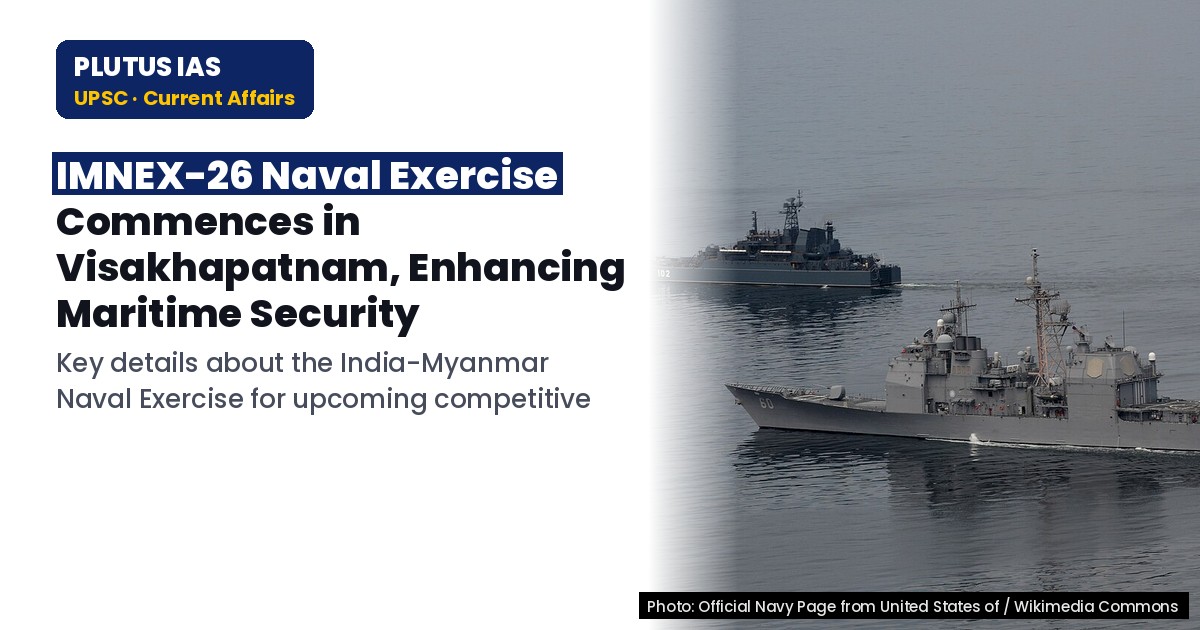
11 Nov IMNEX-26: India-Myanmar Naval Exercise Commences
✎ The India-Myanmar Naval Exercise (IMNEX) is a biennial bilateral exercise aimed at enhancing maritime cooperation, interoperability, and regional security in the Bay of Bengal, aligning with India's 'Act East' and 'Neighbourhood…
Subject Relevance — Where This Topic Fits
- GS Paper II — International Relations: Bilateral, regional and global groupings and agreements involving India and/or affecting India’s interests; India and its neighborhood-relations. | GS Paper III — Security: Various Security forces and agencies and their mandate; Challenges to internal security through communication networks, role of media and social networking sites in internal security challenges, basics of cyber security; money-laundering and its prevention.
- Prelims: IMNEX, India-Myanmar relations, SAGAR Vision, Act East Policy, Bay of Bengal maritime security, HADR operations, Visakhapatnam, ASEAN
- Essay: The evolving dynamics of India’s neighbourhood policy and its implications for regional stability., Maritime security as a cornerstone of economic prosperity and geopolitical influence in the Indo-Pacific.
Quick Revision: The India-Myanmar Naval Exercise (IMNEX) is a biennial bilateral exercise aimed at enhancing maritime cooperation, interoperability, and regional security in the Bay of Bengal, aligning with India’s ‘Act East’ and ‘Neighbourhood First’ policies.
Why is this in the news?
The 8th edition of the India–Myanmar Naval Exercise (IMNEX-26) has commenced at Visakhapatnam, underscoring the ongoing commitment of both nations to enhance maritime cooperation. This biennial exercise serves as a critical platform for strengthening interoperability, sharing best practices, and addressing common challenges in the maritime domain, thereby contributing to regional security and stability.
Background
- India and Myanmar share a long land and maritime border, necessitating robust bilateral engagement for border management and regional stability.
- Myanmar is a crucial component of India’s ‘Act East Policy’ and ‘Neighbourhood First Policy’, aimed at strengthening ties with Southeast Asian nations.
- Maritime security in the Bay of Bengal is a shared concern, encompassing issues such as piracy, illegal fishing, drug trafficking, and humanitarian assistance/disaster relief (HADR) operations.
- The IMNEX series was initiated to foster greater understanding and cooperation between the Indian Navy and the Myanmar Navy, building trust and enhancing operational capabilities.
- India has consistently provided capacity building and training support to the Myanmar armed forces, including naval personnel, to bolster their capabilities.
- The exercise aligns with India’s broader vision for ‘Security and Growth for All in the Region’ (SAGAR), promoting a secure and stable maritime environment.
What is the India-Myanmar Naval Exercise (IMNEX)?
- IMNEX is a biennial bilateral naval exercise conducted between the Indian Navy and the Myanmar Navy.
- The primary objective of IMNEX is to enhance interoperability, mutual understanding, and the exchange of best practices between the two navies.
- The exercise typically involves various drills, including anti-surface warfare, anti-air warfare, maritime interdiction operations, and search and rescue scenarios.
- It provides a platform for professional interaction and knowledge sharing on diverse aspects of naval operations and maritime security challenges.
- IMNEX contributes to strengthening the overall maritime security architecture in the Bay of Bengal region.
- The exercise facilitates the development of common operating procedures, which are crucial for coordinated responses to maritime threats and HADR situations.
- It reflects the growing strategic convergence between India and Myanmar on issues pertaining to regional maritime stability and security.
- The exercise underscores India’s commitment to its ‘Neighbourhood First’ policy and its ‘Act East’ policy by fostering deeper defence and security ties with Myanmar.
Key Features
| Feature | Significance |
|---|---|
| Bilateral Naval Exercise (IMNEX) | Enhances interoperability and mutual understanding between the Indian Navy and the Myanmar Navy, crucial for maritime security in the Indian Ocean Region. |
| 8th Edition | Indicates a sustained commitment to bilateral defence cooperation and a maturing strategic partnership between the two nations. |
| Location: Visakhapatnam | A key naval base for the Indian Navy’s Eastern Naval Command, facilitating logistical support and demonstrating India’s maritime capabilities in the Bay of Bengal. |
| Focus on Maritime Security | Addresses common challenges such as piracy, illegal fishing, and drug trafficking, contributing to regional stability and safety of sea lanes. |
| Professional Interaction | Provides a platform for sharing best practices, operational procedures, and tactical knowledge, thereby improving collective response mechanisms. |
Why it Matters
Strategic Significance
- Strengthens India’s ‘Act East’ policy by fostering closer defence ties with a key Southeast Asian neighbour, enhancing regional influence and stability.
- Contributes to India’s broader vision of ‘Security and Growth for All in the Region’ (SAGAR) by promoting collaborative maritime security frameworks.
- Reinforces India’s role as a net security provider in the Indian Ocean Region, crucial for safeguarding vital sea lines of communication.
Geopolitical Significance
- Enhances bilateral relations with Myanmar, a country strategically located at the crossroads of South Asia and Southeast Asia, vital for regional connectivity initiatives.
- Provides a platform for diplomatic engagement and confidence-building measures, fostering trust and cooperation despite complex regional dynamics.
- Supports a rules-based order in the Indo-Pacific by demonstrating a commitment to international maritime law and freedom of navigation.
Defence Cooperation Significance
- Improves the operational readiness and capabilities of both navies through joint training and exercises, preparing them for coordinated responses to maritime threats.
- Facilitates the exchange of expertise in areas such as anti-piracy operations, search and rescue, and disaster relief, enhancing collective maritime domain awareness.
- Promotes standardisation of procedures and communication protocols, essential for effective joint operations in complex maritime environments.
Challenges
1. Regional Geopolitical Volatility
- Myanmar’s internal political situation and its implications for regional stability can pose challenges to sustained bilateral engagement.
- The presence of other major powers in the Bay of Bengal region necessitates careful diplomatic navigation to maintain strategic balance.
UPSC Link: GS-II: International Relations
2. Maritime Security Threats
- Persistent challenges like illegal, unreported, and unregulated (IUU) fishing, drug trafficking, and arms smuggling require continuous and coordinated efforts.
- The vastness of the maritime domain makes comprehensive surveillance and interdiction difficult, demanding robust intelligence sharing and patrol coordination.
UPSC Link: GS-III: Security Challenges
3. Capacity Building Disparities
- Differences in naval capabilities and technological advancements between the two nations may affect the scope and complexity of joint exercises.
- Ensuring equitable benefits and mutual learning from exercises requires tailored training modules and technology transfer initiatives.
UPSC Link: GS-II: International Relations
Challenges — UPSC Perspective
| Issue | Concern |
|---|---|
| Internal Political Instability in Myanmar | Potential for disruption of bilateral engagements and impact on the long-term viability of defence cooperation initiatives. |
| Cross-border Criminal Activities | Challenges in effectively combating illicit trade, human trafficking, and insurgency along the maritime and land borders, requiring enhanced intelligence and coordinated action. |
| Balancing Regional Interests | Navigating the complex geopolitical landscape of the Indo-Pacific, where multiple global and regional powers have competing strategic interests. |
| Environmental Degradation of Marine Ecosystems | Impact of maritime activities on sensitive marine environments, necessitating joint efforts in conservation and sustainable resource management. |
Way Forward
- Enhance intelligence sharing mechanisms to effectively counter transnational maritime crimes such as drug trafficking and illegal fishing.
- Expand the scope of joint exercises to include more complex scenarios, such as humanitarian assistance and disaster relief (HADR) operations, to improve collective response capabilities.
- Promote capacity building initiatives for the Myanmar Navy through training programs, technology transfer, and joint research in maritime domain awareness.
- Strengthen diplomatic channels to address geopolitical sensitivities and ensure sustained bilateral cooperation amidst regional complexities.
- Explore avenues for greater collaboration in maritime infrastructure development and port connectivity projects, aligning with India’s Act East policy.
- Foster greater interaction between naval personnel at various levels to build deeper professional relationships and mutual trust.
- Develop a comprehensive framework for joint surveillance and patrol operations in the Bay of Bengal to enhance maritime security and stability.
UPSC Value Addition
Keywords for Mains Answer-Writing
India-Myanmar relations · Act East Policy · SAGAR Vision · Indo-Pacific security · maritime cooperation · bilateral naval exercises · regional stability · humanitarian assistance · disaster relief · strategic convergence
Concept Flow
Bilateral Naval Exercise (IMNEX) commences → Enhances interoperability and mutual understanding → Strengthens maritime security in the Indian Ocean Region → Supports India’s ‘Act East’ policy and SAGAR vision → Contributes to regional stability and rules-based order
Prelims Practice Questions
Q1. Consider the following statements regarding India’s ‘Act East Policy’:
1. It replaced the ‘Look East Policy’ in 2014.
2. Its primary focus is on economic cooperation with Southeast Asian nations.
3. It includes a significant strategic and security dimension, particularly in maritime affairs.
How many of the above statements are correct?
- Only one
- Only two
- All three
- None
Answer: All three — Statement 1 is correct; the ‘Act East Policy’ was launched in 2014, evolving from the ‘Look East Policy’. Statement 2 is incorrect; while economic cooperation is a component, the policy has expanded to include strategic, cultural, and people-to-people linkages. Statement 3 is correct; the policy explicitly incorporates a robust strategic and security dimension, emphasizing cooperation in defense and maritime security.
Q2. Which of the following initiatives is most closely associated with India’s vision for maritime security and growth in the Indian Ocean Region?
- Project Mausam
- Sagarmala Project
- SAGAR (Security and Growth for All in the Region) Vision
- Blue Economy Initiative
Answer: SAGAR (Security and Growth for All in the Region) Vision — The SAGAR (Security and Growth for All in the Region) Vision, articulated by India, is a comprehensive framework for maritime cooperation, security, and sustainable development across the Indian Ocean Region, encompassing various aspects including defense, disaster management, and economic growth. Project Mausam focuses on cultural and economic ties, Sagarmala on port-led development, and Blue Economy is a broader concept.
Mains Practice Question
✍ Discuss the significance of bilateral naval exercises like IMNEX in advancing India’s ‘Act East Policy’ and ‘SAGAR Vision’. How do such engagements contribute to regional maritime security and stability? (15 Marks)
Approach: MODEL-ANSWER SKELETON:
1. Introduction: Briefly define IMNEX and its context (India-Myanmar naval exercise).
2. Significance for ‘Act East Policy’:
a. Enhanced defense cooperation with Southeast Asian partners.
b. Projection of India’s strategic interests in the Indo-Pacific.
c. Facilitation of deeper engagement beyond economic ties.
d. Strengthening regional partnerships for collective security.
3. Significance for ‘SAGAR Vision’:
a. Promotion of security in the Indian Ocean Region (IOR).
b. Capacity building and interoperability with littoral states.
c. Collaborative approach to maritime challenges (piracy, HADR).
d. Reinforcement of India’s role as a net security provider.
4. Contribution to Regional Maritime Security and Stability:
a. Deterrence against non-state actors and illegal activities.
b. Improved disaster response and humanitarian assistance capabilities.
c. Confidence-building measures among navies.
d. Upholding rules-based international order in maritime domain.
e. Countering emerging threats and ensuring freedom of navigation.
5. Conclusion: Summarize the multifaceted benefits of such exercises for India’s strategic objectives and regional peace.
Source: PIB (Press Information Bureau)
Andhra Pradesh PCS (APPSC) — State PCS Practice
Prelims: The 8th edition of the India-Myanmar Naval Exercise (IMNEX-26) recently commenced. In which city of Andhra Pradesh did this significant bilateral exercise take place?
- Kakinada
- Visakhapatnam
- Nellore
- Machilipatnam
Answer: Visakhapatnam — The 8th edition of IMNEX-26 commenced at Visakhapatnam, highlighting its strategic importance as a naval base in Andhra Pradesh.
Mains: Discuss the strategic significance of Visakhapatnam as a host city for international naval exercises like IMNEX-26, considering Andhra Pradesh’s coastal geography and India’s Act East Policy.
Generated by AanyaAi for educational purpose.
Related guides on our sites
- How to prepare for GS paper 1 for UPSC CSE mains exam
- Best UPSC coaching for IFOS exam
- Best mentorship programme for upsc
- UPSC+BA degree

- IMNEX-26: India-Myanmar Naval Exercise Commences - November 11, 2026
- प्रधानमंत्री मोदी का कर्नाटक-गुजरात दौरा: विकास परियोजनाएं और सांस्कृतिक कार्यक्रम - November 11, 2026
- Noida Aqua Line Metro Extension: UPSC & State PCS Analysis - November 11, 2026

No Comments