


12 Nov Nasha Mukt Bharat Abhiyaan: Impact on Youth & Women
✎ The Nasha Mukt Bharat Abhiyaan is a flagship initiative by the Ministry of Social Justice and Empowerment, launched in 2020, to combat substance abuse through a comprehensive awareness and outreach campaign, particularly…
Subject Relevance — Where This Topic Fits
- GS Paper II — Social Justice: Issues relating to development and management of Social Sector/Services relating to Health, Education, Human Resources. | GS Paper II — Government Policies and Interventions for Development in various sectors and Issues arising out of their Design and Implementation.
- Prelims: Nasha Mukt Bharat Abhiyaan, Ministry of Social Justice and Empowerment, Drug Demand Reduction, National Action Plan for Drug Demand Reduction (NAPDDR), Integrated Rehabilitation Centres for Addicts (IRCAs), De-addiction services
- Essay: The role of public awareness campaigns in addressing societal challenges., Youth empowerment and social welfare: Strategies for a drug-free society.
Quick Revision: The Nasha Mukt Bharat Abhiyaan is a flagship initiative by the Ministry of Social Justice and Empowerment, launched in 2020, to combat substance abuse through a comprehensive awareness and outreach campaign, particularly targeting youth and women in identified vulnerable districts.
Why is this in the news?
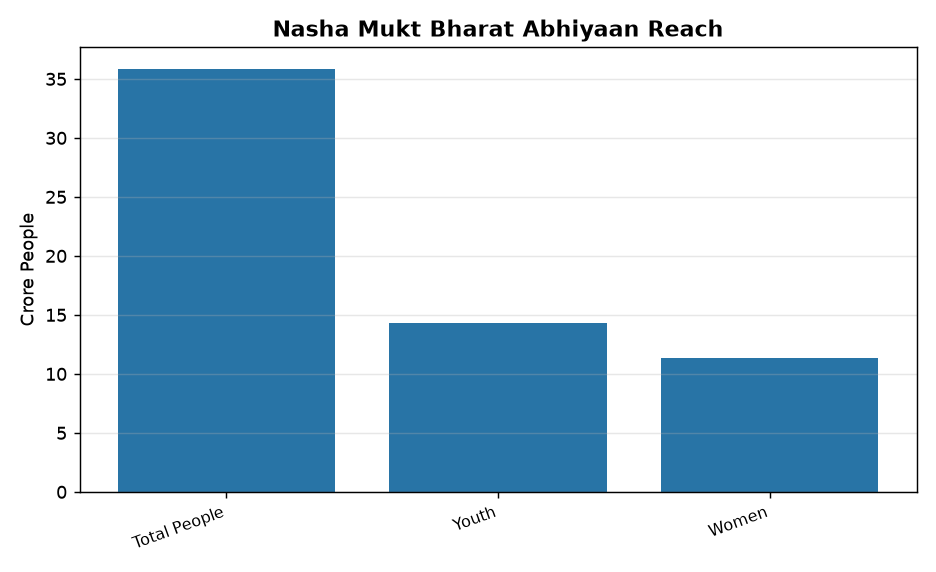
The Nasha Mukt Bharat Abhiyaan (NMBA) has achieved significant outreach, engaging over 35.88 crore individuals nationwide. This extensive awareness campaign has specifically targeted vulnerable demographics, including over 14.35 crore youth and 11.33 crore women, underscoring its broad societal impact in the ongoing efforts to combat substance abuse.
Background
- Substance abuse poses a significant public health and socio-economic challenge in India, affecting individuals, families, and communities.
- The Ministry of Social Justice and Empowerment is the nodal ministry for drug demand reduction and rehabilitation of drug users in India.
- The National Action Plan for Drug Demand Reduction (NAPDDR) 2018-2025 outlines a comprehensive strategy to address the issue of drug abuse.
- The NAPDDR focuses on a multi-pronged approach encompassing awareness generation, identification, counselling, treatment, and rehabilitation of drug dependents.
- Previous governmental initiatives have included support for Integrated Rehabilitation Centres for Addicts (IRCAs) and outreach programmes.
- The need for a targeted, time-bound campaign was identified to intensify efforts and achieve greater public engagement, particularly among youth and women.
What is the Nasha Mukt Bharat Abhiyaan (NMBA)?
- The Nasha Mukt Bharat Abhiyaan (NMBA), or Drug-Free India Campaign, was launched on August 15, 2020, in 272 identified vulnerable districts across India.
- It is an initiative of the Ministry of Social Justice and Empowerment, Government of India.
- The Abhiyaan aims to create awareness about the ill effects of substance abuse, focusing on youth, women, and educational institutions.
- Its primary objectives include reaching out to the youth in educational institutions and community settings to sensitise them about drug abuse.
- The campaign also focuses on identifying dependent individuals and providing access to treatment and rehabilitation services.
- It leverages the support of various stakeholders, including district administrations, NGOs, educational institutions, and volunteers, for its implementation.
- Key activities under NMBA include awareness generation, community outreach, capacity building of service providers, and strengthening the network of de-addiction facilities.
- The Abhiyaan employs digital platforms and social media extensively to disseminate information and engage a wider audience in its awareness drives.
Key Features
| Feature | Significance |
|---|---|
| Nasha Mukt Bharat Abhiyaan (NMBA) | A flagship campaign by the Ministry of Social Justice and Empowerment aimed at creating a drug-free India through a multi-pronged strategy. |
| Extensive Outreach | The campaign has engaged over 35.88 crore people, demonstrating a broad societal impact and reach across diverse demographics. |
| Targeted Demographics | Specific focus on youth (over 14.35 crore) and women (over 11.33 crore) highlights a strategic approach to address vulnerable populations. |
| Awareness Generation | Primary emphasis on nationwide awareness campaigns to educate the public about the detrimental effects of substance abuse. |
| Community Participation | The success of the Abhiyaan is predicated on active involvement of local communities, educational institutions, and civil society organizations. |
Why it Matters
Social Significance
- Addresses a critical public health issue by combating substance abuse, which has far-reaching negative consequences on individuals, families, and communities.
- Promotes social well-being and productivity by reducing the burden of addiction, thereby fostering a healthier and more engaged populace.
- Empowers vulnerable groups, particularly youth and women, by providing them with information and support to resist substance abuse and seek help.
Governance Significance
- Demonstrates the government’s commitment to tackling social challenges through comprehensive and inclusive policy interventions.
- Highlights the effectiveness of multi-stakeholder approaches, involving various ministries, state governments, and civil society, in achieving national objectives.
- Provides valuable data and insights into the scale and nature of substance abuse in India, informing future policy formulation and resource allocation.
Human Resource Development Significance
- Safeguards the potential of the youth, who represent a significant demographic dividend, from the debilitating effects of drug addiction.
- Contributes to a healthier workforce, enhancing overall human capital and economic productivity by reducing health-related absenteeism and incapacitation.
- Fosters a culture of responsible citizenship and healthy living among the populace, which is crucial for long-term national development.
Challenges
1. Stigma and Discrimination
- Individuals struggling with substance abuse often face societal stigma, leading to reluctance in seeking help and accessing treatment.
- Discrimination can hinder reintegration into society, perpetuating a cycle of addiction and social exclusion.
UPSC Link: Social Justice: Vulnerable sections
2. Accessibility of Treatment and Rehabilitation
- Uneven distribution and limited availability of de-addiction and rehabilitation centers, particularly in rural and remote areas.
- High cost of treatment can be a barrier for economically disadvantaged individuals, despite government initiatives.
UPSC Link: Social Justice: Health; Welfare schemes
3. Evolving Nature of Substance Abuse
- Emergence of new psychoactive substances and changing patterns of drug use pose continuous challenges for prevention and intervention strategies.
- The illicit drug trade’s adaptability requires constant updates to law enforcement and public health responses.
UPSC Link: Internal Security: Organized crime; Public Health
4. Sustained Engagement and Follow-up
- Maintaining long-term engagement with individuals post-rehabilitation is crucial to prevent relapse, but often proves challenging.
- Lack of robust follow-up mechanisms can undermine the effectiveness of initial intervention efforts.
UPSC Link: Social Justice: Welfare schemes; Governance
Challenges — UPSC Perspective
| Issue | Concern |
|---|---|
| Lack of Comprehensive Data | Absence of granular, real-time data on drug use patterns, prevalence, and emerging trends hinders targeted interventions. |
| Cross-Border Drug Trafficking | India’s geographical proximity to major illicit drug-producing regions (Golden Crescent and Golden Triangle) exacerbates the problem of drug availability. |
| Inadequate Human Resources | Shortage of trained professionals, including counselors, psychologists, and medical staff, in de-addiction centers. |
| Limited Public Awareness in Remote Areas | Despite extensive campaigns, penetration in highly remote or marginalized communities remains a challenge, requiring tailored approaches. |
| Youth Vulnerability | Peer pressure, academic stress, and easy access to substances, particularly online, make youth highly susceptible to addiction. |
Government Initiatives — Must-Memorise for Prelims
- Nasha Mukt Bharat Abhiyaan (NMBA)
- National Action Plan for Drug Demand Reduction (NAPDDR)
Way Forward
- Strengthen community-led initiatives and local self-governance bodies to enhance outreach and sustained engagement at the grassroots level.
- Integrate de-addiction and rehabilitation services more effectively into the mainstream healthcare system, ensuring accessibility and affordability.
- Leverage digital platforms and social media to disseminate awareness messages, particularly targeting youth, and provide online counseling services.
- Enhance inter-ministerial coordination and collaboration with law enforcement agencies to curb the supply of illicit drugs and dismantle trafficking networks.
- Invest in research and development to understand evolving drug abuse patterns and develop evidence-based prevention and treatment strategies.
- Promote vocational training and skill development for individuals undergoing rehabilitation to facilitate their social and economic reintegration.
- Implement robust monitoring and evaluation frameworks to assess the impact of interventions and ensure accountability in resource utilization.
- Foster a supportive environment through anti-stigma campaigns to encourage individuals to seek help without fear of judgment.
UPSC Value Addition
Keywords for Mains Answer-Writing
Nasha Mukt Bharat Abhiyaan · drug abuse prevention · substance use disorder · Ministry of Social Justice and Empowerment · National Action Plan for Drug Demand Reduction · youth engagement · women’s empowerment · community-based intervention · public health initiative · social welfare schemes
Constitutional & Policy Linkages
- Article 47: Duty of the State to raise the level of nutrition and the standard of living and to improve public health.
Concept Flow
Substance Abuse Prevalence → Government Intervention (NMBA) → Nationwide Awareness Campaigns → Community Engagement & Outreach → Reduced Demand & Stigma → Improved Public Health Outcomes → Enhanced Human Resource Development
Prelims Practice Questions
Q1. Consider the following statements regarding the Nasha Mukt Bharat Abhiyaan (NMBA):
1. It is an initiative of the Ministry of Health and Family Welfare.
2. The Abhiyaan focuses on awareness generation, especially among youth and women.
3. It aims to establish de-addiction centres across all districts of India.
How many of the above statements are correct?
- Only one
- Only two
- All three
- None
Answer: Only one — Statement 1 is incorrect: The Nasha Mukt Bharat Abhiyaan is an initiative of the Ministry of Social Justice and Empowerment. Statement 2 is correct: A key objective of the NMBA is to generate awareness about the ill effects of substance abuse, with a particular focus on vulnerable groups like youth and women. Statement 3 is incorrect: While de-addiction services are part of the broader strategy, the primary focus of NMBA is on awareness and community outreach, not solely on establishing de-addiction centres across all districts.
Q2. Which of the following bodies is primarily responsible for implementing the Nasha Mukt Bharat Abhiyaan?
- National Institute of Social Defence (NISD)
- National Centre for Disease Control (NCDC)
- Narcotics Control Bureau (NCB)
- National Disaster Management Authority (NDMA)
Answer: National Institute of Social Defence (NISD) — The National Institute of Social Defence (NISD), an autonomous body under the Ministry of Social Justice and Empowerment, plays a crucial role in training, research, and documentation for drug abuse prevention, thereby supporting the implementation of the Nasha Mukt Bharat Abhiyaan.
Mains Practice Question
✍ The Nasha Mukt Bharat Abhiyaan represents a significant community-centric approach to tackling substance abuse in India. Discuss its key features and evaluate its effectiveness in addressing the multifaceted challenge of drug demand reduction. (15 Marks)
Approach: INTRODUCTION: Briefly define the Nasha Mukt Bharat Abhiyaan (NMBA) and its launch by the Ministry of Social Justice and Empowerment.
KEY FEATURES OF NMBA:
1. Community Outreach and Awareness: Highlight its focus on generating awareness among vulnerable populations (youth, women, educational institutions).
2. Targeted Districts: Mention its implementation in identified vulnerable districts.
3. Multi-pronged Strategy: Discuss the integration of awareness, treatment, and rehabilitation.
4. Role of Volunteers and NGOs: Emphasize the involvement of youth volunteers (NSS, NYKS) and civil society organizations.
5. Digital Interventions: Note the use of technology for awareness and data collection.
6. Focus on Prevention: Stress its primary objective of preventing substance abuse rather than solely treating it.
EFFECTIVENESS AND CHALLENGES:
1. Reach and Impact: Refer to the reported figures of people reached (e.g., 35.88 crore people, 14.35 crore youth, 11.33 crore women) as evidence of broad outreach.
2. Behavioral Change: Discuss the challenge of translating awareness into sustained behavioral change.
3. Infrastructure Gaps: Acknowledge potential limitations in treatment and rehabilitation infrastructure, especially in rural areas.
4. Stigma: Address the persistent social stigma associated with substance abuse, hindering help-seeking behavior.
5. Coordination: Examine the need for enhanced inter-ministerial and inter-agency coordination (e.g., Health, Home Affairs, Education).
6. Sustainability: Evaluate the long-term sustainability of community-driven initiatives.
7. Data-driven Approach: Discuss the importance of robust data collection and analysis for evidence-based policy making.
CONCLUSION: Summarize the importance of a holistic, multi-stakeholder approach to drug demand reduction, acknowledging the NMBA’s positive contributions while highlighting areas for further strengthening.
Source: PIB (Press Information Bureau)
Generated by AanyaAi for educational purpose.
Related guides on our sites
- Best sociology optional coaching
- Best coaching for sociology optional
- Best sociology optional coaching online
- is sociology good optional

- Nasha Mukt Bharat Abhiyaan: Impact on Youth & Women - November 12, 2026
- वैश्विक उत्सर्जन में गिरावट के बावजूद भारत में कार्बन उत्सर्जन वृद्धि: कारण और निहितार्थ - November 12, 2026
- PLI ACC Scheme: MHI Receives 22 Bids for Battery Manufacturing - November 12, 2026

No Comments