


13 Nov India’s Rising Inflation: Causes, CPI & RBI Mandate
✎ Current inflationary pressures in India are multifaceted, driven by elevated food prices, increased airfares, and the rising cost of electronic components, pushing overall inflation beyond the RBI's mandated tolerance band.
Subject Relevance — Where This Topic Fits
- GS Paper III — Economy
- Prelims: Consumer Price Index (CPI), Inflation targeting, Monetary Policy Committee (MPC), Core inflation, Food inflation, Fuel inflation, Supply-side shocks
- Essay: The multifaceted challenge of inflation in a developing economy, Balancing growth and price stability: The role of monetary policy
Quick Revision: Current inflationary pressures in India are multifaceted, driven by elevated food prices, increased airfares, and the rising cost of electronic components, pushing overall inflation beyond the RBI’s mandated tolerance band.
Why is this in the news?
Recent data indicates that household inflation in India has surpassed the 6% upper tolerance limit mandated for the Reserve Bank of India (RBI) after a two-year period. This development has prompted concerns among economists regarding the persistence of elevated price levels, with projections suggesting that inflation may remain above the threshold for an extended duration. The rise is attributed to a combination of factors, including significant increases in airfares, food prices, and the cost of electronic components.
Background
- The Reserve Bank of India (RBI) operates under a flexible inflation targeting framework, with a primary objective of maintaining price stability while keeping in mind the objective of growth.
- The statutory basis for the flexible inflation targeting framework is provided by the Reserve Bank of India Act, 1934, as amended in 2016.
- Under this framework, the central government, in consultation with the RBI, sets an inflation target, which is currently 4% with a tolerance band of +/- 2% (i.e., between 2% and 6%).
- If the average inflation, as measured by the Consumer Price Index (CPI), remains above 6% or below 2% for three consecutive quarters, the RBI is deemed to have failed in achieving its mandate.
- The Monetary Policy Committee (MPC) is entrusted with the task of fixing the policy interest rate (repo rate) to achieve the inflation target.
- Inflation is a sustained increase in the general price level of goods and services in an economy over a period of time, resulting in a fall in the purchasing power of money.
Key Drivers of Current Inflationary Trends
- Food inflation has shown a significant surge, primarily influenced by factors such as a weak monsoon, which impacts agricultural output, and increased demand during the festival season.
- Airfare inflation has witnessed a substantial increase, with average airfares rising considerably compared to the previous year, partly due to higher jet fuel prices and increased demand.
- ‘Chipflation,’ or the spiralling price of memory chips used in consumer electronics, is contributing to inflation in goods like pen drives, phones, and laptops, driven by a persistent global chip shortage.
- Core inflation, which excludes volatile food and fuel components, is also on an upward trajectory, indicating that price pressures are becoming more generalised across the economy.
- The war in West Asia has contributed to higher global crude oil prices, which in turn affects the cost of jet fuel and other energy-intensive goods and services.
- Increased input costs for restaurants, including cooking gas, are contributing to higher prices for dining out, reflecting broader inflationary pressures in the services sector.
- Supply-side disruptions, whether due to climatic events affecting agriculture or global supply chain issues impacting electronics, play a crucial role in driving up prices.
Key Features
| Feature | Significance |
|---|---|
| Household Inflation Exceeds RBI Tolerance Band | Consumer Price Index (CPI) inflation surpassed 6% in October, marking the first instance in two years. This is critical as 6% is the upper limit of the Reserve Bank of India’s (RBI) legally mandated tolerance range. |
| Food Inflation Surge | Food inflation escalated to 8.94% in October, indicating a substantial increase in the cost of essential food items for households. This is attributed to factors like a weak monsoon and the festival season. |
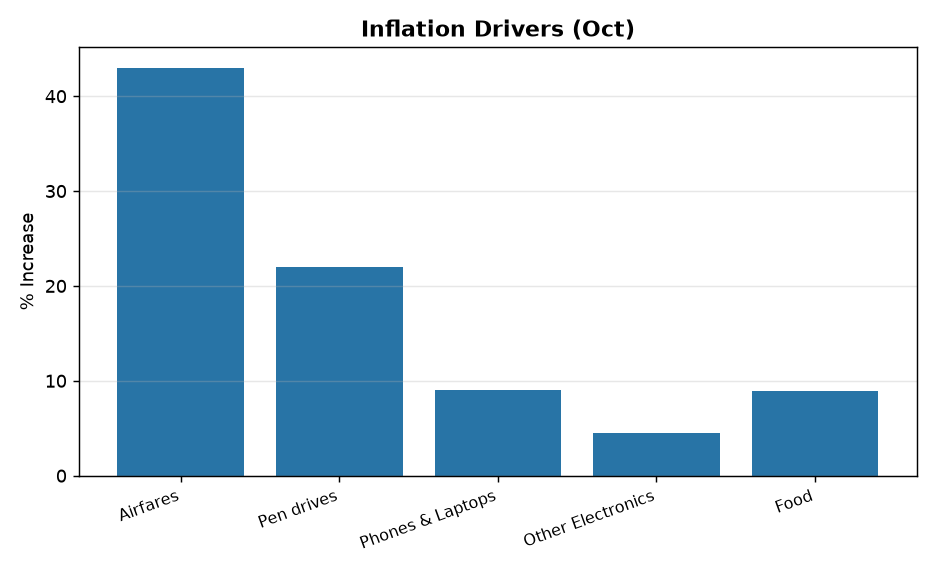
| Airfare Inflation | Average airfares witnessed a 43% year-on-year increase in October, with a 13.36% month-on-month rise. This significant increase is partly due to elevated jet fuel prices and festival season demand. |
| ‘Chipflation’ Impact | Prices of consumer electronics, driven by memory chip costs, continue to rise. Pen drive inflation reached 22%, while phones and laptops saw a 9% increase, reflecting global supply chain issues. |
| Rising Core Inflation | Core inflation, which excludes volatile food and fuel prices, also registered an increase, reaching 4.5% in October. This suggests that underlying price pressures are broadening across the economy. |
Why it Matters
Economic Stability
- Sustained inflation above the RBI’s tolerance band can erode purchasing power, particularly for lower-income households, and may necessitate tighter monetary policy interventions.
- Rising core inflation indicates a generalisation of price pressures beyond volatile components, posing a broader challenge to macroeconomic stability and growth prospects.
Monetary Policy Implications
- The RBI’s mandate requires it to explain its failure if average inflation remains outside the 2-6% band for three consecutive quarters, potentially leading to a review of monetary policy frameworks.
- Persistent inflation may compel the RBI to maintain or further tighten interest rates, impacting credit availability, investment, and overall economic growth.
Sectoral Impact
- High airfares can deter travel, affecting tourism, hospitality, and related sectors, while also increasing business operational costs.
- Increased prices of electronic goods due to ‘chipflation’ can dampen consumer demand for durables and impact manufacturing sectors reliant on these components.
Social Welfare
- Elevated food inflation disproportionately affects household budgets, particularly for essential commodities, potentially exacerbating food insecurity and reducing real incomes.
- The overall rise in household expenses can lead to a decline in living standards and increased financial stress for a significant portion of the population.
Challenges
1. Controlling Inflationary Pressures
- Managing persistent inflationary pressures, especially when driven by both supply-side factors (e.g., weak monsoon, global chip shortages) and demand-side factors (e.g., festival season demand).
- Balancing the objective of price stability with supporting economic growth, as aggressive monetary tightening could stifle investment and consumption.
UPSC Link: GS3 – Indian Economy and issues relating to planning, mobilization of resources, growth, development and employment.
2. Supply Chain Resilience
- Addressing vulnerabilities in global supply chains, particularly for critical components like semiconductors, to mitigate ‘chipflation’ and ensure the availability of essential goods.
- Enhancing domestic agricultural productivity and supply chain efficiency to stabilise food prices, which are often susceptible to climatic variations and logistical bottlenecks.
UPSC Link: GS3 – Infrastructure: Energy, Ports, Roads, Airports, Railways etc.
3. Monetary Policy Effectiveness
- Ensuring the effectiveness of monetary policy tools in an environment where inflation is driven by diverse and often external factors.
- Communicating policy actions clearly to manage inflation expectations among consumers and businesses, which is crucial for anchoring price stability.
UPSC Link: GS3 – Monetary policy; Government Budgeting.
4. Fiscal Policy Coordination
- Coordinating fiscal policy measures with monetary policy to address inflation without creating conflicting signals or exacerbating economic imbalances.
- Implementing targeted fiscal interventions to support vulnerable populations affected by high inflation, while maintaining fiscal prudence.
UPSC Link: GS3 – Government Budgeting.
Challenges — UPSC Perspective
| Issue | Concern |
|---|---|
| Persistent Inflation | Household inflation exceeding the RBI’s 6% upper tolerance limit, indicating broad-based price pressures. |
| Food Price Volatility | Food inflation at 8.94%, driven by weak monsoon and festival demand, disproportionately impacting household budgets. |
| Supply Chain Disruptions | Global chip shortages contributing to ‘chipflation’ in electronics, indicating external vulnerabilities. |
| Rising Core Inflation | Core inflation at 4.5%, suggesting underlying and widespread price pressures beyond food and fuel. |
| High Airfares | Significant increase in airfares (43% YoY, 13.36% MoM) impacting travel and related sectors. |
Way Forward
- Strengthening supply chain resilience for essential goods and critical components to mitigate external shocks and ensure stable availability.
- Implementing targeted fiscal measures to support vulnerable sections of the population affected by high food and fuel prices, without exacerbating inflationary pressures.
- Enhancing agricultural productivity and improving post-harvest management to reduce wastage and stabilise food prices.
- Continuing prudent monetary policy measures by the Reserve Bank of India to anchor inflation expectations and ensure price stability.
- Investing in infrastructure development, particularly in logistics and transportation, to reduce costs and improve efficiency in the movement of goods.
- Promoting domestic manufacturing and technological self-reliance, especially in critical sectors like semiconductors, to reduce import dependence and mitigate ‘chipflation’.
- Monitoring global economic developments and their potential impact on domestic inflation, enabling proactive policy responses.
UPSC Value Addition
Keywords for Mains Answer-Writing
Inflation targeting · Monetary Policy Committee (MPC) · Consumer Price Index (CPI) · Core inflation · Food inflation · Supply-side factors · Demand-side factors · Reserve Bank of India (RBI) · Fiscal policy · Inflationary pressures
Constitutional & Policy Linkages
- {‘Article’: ‘Article 263’, ‘note’: ‘Inter-State Council for economic coordination.’}
- {‘Article’: ‘Article 280’, ‘note’: ‘Finance Commission recommendations on fiscal matters.’}
Concept Flow
Global supply chain disruptions and geopolitical events (e.g., West Asia conflict) → Increased input costs (e.g., jet fuel, memory chips) and domestic supply shocks (e.g., weak monsoon) → Rising sectoral inflation (e.g., airfares, electronics, food) → Broadening of price pressures to core inflation → Overall Consumer Price Index (CPI) inflation exceeding RBI’s tolerance band → Potential for tighter monetary policy and impact on economic growth
Prelims Practice Questions
Q1. Consider the following statements regarding inflation in India:
1. The Reserve Bank of India (RBI) is legally mandated to maintain average inflation, as measured by the Consumer Price Index (CPI), within a tolerance range of 2% to 6%.
2. If average inflation remains above 6% or below 2% for three consecutive quarters, the central bank is deemed to have failed in its mandate.
3. Core inflation excludes volatile components like food and fuel prices to indicate underlying price pressures.
How many of the above statements are correct?
- Only one
- Only two
- All three
- None
Answer: All three — Statement 1 is correct: The RBI’s monetary policy framework mandates maintaining CPI inflation within the 2-6% band. Statement 2 is correct: This is the legal criterion for assessing the RBI’s failure in its inflation-targeting mandate. Statement 3 is correct: Core inflation is a key metric used by policymakers to understand persistent inflationary trends by removing the impact of transient price shocks from food and fuel.
Q2. Which of the following factors are considered primary drivers of the recent rise in inflation in India, as per economic analysis?
1. Increased airfares due to higher jet fuel costs.
2. Rising prices of memory chips used in consumer electronics.
3. Surge in food prices attributed to weak monsoon and festival season demand.
Select the correct answer using the code given below:
- 1 and 2 only
- 2 and 3 only
- 1 and 3 only
- 1, 2 and 3
Answer: 1, 2 and 3 — All three factors listed—increased airfares, rising memory chip prices, and surging food prices—have been identified as significant contributors to the recent inflationary trend in India. Airfares are affected by jet fuel costs, chip prices by global supply chain issues, and food prices by agricultural output and seasonal demand.
Mains Practice Question
✍ The Reserve Bank of India (RBI) operates under an inflation-targeting framework. Discuss the key components of this framework and critically examine the challenges faced by the RBI in maintaining price stability in the contemporary Indian economic context, with specific reference to recent inflationary trends. (15 Marks)
Approach: Introduction: Briefly define inflation targeting and the RBI’s mandate. Key Components of the Framework: Explain the role of the Monetary Policy Committee (MPC), the Consumer Price Index (CPI) as the target variable, and the statutory inflation target (4% with a +/- 2% tolerance band). Challenges in Maintaining Price Stability: Discuss both demand-side and supply-side factors contributing to inflation. Refer to recent trends like food inflation (weak monsoon, festival demand), energy price shocks (jet fuel), global supply chain disruptions (chip shortages), and rising core inflation. Mention the ‘failure’ criterion for the RBI (inflation outside the band for three consecutive quarters). Conclude with the complexities of monetary policy in addressing diverse inflationary drivers.
Source: The Indian Express
Generated by AanyaAi for educational purpose.
Related guides on our sites
- Best economics optional coaching for upsc
- Best economics optional teacher for upsc
- How to prepare for GS paper 1 for UPSC CSE mains exam
- Best UPSC coaching for IFOS exam

- India’s Rising Inflation: Causes, CPI & RBI Mandate - November 13, 2026
- लाड़ली बहना योजना: 42वीं किस्त जारी, महिला सशक्तिकरण पर प्रभाव - November 13, 2026
- P&T Colony Rehabilitation: Ernakulam Collector Report Sought - November 13, 2026

No Comments