


13 Nov Special Parliament Sessions: Rules, Article 85 & Provisions
✎ Article 85 of the Constitution empowers the President to summon Parliament, ensuring that not more than six months elapse between two sessions, with the government determining the legislative agenda for all sessions, including…
Subject Relevance — Where This Topic Fits
- GS Paper II — Indian Constitution — significant provisions and basic structure; Parliament and State Legislatures — structure, functioning, conduct of business, powers & privileges and issues arising out of these. | GS Paper II — Governance — Government policies and interventions for development in various sectors and issues arising out of their design and implementation.
- Prelims: Article 85, Summoning of Parliament, Prorogation, Adjournment sine die, Cabinet Committee on Parliamentary Affairs, Government of India Act, 1935, Parliamentary sessions (Budget, Monsoon, Winter), Delimitation, Women’s Reservation
- Essay: The Evolving Dynamics of Parliamentary Functioning in India, Constitutionalism and the Democratic Process: Ensuring Effective Legislative Governance
Quick Revision: Article 85 of the Constitution empowers the President to summon Parliament, ensuring that not more than six months elapse between two sessions, with the government determining the legislative agenda for all sessions, including any ‘special’ sittings convened outside the conventional schedule.
Why is this in the news?
Recent reports indicate the potential convening of a special session of Parliament prior to the regularly scheduled Winter Session. This proposed session aims to facilitate the passage of critical legislative agenda, specifically concerning the delimitation of electoral constituencies and the implementation of women’s reservation, with a view to advancing their application to the 2029 Lok Sabha elections. This development brings into focus the constitutional provisions and procedural aspects governing parliamentary sessions.
Background
- The Indian Constitution does not explicitly employ the term ‘special session’; however, it provides for the summoning of Parliament, which can be interpreted to include such extraordinary sittings.
- In the ordinary course, the Indian Parliament adheres to a conventional schedule of three sessions annually: the Budget Session (January-April/May), the Monsoon Session (July-August), and the Winter Session (November-December).
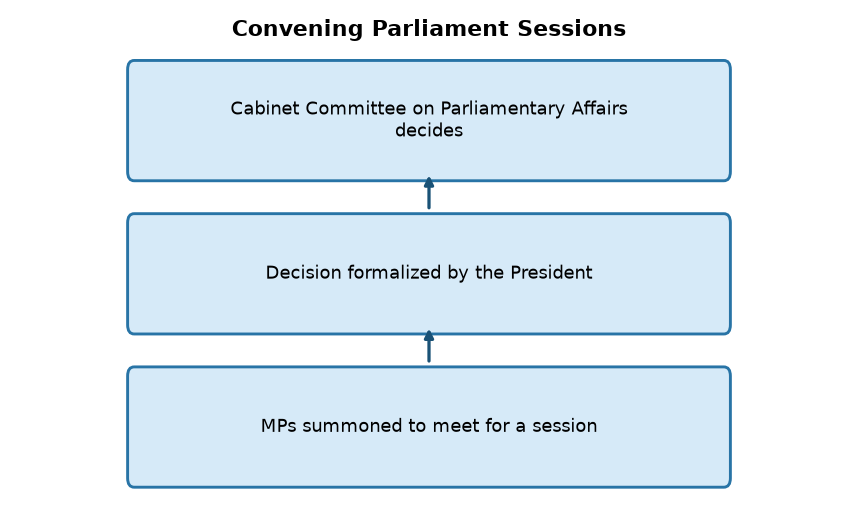
- The authority to convene a session of Parliament is vested in the government, with the decision formally taken by the Cabinet Committee on Parliamentary Affairs and subsequently formalised by the President, who summons the Members of Parliament.
- India does not operate under a fixed parliamentary calendar; however, Article 85 of the Constitution mandates that a period of six months shall not intervene between two sessions of Parliament, ensuring that Parliament meets at least twice a year.
- The provision for summoning Parliament, as enshrined in Article 85, draws its lineage from the Government of India Act, 1935, which stipulated that the central legislature must meet at least once a year, with a maximum interval of twelve months between sessions.
- An ‘adjournment sine die’ signifies the postponement of a parliamentary sitting without specifying a date for reconvening. If Parliament has been adjourned sine die but not prorogued, it can be reconvened at any time without the standard 14-day notice period typically required for summoning a new session.
- ‘Prorogation’ refers to the termination of a session of Parliament by the President, but it does not dissolve the Lok Sabha. It implies the end of the session, and all pending notices (except those for Bills) lapse.
- ‘Delimitation’ is the act or process of fixing limits or boundaries of territorial constituencies in a country or a province having a legislative body.
- ‘Women’s reservation’ refers to the legislative proposal to reserve a certain percentage of seats for women in legislative bodies, aimed at enhancing their representation.
- The Cabinet Committee on Parliamentary Affairs (CCPA) is a key governmental body responsible for overseeing parliamentary business, including the scheduling of sessions, deciding on legislative priorities, and managing relations between the government and Parliament.
What are the provisions governing Parliamentary Sessions in India?
- Article 85 of the Indian Constitution governs the summoning, prorogation, and dissolution of Parliament. It states that the President shall from time to time summon each House of Parliament to meet at such time and place as he thinks fit, but six months shall not intervene between its last sitting in one session and the date appointed for its first sitting in the next session.
- The power to summon Parliament is exercised by the President on the aid and advice of the Council of Ministers, specifically through the Cabinet Committee on Parliamentary Affairs.
- While the Constitution mandates a minimum of two parliamentary sessions in a year, by convention, Parliament typically holds three sessions: the Budget Session, the Monsoon Session, and the Winter Session.
- A ‘special session’ is not explicitly defined in the Constitution but refers to a parliamentary sitting convened outside the usual schedule, often to address urgent legislative or national matters.
- The President also has the power to prorogue either House of Parliament, which brings a session to an end. Prorogation terminates all pending notices (except Bills) and motions.
- An ‘adjournment sine die’ is a temporary suspension of the House’s proceedings without fixing a date for its next meeting. This differs from prorogation, as the House remains in session, albeit in a suspended state, and can be reconvened by the Speaker/Chairman.
- The legislative agenda for any session, including a special one, is determined by the government, which prioritises Bills and discussions based on national requirements and policy objectives.
- The Government of India Act, 1935, served as a foundational legal framework, influencing several provisions of the Indian Constitution, including the regulation of legislative sessions, albeit with modifications such as reducing the maximum interval between sessions from twelve to six months.
Key Features
| Feature | Significance |
|---|---|
| Convening Authority | The Executive, specifically the Cabinet Committee on Parliamentary Affairs, decides to convene a session, which is then formally executed by the President. |
| Constitutional Mandate | Article 85 mandates that not more than six months shall elapse between two sessions of Parliament, ensuring regular legislative oversight. |
| Session Types | Traditionally, Parliament holds three sessions annually: Budget, Monsoon, and Winter Sessions, each with distinct legislative and deliberative focuses. |
| Absence of ‘Special Session’ Term | The Constitution does not explicitly use the term ‘special session’; any session outside the regular calendar is convened under the general provisions of Article 85. |
| Prorogation and Adjournment Sine Die | Prorogation ends a session, while adjournment sine die postpones it indefinitely. The absence of prorogation allows for reconvening without a 14-day notice. |
Why it Matters
Legislative Process
- Special sessions enable the government to address urgent legislative matters that cannot await the regular parliamentary calendar, ensuring timely policy implementation.
- They provide an opportunity for expedited passage of critical bills, such as those pertaining to electoral reforms or constitutional amendments, which require immediate attention.
Governance and Policy Implementation
- The flexibility to convene Parliament outside its ordinary schedule allows the executive to respond promptly to unforeseen national exigencies or to advance significant policy agendas.
- This mechanism facilitates continuous governance by ensuring that legislative approval is not unduly delayed, thereby supporting the effective functioning of the state.
Constitutional Framework
- The provisions governing parliamentary sessions underscore the constitutional principle of parliamentary sovereignty and the requirement for regular legislative engagement.
- The six-month gap rule, enshrined in Article 85, ensures that the executive remains accountable to the legislature and that legislative business is conducted periodically.
Challenges
1. Notice Period and Preparedness
- Convening a session without the standard 14-day notice, while constitutionally permissible under specific circumstances (e.g., non-prorogation), can limit the time available for Members of Parliament to prepare adequately for legislative debates and scrutiny.
- Reduced preparation time may impact the quality of parliamentary deliberation and the effectiveness of legislative oversight.
UPSC Link: Parliamentary functioning
2. Executive Discretion and Legislative Autonomy
- The power to convene sessions largely rests with the executive, which, while necessary for efficient governance, could potentially be perceived as influencing the legislative agenda and timing.
- Maintaining a balance between executive prerogative and the independent functioning of the legislature is crucial for democratic health.
UPSC Link: Separation of powers
3. Public Scrutiny and Transparency
- Expedited sessions, particularly those convened with shorter notice, might reduce the window for public discourse and stakeholder consultations on proposed legislation.
- Ensuring transparency and adequate public engagement remains vital for robust democratic processes.
UPSC Link: Transparency and accountability
Challenges — UPSC Perspective
| Issue | Concern |
|---|---|
| Lack of fixed parliamentary calendar | Absence of a predetermined schedule can lead to uncertainty in legislative planning and may impact the predictability of parliamentary business. |
| Short notice for sessions | Convening Parliament with minimal notice, while permissible, can restrict the time available for MPs to prepare for debates and for parliamentary committees to conduct thorough scrutiny. |
| Executive’s role in convening | The executive’s primary role in summoning Parliament can raise questions about the balance of power and potential influence over the legislative agenda. |
| Prolonged adjournment sine die | An extended period of adjournment sine die without prorogation, while allowing for quick reconvening, can also imply a period of legislative inactivity and reduced oversight. |
Way Forward
- Establish a consultative mechanism involving parliamentary leadership and the executive to plan the parliamentary calendar, ensuring predictability and adequate preparation time for all stakeholders.
- Promote greater transparency in the decision-making process for convening parliamentary sessions, including the rationale for any deviations from the conventional schedule.
- Strengthen the capacity of parliamentary committees to conduct continuous scrutiny of legislative proposals, irrespective of session timings, ensuring thorough examination.
- Explore the feasibility of a fixed parliamentary calendar, possibly with provisions for extraordinary sessions, to enhance institutional predictability and efficiency.
- Utilise digital platforms and modern communication tools to disseminate information about upcoming legislative business promptly, facilitating better preparedness among MPs and the public.
- Encourage broader public engagement and expert consultations on significant legislative proposals, even during expedited sessions, to enrich the democratic process.
UPSC Value Addition
Keywords for Mains Answer-Writing
Parliamentary sessions · Article 85 · Summoning of Parliament · Prorogation · Adjournment sine die · Cabinet Committee on Parliamentary Affairs · Government of India Act 1935 · Legislative agenda · Constitutional provisions · Parliamentary conventions
Constitutional & Policy Linkages
- {‘Article 85’: ‘Summoning, prorogation, and dissolution of Parliament.’}
Concept Flow
Government identifies urgent legislative agenda. → Cabinet Committee on Parliamentary Affairs decides to convene a session. → President formally summons Members of Parliament. → Parliament convenes for legislative deliberation and passage. → Bills are debated, scrutinised, and potentially enacted into law.
Prelims Practice Questions
Q1. Consider the following statements regarding sessions of the Indian Parliament:
1. The Indian Constitution explicitly uses the term “special session” for extraordinary sittings.
2. The power to convene a session of Parliament rests with the President of India, acting on the advice of the Cabinet Committee on Parliamentary Affairs.
3. The Constitution mandates that not more than six months shall elapse between two sessions of Parliament.
How many of the above statements are correct?
- Only one
- Only two
- Only three
- None
Answer: Only two — Statement 1 is incorrect: The Indian Constitution does not explicitly use the term “special session”. Statement 2 is correct: The President summons Parliament on the advice of the Cabinet Committee on Parliamentary Affairs. Statement 3 is correct: Article 85(1) specifies that six months shall not intervene between the last sitting in one session and the date appointed for its first sitting in the next session.
Q2. Which of the following constitutional articles deals with the summoning, prorogation, and dissolution of Parliament?
- Article 74
- Article 85
- Article 108
- Article 110
Answer: Article 85 — Article 85 of the Indian Constitution empowers the President to summon each House of Parliament to meet at such time and place as he thinks fit, and to prorogue the Houses or dissolve the Lok Sabha. The other articles deal with the Council of Ministers (Article 74), joint sittings (Article 108), and Money Bills (Article 110).
Mains Practice Question
✍ Examine the constitutional provisions and parliamentary conventions governing the summoning and prorogation of sessions of the Indian Parliament. Discuss the implications of an extended adjournment sine die on parliamentary functioning. (15 Marks)
Approach: MODEL-ANSWER SKELETON:
1. **Introduction**: Briefly define parliamentary sessions and their importance in democratic governance.
2. **Constitutional Provisions**: Detail Article 85 of the Constitution, covering:
* President’s power to summon Parliament.
* Mandate of not more than six months between sessions.
* President’s power to prorogue Houses and dissolve Lok Sabha.
* Mention the origin from the Government of India Act, 1935.
3. **Parliamentary Conventions**: Explain the established practices:
* Three regular sessions: Budget, Monsoon, Winter.
* Role of the Cabinet Committee on Parliamentary Affairs in deciding session dates.
* Absence of a fixed parliamentary calendar.
* The concept of ‘special sessions’ as a convention rather than a constitutional term.
4. **Adjournment Sine Die**: Define and explain its procedural aspects.
5. **Implications of Extended Adjournment Sine Die**: Discuss the consequences:
* Facilitates reconvening Parliament without the usual 14-day notice period.
* Potential for government to advance legislative agenda swiftly.
* Impact on parliamentary oversight and debate.
* Possible concerns regarding legislative scrutiny and deliberation.
6. **Conclusion**: Summarise the balance between constitutional mandates, conventions, and the practicalities of parliamentary management, emphasising the need for robust legislative processes.
Source: The Indian Express
Generated by AanyaAi for educational purpose.
Related guides on our sites
- Best PSIR optional coaching for upsc
- Best PSIR optional teacher for upsc
- Best teacher of PSIR optional for upsc
- Best PSIR optional coaching in delhi for UPSC

- Special Parliament Sessions: Rules, Article 85 & Provisions - November 13, 2026
- जनजातीय औषधीय ज्ञान का संरक्षण एवं रोजगार: एनबीआरआई की पहल - November 13, 2026
- Digital Life Certificate Drive 5.0: Defence Pensioners’ Verification - November 13, 2026

No Comments