


13 Nov Kuno Cheetahs in Rajasthan: UPSC Environment Analysis
✎ Project Cheetah is India's initiative to reintroduce cheetahs, aiming to establish a self-sustaining population and address the ecological complexities of their integration into existing carnivore landscapes.
Subject Relevance — Where This Topic Fits
- GS Paper III — Environment, Ecology, Biodiversity, Wildlife Protection
- Prelims: Project Cheetah, Kuno National Park, Cheetah reintroduction, Wildlife corridors, Predator-prey dynamics, Interspecific competition, Wildlife Protection Act, 1972, IUCN Red List
- Essay: Conservation challenges in the Anthropocene: Balancing development and biodiversity, The role of scientific intervention in ecological restoration and wildlife management
Quick Revision: Project Cheetah is India’s initiative to reintroduce cheetahs, aiming to establish a self-sustaining population and address the ecological complexities of their integration into existing carnivore landscapes.
Why is this in the news?
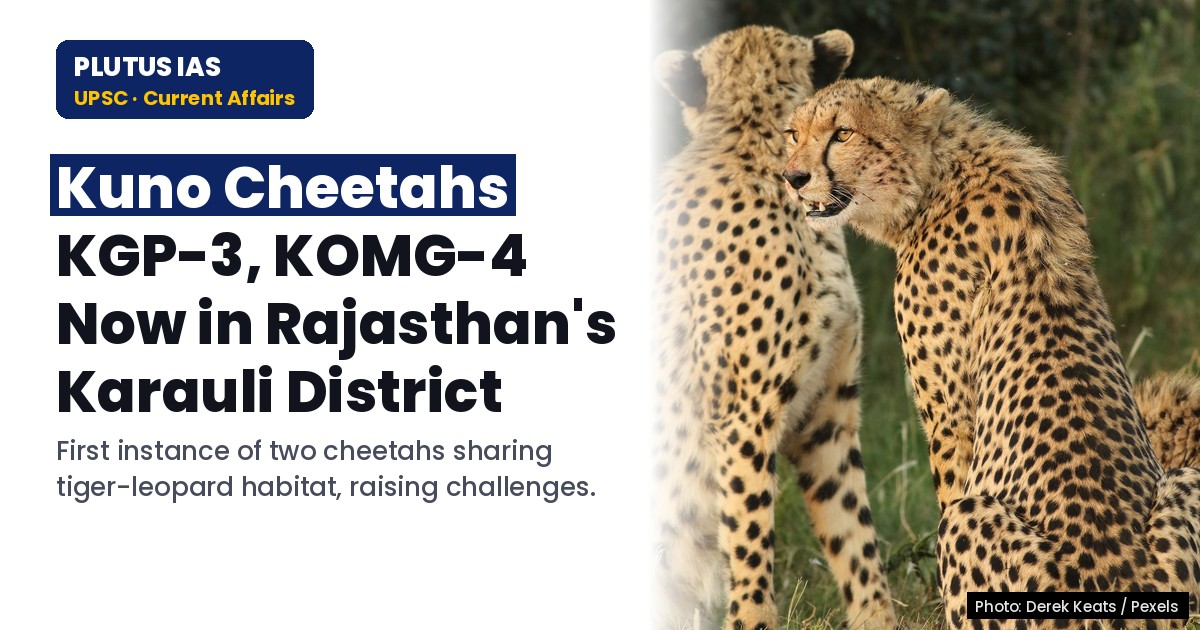
Two male cheetahs, KGP-3 and KOMG-4, from Kuno National Park in Madhya Pradesh, have expanded their range into the Karanpur range of Karauli district in Rajasthan. This marks the first instance of two Kuno cheetahs coexisting within the same range in Rajasthan, a region also inhabited by tigers and leopards, thereby intensifying the challenges associated with monitoring, security, and potential interspecific competition among large carnivores.
Background
- Project Cheetah, initiated in 2022, aims to reintroduce cheetahs to India, following their extinction in the country in 1952. The project involves translocating cheetahs from South Africa and Namibia to designated sites in India.
- Kuno National Park in Madhya Pradesh was selected as the primary reintroduction site due to its suitable habitat, prey base, and historical presence of cheetahs.
- The reintroduction initiative seeks to establish a viable cheetah population, contributing to global conservation efforts and restoring a critical component of India’s ecological heritage.
- Monitoring of translocated cheetahs is conducted using satellite collars to track their movements, assess their adaptation to the new environment, and mitigate potential conflicts.
- The expansion of cheetahs into new territories, such as the Karanpur range, necessitates adaptive management strategies to address challenges arising from their dispersal and interaction with existing carnivore populations.
- The Karanpur range is part of a larger landscape that supports a diverse array of wildlife, including apex predators like tigers and leopards, making it a complex ecological system for the integration of a new large carnivore species.
What is Project Cheetah?
- Project Cheetah is an ambitious conservation initiative by the Government of India to reintroduce cheetahs into the country after their local extinction in 1952.
- The project’s primary objective is to establish a self-sustaining, free-ranging population of cheetahs in India, thereby contributing to global cheetah conservation efforts.
- The reintroduction involves translocating cheetahs from source populations in African countries, specifically Namibia and South Africa, to designated sites in India.
- Kuno National Park in Madhya Pradesh was chosen as the initial reintroduction site due to its extensive grassland and open forest habitats, abundant prey species, and historical suitability for cheetahs.
- The project encompasses a comprehensive approach, including habitat management, prey augmentation, veterinary care, and continuous monitoring of the reintroduced animals.
- A key aspect of the project involves studying the ecological interactions of cheetahs with other large carnivores, such as leopards and tigers, within the same landscape.
- The project is implemented under the guidance of the National Tiger Conservation Authority (NTCA) and in collaboration with international cheetah conservation experts.
- Long-term goals include establishing multiple cheetah populations across suitable habitats in India to ensure genetic diversity and resilience against localized threats.
Key Features
| Feature | Significance |
|---|---|
| Inter-State Cheetah Movement | Indicates the natural dispersal behaviour of cheetahs and the potential for establishing a wider meta-population across suitable habitats. |
| Presence in Karauli’s Karanpur Range | Marks the first instance of two Kuno cheetahs co-existing in a specific range in Rajasthan, expanding their documented roaming area beyond Madhya Pradesh. |
| Co-occurrence with Tigers and Leopards | Highlights a unique ecological scenario where three apex predators share a single landscape, necessitating complex conservation strategies. |
| Chambal River Crossing by KOMG-4 | Demonstrates the cheetahs’ ability to traverse significant geographical barriers, suggesting adaptability and potential for natural corridor utilisation. |
| Monitoring of Cheetah Behaviour | Crucial for understanding social dynamics (e.g., coalition formation) and spatial ecology in a new environment, informing future management decisions. |
Why it Matters
Ecological Significance
- The expansion of cheetahs into new territories contributes to the broader goal of re-establishing a viable cheetah population in India, enhancing biodiversity.
- The co-existence of cheetahs, tigers, and leopards in the same landscape offers a unique opportunity for ecological research into inter-species interactions and resource partitioning among large carnivores.
- Natural dispersal patterns observed, such as the crossing of the Chambal River, indicate the potential for the establishment of ecological corridors, which are vital for long-term species survival and genetic exchange.
Conservation Significance
- The successful movement and establishment of cheetahs in Rajasthan signify progress in the ‘Project Cheetah’ initiative, validating efforts in habitat identification and translocation.
- Increased vigilance and monitoring in the Karanpur Range will generate valuable data on cheetah adaptation, prey base utilisation, and potential human-wildlife interface challenges in a multi-predator environment.
- This development underscores the importance of inter-state cooperation in wildlife management, as the movement of animals across administrative boundaries necessitates coordinated conservation actions.
Research and Management Significance
- The presence of multiple apex predators in one area provides a natural laboratory to study competitive exclusion, niche partitioning, and the dynamics of predator-prey relationships in a complex ecosystem.
- Monitoring the social behaviour of male cheetahs, particularly regarding coalition formation or solitary existence in a new habitat, is critical for understanding their reproductive strategies and territorial requirements.
- The challenges posed by managing three large carnivores in a shared habitat will inform the development of advanced wildlife management protocols, including enhanced tracking, conflict mitigation, and habitat restoration techniques.
Challenges
1. Inter-Species Competition
- The co-existence of cheetahs with established populations of tigers and leopards in the same range could lead to competition for prey and territorial disputes.
- Cheetahs, being less dominant than tigers and leopards, may face increased mortality risks or displacement from prime hunting grounds due to competitive interactions.
UPSC Link: Environment: Conservation, Environmental Impact Assessment
2. Monitoring and Security
- Tracking and ensuring the safety of multiple apex predators across a vast and potentially fragmented landscape pose significant logistical and resource challenges for forest departments.
- Preventing human-wildlife conflict, particularly with the expansion of cheetah territories into areas with human habitation or livestock, requires continuous vigilance and community engagement.
UPSC Link: Environment: Conservation, Security Challenges
3. Habitat Suitability and Connectivity
- Assessing the long-term suitability of the Karanpur Range, considering prey availability, habitat quality, and potential for further dispersal, is crucial for sustainable cheetah populations.
- Maintaining and establishing ecological corridors between Kuno National Park and potential new habitats in Rajasthan is essential for genetic diversity and population viability.
UPSC Link: Environment: Conservation, Habitat Fragmentation
4. Disease Transmission
- The interaction between different carnivore species in a shared habitat increases the risk of disease transmission, which could impact the health and survival of all populations, including the translocated cheetahs.
- Monitoring and managing potential disease outbreaks among wildlife populations require robust veterinary support and surveillance mechanisms.
UPSC Link: Environment: Biodiversity, Animal Health
Challenges — UPSC Perspective
| Issue | Concern |
|---|---|
| Predator Overlap | Potential for increased inter-species aggression and competition for resources among cheetahs, tigers, and leopards. |
| Prey Base Sustainability | Ensuring adequate prey populations to support three apex predator species in the Karanpur Range without over-depletion. |
| Human-Wildlife Interface | Mitigating potential conflicts arising from cheetahs venturing into human-dominated areas, especially in a new landscape. |
| Genetic Isolation | Risk of genetic bottlenecks if cheetah populations remain isolated without sufficient connectivity to other suitable habitats. |
| Monitoring Resource Intensity | The substantial financial and human resources required for continuous, intensive monitoring of multiple large carnivores. |
Government Initiatives — Must-Memorise for Prelims
- Project Cheetah
Way Forward
- Implement advanced satellite telemetry and camera trapping for continuous, real-time monitoring of cheetah movements, social interactions, and health status.
- Conduct comprehensive ecological studies to assess prey base dynamics, habitat carrying capacity, and inter-species competition within the Karanpur Range.
- Strengthen inter-state coordination between Madhya Pradesh and Rajasthan forest departments for integrated wildlife management and corridor protection.
- Engage local communities in conservation efforts through awareness campaigns, livelihood support, and conflict mitigation strategies to foster co-existence.
- Develop and implement a robust veterinary surveillance programme to monitor for diseases and ensure the health of all carnivore populations in the shared landscape.
- Identify and secure additional suitable habitats and ecological corridors to facilitate natural dispersal and establish a genetically viable meta-population of cheetahs.
- Formulate adaptive management strategies based on ongoing research findings to address emerging challenges related to predator interactions and habitat utilisation.
UPSC Value Addition
Keywords for Mains Answer-Writing
Cheetah reintroduction · Project Cheetah · Wildlife conservation · Habitat management · Predator-prey dynamics · Interspecific competition · Kuno National Park · Biodiversity preservation · Translocation challenges · Ecological balance
Concept Flow
Cheetahs translocated to Kuno National Park. → Cheetahs disperse naturally from Kuno. → Two male cheetahs enter Rajasthan’s Karanpur Range. → Karanpur Range already hosts tigers and leopards. → Three apex predators now share a single landscape. → Increased challenges in monitoring and inter-species management.
Prelims Practice Questions
Q1. Consider the following statements regarding the Cheetah reintroduction project in India:
1. Cheetahs were declared extinct in India in 1952.
2. The reintroduction project primarily involves African Cheetahs.
3. Kuno National Park in Madhya Pradesh is the only designated site for cheetah reintroduction.
How many of the above statements are correct?
- Only one
- Only two
- Only three
- None
Answer: Only two — Statement 1 is correct: Cheetahs were officially declared extinct in India in 1952. Statement 2 is correct: The reintroduction project involves African Cheetahs, specifically from Namibia and South Africa. Statement 3 is incorrect: While Kuno National Park is a primary site, other potential sites are being explored for future phases, and the recent news indicates cheetah movement into Rajasthan.
Q2. Match the following National Parks/Wildlife Sanctuaries with their associated conservation efforts:
1. Kuno National Park A. Asiatic Lion
2. Gir National Park B. One-horned Rhinoceros
3. Kaziranga National Park C. Cheetah
Which of the above pairs are correctly matched?
- 1-A, 2-B, 3-C
- 1-C, 2-A, 3-B
- 1-B, 2-C, 3-A
- 1-A, 2-C, 3-B
Answer: 1-C, 2-A, 3-B — Kuno National Park is associated with the Cheetah reintroduction project. Gir National Park is the last remaining habitat for the Asiatic Lion. Kaziranga National Park is renowned for its conservation of the Indian One-horned Rhinoceros.
Mains Practice Question
✍ Critically examine the ecological implications of introducing cheetahs into landscapes already inhabited by other large carnivores like tigers and leopards. Discuss the challenges and strategies for managing interspecific competition and ensuring the long-term viability of the reintroduction project. (15 Marks)
Approach: INTRODUCTION: Briefly introduce Project Cheetah and the current news of cheetahs entering tiger/leopard habitats. ECOLOGICAL IMPLICATIONS: Discuss potential interspecific competition for prey and territory, altered predator-prey dynamics, and potential impacts on existing carnivore populations and local ecosystems. CHALLENGES: Detail specific challenges such as habitat overlap, different hunting strategies of cheetahs, tigers, and leopards, risk of conflict, disease transmission, and monitoring difficulties. STRATEGIES FOR MANAGEMENT: Outline measures like extensive habitat monitoring, prey base augmentation, spatial separation techniques, community engagement, scientific research on interspecific interactions, and adaptive management protocols. LONG-TERM VIABILITY: Conclude by discussing the importance of these strategies for the sustained success of the reintroduction project and the broader goals of biodiversity conservation. Refer to the ‘carrying capacity’ of the habitat.
Source: bhaskar.com
Rajasthan PCS (RPSC / RAS) — State PCS Practice
Prelims: Recently, two male cheetahs from Kuno National Park were translocated to which of the following wildlife sanctuaries/reserves in Rajasthan, marking the first time cheetahs have been introduced to a tiger habitat in the state?
- A. Ranthambore National Park
- B. Sariska Tiger Reserve
- C. Mukundra Hills Tiger Reserve
- D. Ramgarh Vishdhari Tiger Reserve
Answer: D. Ramgarh Vishdhari Tiger Reserve — Two male cheetahs from Kuno were recently translocated to Ramgarh Vishdhari Tiger Reserve in Rajasthan, marking a significant step in cheetah conservation.
Mains: Discuss the potential ecological implications and conservation challenges associated with introducing cheetahs into a tiger habitat, with specific reference to the recent translocation in Rajasthan.
Generated by AanyaAi for educational purpose.
Related guides on our sites
- How to prepare for GS paper 1 for UPSC CSE mains exam
- Best UPSC coaching for IFOS exam
- Best geography optional coaching
- Best geography optional coaching

- Kuno Cheetahs in Rajasthan: UPSC Environment Analysis - November 13, 2026
- तेलंगाना के आर्थिक लक्ष्यों हेतु संरचनात्मक परिवर्तन व नीति गहनता आवश्यक: CESS अध्ययन - November 13, 2026
- CCPA Fines Ola for ‘Dark Patterns’ in Pre-Ride Tips - November 13, 2026

No Comments