


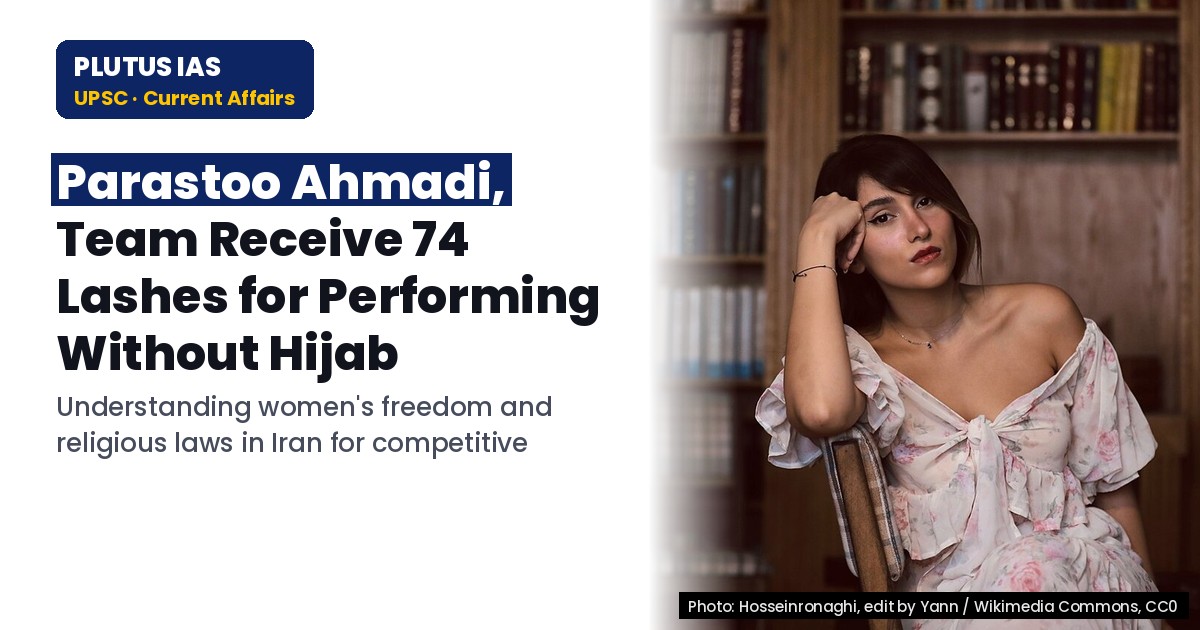
24 Nov Iran’s 74-Lash Sentence for Singer: Women’s Rights & Society
✎ The Parastoo Ahmadi case highlights the enforcement of religious laws in Iran, particularly concerning women's attire and public expression, leading to judicial penalties and drawing international scrutiny on human rights.
Subject Relevance — Where This Topic Fits
- GS Paper II — International Relations | GS Paper II — Social Justice | GS Paper II — Governance | GS Paper I — Society
- Prelims: Iran, Islamic Revolution, Sharia Law, Human Rights, Freedom of Expression, Women’s Rights, Judicial Punishment, Cultural Norms
- Essay: The intersection of religious law, state authority, and individual freedoms in contemporary societies., Examining the global discourse on human rights and cultural relativism.
Quick Revision: The Parastoo Ahmadi case highlights the enforcement of religious laws in Iran, particularly concerning women’s attire and public expression, leading to judicial penalties and drawing international scrutiny on human rights.
Why is this in the news?
Iranian singer Parastoo Ahmadi and four members of her team were reportedly subjected to 74 lashes following a judicial sentence. Their alleged transgression involved performing a musical concert without adhering to the mandatory hijab and subsequently disseminating the video online. This incident has reignited international discussions regarding the scope of women’s rights, freedom of expression, and the application of religious laws in Iran.
Background
- The 1979 Islamic Revolution in Iran led to the establishment of an Islamic Republic, fundamentally transforming the nation’s legal and social framework.
- Post-revolution, the legal system in Iran became largely based on interpretations of Islamic Sharia law, influencing various aspects of public and private life.
- Mandatory veiling (hijab) for women in public spaces was enforced, becoming a cornerstone of the Islamic Republic’s social regulations.
- Restrictions on women’s public roles, including their participation in certain artistic and musical performances, were instituted.
- The Iranian government has consistently dismissed international criticisms regarding its human rights record, often citing cultural sovereignty and the need to address internal issues in criticising nations.
- The case of Parastoo Ahmadi originated in December 2024, when she recorded an ‘Imaginary Concert’ without a hijab in a historical caravanserai in Qom province, which subsequently garnered millions of views online.
Understanding Judicial Punishments and Women’s Rights in Iran
- The Iranian legal system, post-1979, incorporates elements of Islamic jurisprudence, where certain acts deemed contrary to religious or moral codes can incur specific judicial penalties.
- The mandatory hijab law requires all women, including foreign visitors, to cover their hair and wear loose-fitting clothing in public.
- Violations of public decency and moral codes, particularly concerning women’s attire and public conduct, are subject to legal prosecution and can result in various forms of punishment, including fines, imprisonment, and corporal punishment.
- The judiciary in Iran operates under the oversight of religious authorities, with courts enforcing laws derived from Islamic principles.
- Women’s participation in public singing, especially solo performances before mixed-gender audiences, is generally restricted or prohibited under current interpretations of Islamic law in Iran.
- The Parastoo Ahmadi case involved charges of ‘public indecency’ and ‘producing and disseminating obscene and immoral content online’ for her performance without a hijab.
- The sentence included 74 lashes, a two-year ban on artistic activities, and a two-year travel ban, upheld by an appeals court.
- International human rights organisations frequently express concerns over the application of corporal punishment and restrictions on fundamental freedoms in Iran, citing potential violations of international human rights conventions.
Key Features
| Feature | Significance |
|---|---|
| Public Decorum and Morality Laws | These laws, rooted in Islamic jurisprudence, dictate acceptable public behavior, dress, and artistic expression, particularly for women, reflecting the state’s interpretation of religious norms. |
| Restrictions on Women’s Public Performance | The prohibition of women singing in public, especially without specific attire like the hijab, underscores the state’s control over women’s participation in cultural and public life. |
| Judicial System and Punishments | The application of corporal punishment, such as lashing, for violations of public morality laws highlights the severity of penalties and the nature of the legal framework in certain jurisdictions. |
| Online Content Regulation | The prosecution for disseminating content online that violates state norms demonstrates efforts to extend legal and cultural controls into the digital sphere, impacting freedom of expression. |
| International Human Rights Scrutiny | The consistent international criticism regarding human rights records, particularly concerning women’s rights and freedom of expression, indicates a global divergence in legal and ethical standards. |
Why it Matters
Socio-Cultural Implications
- The incident underscores the ongoing tension between traditional religious interpretations and contemporary expressions of individual freedom, particularly concerning women’s roles in public life and artistic endeavors.
- It highlights the state’s stringent enforcement of dress codes and behavioral norms, which significantly impact personal liberties and cultural practices within the society.
- The case reflects broader societal debates on gender equality, artistic freedom, and the extent of state control over private and public spheres of life.
Governance and Legal Framework
- The application of Sharia-based laws in the judicial system demonstrates the integration of religious doctrine into state governance, influencing legal pronouncements and punitive measures.
- It illustrates the mechanisms through which legal systems can be utilized to enforce specific moral and cultural codes, leading to severe penalties for perceived transgressions.
- The rejection of international human rights criticisms by the state indicates a sovereign stance on internal legal matters, often prioritizing domestic legal interpretations over global norms.
International Relations and Human Rights
- The incident draws international attention to human rights conditions, particularly women’s rights and freedom of expression, potentially impacting diplomatic relations and global perceptions.
- It contributes to the ongoing discourse on universal human rights standards versus cultural relativism, where different states interpret and apply rights based on their unique socio-political and religious contexts.
- Such events often lead to advocacy from international human rights organizations, calling for greater adherence to international conventions and protections for individual liberties.
Challenges
1. Freedom of Expression and Artistic Liberty
- The imposition of severe penalties for artistic performances that do not conform to state-mandated norms curtails creative expression.
- Artists face significant risks when their work challenges established cultural or religious interpretations, leading to self-censorship or legal repercussions.
UPSC Link: International Relations, Human Rights
2. Women’s Rights and Public Participation
- Restrictions on women’s attire and public activities limit their autonomy and participation in social, cultural, and economic spheres.
- The enforcement of gender-specific conduct codes can perpetuate gender inequality and restrict opportunities for women in public life.
UPSC Link: Social Justice, Gender Issues
3. Adherence to International Human Rights Standards
- The application of corporal punishment and restrictions on fundamental freedoms often conflicts with international human rights covenants and declarations.
- States face scrutiny and criticism from international bodies and other nations for practices perceived as violations of universal human rights principles.
UPSC Link: International Relations, Human Rights
4. Digital Content Regulation and Surveillance
- The prosecution for online dissemination of content highlights the challenges of regulating digital spaces while upholding freedom of speech.
- Governments’ efforts to control online narratives and content can lead to concerns about digital surveillance and censorship.
UPSC Link: Internal Security, Cyber Security
Challenges — UPSC Perspective
| Issue | Concern |
|---|---|
| Freedom of Artistic Expression | The state’s legal framework imposes significant restrictions on artistic activities, particularly music and public performances, limiting creative freedom. |
| Women’s Autonomy and Public Role | Laws dictating women’s attire and public conduct restrict their personal autonomy and participation in public life, including cultural events. |
| Judicial Punishments | The application of corporal punishment, such as lashing, raises serious human rights concerns regarding cruel, inhuman, or degrading treatment. |
| International Norms vs. Domestic Laws | There is a persistent divergence between the state’s interpretation and enforcement of laws, often based on religious jurisprudence, and internationally recognized human rights standards. |
| Online Content Control | The prosecution for online dissemination of content indicates a broad effort to control digital media, potentially infringing on freedom of information and expression. |
Way Forward
- Promote dialogue between state authorities and civil society organizations to foster a common understanding of human rights and cultural expression.
- Encourage legal reforms that align domestic laws with international human rights conventions, particularly concerning freedom of expression and women’s rights.
- Support educational initiatives to raise awareness about gender equality and the importance of diverse cultural and artistic contributions.
- Advocate for the abolition of corporal punishment and other forms of cruel, inhuman, or degrading treatment in judicial systems.
- Facilitate international cooperation and cultural exchange programs to foster mutual understanding and respect for diverse legal and cultural frameworks.
- Explore mechanisms for independent oversight of legal processes to ensure fairness, transparency, and adherence to due process.
UPSC Value Addition
Keywords for Mains Answer-Writing
Human Rights · Freedom of Expression · Cultural Rights · Gender Equality · International Law · Religious Law · State Sovereignty · Universal Declaration of Human Rights · International Covenant on Civil and Political Rights · Islamic Revolution
Concept Flow
Artistic performance without prescribed attire and public conduct. → Video disseminated online, reaching a wide audience. → Authorities deem content a violation of public decency and cultural norms. → Legal proceedings initiated, leading to conviction. → Imposition of corporal punishment and restrictions on artistic activities.
Prelims Practice Questions
Q1. Consider the following statements regarding international human rights instruments:
1. The Universal Declaration of Human Rights (UDHR) is a legally binding treaty.
2. The International Covenant on Civil and Political Rights (ICCPR) protects the right to freedom of expression.
3. India is a signatory to both the UDHR and the ICCPR.
How many of the above statements are correct?
- Only one
- Only two
- Only three
- None
Answer: Only two — Statement 1 is incorrect: The UDHR is a declaration, not a legally binding treaty, though many of its provisions have become customary international law. Statement 2 is correct: Article 19 of the ICCPR explicitly protects the right to freedom of expression. Statement 3 is incorrect: While India is a signatory to the ICCPR, the UDHR is a declaration and not subject to signature or ratification by states.
Q2. Which of the following international bodies is primarily responsible for monitoring the implementation of the International Covenant on Civil and Political Rights (ICCPR)?
- United Nations Security Council
- International Court of Justice
- Human Rights Committee
- United Nations Human Rights Council
Answer: Human Rights Committee — The Human Rights Committee is the body of independent experts that monitors implementation of the International Covenant on Civil and Political Rights by its State parties. The UN Human Rights Council is a broader inter-governmental body.
Mains Practice Question
✍ Examine the challenges to the universal application of human rights principles, particularly in the context of cultural and religious diversity. Discuss with reference to the concept of cultural relativism and state sovereignty. (15 Marks)
Approach: MODEL-ANSWER SKELETON: Introduction: Define universal human rights (e.g., UDHR, ICCPR) and their foundational principles. Body Paragraph 1: Challenges to universality – Cultural Relativism: Explain the argument that human rights are culturally specific and not universally applicable, citing examples where cultural practices conflict with universal norms (e.g., certain interpretations of religious law, traditional practices). Body Paragraph 2: Challenges to universality – State Sovereignty: Discuss how states invoke sovereignty to resist external scrutiny of their human rights records, emphasizing non-interference in internal affairs (e.g., Iran’s stance on human rights criticisms). Body Paragraph 3: Counterarguments to relativism and sovereignty: Argue for the indivisibility and universality of human rights, citing the ‘Vienna Declaration and Programme of Action’ (1993) which affirmed universality. Discuss the concept of ‘responsibility to protect’ (R2P) as a limitation on absolute sovereignty in cases of grave human rights violations. Body Paragraph 4: Reconciling universality and diversity: Explore approaches like ‘cultural sensitivity’ within a universal framework, emphasizing dialogue and progressive realization of rights. Conclusion: Summarize the ongoing tension and the need for a balanced approach that upholds universal standards while acknowledging legitimate cultural diversity, without compromising fundamental human dignity.
Source: abplive.com
Generated by AanyaAi for educational purpose.
Related guides on our sites
- Current affairs for upsc 2026
- Best sociology optional coaching for upsc
- Which is best sociology optional coaching for upsc
- Best teacher of sociology optional for upsc

- Iran’s 74-Lash Sentence for Singer: Women’s Rights & Society - November 24, 2026
- भारत-ईयू मुक्त व्यापार समझौता: द्विपक्षीय संबंधों पर प्रभाव - November 24, 2026
- Adani Tarali Project: Cost Dispute & Wildlife Fee Explained - November 24, 2026

No Comments