


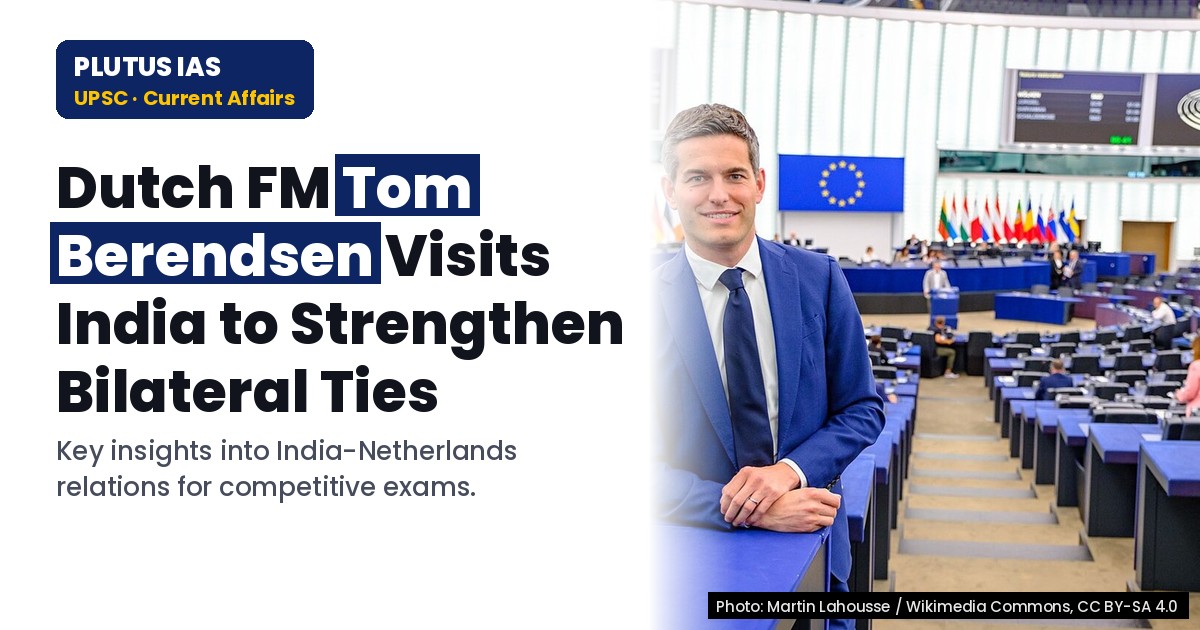
24 Nov Netherlands FM India Visit: Key Bilateral Relations Insights
✎ The recent visit of the Dutch Foreign Minister underscores the deepening strategic partnership between India and the Netherlands, focusing on economic cooperation, water management, and sustainable development initiatives.
Subject Relevance — Where This Topic Fits
- GS Paper II — International Relations: Bilateral, regional and global groupings and agreements involving India and/or affecting India’s interests; Effect of policies and politics of developed and developing countries on India’s interests, Indian diaspora. | GS Paper III — Economy: Liberalization, industrial policy, infrastructure (energy, ports, roads, airports, railways, etc.).
- Prelims: India-Netherlands relations, Strategic Partnership on Water, Indo-Pacific Oceans Initiative (IPOI), Circular Economy, Foreign Direct Investment (FDI), European Union (EU)
- Essay: The evolving dynamics of India’s foreign policy in a multipolar world., Economic diplomacy as a tool for national development and global influence.
Quick Revision: The recent visit of the Dutch Foreign Minister underscores the deepening strategic partnership between India and the Netherlands, focusing on economic cooperation, water management, and sustainable development initiatives.
Why is this in the news?
Mr. Tom Berendsen, the Minister of Foreign Affairs of the Kingdom of the Netherlands, undertook an official visit to India from November 22-23, 2026. This high-level visit aimed to further strengthen the multifaceted bilateral relationship between India and the Netherlands, encompassing areas such as trade, investment, technology, water management, and sustainable development, thereby reinforcing the strategic partnership between the two nations.
Background
- India and the Netherlands share a long-standing relationship rooted in historical ties, cultural exchanges, and a shared commitment to democratic values.
- The Netherlands is a significant economic partner for India within the European Union, serving as a gateway for Indian goods and services into the European market.
- Bilateral trade has shown consistent growth, with substantial Dutch investments in India across various sectors, including infrastructure, manufacturing, and services.
- The ‘Strategic Partnership on Water’ was established in 2019, focusing on collaborative efforts in water management, including river rejuvenation, delta management, and wastewater treatment.
- Both nations are actively engaged in multilateral forums and share perspectives on global issues such as climate change, sustainable development goals, and maritime security.
- The Indian diaspora in the Netherlands constitutes a vibrant community, contributing to the cultural and economic fabric of both countries and acting as a bridge between them.
Key Areas of India-Netherlands Bilateral Cooperation
- Economic and Trade Relations: The Netherlands is a major trading partner and a significant source of Foreign Direct Investment (FDI) for India, particularly in sectors like logistics, agriculture, and high-tech manufacturing.
- Water Management: The ‘Strategic Partnership on Water’ facilitates knowledge sharing and technological collaboration in areas such as flood management, water purification, and sustainable water use, leveraging Dutch expertise in this domain.
- Agriculture and Food Processing: Cooperation extends to areas like horticulture, dairy farming, and food processing, with a focus on sustainable agricultural practices and enhancing food security.
- Science and Technology: Collaborative research and development initiatives are pursued in fields such as renewable energy, health, and information technology, fostering innovation and technological advancements.
- Circular Economy: Both countries are exploring partnerships to promote circular economy principles, focusing on waste management, resource efficiency, and sustainable consumption and production patterns.
- People-to-People Connect: Cultural exchanges, educational collaborations, and the presence of a substantial Indian diaspora in the Netherlands strengthen the human dimension of the bilateral relationship.
- Multilateral Cooperation: India and the Netherlands collaborate on various global platforms, including the United Nations, to address common challenges such as climate change, terrorism, and global health.
Key Features
| Feature | Significance |
|---|---|
| High-Level Diplomatic Engagement | Reinforces bilateral relations and facilitates direct communication on matters of mutual interest, fostering a conducive environment for cooperation. |
| Ministerial-Level Representation | Indicates the importance both nations attach to their relationship, allowing for substantive discussions and policy coordination at a senior executive level. |
| Scheduled Bilateral Visit | Provides a structured platform for reviewing existing collaborations and exploring new avenues for partnership across various sectors. |
| Focus on Foreign Affairs | Suggests discussions on geopolitical developments, regional stability, multilateral cooperation, and international policy alignment. |
| Strengthening of India-Netherlands Ties | Contributes to the deepening of a long-standing relationship, which spans economic, political, and cultural dimensions. |
Why it Matters
Geopolitical Significance
- Enhances India’s diplomatic outreach with key European partners, contributing to a diversified foreign policy strategy.
- Facilitates alignment on global issues such as climate change, sustainable development, and multilateral institutional reforms.
- Strengthens India’s position as a significant actor in international relations, engaging with developed economies on a peer-to-peer basis.
Economic Significance
- Potential for increased trade and investment flows between India and the Netherlands, a major European economy and gateway.
- Opportunities for collaboration in sectors where the Netherlands possesses expertise, such as water management, agriculture, and renewable energy.
- Facilitates discussions on market access, regulatory frameworks, and business environment improvements to foster economic partnerships.
Strategic Significance
- Deepens strategic dialogue on regional security, counter-terrorism, and maritime cooperation, given both nations’ interests in a stable global order.
- Explores avenues for technological collaboration, particularly in advanced manufacturing, digital technologies, and innovation.
- Contributes to building a network of like-minded partners committed to rules-based international order and multilateralism.
Bilateral Relations
- Reaffirms the commitment of both nations to a robust and comprehensive bilateral partnership.
- Provides an opportunity to review the progress of ongoing joint initiatives and identify areas for further cooperation.
- Fosters cultural exchange and people-to-people connections, strengthening the foundation of the bilateral relationship.
Challenges
1. Global Economic Headwinds
- Uncertainty in global economic growth and trade patterns can impact the pace and scale of bilateral economic cooperation.
- Inflationary pressures and supply chain disruptions may affect investment decisions and project implementation.
UPSC Link: Economy: International Trade
2. Geopolitical Volatility
- Ongoing conflicts and regional tensions can divert diplomatic attention and resources, potentially impacting the focus on bilateral agendas.
- Shifting alliances and evolving international power dynamics may necessitate continuous recalibration of foreign policy approaches.
UPSC Link: International Relations: Global Groupings
3. Regulatory and Market Access Issues
- Differences in regulatory frameworks and standards between India and the Netherlands can pose challenges for businesses operating in both markets.
- Non-tariff barriers and market access restrictions may impede the full potential of bilateral trade and investment.
UPSC Link: Economy: Trade Policy
4. Climate Change and Sustainability Commitments
- Achieving ambitious climate targets requires significant investment and technological transfer, which can be complex to coordinate bilaterally.
- Ensuring equitable burden-sharing and common but differentiated responsibilities remains a challenge in international climate negotiations.
UPSC Link: Environment: Climate Change
5. Technological Cooperation Hurdles
- Intellectual property rights protection and technology transfer mechanisms can be complex, requiring robust legal frameworks and trust.
- Ensuring cybersecurity and data privacy in collaborative technological ventures is crucial but challenging in a rapidly evolving digital landscape.
UPSC Link: Science & Tech: IPR Issues
Challenges — UPSC Perspective
| Issue | Concern |
|---|---|
| Trade Imbalance | Addressing potential disparities in bilateral trade volumes and ensuring equitable benefits for both economies. |
| Investment Barriers | Identifying and mitigating regulatory or bureaucratic hurdles that may deter foreign direct investment. |
| Technology Transfer | Facilitating the smooth and mutually beneficial transfer of advanced technologies while safeguarding intellectual property. |
| Multilateral Coordination | Aligning positions on complex global issues within various international forums, despite differing national interests. |
| People-to-People Connectivity | Enhancing cultural exchange, tourism, and educational opportunities to strengthen societal bonds. |
Way Forward
- Sustain high-level diplomatic engagements to maintain momentum in bilateral relations and address emerging issues proactively.
- Identify and promote specific sectors for enhanced economic cooperation, such as green technologies, smart cities, and port development.
- Establish joint working groups to streamline regulatory processes and address market access concerns for businesses.
- Intensify collaboration on global challenges, including climate action, sustainable development goals, and multilateral institutional reforms.
- Foster greater academic and research partnerships to facilitate knowledge exchange and innovation in critical areas.
- Promote cultural exchanges and tourism to strengthen people-to-people connections and mutual understanding.
- Regularly review and update existing bilateral agreements to ensure their relevance and effectiveness in the evolving global landscape.
UPSC Value Addition
Keywords for Mains Answer-Writing
India-Netherlands relations · Bilateral cooperation · Strategic partnership · Economic diplomacy · Multilateral engagement · Indo-Pacific strategy · Green strategic partnership · Circular economy · Water management · Agricultural technology
Constitutional & Policy Linkages
- {‘Article 51’: ‘Promotion of international peace and security’}
Concept Flow
Ministerial visit occurs → Bilateral discussions on key areas → Identification of cooperation opportunities → Formulation of joint initiatives/agreements → Implementation of collaborative projects → Strengthening of India-Netherlands relations
Prelims Practice Questions
Q1. Consider the following statements regarding India-Netherlands bilateral relations:
1. The Netherlands is India’s fourth-largest trading partner in the European Union.
2. India and the Netherlands have a ‘Green Strategic Partnership’ focused on water and agriculture.
3. The Netherlands is a significant source of Foreign Direct Investment (FDI) into India.
How many of the above statements are correct?
- Only one
- Only two
- Only three
- None
Answer: Only three — Statement 1 is incorrect; the Netherlands is among India’s top trading partners in the EU but not consistently the fourth largest. The ranking can fluctuate. Statement 2 is correct; the ‘Green Strategic Partnership’ emphasizes cooperation in water management, sustainable agriculture, and circular economy. Statement 3 is correct; the Netherlands has historically been one of the largest sources of FDI into India, often ranking among the top five.
Q2. Which of the following initiatives or agreements is most relevant to strengthening economic ties between India and the Netherlands?
- Comprehensive Economic Partnership Agreement (CEPA) with ASEAN
- India-EU Free Trade Agreement negotiations
- Quadrilateral Security Dialogue (Quad)
- BRICS New Development Bank
Answer: India-EU Free Trade Agreement negotiations — The India-EU Free Trade Agreement negotiations are directly relevant as the Netherlands is a prominent member of the European Union, and a comprehensive trade agreement would significantly enhance bilateral economic relations within that framework. The other options are either not directly bilateral or relate to different geopolitical/economic blocs.
Mains Practice Question
✍ Examine the evolving contours of India-Netherlands bilateral relations in the context of India’s ‘Act East’ policy and its broader engagement with the European Union. Discuss the key areas of cooperation and potential for future collaboration. (15 Marks)
Approach: MODEL-ANSWER SKELETON: The answer should first delineate the historical and contemporary significance of India-Netherlands relations. It must then connect this relationship to India’s ‘Act East’ policy, explaining how the Netherlands, as a gateway to Europe and a maritime nation, fits into this strategic outreach. The discussion should also integrate the broader India-EU relationship, positioning bilateral ties within that larger framework. Key areas of cooperation to be detailed include: 1. Economic and Trade (FDI, trade volume, specific sectors like IT, chemicals, pharmaceuticals). 2. Green Strategic Partnership (water management, sustainable agriculture, circular economy, renewable energy). 3. Science and Technology (innovation, research collaboration). 4. People-to-people ties (diaspora, cultural exchange, education). 5. Multilateral cooperation (UN, G20, climate change). Potential for future collaboration should focus on emerging sectors, enhanced strategic dialogue, and addressing global challenges jointly. Conclude by emphasizing the mutual benefits and strategic alignment.
Source: Ministry of External Affairs
Generated by AanyaAi for educational purpose.
Related guides on our sites
- Current affairs for upsc 2026
- Best PSIR optional coaching for upsc
- Best PSIR optional teacher for upsc
- Best teacher of PSIR optional for upsc

- Netherlands FM India Visit: Key Bilateral Relations Insights - November 24, 2026
- केंद्रीय मंत्री डॉ. वीरेंद्र कुमार द्वारा समावेश और ई-अनुदान पोर्टल का शुभारंभ - November 24, 2026
- COP31 Failure: Implications for India’s Climate Action - November 24, 2026

No Comments