


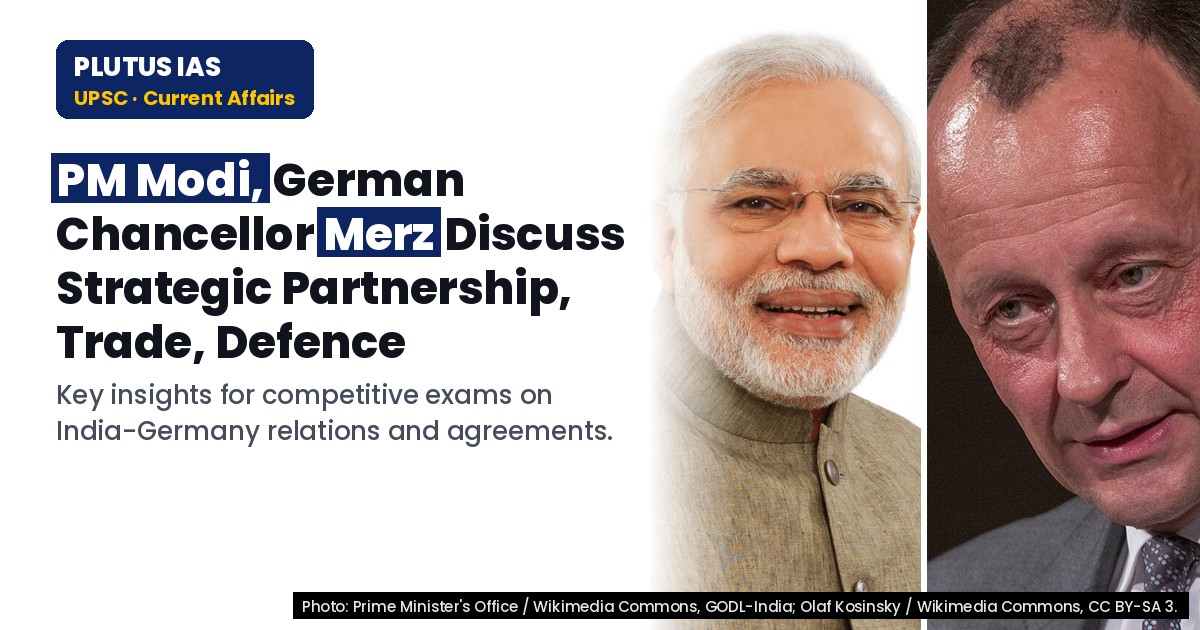
24 Nov India-Germany Strategic Partnership: Defence & Trade
✎ The India-Germany Strategic Partnership is a multifaceted bilateral relationship focused on enhancing cooperation across trade, investment, defence, and advanced technologies, underpinned by shared commitments to multilateralism…
Subject Relevance — Where This Topic Fits
- GS Paper II — International Relations: Bilateral, regional and global groupings and agreements involving India and/or affecting India’s interests; Effect of policies and politics of developed and developing countries on India’s interests, Indian diaspora. | GS Paper III — Economy: Indian Economy and issues relating to planning, mobilization of resources, growth, development and employment; Infrastructure: Energy, Ports, Roads, Airports, Railways etc.; Investment models.
- Prelims: India-Germany Strategic Partnership, Friedrich Merz, India-EU Free Trade Agreement, Multilateral fora, Rules-based international order, Defence cooperation, Advanced technologies
- Essay: India’s Evolving Role in a Multipolar World: Opportunities and Challenges in Strategic Partnerships., The Significance of Economic Diplomacy in India’s Foreign Policy.
Quick Revision: The India-Germany Strategic Partnership is a multifaceted bilateral relationship focused on enhancing cooperation across trade, investment, defence, and advanced technologies, underpinned by shared commitments to multilateralism and a rules-based international order.
Why is this in the news?
Prime Minister Narendra Modi recently engaged in a telephonic conversation with German Chancellor Friedrich Merz, during which they reviewed the progress of the India-Germany Strategic Partnership. The leaders discussed avenues for enhanced cooperation in trade, investment, defence, and advanced technologies, reaffirming their commitment to strengthening bilateral ties as both nations commemorate 75 years of diplomatic relations. Discussions also encompassed regional and global developments, underscoring the importance of continued collaboration in multilateral fora.
Background
- India and Germany established diplomatic relations in 1951, marking a long history of bilateral engagement.
- The relationship was elevated to a ‘Strategic Partnership’ in 2000, signifying a deeper commitment to comprehensive cooperation.
- Both nations have regularly held Inter-Governmental Consultations (IGC) since 2011, a unique mechanism for high-level dialogue and coordination.
- Germany is a significant economic partner for India, being one of its largest trading partners within the European Union.
- Cooperation extends across various sectors including trade, investment, science and technology, education, culture, and defence.
- The ongoing negotiations for the India-EU Free Trade Agreement are anticipated to significantly boost bilateral trade and investment between India and Germany.
India-Germany Strategic Partnership
- The India-Germany Strategic Partnership is a comprehensive framework for bilateral cooperation, encompassing political, economic, security, and cultural dimensions.
- It is characterized by regular high-level exchanges, including Inter-Governmental Consultations (IGC) led by the respective heads of government.
- Economic cooperation is a cornerstone, with Germany being a major source of foreign direct investment (FDI) into India and a key trading partner.
- Collaboration in defence and security includes joint exercises, technology transfer, and cooperation in defence manufacturing.
- Both countries are committed to working together on global issues such as climate change, sustainable development, and promoting a rules-based international order.
- The partnership emphasizes cooperation in advanced technologies, including artificial intelligence, renewable energy, and digital transformation.
- Cultural and educational exchanges are promoted through various initiatives, fostering people-to-people connections.
- The partnership aims to leverage synergies between India’s economic growth and Germany’s technological prowess for mutual benefit and global stability.
Key Features
| Feature | Significance |
|---|---|
| Strategic Partnership | Elevates bilateral relations beyond transactional exchanges to encompass shared geopolitical interests and long-term cooperation. |
| Trade and Investment | Aims to enhance economic ties, foster capital flows, and integrate supply chains, thereby boosting economic growth and employment in both nations. |
| Defence Cooperation | Focuses on joint development, co-production, and procurement of advanced defence technologies, contributing to national security and strategic autonomy. |
| Advanced Technologies | Involves collaboration in emerging and critical technologies, driving innovation, research and development, and industrial competitiveness. |
| India-EU Free Trade Agreement (FTA) | Expected to reduce tariffs and non-tariff barriers, facilitating greater market access and expanding bilateral trade and investment opportunities between India and Germany within the broader EU framework. |
| Multilateral Fora Cooperation | Emphasises coordinated efforts in international organisations to address global challenges and uphold a rules-based international order. |
Why it Matters
Geopolitical Significance
- Strengthens India’s position as a key player in the Indo-Pacific region and enhances its strategic autonomy through diversified partnerships.
- Reinforces the global commitment to a rules-based international order, particularly in the context of evolving geopolitical dynamics.
- Provides a counterweight to emerging global power imbalances by fostering cooperation among like-minded democratic nations.
Economic Significance
- Facilitates increased bilateral trade and foreign direct investment, contributing to economic growth and job creation in both India and Germany.
- Promotes the integration of supply chains, enhancing resilience and reducing vulnerabilities to global economic shocks.
- Accelerates technological transfer and joint innovation, particularly in advanced manufacturing, renewable energy, and digital technologies.
Security and Defence Significance
- Enhances India’s defence capabilities through access to advanced German defence technologies and expertise.
- Fosters co-development and co-production initiatives, aligning with India’s ‘Atmanirbhar Bharat’ vision in the defence sector.
- Contributes to regional stability by strengthening India’s capacity as a net security provider.
Diplomatic Significance
- Marks 75 years of diplomatic relations, signifying a mature and enduring partnership built on mutual respect and shared values.
- Underscores the importance of bilateral dialogues at the highest levels for addressing complex global and regional issues.
- Demonstrates India’s proactive engagement with major global economies to advance its national interests and global responsibilities.
Challenges
1. Trade Imbalances and Market Access
- Addressing existing trade imbalances and ensuring equitable market access for Indian goods and services in Germany.
- Navigating non-tariff barriers and regulatory complexities that may impede smoother trade flows.
UPSC Link: GS Paper 3: Indian Economy and issues relating to planning, mobilization of resources, growth, development and employment.
2. Technology Transfer and Intellectual Property Rights
- Facilitating seamless transfer of advanced technologies while safeguarding intellectual property rights of both nations.
- Ensuring that technology collaboration translates into tangible benefits for India’s indigenous industrial base.
UPSC Link: GS Paper 3: Science and Technology – developments and their applications and effects in everyday life. Indigenization of technology and developing new technology.
3. Geopolitical Divergences
- Managing potential divergences in approaches to certain regional and global geopolitical issues.
- Ensuring alignment on critical matters such as climate change, multilateral reforms, and regional security dynamics.
UPSC Link: GS Paper 2: India and its neighborhood- relations. Bilateral, regional and global groupings and agreements involving India and/or affecting India’s interests.
4. Bureaucratic Hurdles and Implementation Gaps
- Overcoming bureaucratic complexities and ensuring efficient implementation of agreed-upon initiatives and projects.
- Streamlining approval processes for investments and joint ventures to expedite cooperation.
UPSC Link: GS Paper 2: Government policies and interventions for development in various sectors and issues arising out of their design and implementation.
5. Global Economic Headwinds
- Mitigating the impact of global economic slowdowns, inflationary pressures, and supply chain disruptions on bilateral trade and investment.
- Adapting cooperation strategies to respond effectively to evolving global economic landscapes.
UPSC Link: GS Paper 3: Effects of liberalization on the economy, changes in industrial policy and their effects on industrial growth.
Challenges — UPSC Perspective
| Issue | Concern |
|---|---|
| Trade Barriers | Potential for non-tariff barriers and regulatory differences to hinder full realisation of trade potential, even with an FTA. |
| Investment Climate | Ensuring a consistently attractive and stable investment environment in India for German businesses, addressing ease of doing business. |
| Defence Technology Transfer | Balancing strategic autonomy with the need for advanced technology acquisition, including local manufacturing capabilities. |
| Global Supply Chain Resilience | Diversifying and strengthening supply chains to reduce dependencies and enhance resilience against disruptions. |
| Multilateral Consensus | Achieving common ground on complex global issues within multilateral fora, given diverse national interests. |
Way Forward
- Expedite the finalisation and implementation of the India-EU Free Trade Agreement to unlock full bilateral trade and investment potential.
- Establish dedicated joint working groups for specific sectors like advanced technologies, defence manufacturing, and green energy to foster targeted collaboration.
- Promote greater business-to-business interaction and investment facilitation through regular dialogues and streamlined regulatory processes.
- Enhance cooperation in research and development, particularly in areas of mutual strategic interest such as artificial intelligence, quantum computing, and sustainable technologies.
- Strengthen defence industrial collaboration through co-development and co-production initiatives, aligning with India’s ‘Make in India’ and ‘Atmanirbhar Bharat’ objectives.
- Increase cultural and educational exchanges to foster deeper understanding and people-to-people connections, building a strong foundation for long-term partnership.
- Coordinate positions on global issues within multilateral fora, such as the G20 and the United Nations, to promote shared values and a rules-based international order.
- Regularly review and assess the progress of the Strategic Partnership to identify new opportunities and address emerging challenges proactively.
UPSC Value Addition
Keywords for Mains Answer-Writing
India-Germany Strategic Partnership · Bilateral Trade and Investment · Defence Cooperation · Advanced Technologies · India-EU Free Trade Agreement · Multilateral Fora · Rules-Based International Order · Diplomatic Relations · Supply Chain Integration · Global Challenges
Constitutional & Policy Linkages
- {‘article’: ‘Article 51’, ‘note’: ‘Promotion of international peace and security’}
- {‘article’: ‘Seventh Schedule’, ‘note’: ‘Union List (Entry 10: Foreign Affairs)’}
Concept Flow
High-level bilateral dialogue between leaders. → Review of existing Strategic Partnership momentum. → Identification of new opportunities in trade, defence, technology. → Emphasis on India-EU Free Trade Agreement for economic expansion. → Discussion on regional and global developments. → Commitment to multilateral cooperation for global challenges.
Prelims Practice Questions
Q1. Consider the following statements regarding India-Germany relations:
1. India and Germany are celebrating 75 years of diplomatic relations in the current year.
2. The India-EU Free Trade Agreement is expected to reduce tariffs on many industrial and agricultural products.
3. Germany is a founding member of the Shanghai Cooperation Organisation (SCO).
How many of the above statements are correct?
- Only one
- Only two
- Only three
- None
Answer: Only two — Statement 1 is correct as the news explicitly mentions India and Germany celebrating 75 years of diplomatic relations. Statement 2 is correct as the German Ambassador stated the India-EU FTA would reduce tariffs on industrial and partially on agricultural products. Statement 3 is incorrect; Germany is not a member of the SCO.
Q2. Which of the following sectors were specifically highlighted for enhanced cooperation during the recent telephonic conversation between Prime Minister Modi and German Chancellor Merz?
1. Trade and Investment
2. Defence
3. Advanced Technologies
4. Space Exploration
- 1 and 2 only
- 2 and 3 only
- 1, 2 and 3 only
- 1, 2, 3 and 4
Answer: 1, 2 and 3 only — The news report explicitly mentions ‘trade and investment, defence and advanced technologies’ as areas of discussion for unlocking new opportunities and strengthening cooperation. Space exploration was not mentioned.
Mains Practice Question
✍ Examine the significance of the India-Germany Strategic Partnership in the context of India’s foreign policy objectives. Discuss how the proposed India-EU Free Trade Agreement could further deepen this bilateral relationship. (15 Marks)
Approach: MODEL-ANSWER SKELETON:
1. **Introduction:** Briefly introduce the India-Germany Strategic Partnership and its historical context (75 years of diplomatic relations).
2. **Significance of the Partnership (India’s Foreign Policy Objectives):**
* **Economic Dimension:** Diversification of trade, investment inflows, technology transfer, ‘Make in India’ initiatives, supply chain resilience.
* **Strategic Autonomy:** Partnership with a major European power to balance geopolitical interests, reduce over-reliance on single partners.
* **Multilateralism:** Cooperation on global challenges (climate change, terrorism, UN reforms) and shared commitment to a rules-based international order.
* **Defence and Security:** Collaboration in defence manufacturing, technology sharing, regional security dialogues.
* **Advanced Technologies:** Joint research and development, innovation partnerships, digital transformation.
3. **Impact of India-EU Free Trade Agreement (FTA) on India-Germany Relations:**
* **Enhanced Bilateral Trade:** Reduction of tariffs and non-tariff barriers, leading to increased volume and value of goods and services exchanged.
* **Investment Flows:** Greater predictability and ease of doing business, attracting more German FDI into India and vice-versa.
* **Supply Chain Integration:** Potential for deeper integration of Indian and German supply chains, fostering resilience and efficiency.
* **Market Access:** Improved access for Indian products to the German and wider EU market, and for German products to the Indian market.
* **Regulatory Harmonisation:** Alignment of standards and regulations, reducing trade friction.
* **Strategic Alignment:** Reinforces the broader India-EU strategic partnership, of which Germany is a key pillar.
4. **Conclusion:** Summarise the potential for the partnership to evolve further, leveraging the FTA to achieve mutual strategic and economic benefits.
Source: orissapost.com
Generated by AanyaAi for educational purpose.
Related guides on our sites
- Best PSIR optional coaching for upsc
- Best PSIR optional teacher for upsc
- Best teacher of PSIR optional for upsc
- Best PSIR optional coaching in delhi for UPSC

- India-Germany Strategic Partnership: Defence & Trade - November 24, 2026
- भारत की भूस्खलन संवेदनशीलता मानचित्रण: आपदा प्रबंधन में बदलाव - November 24, 2026
- Netherlands FM India Visit: Key Bilateral Relations Insights - November 24, 2026

No Comments