


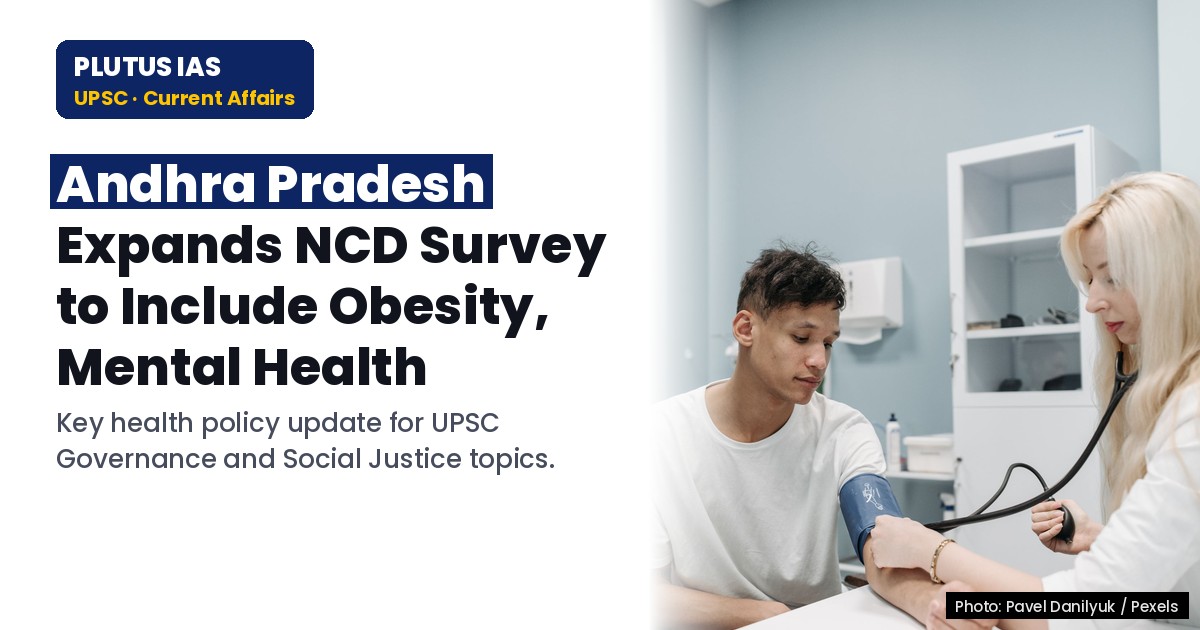
24 Nov Andhra Pradesh NCD Survey Expands: UPSC Governance Focus
✎ The expanded NCD survey in Andhra Pradesh now encompasses nine health conditions, leveraging technology for early detection and integrated healthcare management.
Subject Relevance — Where This Topic Fits
- GS Paper II — Governance, Social Justice and International Relations (Health, Government Policies and Interventions) | GS Paper III — Economy (Health Sector, Human Resource Development)
- Prelims: Non-Communicable Diseases (NCDs), Public Health Initiatives, Ayushman Bharat Health Account (ABHA) ID, Tele-MANAS, Primary Health Centres (PHCs), Facial Recognition System (FRS)
- Essay: Public Health as a Cornerstone of National Development, Technological Integration in Healthcare Delivery and Disease Management
Quick Revision: The expanded NCD survey in Andhra Pradesh now encompasses nine health conditions, leveraging technology for early detection and integrated healthcare management.
Why is this in the news?
The Department of Health, Medical and Family Welfare in Andhra Pradesh has announced the expansion of its Non-Communicable Diseases (NCD) survey to include four additional health conditions: obesity, fatty liver disease, chronic respiratory conditions, and mental health disorders. This initiative, conducted annually, aims to identify these conditions at an early stage, thereby facilitating timely intervention and management, and is scheduled to commence for the financial year 2026–27.
Background
- Non-Communicable Diseases (NCDs) are a significant public health challenge globally and in India, accounting for a substantial proportion of morbidity and mortality.
- The existing NCD survey in Andhra Pradesh previously screened individuals aged 18 and above for five major conditions: hypertension, diabetes, oral cancer, breast cancer, and cervical cancer.
- The expansion is a response to evolving lifestyle patterns, increasing prevalence of obesity, and the growing risk of other chronic diseases within the population.
- Early detection and management of NCDs are crucial for preventing disease progression, reducing healthcare burdens, and improving quality of life.
- The initiative aligns with national health objectives focused on strengthening primary healthcare and promoting preventive health measures.
- Technological integration, such as the use of Facial Recognition Systems (FRS) and Ayushman Bharat Health Account (ABHA) IDs, is being adopted to enhance the efficiency and record-keeping of the survey.
What is the expanded NCD survey in Andhra Pradesh?
- The expanded NCD survey is an annual health screening programme conducted by the Department of Health, Medical and Family Welfare in Andhra Pradesh.
- It now covers nine health conditions: hypertension, diabetes, oral cancer, breast cancer, cervical cancer, obesity, fatty liver disease, chronic respiratory conditions, and mental health disorders.
- The primary objective is the early identification of these diseases to enable prompt medical intervention and guidance.
- For obesity, individuals will be identified, their risk of complications assessed, and guidance provided on diet, physical activity, and weight management.
- Assessment for fatty liver disease will be conducted for individuals with obesity, hypertension, diabetes, and thyroid disorders.
- Chronic respiratory conditions will be identified early, with symptomatic individuals examined at Primary Health Centres (PHCs) and referred to higher facilities with spirometers for lung function assessment.
- Mental health assessment involves a questionnaire for symptoms of depression, anxiety, memory issues, and psychotic disorders, with preliminary telephonic assessments via Tele-MANAS and referrals through the District Mental Health Programme.
- The survey will incorporate a Facial Recognition System (FRS) for identification and biometric data collection, and an Ayushman Bharat Health Account (ABHA) ID will be generated for each individual to link their medical records digitally.
Key Features
| Feature | Significance |
|---|---|
| Expanded Scope of Screening | Inclusion of obesity, fatty liver disease, chronic respiratory conditions, and mental health disorders alongside existing hypertension, diabetes, and cancers, addressing a broader spectrum of non-communicable diseases (NCDs). |
| Early Identification Focus | Emphasis on detecting diseases at nascent stages to facilitate timely intervention and prevent progression to severe complications, thereby improving prognosis and reducing healthcare burden. |
| Annual Screening Cycle | Conducting health screenings every financial year ensures continuous monitoring of population health and allows for dynamic adjustments in public health strategies. |
| Integrated Referral System | Patients requiring advanced diagnostics or specialized treatment are referred from Primary Health Centres (PHCs) to regional and district hospitals, ensuring continuity of care. |
| Digital Health Integration | Implementation of Facial Recognition System (FRS) for identification, generation of Ayushman Bharat Health Account (ABHA) IDs, and digital recording of medical data, enhancing data management and patient tracking. |
| Mental Health Assessment | Utilisation of questionnaires for initial screening of mental health conditions, followed by telephonic assessments via Tele-MANAS and referrals to District Mental Health Programmes for comprehensive care. |
Why it Matters
Public Health Enhancement
- The expanded NCD survey facilitates a more comprehensive understanding of the disease burden within the population, enabling evidence-based policy formulation.
- Early detection and intervention for a wider range of NCDs can significantly reduce morbidity, mortality, and the long-term socio-economic impact of these conditions.
- Integration of mental health screening addresses a critical, often overlooked, aspect of public health, promoting holistic well-being.
Healthcare System Strengthening
- The referral mechanism from PHCs to higher-level facilities ensures that individuals receive appropriate care based on the complexity of their condition, optimizing resource utilization.
- Availability of spirometers at district hospitals enhances diagnostic capabilities for chronic respiratory conditions, improving the accuracy of diagnosis and treatment.
- Digital integration through ABHA IDs and FRS streamlines patient identification, record-keeping, and follow-up, improving efficiency and data integrity within the healthcare system.
Socio-Economic Impact
- By identifying and managing NCDs early, the survey can reduce out-of-pocket expenditure for individuals and families, mitigating financial distress associated with chronic illness.
- A healthier workforce, resulting from effective NCD management, contributes to increased productivity and economic growth.
- Addressing lifestyle-related conditions like obesity and fatty liver disease through guidance on diet and physical activity promotes healthier living practices across the population.
Challenges
1. Data Management and Privacy
- Ensuring the secure storage, access, and privacy of sensitive health data collected through FRS and linked to ABHA IDs is paramount.
- The sheer volume of data generated annually requires robust IT infrastructure and skilled personnel for effective management and analysis.
UPSC Link: Governance, e-governance, data privacy
2. Healthcare Infrastructure and Human Resources
- The expanded scope necessitates adequately trained medical officers, specialists, and support staff at all levels of the healthcare system, from PHCs to district hospitals.
- Ensuring the availability and maintenance of diagnostic equipment, such as spirometers, across all designated facilities can be challenging.
UPSC Link: Health, human resources, infrastructure
3. Public Awareness and Participation
- Encouraging widespread participation in annual screenings requires sustained public awareness campaigns to overcome hesitancy and misconceptions.
- Ensuring individuals adhere to follow-up consultations and lifestyle modifications identified during the survey is crucial for long-term health outcomes.
UPSC Link: Social sector, health awareness
4. Financial Sustainability
- The expanded survey, including additional screenings and infrastructure requirements, demands consistent and substantial financial allocation.
- Ensuring the long-term financial viability of the programme without compromising the quality and accessibility of services is a continuous challenge.
UPSC Link: Government budgeting, health financing
Challenges — UPSC Perspective
| Issue | Concern |
|---|---|
| Data Security and Privacy | Protection of sensitive biometric and health information from breaches and misuse is critical. |
| Infrastructure Capacity | Ensuring adequate diagnostic equipment and referral facilities to handle the increased patient load. |
| Human Resource Availability | Shortage of trained medical professionals for expanded screening and specialized care. |
| Public Engagement | Motivating sustained participation and adherence to recommended health interventions. |
| Inter-departmental Coordination | Seamless collaboration between health, IT, and other relevant departments for effective implementation. |
| Quality Control | Maintaining uniformity and accuracy in screening protocols and data collection across all centres. |
Government Initiatives — Must-Memorise for Prelims
- Ayushman Bharat Health Account (ABHA)
- Tele-MANAS
- District Mental Health Programme
Way Forward
- Strengthen digital infrastructure and cybersecurity protocols to safeguard sensitive patient data and ensure system reliability.
- Invest in continuous training and capacity building for healthcare professionals across all levels, focusing on the newly added NCDs and digital tools.
- Launch comprehensive public awareness campaigns to educate citizens about the importance of NCD screening, early detection, and lifestyle modifications.
- Ensure adequate and sustainable financial allocation for the expanded NCD survey, including procurement of equipment and human resource development.
- Establish robust monitoring and evaluation frameworks to assess the effectiveness of the expanded survey and make data-driven adjustments.
- Foster inter-departmental collaboration for seamless implementation, particularly between health, IT, and social welfare departments.
- Integrate traditional and community health workers into the awareness and follow-up processes to enhance reach and adherence.
- Develop clear referral pathways and ensure timely access to higher-level care for individuals requiring specialized investigations or treatment.
UPSC Value Addition
Keywords for Mains Answer-Writing
Non-Communicable Diseases (NCDs) · Public Health Initiatives · Preventive Healthcare · Early Disease Detection · Ayushman Bharat Digital Mission (ABDM) · Tele-MANAS · Primary Healthcare Centres (PHCs) · Digital Health Records · Lifestyle Diseases · Health Screening Programmes
Constitutional & Policy Linkages
- Article 21: Right to life and personal liberty, including health.
- Article 47: Duty of the State to raise the level of nutrition and the standard of living and to improve public health.
Concept Flow
Lifestyle changes lead to increased NCD risk. → Expanded NCD survey identifies conditions early. → Digital health records (ABHA) link patient data. → Referral system guides patients to appropriate care. → Early intervention improves health outcomes. → Reduced disease burden enhances public health.
Prelims Practice Questions
Q1. Consider the following statements regarding Non-Communicable Diseases (NCDs) and related health initiatives in India:
1. NCDs are primarily caused by infectious agents and are transmissible.
2. The Ayushman Bharat Health Account (ABHA) ID aims to link an individual’s medical records digitally.
3. Tele-MANAS is a national tele-mental health service launched under the Ayushman Bharat Digital Mission.
How many of the above statements are correct?
- Only one
- Only two
- Only three
- None
Answer: Only two — Statement 1 is incorrect: NCDs are chronic diseases that are not passed from person to person and are often associated with lifestyle factors. Statement 2 is correct: ABHA ID is designed to create a unique health identifier for individuals, linking their medical records across various healthcare providers. Statement 3 is correct: Tele-MANAS provides tele-mental health services, addressing the mental health crisis across the country.
Q2. Which of the following conditions are generally classified as Non-Communicable Diseases (NCDs)?
1. Hypertension
2. Diabetes
3. Oral Cancer
4. Chronic Respiratory Conditions
5. Mental Health Disorders
Select the correct answer using the code given below:
- 1, 2 and 3 only
- 2, 3, 4 and 5 only
- 1, 2, 3, 4 and 5
- 1, 3 and 5 only
Answer: 1, 2, 3, 4 and 5 — Hypertension, diabetes, oral cancer, chronic respiratory conditions, and mental health disorders are all examples of Non-Communicable Diseases (NCDs) that are often chronic and require long-term management.
Mains Practice Question
✍ Discuss the significance of expanding Non-Communicable Disease (NCD) screening programmes in India, particularly in the context of changing lifestyles and the integration of digital health initiatives. What challenges might arise in their effective implementation? (15 Marks)
Approach: Significance of NCD screening expansion: Address the rising burden of NCDs, shift towards preventive healthcare, early detection benefits, reduced healthcare costs, improved quality of life, and alignment with national health goals (e.g., National Health Policy 2017, Ayushman Bharat). Discuss the role of changing lifestyles (diet, physical activity, stress) in the NCD epidemic. Integration of digital health initiatives: Explain how Ayushman Bharat Digital Mission (ABDM), ABHA ID, Tele-MANAS, and Facial Recognition Systems enhance data management, accessibility, follow-up, and continuity of care. Challenges in implementation: Discuss issues such as infrastructure gaps (especially in rural areas), shortage of trained healthcare personnel, digital literacy barriers, data privacy concerns, funding constraints, public awareness and participation, and ensuring equitable access across socio-economic strata. Conclude with recommendations for overcoming these challenges.
Source: The Hindu
Andhra Pradesh PCS (APPSC) — State PCS Practice
Prelims: The Andhra Pradesh government recently expanded its Non-Communicable Diseases (NCD) survey to include four additional health conditions. Which of the following conditions was NOT explicitly mentioned as one of the newly added conditions in this expanded survey?
- Chronic Kidney Disease (CKD)
- Depression
- Chronic Obstructive Pulmonary Disease (COPD)
- Sickle Cell Anemia
Answer: Sickle Cell Anemia — The expanded NCD survey in Andhra Pradesh added Chronic Kidney Disease (CKD), Depression, and Chronic Obstructive Pulmonary Disease (COPD) along with other conditions, but Sickle Cell Anemia was not mentioned.
Mains: Discuss the significance of expanding the Non-Communicable Diseases (NCD) survey in Andhra Pradesh to include additional health conditions. How might this expansion contribute to better public health policy formulation and resource allocation in the state, particularly in the context of the state’s healthcare priorities?
Generated by AanyaAi for educational purpose.
Related guides on our sites
- Best PSIR optional coaching for upsc
- Best economics optional coaching for upsc
- Best PSIR optional teacher for upsc
- Best teacher of PSIR optional for upsc

- Andhra Pradesh NCD Survey Expands: UPSC Governance Focus - November 24, 2026
- शंघाई सहयोग संगठन ने लाहौर को पर्यटन और सांस्कृतिक राजधानी घोषित किया - November 24, 2026
- India-Germany Strategic Partnership: Defence & Trade - November 24, 2026

No Comments