



25 Nov Supreme Court Collegium Proposes Jharkhand HC Chief Justice Successor
✎ The Supreme Court Collegium, through the Memorandum of Procedure, recommends appointments and transfers of High Court Chief Justices, a process critical for judicial continuity and administrative stability, as highlighted by…
Subject Relevance — Where This Topic Fits
- GS Paper II — Indian Polity and Governance: Structure, organisation and functioning of the Executive and the Judiciary; Appointments to various Constitutional posts, powers, functions and responsibilities of various Constitutional Bodies.
- Prelims: Supreme Court Collegium, High Court Chief Justice appointment, Memorandum of Procedure (MoP), Judicial appointments, Constitutional courts, Article 217, Article 222
- Essay: Judicial independence and accountability in India, The role of constitutional bodies in maintaining democratic governance
Quick Revision: The Supreme Court Collegium, through the Memorandum of Procedure, recommends appointments and transfers of High Court Chief Justices, a process critical for judicial continuity and administrative stability, as highlighted by recent developments.
Why is this in the news?
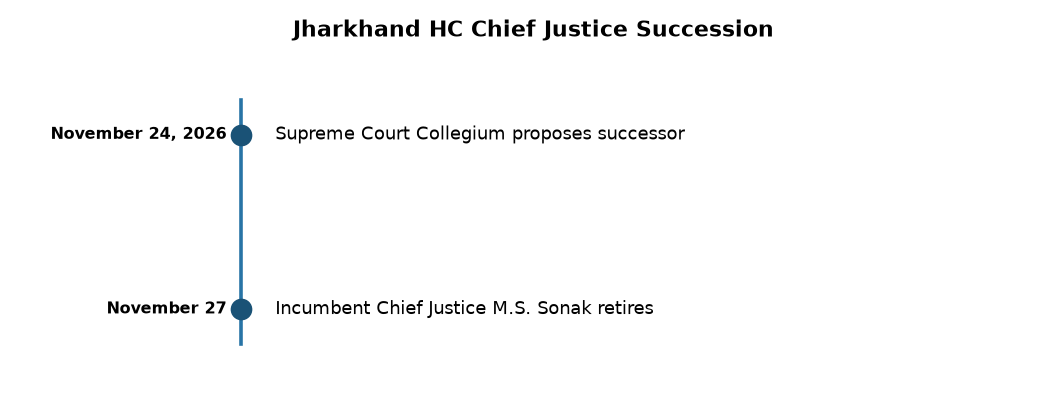
The Supreme Court Collegium recently proposed the transfer of the Karnataka High Court Chief Justice to the Jharkhand High Court, days before the incumbent’s retirement. This decision followed a communication from the Jharkhand Chief Minister to the Chief Justice of India, expressing concern over the delay in appointing a successor and advocating for a regular Chief Justice rather than an interim arrangement, in adherence to the established Memorandum of Procedure for judicial appointments.
Background
- The Supreme Court Collegium, headed by the Chief Justice of India, is responsible for recommending appointments and transfers of judges to the Supreme Court and High Courts.
- The process for appointing High Court Chief Justices involves recommendations from the Supreme Court Collegium, followed by clearance from the Union government.
- The Memorandum of Procedure (MoP) outlines the detailed steps and consultations required for the appointment and transfer of judges to constitutional courts.
- The Chief Minister of a state, as the head of the state government, has a legitimate interest in the timely appointment of a regular Chief Justice to the state’s High Court to ensure administrative continuity and institutional stability.
- Interim arrangements for the position of Chief Justice can potentially disrupt judicial administration and planning, leading to uncertainty within the judicial establishment.
- The recent recommendations by the Collegium also included the transfer of a Chief Justice from one High Court to another and the appointment of a new Chief Justice to a High Court following a transfer.
The Supreme Court Collegium and Judicial Appointments
- The Collegium system is a mechanism for the appointment and transfer of judges to the Supreme Court and High Courts, evolving through judicial pronouncements rather than a specific constitutional provision or parliamentary law.
- It comprises the Chief Justice of India and four senior-most judges of the Supreme Court for appointments to the Supreme Court and High Courts.
- For High Court appointments, the Collegium also includes the Chief Justice of the concerned High Court and two senior-most judges of that High Court.
- The process for appointing a High Court Chief Justice typically begins with a recommendation from the Supreme Court Collegium, which then goes to the Union government for approval.
- Article 217 of the Constitution of India deals with the appointment and conditions of the office of a High Court judge, while Article 222 pertains to the transfer of a judge from one High Court to another.
- The Memorandum of Procedure (MoP) is a detailed document that guides the Collegium and the government in the appointment and transfer of judges, aiming to ensure transparency and efficiency.
- The Chief Justice of a High Court holds a crucial administrative and judicial role, overseeing the court’s functioning and managing its judicial roster.
- Timely appointments are considered essential to avoid administrative vacuums and maintain the efficiency and independence of the judiciary.
Key Features
| Feature | Significance |
|---|---|
| Supreme Court Collegium | The institutional mechanism responsible for recommending appointments and transfers of judges to the Supreme Court and High Courts, ensuring judicial independence. |
| Chief Justice of India (CJI) | Heads the Supreme Court Collegium and plays a pivotal role in the judicial appointment and transfer process. |
| High Court Chief Justice | The administrative and judicial head of a High Court, responsible for its efficient functioning and maintaining judicial standards. |
| Memorandum of Procedure (MoP) | A document outlining the detailed process for the appointment and transfer of judges to the higher judiciary, developed through consultations between the judiciary and the executive. |
| Superannuation | The mandatory retirement of a judge upon reaching a specified age, necessitating timely succession planning to maintain judicial continuity. |
| Interim Arrangement for Chief Justice | A temporary appointment, often of an acting Chief Justice, when a regular Chief Justice is not appointed in a timely manner, which can disrupt administrative continuity. |
Why it Matters
Governance and Institutional Integrity
- Timely judicial appointments are crucial for maintaining the smooth functioning and administrative stability of High Courts, which are vital pillars of the state judiciary.
- The adherence to established procedures, such as the Memorandum of Procedure, reinforces institutional integrity and predictability in the process of judicial appointments and transfers.
- Ensuring a regular Chief Justice rather than an interim arrangement prevents potential disruptions in institutional planning and decision-making within the High Court.
Judicial Independence and Efficiency
- Prompt recommendations by the Supreme Court Collegium underscore its role in upholding judicial independence by initiating the appointment process without undue delay.
- The absence of a regular Chief Justice can impede the efficient administration of justice and affect the overall productivity of the High Court.
- Continuity in leadership is essential for effective case management, allocation of judicial resources, and implementation of administrative reforms within the High Court.
Centre-State Relations (Judiciary)
- The Chief Minister’s communication to the CJI highlights the state government’s interest in the timely appointment of a High Court Chief Justice, reflecting the collaborative, albeit distinct, roles of the executive and judiciary in such matters.
- The interaction underscores the importance of inter-institutional communication in ensuring that constitutional offices are filled promptly, preventing administrative vacuums.
Challenges
1. Delays in Judicial Appointments
- Protracted timelines in the appointment of High Court Chief Justices can lead to administrative uncertainty and impact the operational efficiency of the judiciary.
- Such delays may necessitate interim arrangements, which can undermine the stability and authority associated with a regular, full-time Chief Justice.
UPSC Link: Indian Judiciary; Appointment of Judges
2. Administrative Continuity and Planning
- Frequent transitions or prolonged interim arrangements for the Chief Justice position can disrupt long-term administrative planning and policy implementation within a High Court.
- This discontinuity may affect the institutional capacity to address pending cases and manage judicial resources effectively.
UPSC Link: Structure, organization and functioning of the Executive and the Judiciary
3. Clarity and Adherence to MoP
- Any perceived deviation from the established Memorandum of Procedure can raise concerns regarding the transparency and predictability of the judicial appointment process.
- Ensuring strict adherence to the MoP is vital for maintaining public trust in the integrity of judicial appointments.
UPSC Link: Indian Constitution; Appointment of Judges
4. Inter-institutional Coordination
- Effective coordination between the Supreme Court Collegium, the Union Government, and State Governments is essential for the timely processing and notification of judicial appointments.
- Breakdowns in this coordination can lead to delays and create administrative challenges.
UPSC Link: Separation of powers between various organs; Dispute Redressal Mechanisms
Challenges — UPSC Perspective
| Issue | Concern |
|---|---|
| Timely Succession Planning | Delays in proposing and clearing successors for retiring Chief Justices can create leadership vacuums. |
| Administrative Disruption | Interim arrangements for High Court Chief Justices can disrupt administrative continuity and institutional planning. |
| Impact on Judicial Functioning | Lack of a regular Chief Justice may affect the efficient administration of justice and decision-making within the High Court. |
| Adherence to Memorandum of Procedure | Ensuring all stakeholders follow the prescribed MoP for judicial appointments to maintain transparency and predictability. |
| Inter-institutional Communication | Need for effective communication and coordination between the judiciary and the executive for prompt appointments. |
Way Forward
- Strict adherence to the timelines stipulated in the Memorandum of Procedure for judicial appointments to ensure prompt succession planning.
- Enhanced coordination and communication between the Supreme Court Collegium, the Union Government, and State Governments to expedite the processing of recommendations.
- Proactive initiation of the appointment process well in advance of a Chief Justice’s superannuation to avoid interim arrangements.
- Regular review and, if necessary, refinement of the Memorandum of Procedure to address any bottlenecks or ambiguities in the appointment process.
- Leveraging technology for efficient tracking and monitoring of judicial appointment proposals to ensure timely progression through various stages.
- Establishing clear protocols for inter-institutional dialogue to address concerns and expedite resolutions regarding judicial appointments.
UPSC Value Addition
Keywords for Mains Answer-Writing
Supreme Court Collegium · High Court Chief Justice appointment · Memorandum of Procedure · Judicial appointments · Constitutional courts · Separation of powers · Judicial independence · Executive-Judiciary relations · Article 217 · Article 222 · Judicial vacancies
Constitutional & Policy Linkages
- {‘Article 124’: ‘Establishes the Supreme Court and outlines the appointment of judges.’}
- {‘Article 217’: ‘Pertains to the appointment and conditions of office of a High Court Judge.’}
- {‘Article 222’: ‘Deals with the transfer of a High Court Judge from one High Court to another.’}
Concept Flow
Chief Justice of High Court approaches superannuation. → Supreme Court Collegium initiates recommendation for successor. → Collegium proposes transfer of another Chief Justice/Judge. → Union Government reviews and clears Collegium’s resolution. → President of India issues warrant of appointment. → New Chief Justice assumes office, ensuring continuity.
Prelims Practice Questions
Q1. Consider the following statements regarding the appointment and transfer of High Court judges in India:
1. The Chief Justice of a High Court is appointed by the President after consultation with the Chief Justice of India and the Governor of the concerned State.
2. The transfer of a High Court judge from one High Court to another requires the consent of the judge concerned.
3. The Supreme Court Collegium’s recommendations for judicial appointments are binding on the Union Government.
How many of the above statements are correct?
- Only one
- Only two
- Only three
- None
Answer: Only two — Statement 1 is correct. Article 217(1) of the Constitution outlines this procedure. Statement 2 is incorrect; while the judge’s views are considered, their consent is not constitutionally mandated for transfer. Statement 3 is incorrect; while the Collegium’s recommendations are generally given great weight, the government can return them for reconsideration, though repeated recommendations are usually binding.
Q2. Assertion (A): The Chief Minister of a State plays a crucial role in the appointment of the Chief Justice of the State High Court.
Reason (R): The Chief Minister, as the head of the State government, is consulted by the President during the appointment process for the Chief Justice of the State High Court.
In the context of the above two statements, which one of the following is correct?
- Both A and R are true and R is the correct explanation of A.
- Both A and R are true but R is not the correct explanation of A.
- A is true but R is false.
- A is false but R is true.
Answer: A is false but R is true. — Assertion (A) is true in a limited sense, as the Chief Minister often expresses concerns or views, as seen in the news. However, the primary constitutional consultation for the Chief Justice of a High Court is with the Governor of the State, not directly the Chief Minister. Reason (R) is false because the President consults the Governor of the concerned State, not the Chief Minister directly, for the appointment of a High Court Chief Justice under Article 217(1).
Mains Practice Question
✍ Critically examine the role of the Supreme Court Collegium in the appointment and transfer of High Court Chief Justices, particularly in ensuring judicial independence and administrative continuity. Discuss the constitutional provisions and procedural mechanisms governing these appointments. (15 Marks)
Approach: MODEL-ANSWER SKELETON:
1. **Introduction:** Briefly define the Collegium system and its function in judicial appointments and transfers, setting the context of its evolution.
2. **Constitutional Provisions:** Detail relevant Articles: Article 217 (Appointment of High Court Judges), Article 222 (Transfer of a Judge from one High Court to another). Emphasize that the Constitution does not explicitly mention the ‘Collegium’ but vests power in the President (acting on aid and advice).
3. **Role of the Supreme Court Collegium:**
* **Appointment of High Court Chief Justices:** Explain the process involving the CJI, two senior-most SC judges, and consultation with the Governor and Chief Justice of the concerned High Court.
* **Transfer of High Court Chief Justices/Judges:** Outline the process involving the CJI and four senior-most SC judges, and consultation with the Chief Justices of both High Courts.
4. **Ensuring Judicial Independence:**
* **Arguments for:** Collegium system aims to insulate judiciary from executive interference, uphold merit, and maintain the integrity of the judicial process.
* **Arguments against/Challenges:** Lack of transparency, potential for nepotism, ‘judges appointing judges’ criticism, and occasional delays in appointments.
5. **Ensuring Administrative Continuity:**
* **Importance:** Highlight the need for timely appointments to prevent administrative disruption, ensure efficient functioning of High Courts, and avoid interim arrangements.
* **Challenges:** Discuss instances of delays, as highlighted in the news, and their impact on institutional planning and judicial administration.
6. **Procedural Mechanisms (Memorandum of Procedure – MoP):** Explain the MoP as a detailed document governing the appointment process, including timelines and consultation protocols. Mention the ongoing debate and revisions regarding the MoP.
7. **Executive-Judiciary Dynamics:** Briefly touch upon the relationship and potential friction points between the Collegium and the Union Government, especially concerning delays or disagreements over recommendations.
8. **Conclusion:** Summarize the dual objectives of judicial independence and administrative continuity, acknowledging the strengths and weaknesses of the Collegium system, and suggesting areas for reform (e.g., greater transparency, fixed timelines) while preserving judicial autonomy.
Source: The Hindu
Jharkhand PCS (JPSC) — State PCS Practice
Prelims: Which body is primarily responsible for proposing the successor to a High Court Chief Justice in India?
- The Governor of the respective state
- The Union Ministry of Law and Justice
- The Supreme Court Collegium
- The President of India in consultation with the Chief Justice of India
Answer: The Supreme Court Collegium — The Supreme Court Collegium, comprising the Chief Justice of India and four senior-most judges, recommends appointments and transfers of High Court judges and Chief Justices.
Mains: Discuss the process of appointment of a Chief Justice to a High Court in India, highlighting the role of the Supreme Court Collegium and any specific considerations that might arise in the context of a state like Jharkhand.
Generated by AanyaAi for educational purpose.
Related guides on our sites
- Best PSIR optional coaching for upsc
- Best PSIR optional teacher for upsc
- Best teacher of PSIR optional for upsc
- Best PSIR optional coaching in delhi for UPSC

- Supreme Court Collegium Proposes Jharkhand HC Chief Justice Successor - November 25, 2026
- एससीओ मंच और सभ्यतागत राज्य: वैश्विक राजनीति में बदलाव - November 25, 2026
- SBI MF to acquire 9.99% stake in South Indian Bank - November 25, 2026

No Comments