


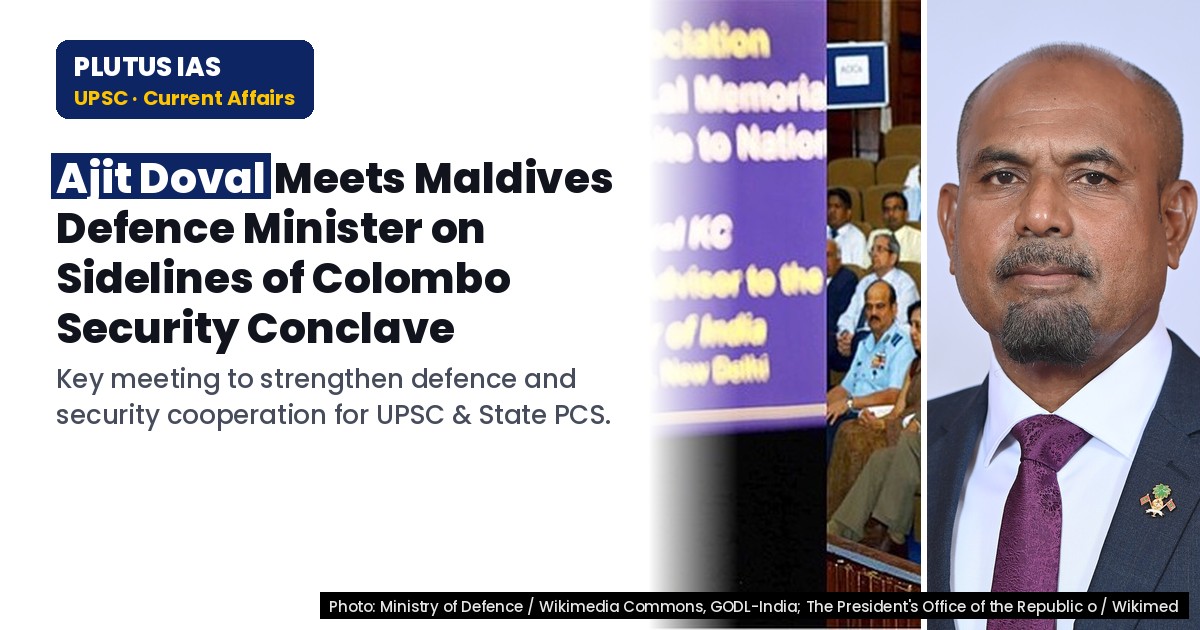
25 Nov India-Maldives Defence Cooperation: Doval Meets Maldives Defence Minister
✎ The Colombo Security Conclave (CSC) is a regional security framework involving India, Sri Lanka, Maldives, Mauritius, Bangladesh, and Seychelles, focused on enhancing cooperation across five key security pillars in the Indian…
Subject Relevance — Where This Topic Fits
- GS Paper II — International Relations: India and its neighborhood- relations; Bilateral, regional and global groupings and agreements involving India and/or affecting India’s interests; Effect of policies and politics of developed and developing countries on India’s interests, Indian diaspora.
- Prelims: Colombo Security Conclave (CSC), National Security Advisor (NSA), Indian Ocean Region (IOR), Bilateral defence cooperation, Maritime security, India-Maldives relations
- Essay: The evolving dynamics of regional security architecture in the Indian Ocean and India’s role., Bilateral relations as a cornerstone of India’s neighbourhood first policy.
Quick Revision: The Colombo Security Conclave (CSC) is a regional security framework involving India, Sri Lanka, Maldives, Mauritius, Bangladesh, and Seychelles, focused on enhancing cooperation across five key security pillars in the Indian Ocean Region.
Why is this in the news?
India’s National Security Advisor (NSA) Ajit Doval recently engaged in a bilateral meeting with the Maldives’ Minister of Defence and National Service, Hassan Rasheed, on the sidelines of the eighth Colombo Security Conclave (CSC) NSA-level meeting. The discussions focused on enhancing defence and security cooperation between the two nations, reaffirming their mutual commitment to strengthening their longstanding partnership.
Background
- India and the Maldives share a historically close relationship, underpinned by cultural, economic, and strategic ties.
- Defence cooperation between the two countries encompasses joint exercises, capacity building, training, and equipment support.
- The Indian Ocean Region (IOR) is strategically vital for both nations, necessitating collaborative efforts to address shared security challenges such as maritime terrorism, piracy, and illegal trafficking.
- The Colombo Security Conclave (CSC) was established in 2020 as a regional security framework to foster cooperation among Indian Ocean littoral states.
- India’s ‘Neighbourhood First’ policy prioritises strengthening relations with its immediate neighbours, with the Maldives being a key partner in this framework.
- Regular high-level exchanges and institutional mechanisms exist to review and advance bilateral defence and security cooperation.
What is the Colombo Security Conclave (CSC)?
- The Colombo Security Conclave (CSC) is a regional security grouping initiated in 2020, aiming to enhance cooperation on shared security challenges in the Indian Ocean Region.
- It was originally formed by India, Sri Lanka, and the Maldives, with Mauritius joining as a new member in 2021, and Bangladesh and Seychelles subsequently becoming members.
- The primary objective of the CSC is to foster a common understanding and coordinated approach to maritime security, counter-terrorism, cyber security, and other transnational crimes.
- The Conclave operates on five pillars of cooperation: Maritime Safety and Security, Countering Terrorism and Radicalisation, Combating Trafficking and Transnational Organised Crime, Cyber Security, and Humanitarian Assistance and Disaster Relief (HADR).
- Meetings are held at various levels, including National Security Advisor (NSA) level, Deputy NSA level, and working group levels, to review progress and chart future cooperation.
- The CSC provides a platform for member states to share intelligence, conduct joint exercises, and build capacity through training programmes.
- It represents a significant step towards building a robust regional security architecture in the Indian Ocean, promoting stability and collective security interests.
Key Features
| Feature | Significance |
|---|---|
| Colombo Security Conclave (CSC) | A regional security framework established in 2020, fostering cooperation among Indian Ocean littoral states. |
| NSA-level Meeting | High-level engagement among National Security Advisors, indicating strategic importance and commitment to regional security dialogues. |
| Defence and Security Cooperation | Encompasses joint exercises, intelligence sharing, capacity building, and coordinated responses to maritime threats. |
| Five Pillars of Cooperation | Areas identified for collaboration within CSC, including maritime safety and security, counter-terrorism, cyber security, and humanitarian assistance. |
| Roadmap for Cooperation and Activities (2025-2026) | A structured plan outlining specific initiatives and timelines for enhancing regional security collaboration. |
Why it Matters
Geopolitical Significance
- Reinforces India’s ‘Neighbourhood First’ policy and its role as a net security provider in the Indian Ocean Region (IOR).
- Strengthens bilateral ties with the Maldives, a crucial maritime neighbour, contributing to regional stability and countering extra-regional influences.
- Enhances multilateral security architecture through the Colombo Security Conclave, promoting collective responses to shared challenges.
Strategic Implications
- Addresses common non-traditional security threats such as maritime terrorism, piracy, drug trafficking, and illegal, unreported, and unregulated (IUU) fishing.
- Facilitates information exchange and intelligence sharing, crucial for real-time threat assessment and coordinated security operations.
- Contributes to maintaining a free, open, and inclusive Indo-Pacific, aligning with India’s broader strategic objectives.
Defence and Security Enhancement
- Promotes capacity building and interoperability between the defence forces of India and the Maldives through joint training and exercises.
- Supports the development of robust maritime domain awareness (MDA) capabilities, essential for monitoring and securing vital sea lanes of communication (SLOCs).
- Reaffirms commitment to a rules-based order in the IOR, ensuring freedom of navigation and overflight.
Challenges
1. Balancing Bilateral and Multilateral Engagements
- Ensuring that bilateral security cooperation with individual CSC members complements rather than complicates the broader multilateral framework.
- Managing diverse national interests and priorities within the CSC to achieve consensus on collective security initiatives.
UPSC Link: International Relations: Bilateral, Regional and Global Groupings
2. Addressing Non-Traditional Security Threats
- Developing effective and coordinated strategies to combat complex and evolving threats like maritime terrorism, cyber warfare, and environmental security challenges.
- Overcoming resource constraints and technological disparities among member states to ensure equitable capacity building.
UPSC Link: Security Challenges and their Management in Border Areas
3. External Power Dynamics in the IOR
- Navigating the increasing presence and influence of extra-regional powers in the Indian Ocean, which can introduce geopolitical complexities.
- Maintaining strategic autonomy and preventing the region from becoming an arena for great power competition.
UPSC Link: Effect of Policies and Politics of Developed and Developing Countries on India’s Interests
4. Ensuring Sustained Political Will and Commitment
- Maintaining consistent high-level engagement and political commitment from all member states despite domestic political changes or shifting priorities.
- Translating agreed-upon roadmaps and frameworks into tangible, on-ground cooperation and measurable outcomes.
UPSC Link: International Relations: Bilateral, Regional and Global Groupings
Challenges — UPSC Perspective
| Issue | Concern |
|---|---|
| Maritime Domain Awareness (MDA) | Gaps in surveillance and intelligence sharing capabilities among regional partners, hindering comprehensive threat assessment. |
| Capacity Building Disparities | Varying levels of defence capabilities and technological advancement among CSC member states, impacting collective response effectiveness. |
| Geopolitical Competition | Increased strategic competition in the Indian Ocean, potentially complicating regional security cooperation and alignment. |
| Climate Change Impacts | Rising sea levels and extreme weather events posing existential threats to island nations, requiring integrated security and humanitarian responses. |
| Transnational Crimes | Persistent challenges from drug trafficking, human smuggling, and illegal fishing, demanding enhanced cross-border coordination. |
Way Forward
- Intensify joint maritime patrols and surveillance operations to enhance maritime domain awareness and deter illicit activities.
- Promote greater interoperability through regular joint military exercises, training programs, and standardisation of procedures.
- Strengthen intelligence sharing mechanisms and real-time information exchange to counter emerging security threats effectively.
- Expand capacity building initiatives for smaller island nations within the CSC framework, focusing on maritime security and disaster response.
- Foster greater collaboration on non-traditional security challenges, including cyber security, environmental protection, and humanitarian assistance/disaster relief.
- Encourage regular high-level diplomatic and security dialogues to sustain political momentum and address evolving regional dynamics.
- Explore avenues for greater private sector involvement in maritime infrastructure development and security technology solutions.
UPSC Value Addition
Keywords for Mains Answer-Writing
Colombo Security Conclave · Indian Ocean Region security · India-Maldives defence cooperation · Regional security architecture · Maritime security challenges · National Security Advisor · Bilateral defence partnership · Capacity building initiatives · Geopolitical significance of Maldives · SAGAR doctrine · Net Security Provider
Concept Flow
Regional Security Dialogue (CSC) → High-Level Engagement (NSA Meeting) → Discussion on Defence & Security Cooperation → Commitment to Strengthening Partnership → Enhanced Maritime Security & Stability
Prelims Practice Questions
Q1. Consider the following statements regarding the Colombo Security Conclave (CSC):
1. The CSC was established in 2020 as a regional security framework.
2. Bangladesh and Seychelles are observer states in the CSC.
3. The primary objective of the CSC is to promote cooperation among Indian Ocean countries in addressing shared security challenges.
How many of the above statements are correct?
- Only one
- Only two
- Only three
- None
Answer: Only two — Statement 1 is correct as the CSC was indeed formed in 2020. Statement 2 is incorrect; Bangladesh and Seychelles are full member states, not observers. Statement 3 is correct, accurately describing the primary objective of the CSC.
Q2. Which of the following countries are member states of the Colombo Security Conclave (CSC)?
1. India
2. Sri Lanka
3. Maldives
4. Mauritius
5. Myanmar
Select the correct answer using the code given below:
- 1, 2, 3 and 4 only
- 1, 2, 3 and 5 only
- 1, 2, 4 and 5 only
- 1, 3, 4 and 5 only
Answer: 1, 2, 3 and 4 only — The member states of the Colombo Security Conclave are India, Sri Lanka, Maldives, Mauritius, Bangladesh, and Seychelles. Myanmar is not a member state of the CSC.
Mains Practice Question
✍ Discuss the significance of the Colombo Security Conclave (CSC) in enhancing regional maritime security in the Indian Ocean Region. Critically examine India’s role in fostering cooperation within this framework. (15 Marks)
Approach: MODEL-ANSWER SKELETON:
1. **Introduction:** Briefly introduce the Colombo Security Conclave (CSC) as a regional security framework established in 2020 to address shared security challenges in the Indian Ocean Region (IOR).
2. **Significance of CSC:**
* **Regional Ownership:** Emphasise the framework’s role in promoting indigenous solutions to regional security issues.
* **Addressing Non-Traditional Threats:** Highlight its focus on maritime safety and security, counter-terrorism, combating drug and human trafficking, cyber security, and humanitarian assistance and disaster relief (HADR).
* **Enhanced Information Sharing:** Discuss how it facilitates intelligence exchange and operational coordination among member states.
* **Capacity Building:** Mention joint training exercises and capacity enhancement initiatives for maritime law enforcement and security agencies.
* **Countering External Influence:** Implicitly or explicitly refer to its role in maintaining regional stability amidst increasing geopolitical competition.
3. **India’s Role in CSC:**
* **Founding Member and Proponent:** India’s initiative in establishing and expanding the CSC.
* **Net Security Provider:** India’s commitment to the ‘SAGAR’ (Security and Growth for All in the Region) doctrine and its practical manifestation through CSC.
* **Bilateral Engagements:** Reference India’s bilateral defence and security cooperation with member states, such as the recent meeting with the Maldives Defence Minister, which reinforces CSC objectives.
* **Resource and Expertise Sharing:** India’s contribution of resources, training, and expertise to strengthen the collective capabilities of CSC members.
* **Agenda Setting:** India’s active participation in setting the agenda and roadmap for cooperation within the CSC.
4. **Critical Examination of India’s Role:**
* **Challenges of Trust and Sovereignty:** Acknowledge potential sensitivities among smaller states regarding India’s dominant role.
* **Pace of Implementation:** Evaluate the effectiveness and speed of implementing joint initiatives.
* **Inclusivity and Expansion:** Discuss the balance between expanding membership and maintaining operational cohesion.
* **Addressing Asymmetric Capabilities:** How India helps bridge capability gaps among member states without appearing overbearing.
* **Geopolitical Competition:** The challenge of positioning CSC as a genuinely regional initiative distinct from broader power rivalries.
5. **Conclusion:** Summarise the CSC’s potential as a vital pillar of IOR security and reiterate India’s crucial, albeit nuanced, role in its evolution and effectiveness, advocating for continued collaborative efforts.
Source: orissapost.com
Generated by AanyaAi for educational purpose.

- India-Maldives Defence Cooperation: Doval Meets Maldives Defence Minister - November 25, 2026
- पुनर्जनी योजना: केरल HC ने CBI जांच याचिका मुख्य न्यायाधीश को भेजी - November 25, 2026
- Supreme Court Collegium Proposes Jharkhand HC Chief Justice Successor - November 25, 2026

No Comments