


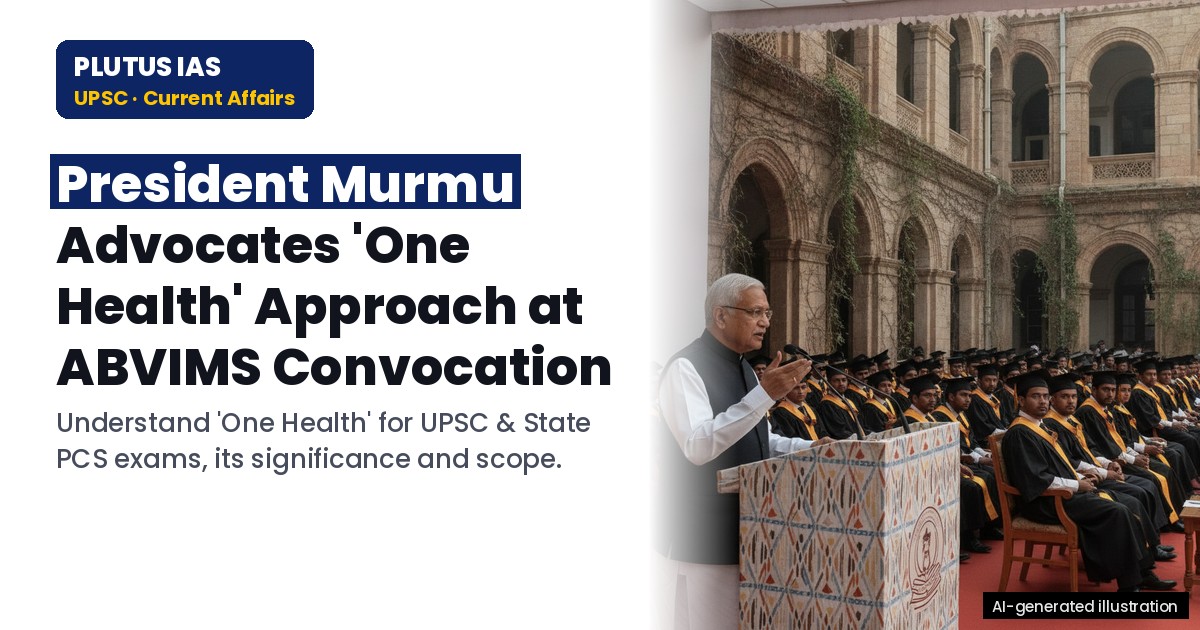
25 Nov President Murmu Emphasizes ‘One Health’ Approach at Convocation
✎ The 'One Health' concept is an integrated approach acknowledging the interdependence of human, animal, and environmental health, crucial for addressing global health challenges and aligning with India's National Health Policy…
Subject Relevance — Where This Topic Fits
- GS Paper II — Governance, Social Justice (Health) | GS Paper III — Environment, Science and Technology (Health and Disease)
- Prelims: One Health concept, National Health Policy 2017, Preventive healthcare, Curative healthcare, Palliative care, Non-communicable diseases
- Essay: The imperative of an integrated ‘One Health’ approach for sustainable global well-being., Transforming India’s healthcare landscape: From curative to comprehensive and inclusive models.
Quick Revision: The ‘One Health’ concept is an integrated approach acknowledging the interdependence of human, animal, and environmental health, crucial for addressing global health challenges and aligning with India’s National Health Policy 2017’s emphasis on comprehensive and preventive healthcare.
Why is this in the news?
The President of India, Smt. Droupadi Murmu, addressed the 12th Convocation Ceremony of Atal Bihari Vajpayee Institute of Medical Sciences (ABVIMS) & Dr. Ram Manohar Lohia Hospital in New Delhi on November 20, 2026. During her address, the President highlighted the critical importance of the ‘One Health’ concept in global health and underscored the necessity of an integrated approach involving human medicine, veterinary science, and environmental science to address contemporary health challenges effectively.
Background
- The ‘One Health’ concept recognises that the health of humans, animals, plants, and the environment are interconnected, implying that a health problem in one area can affect others.
- Zoonotic diseases, which transmit from animals to humans, represent a significant public health concern, necessitating a collaborative approach for prevention and control.
- Environmental factors such as air and water pollution, climate change, and ecological imbalances pose substantial threats to human health, requiring interdisciplinary solutions.
- The National Health Policy 2017 was revised to adopt a comprehensive and inclusive approach, prioritising preventive and promotive healthcare alongside curative solutions.
- The policy also emphasised the strengthening of rehabilitative and palliative care facilities, acknowledging the evolving health needs of the nation.
- India is experiencing a rapid increase in non-communicable diseases (NCDs) such as mental stress, diabetes, and cancer, necessitating focused strategies for their prevention and management.
The ‘One Health’ Concept and India’s Healthcare Policy
- The ‘One Health’ approach is a collaborative, multisectoral, and trans-disciplinary strategy, working at local, national, and global levels, to achieve optimal health outcomes by recognising the interconnection between people, animals, plants, and their shared environment.
- It addresses shared health threats, including zoonotic diseases, antimicrobial resistance, food safety and security, vector-borne diseases, environmental contamination, and climate change.
- The National Health Policy 2017 aims to achieve the highest possible level of health and well-being for all through a comprehensive primary healthcare approach, focusing on preventive and promotive health.
- Key objectives of the policy include ensuring universal access to quality healthcare services, reducing out-of-pocket expenditure, and strengthening health systems across all levels.
- The policy advocates for a shift from a disease-centric approach to a holistic health framework that considers social, economic, nutritional, and environmental determinants of health.
- It also stresses the importance of research and innovation tailored to local health challenges and conditions, promoting evidence-based interventions.
- The expansion of health services from primary to tertiary levels, along with a focus on non-communicable diseases, reflects the government’s commitment to a robust and responsive healthcare system.
Key Features
| Feature | Significance |
|---|---|
| One Health Approach | Emphasises the interconnectedness of human, animal, plant, and environmental health, advocating for collaborative efforts among diverse scientific disciplines to address health challenges comprehensively. |
| Preventive and Promotive Health | Shifts focus from purely curative solutions to proactive measures, including understanding socio-economic, nutritional, and environmental determinants of health, to enhance overall well-being and prevent disease onset. |
| Integrated Health Policy (2017) | A revised national health policy that prioritises a holistic approach, encompassing preventive, promotive, curative, rehabilitative, and palliative care, to address the evolving health needs of the nation. |
| Addressing Non-Communicable Diseases (NCDs) | Special emphasis on the prevention and management of rapidly increasing NCDs such as mental stress, diabetes, and cancer, reflecting a significant public health challenge. |
| Research and Innovation in Healthcare | Encourages research tailored to local health challenges and conditions, aiming to develop more effective, accessible, affordable, and people-centric health services. |
| Equitable Access to Healthcare | Stresses the importance of extending the benefits of medical expertise and advanced healthcare services to remote and underserved communities, strengthening primary healthcare infrastructure. |
Why it Matters
Public Health
- Promotes a holistic understanding of health determinants, integrating environmental and animal health with human health, crucial for preventing zoonotic diseases and addressing broader ecological impacts on human well-being.
- Strengthens disease surveillance and early warning systems by fostering inter-sectoral collaboration, enhancing preparedness for future health crises.
- Focuses on preventive and promotive aspects, reducing the burden of disease and improving population health outcomes, particularly against emerging infectious diseases and non-communicable diseases.
Governance and Policy
- Highlights the government’s commitment to a comprehensive and inclusive health policy, demonstrating an adaptive approach to evolving national health requirements.
- Encourages policy coherence across different ministries and departments (e.g., Health, Environment, Agriculture) to implement the ‘One Health’ framework effectively.
- Reinforces the role of research and development in informing evidence-based policy decisions and tailoring health interventions to specific local contexts.
Social Equity
- Emphasises the ethical imperative for medical professionals to serve disadvantaged communities, thereby reducing health disparities and promoting inclusive healthcare access.
- Advocates for making healthcare services more accessible and affordable, aligning with the principles of universal health coverage.
- Addresses the socio-economic and environmental factors influencing health, recognising that health outcomes are deeply intertwined with broader societal conditions.
Scientific and Medical Advancement
- Stimulates interdisciplinary research and collaboration among human medicine, veterinary science, and environmental science professionals, fostering innovation in health solutions.
- Encourages the development of context-specific diagnostic tools, treatments, and preventive strategies relevant to India’s diverse epidemiological landscape.
- Promotes the application of medical expertise to strengthen primary healthcare, ensuring that advanced knowledge benefits even the most remote populations.
Challenges
1. Inter-sectoral Coordination
- Achieving seamless collaboration among human health, animal health, and environmental sectors, which traditionally operate in silos, remains a significant institutional challenge.
- Developing common policy frameworks, funding mechanisms, and data-sharing protocols across diverse governmental and non-governmental entities is complex.
UPSC Link: Governance: Role of Civil Services
2. Resource Allocation and Infrastructure
- Ensuring adequate financial, human, and technological resources for implementing the ‘One Health’ approach across all levels of healthcare, particularly in rural and remote areas.
- Upgrading primary healthcare infrastructure to effectively integrate preventive, promotive, and rehabilitative services, alongside curative care.
UPSC Link: Social Sector: Health Infrastructure
3. Public Awareness and Behavioural Change
- Educating the public about the interconnectedness of human, animal, and environmental health, and promoting behavioural changes necessary for disease prevention and health promotion.
- Addressing socio-cultural factors and traditional practices that may impede the adoption of recommended health and hygiene practices.
UPSC Link: Social Sector: Health Education
4. Research and Development Gaps
- Fostering research that is directly applicable to local health challenges and developing affordable, accessible, and context-specific health solutions.
- Bridging the gap between academic research and practical implementation in public health programmes, especially for neglected diseases and underserved populations.
UPSC Link: Science & Technology: Health Research
5. Addressing Health Disparities
- Ensuring equitable access to quality healthcare services for all segments of society, particularly the vulnerable and marginalised, who often bear a disproportionate burden of disease.
- Overcoming geographical, economic, and social barriers that prevent remote and disadvantaged communities from accessing essential health services.
UPSC Link: Social Justice: Health Equity
Challenges — UPSC Perspective
| Issue | Concern |
|---|---|
| Fragmented Health Systems | Lack of integrated planning and execution across human, animal, and environmental health sectors hinders a holistic approach to disease prevention and control. |
| Rising Non-Communicable Diseases (NCDs) | The increasing prevalence of NCDs like diabetes, cancer, and mental health issues necessitates a robust, multi-faceted strategy focused on prevention, early detection, and long-term management. |
| Accessibility and Affordability of Healthcare | Ensuring that quality healthcare services are within reach, both geographically and financially, for all citizens, especially those in remote and underserved regions. |
| Environmental Determinants of Health | Addressing the profound impact of air and water pollution, climate change, and ecological imbalances on human health requires concerted efforts across environmental and health domains. |
| Capacity Building in Primary Healthcare | Strengthening the skills and resources of primary healthcare providers to deliver comprehensive services, including preventive, promotive, and rehabilitative care, effectively at the community level. |
| Research Translation into Practice | Translating academic research findings into actionable public health policies and programmes, ensuring that scientific advancements benefit the wider population. |
Way Forward
- Establish a dedicated national ‘One Health’ coordination mechanism involving relevant ministries (Health, Agriculture, Environment) to ensure integrated policy formulation and implementation.
- Strengthen primary healthcare infrastructure and human resources, particularly in rural and remote areas, to deliver comprehensive preventive, promotive, and rehabilitative services.
- Promote interdisciplinary research and development focused on local health challenges, fostering innovations that lead to affordable and accessible health solutions.
- Launch targeted public awareness campaigns to educate citizens about the ‘One Health’ concept and the importance of environmental and animal health for human well-being.
- Integrate ‘One Health’ principles into medical, veterinary, and environmental science curricula to foster a new generation of professionals equipped for collaborative action.
- Enhance surveillance systems for zoonotic diseases and environmental health indicators, leveraging technology for early detection and rapid response mechanisms.
- Develop robust funding mechanisms and incentives to encourage private sector participation and community engagement in ‘One Health’ initiatives.
- Prioritise mental health services and NCD prevention programmes, integrating them into primary healthcare to address the growing burden of these conditions.
UPSC Value Addition
Keywords for Mains Answer-Writing
One Health concept · National Health Policy 2017 · preventive healthcare · primary healthcare · non-communicable diseases · environmental determinants of health · integrated healthcare approach · public health initiatives · health equity · tertiary healthcare
Constitutional & Policy Linkages
- {‘article’: ‘Article 21’, ‘note’: ‘Right to life and personal liberty’}
- {‘article’: ‘Article 47’, ‘note’: ‘Duty to raise nutrition and public health’}
Concept Flow
Interconnectedness of Human, Animal, Environment → Emergence of Zoonotic Diseases and Environmental Health Threats → Need for ‘One Health’ Integrated Approach → Policy Revision (National Health Policy 2017) and Initiatives → Expansion of Health Services and Focus on Prevention → Improved Public Health Outcomes and Equity
Prelims Practice Questions
Q1. Consider the following statements regarding the ‘One Health’ approach:
1. It emphasizes the interconnectedness of human health, animal health, and environmental health.
2. Zoonotic diseases, which spread from animals to humans, are a key concern addressed by this approach.
3. Climate change and pollution are considered external factors that do not directly fall under the ‘One Health’ framework.
How many of the above statements are correct?
- Only one
- Only two
- All three
- None
Answer: Only two — Statement 1 is correct as ‘One Health’ fundamentally recognizes the interdependence of human, animal, and environmental well-being. Statement 2 is correct because zoonotic diseases are a primary example of the interspecies health challenges that ‘One Health’ seeks to address. Statement 3 is incorrect; environmental factors like climate change and pollution are integral components of the ‘One Health’ framework, as they significantly impact human and animal health.
Q2. Which of the following best describes the primary focus of the National Health Policy 2017?
- Exclusively on tertiary care infrastructure development.
- Prioritizing curative solutions over preventive measures.
- Emphasizing preventive and promotive healthcare alongside curative and rehabilitative services.
- Focusing solely on urban health challenges.
Answer: Emphasizing preventive and promotive healthcare alongside curative and rehabilitative services. — The National Health Policy 2017 adopted a comprehensive and inclusive approach, placing significant emphasis on preventive and promotive healthcare services, in addition to strengthening curative, rehabilitative, and palliative care. This marked a shift towards a more holistic health strategy.
Mains Practice Question
✍ Elucidate the ‘One Health’ concept and discuss its significance in addressing contemporary global health challenges. Critically examine the initiatives undertaken by the Indian government to integrate this approach into its public health strategy. (15 Marks)
Approach: Definition and core principles of ‘One Health’ (interconnectedness of human, animal, environmental health). Significance in addressing global health challenges (e.g., zoonotic diseases, antimicrobial resistance, food safety, climate change impacts). Government initiatives: Reference National Health Policy 2017’s shift towards preventive and promotive care, mention schemes like Ayushman Bharat (holistic health and wellness centres), National Centre for Disease Control’s ‘One Health’ initiatives, veterinary and environmental collaborations. Critical examination: Assess the extent of integration, challenges in implementation (inter-sectoral coordination, resource allocation, awareness), and potential for further strengthening.
Source: PIB (Press Information Bureau)
Bihar PCS (BPSC) — State PCS Practice
Prelims: Consider the following statements regarding the 12th Convocation Ceremony attended by the President of India at Atal Bihari Vajpayee Institute of Medical Sciences and Dr. Ram Manohar Lohia Hospital:
1. The President emphasized the importance of medical professionals serving in rural and remote areas, including those in states like Bihar.
2. The ceremony highlighted advancements in medical education and healthcare infrastructure across various states.
3. Dr. Ram Manohar Lohia, a prominent socialist leader, had significant connections with Bihar’s political and social movements.
Which of the statements given above is/are correct?
- 1 only
- 1 and 2 only
- 2 and 3 only
- 1, 2 and 3
Answer: 1, 2 and 3 — All statements are plausible given the context of a presidential address at a medical convocation and the historical relevance of Dr. Ram Manohar Lohia, particularly his connections to Bihar’s political landscape.
Mains: Discuss the role of medical institutions like Atal Bihari Vajpayee Institute of Medical Sciences and Dr. Ram Manohar Lohia Hospital in strengthening healthcare infrastructure and medical education in India. In this context, critically evaluate the challenges faced by states like Bihar in ensuring equitable access to quality healthcare and suggest measures for improvement.
Generated by AanyaAi for educational purpose.
Related guides on our sites
- How to prepare for GS paper 1 for UPSC CSE mains exam
- Best UPSC coaching for IFOS exam
- Best mentorship programme for upsc
- UPSC+BA degree

- President Murmu Emphasizes ‘One Health’ Approach at Convocation - November 25, 2026
- ‘Far too much failure’: UN deputy chief’s final call to end violence against women - November 25, 2026
- Himachal Pradesh Debt Burden: Financial Crisis Analysis - November 25, 2026

No Comments