


25 Nov VP Addresses Odisha Assembly Orientation: Key Takeaways
✎ State Legislative Assemblies are pivotal democratic institutions responsible for law-making, financial oversight, and executive accountability at the state level, contributing significantly to national development and the vision…
Subject Relevance — Where This Topic Fits
- GS Paper II — Indian Polity and Governance: Parliament and State Legislatures—structure, functioning, conduct of business, powers & privileges and issues arising out of these. | GS Paper II — Indian Polity and Governance: Separation of powers between various organs dispute redressal mechanisms and institutions.
- Prelims: Legislative Assembly, Vice-President of India, Orientation Programme, Viksit Bharat @2047, Democratic traditions of India, Chola Kudavolai system
- Essay: The Role of Legislators in Upholding Democratic Values and Fostering National Development, Leveraging Technology and Constructive Dialogue for Effective Governance
Quick Revision: State Legislative Assemblies are pivotal democratic institutions responsible for law-making, financial oversight, and executive accountability at the state level, contributing significantly to national development and the vision of ‘Viksit Bharat @2047’.
Why is this in the news?
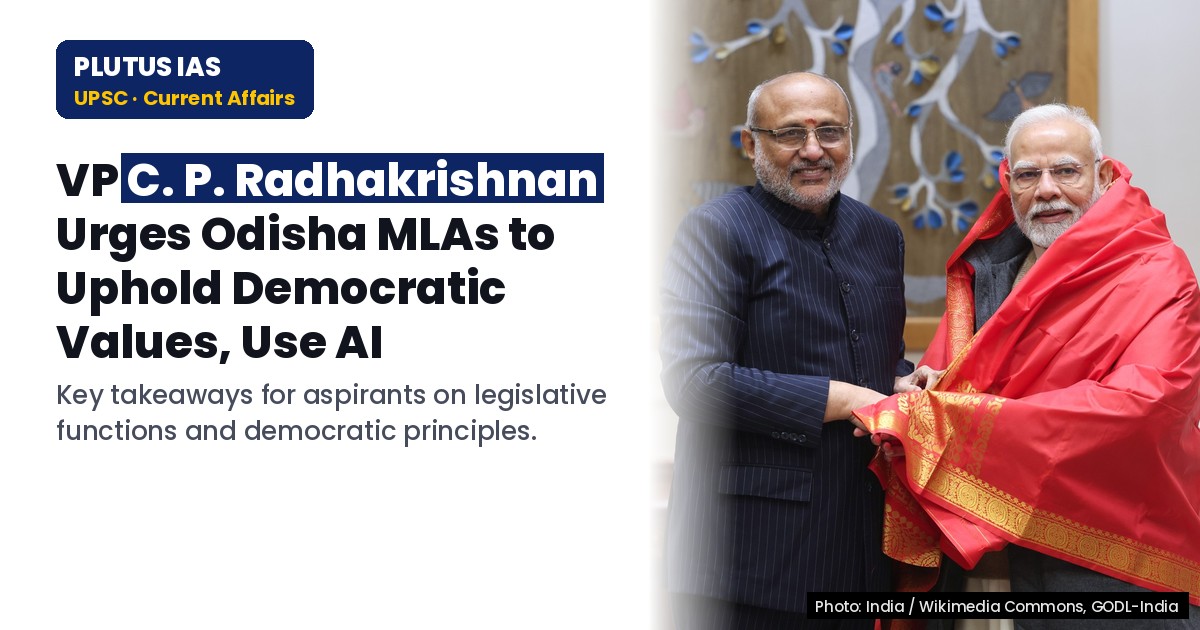
The Vice-President of India addressed an orientation programme for the members of the 17th Odisha Legislative Assembly in Bhubaneswar. During his address, he underscored the critical importance of constructive debates, informed discussions, adherence to legislative procedures, and the adoption of emerging technologies to fortify democratic institutions. He urged the legislators to uphold India’s rich democratic traditions and contribute actively to the vision of ‘Viksit Bharat @2047’ through dedicated public service and effective legislative functioning.
Background
- Orientation programmes for newly elected legislators are designed to familiarise them with legislative procedures, rules of business, parliamentary practices, and their constitutional responsibilities.
- Such initiatives are crucial for enhancing the efficiency and effectiveness of legislative bodies, ensuring that elected representatives are well-equipped to discharge their duties.
- The Vice-President’s emphasis on ‘Viksit Bharat @2047’ highlights the role of state legislatures in achieving national development goals, with state-level progress being integral to the overall national vision.
- References to India’s ancient democratic traditions, such as the institutions of Vaishali and the Chola-era Kudavolai system, serve to contextualise contemporary democratic practices within a historical continuum.
- The call for positive debate and constructive cooperation addresses concerns regarding disruptions in legislative proceedings, advocating for a focus on public service and constitutional commitment over partisan differences.
- The integration of Artificial Intelligence and digital technologies in legislative functioning is a forward-looking recommendation aimed at modernising parliamentary processes and improving governance.
What is the role of State Legislatures in India?
- State Legislatures are primary law-making bodies at the state level, empowered to enact laws on subjects enumerated in the State List and the Concurrent List of the Seventh Schedule to the Constitution of India.
- They exercise financial control over the state government through the approval of the state budget, supplementary grants, and scrutiny of government expenditure.
- Legislators hold the executive accountable through various parliamentary devices such as questions, resolutions, motions, and debates on matters of public importance.
- They serve as representatives of their constituencies, articulating the concerns and aspirations of the populace and advocating for their interests within the legislative framework.
- State Legislatures play a crucial role in deliberating on policy matters, providing a platform for diverse viewpoints, and shaping public policy in alignment with the needs of the state.
- They are instrumental in fostering public trust in democratic institutions by ensuring transparency, responsiveness, and accountability in governance.
- The effective functioning of State Legislatures is vital for the decentralisation of power, promoting local self-governance, and ensuring inclusive development across various regions of the state.
- Legislators also participate in the election of the President of India and members of the Rajya Sabha, underscoring their role in the broader federal structure.
Key Features
| Feature | Significance |
|---|---|
| Orientation Programme for Legislators | Enhances legislative effectiveness and understanding of constitutional responsibilities among newly elected members. |
| Emphasis on Democratic Values | Reinforces the foundational principles of parliamentary democracy, including constructive debate and public service. |
| Integration of Technology | Promotes the adoption of Artificial Intelligence and digital tools for improved legislative functioning and transparency. |
| Vision of Viksit Bharat@2047 | Aligns state-level legislative efforts with national development goals, fostering inclusive growth and prosperity. |
| Upholding Legislative Procedures | Stresses the importance of adherence to established rules and norms for effective governance and public trust. |
Why it Matters
Governance and Public Administration
- Strengthens the capacity of legislators to perform their duties effectively, leading to improved policy formulation and oversight.
- Promotes accountability and transparency in legislative processes, enhancing public confidence in democratic institutions.
- Encourages the adoption of modern technologies for efficient legislative operations and citizen engagement.
Democratic Principles
- Reaffirms the importance of positive debate, informed discussion, and constructive cooperation in a parliamentary system.
- Highlights India’s rich democratic heritage, drawing parallels with historical democratic practices like those of Vaishali and the Kudavolai system.
- Emphasises that electoral victory must translate into dedicated public service and commitment to the Constitution.
National Development
- Positions state legislative assemblies as crucial contributors to the national vision of Viksit Bharat@2047.
- Stresses the role of state-level progress, exemplified by ‘Vision Odisha 2036’, in achieving overall national development goals.
- Encourages legislators to focus on creating opportunities for youth and ensuring equitable distribution of development benefits.
Challenges
1. Disruption in Legislative Proceedings
- Frequent disruptions impede the legislative process, hindering timely policy formulation and critical discussions.
- Undermines the decorum and effectiveness of legislative bodies, potentially eroding public trust in democratic institutions.
UPSC Link: Parliament and State Legislatures – structure, functioning, conduct of business
2. Ensuring Constructive Debate
- Maintaining a balance between dissent and constructive engagement is crucial for productive legislative outcomes.
- The tendency to resort to political rhetoric rather than substantive discussion can dilute the quality of legislative output.
UPSC Link: Parliament and State Legislatures – structure, functioning, conduct of business
3. Effective Utilisation of Technology
- Integrating advanced technologies like AI requires adequate infrastructure, training, and robust cybersecurity measures.
- Ensuring equitable access and digital literacy among all legislators and staff is essential for successful implementation.
UPSC Link: E-governance- applications, models, successes, limitations, potential
4. Translating Electoral Mandate into Public Service
- The challenge lies in consistently prioritising public welfare over political considerations post-election.
- Ensuring that legislative actions directly address the needs and aspirations of the electorate, particularly vulnerable sections.
UPSC Link: Role of Civil Services in a Democracy
Challenges — UPSC Perspective
| Issue | Concern |
|---|---|
| Legislative Disruptions | Impairs effective governance and diminishes the quality of legislative output. |
| Maintaining Decorum | Erodes public confidence in democratic institutions and the legislative process. |
| Technological Adoption | Requires significant investment in infrastructure, training, and data security. |
| Public Trust | Sustaining public faith through dedicated service and adherence to constitutional principles. |
| Policy Implementation Gaps | Ensuring that enacted legislation translates into tangible benefits for citizens at the grassroots level. |
Way Forward
- Promote regular orientation and capacity-building programmes for legislators to enhance their understanding of parliamentary procedures and policy-making.
- Foster a culture of constructive dialogue and debate within legislative assemblies, emphasising consensus-building over confrontation.
- Invest in digital infrastructure and provide comprehensive training to facilitate the effective integration of Artificial Intelligence and other technologies in legislative work.
- Encourage legislators to engage actively with their constituencies, ensuring that public feedback informs policy development and legislative priorities.
- Strengthen ethical conduct and accountability mechanisms for elected representatives to uphold public trust and democratic values.
- Develop robust research and analytical support systems for legislators to enable informed decision-making and effective oversight.
- Emphasise the long-term vision of national development, encouraging state legislatures to align their policies with broader national goals like Viksit Bharat@2047.
UPSC Value Addition
Keywords for Mains Answer-Writing
Legislative Assembly functions · Democratic traditions of India · Role of legislators · Viksit Bharat @2047 · Legislative procedures and conduct · Artificial Intelligence in governance · Constructive debate in democracy · Public trust and accountability · Orientation programmes for MLAs · Constitutional responsibilities of elected representatives
Constitutional & Policy Linkages
- {‘article’: ‘Article 168’, ‘note’: ‘Constitution of State Legislatures’}
- {‘article’: ‘Article 170’, ‘note’: ‘Composition of Legislative Assemblies’}
- {‘article’: ‘Article 194’, ‘note’: ‘Powers, privileges of Legislatures’}
Concept Flow
Orientation Programme for Legislators → Enhanced understanding of legislative procedures → Improved quality of debates and discussions → Effective policy formulation and oversight → Strengthened democratic institutions and public trust → Accelerated progress towards Viksit Bharat@2047
Prelims Practice Questions
Q1. Consider the following statements regarding democratic traditions in India:
1. The ancient democratic institutions of Vaishali are cited as examples of India’s deep-rooted democratic history.
2. The ‘Kudavolai system’ of the Chola period represents an early form of electoral process.
3. India is often referred to as the ‘Mother of Democracy’.
How many of the above statements are correct?
- Only one
- Only two
- All three
- None
Answer: All three — Statement 1 is correct: The Vice President’s address explicitly mentioned Vaishali as an example of ancient democratic institutions. Statement 2 is correct: The Kudavolai system of the Chola period was a unique method of electing village assembly members through a lottery system, demonstrating early democratic practices. Statement 3 is correct: The Vice President’s address reiterated India’s pride in being the ‘Mother of Democracy’, a common reference to India’s ancient democratic roots.
Q2. Which of the following statements best describes the primary role of a Legislative Assembly, as highlighted in the context of an orientation programme for its members?
- It serves primarily as a platform for political party manifestos.
- It is a forum for debates and discussions, where policies are formulated and laws passed to improve citizens’ lives.
- Its main function is to ensure the smooth functioning of the executive branch.
- It is solely responsible for the allocation of financial resources to various government departments.
Answer: It is a forum for debates and discussions, where policies are formulated and laws passed to improve citizens’ lives. — The Vice President explicitly stated that the Assembly is not merely a platform for debate, but where every policy, question, and law has the potential to improve citizens’ lives, underscoring its role in policy formulation and law-making for public welfare.
Mains Practice Question
✍ The Vice President recently underscored the importance of constructive debates, informed discussions, and adherence to legislative procedures for strengthening democratic institutions. Critically examine the challenges faced by legislative assemblies in upholding these principles in contemporary Indian politics. (15 Marks)
Approach: MODEL-ANSWER SKELETON:
1. **Introduction:** Briefly define the role of legislative assemblies in a parliamentary democracy and acknowledge the Vice President’s emphasis on constructive legislative conduct.
2. **Importance of Principles:** Elaborate on why constructive debates, informed discussions, and procedural adherence are crucial for democratic functioning (e.g., accountability, informed policymaking, public trust, rule of law).
3. **Challenges Faced (Critical Examination):**
* **Disruptions and Lack of Decorum:** Frequent adjournments, walkouts, and unparliamentary behaviour (cite examples if possible, e.g., low productivity data).
* **Decline in Quality of Debates:** Focus on political rhetoric rather than substantive policy discussion; lack of expertise in legislative scrutiny.
* **Bypassing Legislative Scrutiny:** Increased use of ordinances, ‘guillotining’ of bills without adequate discussion, referring fewer bills to standing committees.
* **Anti-defection Law Impact:** Perceived stifling of dissent within parties, reducing independent thought and discussion.
* **Role of Money and Muscle Power:** Influence on electoral outcomes and subsequent legislative conduct.
* **Lack of Orientation/Training:** Inadequate understanding of rules of procedure and conduct for new members.
* **Digital Divide/Technological Adoption:** Challenges in integrating AI and digital tools effectively for legislative efficiency.
4. **Consequences of Challenges:** Erosion of public trust, suboptimal policy outcomes, weakening of democratic institutions.
5. **Suggestions/Way Forward:** Emphasise the need for orientation programmes, stricter enforcement of rules, promoting bipartisan cooperation, leveraging technology (AI, digital platforms), strengthening committee systems, and fostering a culture of mutual respect and informed deliberation.
6. **Conclusion:** Reiterate the imperative for legislators to uphold democratic values and procedures to ensure effective governance and contribute to national development, aligning with visions like ‘Viksit Bharat @2047’.
Source: PIB (Press Information Bureau)
Odisha PCS (OPSC (OAS)) — State PCS Practice
Prelims: Which of the following statements is/are correct regarding the recent orientation program for the 17th Odisha Legislative Assembly MLAs?
- A. The program was addressed by the President of India.
- B. It was held in Cuttack, Odisha.
- C. The Vice President of India addressed the program in Bhubaneswar.
- D. The program was for the 16th Odisha Legislative Assembly MLAs.
Answer: C. The Vice President of India addressed the program in Bhubaneswar. — The Vice President of India addressed the orientation program for the 17th Odisha Legislative Assembly MLAs in Bhubaneswar.
Mains: Discuss the significance of orientation programs for newly elected Members of Legislative Assembly (MLAs) in strengthening democratic governance, with particular reference to the recent program held for the 17th Odisha Legislative Assembly.
Generated by AanyaAi for educational purpose.
Related guides on our sites
- Best PSIR optional coaching for upsc
- Best PSIR optional teacher for upsc
- Best teacher of PSIR optional for upsc
- Best PSIR optional coaching in delhi for UPSC

- VP Addresses Odisha Assembly Orientation: Key Takeaways - November 25, 2026
- मिशन चक्काकोम्पन: केरल वन विभाग द्वारा जंगली हाथी को शांत करने की तैयारी - November 25, 2026
- President Murmu Emphasizes ‘One Health’ Approach at Convocation - November 25, 2026

No Comments