


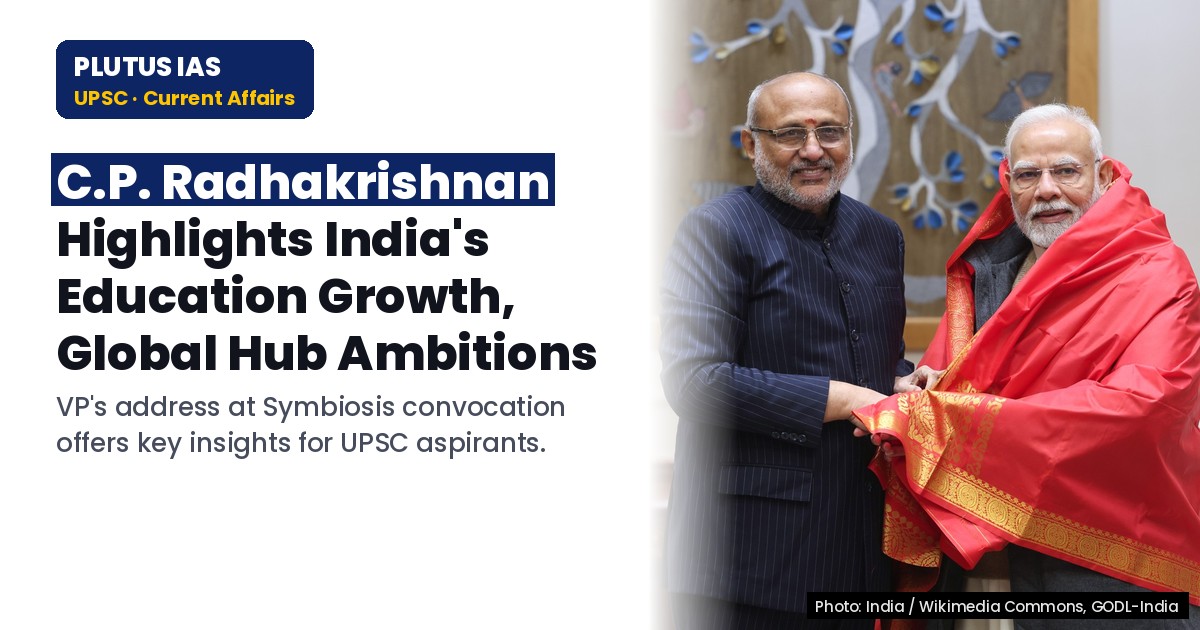
25 Nov VP Radhakrishnan on Education as Bridge & Global Hub
✎ India's higher education sector is undergoing significant expansion and internationalisation, positioning the nation as a global knowledge hub while promoting education as a crucial bridge for international understanding and…
Subject Relevance — Where This Topic Fits
- GS Paper II — Governance, Education, International Relations | GS Paper I — Society (Women Empowerment)
- Prelims: Higher Education Institutions in India, Symbiosis International University, Indian Technical and Economic Cooperation (ITEC) Programme, Vasudhaiva Kutumbakam, National Education Policy (NEP), Women in Higher Education
- Essay: The Role of Education in Fostering Global Cooperation and Cultural Exchange, India’s Journey Towards Becoming a ‘Vishwa Guru’ (Global Teacher) and a Developed Nation by 2047
Quick Revision: India’s higher education sector is undergoing significant expansion and internationalisation, positioning the nation as a global knowledge hub while promoting education as a crucial bridge for international understanding and women’s empowerment.
Why is this in the news?
The Vice President of India, Shri C. P. Radhakrishnan, addressed the 23rd Convocation of Symbiosis International (Deemed University) in Pune. During his address, he underscored the pivotal role of education in fostering international understanding, highlighted India’s expanding higher education landscape, and reiterated the nation’s commitment to becoming a global knowledge hub, aligning with the ethos of ‘Vasudhaiva Kutumbakam’.
Background
- India’s higher education sector has witnessed significant expansion, with the number of universities increasing from 760 in 2014-15 to over 1,400 currently.
- Institutions of national importance, such as IITs, IIMs, and AIIMS, have also seen a substantial increase in their numbers over the past decade.
- Gross Enrolment Ratio (GER) in higher education has shown an upward trend, indicating greater access to tertiary education for students across the country.
- The ‘Nari Shakti’ (women power) initiative is reflected in the increasing participation and achievements of women in higher education, with women often outnumbering men in receiving degrees and medals at convocations.
- India actively promotes international educational partnerships and capacity building through initiatives like the Indian Technical and Economic Cooperation (ITEC) programme.
- The concept of ‘Vasudhaiva Kutumbakam’ (the world is one family) guides India’s foreign policy and its approach to global cooperation, including in the education sector.
India’s Higher Education Landscape and International Engagement
- The Indian higher education system is one of the largest globally, encompassing a diverse range of universities, colleges, and institutions offering various disciplines.
- Significant governmental emphasis has been placed on enhancing access, equity, and quality in higher education, as articulated in policies such as the National Education Policy (NEP) 2020.
- The expansion includes an increase in the number of universities, Indian Institutes of Technology (IITs), Indian Institutes of Management (IIMs), and All India Institutes of Medical Sciences (AIIMS).
- Efforts are underway to internationalise Indian higher education, encouraging foreign collaborations, establishing international branch campuses, and attracting international students.
- The Indian Technical and Economic Cooperation (ITEC) programme, initiated in 1964, is a flagship capacity-building initiative of the Government of India, offering training and educational opportunities to professionals from partner countries.
- The programme aims to share India’s developmental experience and expertise with other developing countries, fostering South-South cooperation.
- The increasing enrolment of women in higher education and their academic achievements signify progress towards gender equality and women’s empowerment in the country.
- The establishment of specialised institutions like ‘Symbiosis Medical College for Women’ further exemplifies the commitment to expanding opportunities for women in critical fields.
Key Features
| Feature | Significance |
|---|---|
| Expansion of Higher Education Institutions | Increase in the number of universities from 760 in 2014-15 to over 1,400, IITs from 16 to 23, IIMs from 13 to 22, and AIIMS from 8 to 23, indicating a substantial growth in access to higher education. |
| Increased Enrollment in Higher Education | Total student enrollment has risen from 3.4 crore in 2014-15 to over 4.5 crore, reflecting enhanced participation rates in tertiary education. |
| Promotion of International Educational Partnerships | Initiatives like Symbiosis International University’s Dubai campus strengthen India’s educational ties with other nations and elevate its standing in global higher education. |
| Focus on Women’s Empowerment in Education | Observation of more women receiving degrees and medals at convocations, coupled with the establishment of institutions like Symbiosis Medical College for Women, signifies progress in ‘Nari Shakti’ and gender inclusivity in higher education. |
| India as a Global Knowledge Hub | Emphasis on education as a bridge between nations and cultures, aligning with the ‘Vasudhaiva Kutumbakam’ ethos, positions India as a significant contributor to global knowledge exchange. |
| Indian Technical and Economic Cooperation (ITEC) Programme | Benefits to over 80,000 professionals from the Global South since 2014, showcasing India’s role as a responsible global partner in capacity building and technical assistance. |
Why it Matters
Social Development
- Enhanced access to higher education contributes to human resource development and social mobility.
- Increased participation of women in higher education signifies progress towards gender equality and empowerment.
- Promotion of inclusive education fosters a diverse and equitable learning environment.
Economic Growth
- Expansion of educational infrastructure and enrollment supports the development of a skilled workforce, crucial for economic competitiveness.
- International educational partnerships attract foreign students and faculty, potentially boosting the service sector and fostering innovation.
- The ITEC program enhances India’s soft power and facilitates economic cooperation with partner countries.
International Relations
- Positioning education as a bridge between nations strengthens diplomatic ties and cultural exchange.
- India’s emergence as a global knowledge hub through international collaborations enhances its influence on the global stage.
- The ‘Vasudhaiva Kutumbakam’ philosophy underpins India’s commitment to global solidarity and shared progress.
Governance and Policy
- The substantial increase in higher education institutions reflects successful policy implementation aimed at expanding educational opportunities.
- Focus on quality and internationalization in education aligns with national development goals, including the ‘Viksit Bharat’ vision for 2047.
- Government initiatives to support educational growth demonstrate a commitment to investing in human capital.
Challenges
1. Quality Assurance and Accreditation
- Ensuring uniform quality across a rapidly expanding number of higher education institutions remains a significant challenge.
- Maintaining high standards of teaching, research, and infrastructure is crucial for global competitiveness and student outcomes.
UPSC Link: Education sector reforms
2. Faculty Recruitment and Development
- Addressing the shortage of qualified faculty and investing in continuous professional development is essential for academic excellence.
- Attracting and retaining top talent in academia requires competitive remuneration and a conducive research environment.
UPSC Link: Human resource development
3. Access and Equity
- Despite increased enrollment, ensuring equitable access to quality higher education for all sections of society, particularly in remote and underserved areas, persists as a challenge.
- Bridging the urban-rural divide in educational opportunities and infrastructure is vital for inclusive growth.
UPSC Link: Inclusive growth and development
4. Curriculum Relevance and Employability
- Aligning educational curricula with industry demands and future skill requirements is critical for enhancing graduate employability.
- Promoting interdisciplinary studies and practical, skill-based learning is necessary to prepare students for a dynamic job market.
UPSC Link: Skill development and employment
5. Internationalization of Education
- While progress has been made, further efforts are needed to attract a larger number of international students and faculty.
- Harmonizing Indian educational standards with global benchmarks is crucial for seamless academic mobility and recognition.
UPSC Link: India’s foreign policy
Challenges — UPSC Perspective
| Issue | Concern |
|---|---|
| Rapid Expansion of Institutions | Potential for dilution of educational quality if growth outpaces regulatory and infrastructural development. |
| Faculty Shortages | Inadequate availability of qualified and experienced faculty members, particularly in specialized fields, affecting teaching and research quality. |
| Infrastructure Disparities | Uneven distribution of modern educational infrastructure and resources, leading to disparities in learning experiences across institutions. |
| Curriculum Obsolescence | Risk of curricula not keeping pace with rapidly evolving technological advancements and industry requirements, impacting graduate relevance. |
| Funding and Resource Allocation | Ensuring sufficient and sustainable funding for research, innovation, and institutional development across all higher education sectors. |
| Brain Drain | Challenges in retaining top academic talent within India due to better opportunities abroad, impacting research and innovation ecosystems. |
Government Initiatives — Must-Memorise for Prelims
- Indian Technical and Economic Cooperation (ITEC) Programme
Way Forward
- Implement robust accreditation and quality assurance mechanisms to ensure high standards across all higher education institutions.
- Invest significantly in faculty recruitment, training, and retention, offering competitive remuneration and research opportunities.
- Promote interdisciplinary research and innovation by fostering collaborations between academia, industry, and government.
- Enhance digital infrastructure and e-learning platforms to improve access to quality education, especially in remote areas.
- Reform curricula to align with global industry demands and future skill requirements, emphasizing practical and experiential learning.
- Strengthen international collaborations and partnerships to attract global talent and enhance India’s position as a knowledge hub.
- Develop targeted policies to further increase the participation and success of women and marginalized communities in higher education.
- Increase public and private investment in higher education to support infrastructure development, research, and scholarships.
UPSC Value Addition
Keywords for Mains Answer-Writing
Higher Education Expansion · Global Knowledge Hub · International Educational Partnerships · Vasudhaiva Kutumbakam · Nari Shakti · Developed India 2047 · Indian Technical and Economic Cooperation (ITEC) · Inclusive Education · Skill Development · Educational Diplomacy
Constitutional & Policy Linkages
- Article 21A: Right to Education
- Article 46: Promotion of educational interests (Directive Principle)
Concept Flow
Government policy focus on higher education → Increased establishment of educational institutions → Higher enrollment rates and greater access → Enhanced human capital and skilled workforce → Contribution to ‘Viksit Bharat’ vision
Prelims Practice Questions
Q1. Consider the following statements regarding the expansion of higher education in India:
1. The number of universities in India has increased from approximately 760 in 2014-15 to over 1,400 currently.
2. The number of Indian Institutes of Technology (IITs) has increased from 16 to 23 since 2014.
3. Gross Enrolment Ratio in higher education has seen a decline since 2014-15.
How many of the above statements are correct?
- Only one
- Only two
- Only three
- None
Answer: Only two — Statement 1 is correct, as per the Vice President’s address. Statement 2 is correct, indicating an increase in premier technical institutions. Statement 3 is incorrect; higher education enrolment has increased from 3.4 crore to over 4.5 crore students, implying an increase in GER.
Q2. Which of the following best describes the ‘Vasudhaiva Kutumbakam’ ethos as applied to education in the context of India’s foreign policy?
- Promoting unilateral educational policies to assert national dominance.
- Encouraging isolationist academic research focused solely on domestic issues.
- Fostering international understanding and collaboration through educational exchanges.
- Limiting access to higher education for international students to prioritize domestic learners.
Answer: Fostering international understanding and collaboration through educational exchanges. — Vasudhaiva Kutumbakam, meaning ‘The World is One Family’, reflects India’s civilizational ethos of global interconnectedness. In education, this translates to fostering international understanding, mutual respect, and collaborative partnerships, aligning with India’s role as a global knowledge hub.
Mains Practice Question
✍ Examine the role of higher education in fostering India’s emergence as a ‘global knowledge hub’ and a responsible international partner. Discuss the initiatives and policy thrusts that support this vision. (15 Marks)
Approach: MODEL-ANSWER SKELETON:
1. **Introduction:** Define ‘global knowledge hub’ and ‘responsible international partner’ in the context of higher education.
2. **Role of Higher Education in Global Knowledge Hub:**
* **Expansion of Institutions:** Mention data like increase in universities (760 to 1400+), IITs (16 to 23), IIMs (13 to 22), AIIMS (8 to 23) since 2014-15.
* **Increased Enrolment:** Higher education enrolment from 3.4 crore to 4.5 crore+.
* **Quality Enhancement:** Reference to National Education Policy (NEP) 2020, emphasis on research, innovation, multidisciplinary education.
* **Internationalisation of Campuses:** Examples like Symbiosis’s international branch campuses (e.g., Dubai), presence of international students (3000+ from 85 countries at Symbiosis).
3. **Role in Responsible International Partnership:**
* **Educational Diplomacy:** Education as a ‘bridge between nations, cultures and communities’ (Vice President’s statement), reflecting ‘Vasudhaiva Kutumbakam’.
* **Indian Technical and Economic Cooperation (ITEC) Programme:** Mention its role in capacity building for Global South (80,000+ professionals trained since 2014).
* **Academic Collaborations:** Joint research, faculty/student exchange programmes, dual degree initiatives.
* **Soft Power Projection:** India’s cultural and educational influence globally.
4. **Policy Thrusts and Initiatives:**
* **NEP 2020:** Focus on internationalisation of education, promoting India as a study destination.
* **Study in India Programme:** Attracting foreign students.
* **Institution of Eminence (IoE) Scheme:** Promoting world-class research and education.
* **Global Research Alliance:** Fostering international research collaborations.
5. **Challenges and Way Forward:** Briefly touch upon challenges like faculty shortages, quality disparities, funding, and suggest measures for further strengthening.
6. **Conclusion:** Reiterate India’s commitment to leveraging higher education for national development and global cooperation, aligning with the ‘Developed India 2047’ vision.
Source: PIB (Press Information Bureau)
Maharashtra PCS (MPSC) — State PCS Practice
Prelims: Which of the following statements regarding the recent 23rd Convocation Ceremony of Symbiosis International University (SIU) in Pune is/are correct?
I. The ceremony was addressed by the Vice President of India, Shri C. P. Radhakrishnan.
II. Symbiosis International University is located in Mumbai, Maharashtra.
III. The event highlighted the importance of higher education in Maharashtra’s development.
Choose the correct option:
- A. Only I
- B. Only I and II
- C. Only I and III
- D. I, II and III
Answer: C. Only I and III — Statement I is correct as the Vice President addressed the ceremony. Statement II is incorrect as SIU is located in Pune, not Mumbai. Statement III is a general inference consistent with such an event in Maharashtra.
Mains: Discuss the significance of high-profile events like the Vice President’s address at Symbiosis International University’s convocation in Pune for promoting Maharashtra as a hub for quality higher education and skill development. (150 words)
Generated by AanyaAi for educational purpose.
Related guides on our sites
- How to prepare for GS paper 1 for UPSC CSE mains exam
- Best UPSC coaching for IFOS exam
- Best mentorship programme for upsc
- UPSC+BA degree

- VP Radhakrishnan on Education as Bridge & Global Hub - November 25, 2026
- जल जीवन मिशन घोटाला: पूर्व IAS सुबोध अग्रवाल को सुप्रीम कोर्ट से जमानत - November 25, 2026
- NIELIT Boosts Quantum Tech & AI Talent in Amaravati - November 25, 2026

No Comments