


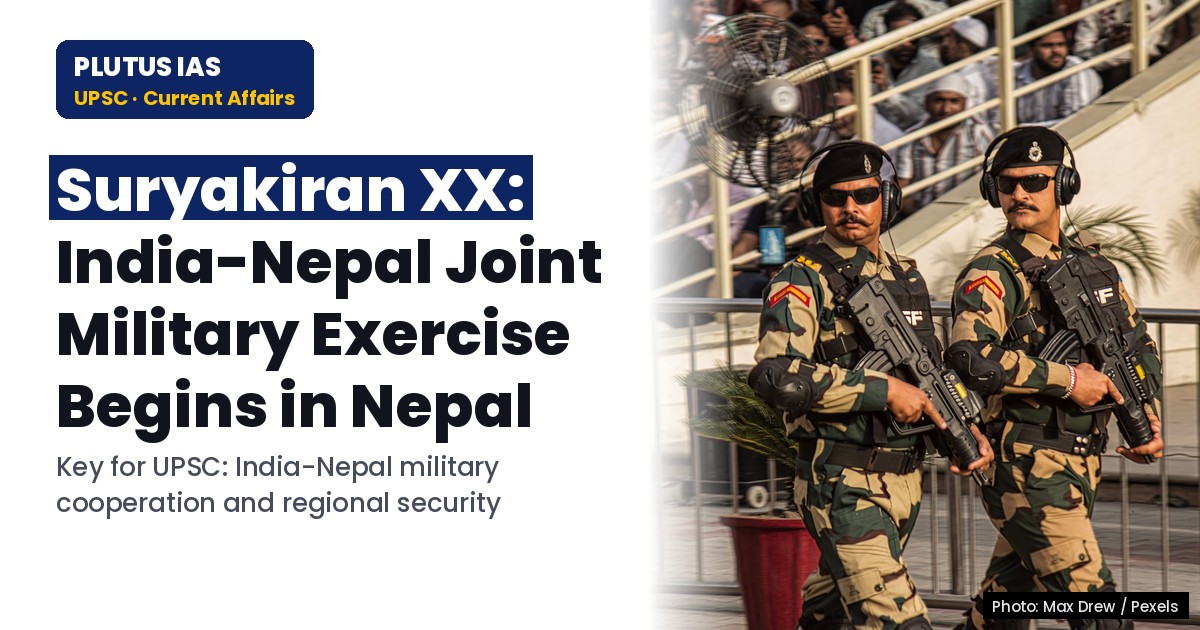
25 Nov Suryakiran XX: India-Nepal Joint Military Exercise Analysis
✎ Exercise Suryakiran is an annual India-Nepal joint military exercise focused on enhancing interoperability in counter-terrorism, jungle warfare, and HADR operations, symbolising robust bilateral defence cooperation.
Subject Relevance — Where This Topic Fits
- GS Paper II — International Relations | GS Paper III — Security
- Prelims: Exercise Suryakiran, India-Nepal relations, Joint military exercises, Bilateral defence cooperation, Humanitarian Assistance and Disaster Relief (HADR)
- Essay: India’s Neighbourhood First Policy and regional stability, The role of defence diplomacy in international relations
Quick Revision: Exercise Suryakiran is an annual India-Nepal joint military exercise focused on enhancing interoperability in counter-terrorism, jungle warfare, and HADR operations, symbolising robust bilateral defence cooperation.
Why is this in the news?
The twentieth edition of the joint military exercise ‘Suryakiran’ between India and Nepal has commenced in Nepal. This annual exercise is a significant component of bilateral defence cooperation, aimed at enhancing interoperability and fostering mutual understanding between the armed forces of both nations, particularly in counter-terrorism operations and disaster response scenarios.
Background
- India and Nepal share a unique relationship characterised by open borders and deep-rooted people-to-people ties, often referred to as ‘Roti-Beti Ka Rishta’.
- Defence cooperation forms a crucial pillar of this bilateral relationship, encompassing training, joint exercises, and equipment supply.
- The ‘Suryakiran’ exercise is an annual event conducted alternately in India and Nepal, signifying a sustained commitment to defence collaboration.
- The exercise primarily focuses on jungle warfare, counter-terrorism operations, and Humanitarian Assistance and Disaster Relief (HADR) operations, reflecting common security challenges faced by both countries.
- Such joint exercises contribute to regional stability and reinforce the strategic partnership between India and its Himalayan neighbour.
- Both nations are members of regional groupings like BIMSTEC and SAARC, further underscoring their shared regional security interests.
About Exercise Suryakiran
- Exercise Suryakiran is a bilateral joint military exercise conducted between the Indian Army and the Nepali Army.
- It is designed to enhance interoperability in jungle warfare, counter-terrorism operations, and mountain terrain operations.
- The exercise also focuses on developing capabilities for Humanitarian Assistance and Disaster Relief (HADR) operations, which are critical in the Himalayan region prone to natural calamities.
- Participants from both armies share experiences and best practices in various tactical drills, including cordon and search operations, heliborne operations, and medical assistance.
- The exercise aims to foster a strong bond of friendship and cooperation between the two armies and promote mutual understanding.
- It serves as a platform for validating joint operational doctrines and improving coordination mechanisms for potential real-world contingencies.
- The alternating venues in India and Nepal ensure that troops from both sides gain familiarity with diverse operational environments.
- The exercise underscores India’s ‘Neighbourhood First’ policy, emphasising cooperative security and capacity building with neighbouring countries.
Key Features
| Feature | Significance |
|---|---|
| Exercise Name | Suryakiran XX, denoting the twentieth iteration of the joint military exercise. |
| Participating Nations | India and Nepal, highlighting bilateral defence cooperation. |
| Location | Nepal, indicating the host nation for this particular iteration. |
| Nature of Exercise | Joint military exercise, focusing on interoperability and tactical skills. |
| Primary Objective | Enhancing military relations, sharing best practices, and improving coordination in counter-terrorism and disaster relief operations. |
Why it Matters
Strategic Significance
- Reinforces the ‘Neighbourhood First’ policy by strengthening defence ties with a key Himalayan neighbour.
- Contributes to regional stability and security through enhanced military interoperability and mutual understanding.
- Serves as a platform for exchanging expertise in mountain warfare and counter-insurgency operations, critical for both nations’ security landscapes.
Diplomatic Significance
- Symbolises the enduring friendship and strategic partnership between India and Nepal.
- Provides a channel for high-level military-to-military engagement, fostering trust and communication.
- Demonstrates a shared commitment to addressing common security challenges, including cross-border crime and disaster management.
Security Significance
- Enhances the operational capabilities of both armed forces in complex terrains and diverse operational environments.
- Facilitates the development of joint doctrines and procedures for humanitarian assistance and disaster relief (HADR) operations, crucial in the disaster-prone Himalayan region.
- Strengthens border management and security through coordinated efforts and intelligence sharing.
Challenges
1. GEOPOLITICAL DYNAMICS
- The evolving geopolitical landscape in South Asia, including the influence of other regional powers, can impact the trajectory of bilateral relations.
- Maintaining a balanced foreign policy amidst competing interests requires careful diplomatic navigation.
UPSC Link: GS-II: India and its neighbourhood relations
2. BORDER MANAGEMENT
- The open border between India and Nepal, while facilitating people-to-people contact, also presents challenges related to illegal migration, smuggling, and cross-border criminal activities.
- Effective coordination and joint mechanisms are essential for comprehensive border security.
UPSC Link: GS-III: Security challenges and their management in border areas
3. DISASTER RESPONSE COORDINATION
- The Himalayan region is highly susceptible to natural disasters, necessitating robust and coordinated disaster response mechanisms.
- Ensuring seamless integration of efforts during crises requires continuous training and resource allocation.
UPSC Link: GS-III: Disaster and disaster management
4. MILITARY INTEROPERABILITY
- Achieving higher levels of interoperability between two distinct military forces requires sustained effort in terms of joint training, equipment standardisation, and communication protocols.
- Differences in military doctrines and operational procedures can pose initial challenges.
UPSC Link: GS-III: Various security forces and agencies and their mandate
Challenges — UPSC Perspective
| Issue | Concern |
|---|---|
| Border Demarcation | Unresolved border disputes in certain areas can periodically strain bilateral relations and necessitate diplomatic resolution. |
| Economic Disparities | Varying levels of economic development and trade imbalances can lead to economic dependencies and occasional friction. |
| Hydropower Cooperation | Optimal utilisation and equitable sharing of transboundary river resources for hydropower generation remain areas requiring sustained cooperation and agreement. |
| Information Sharing | Ensuring timely and effective intelligence sharing on security threats and cross-border criminal activities is crucial for mutual security. |
| Infrastructure Development | Coordinating infrastructure projects along the border and within Nepal requires mutual understanding and strategic alignment to maximise benefits. |
Way Forward
- Sustain regular joint military exercises like ‘Suryakiran’ to continuously enhance interoperability and mutual understanding between the armed forces.
- Strengthen institutional mechanisms for dialogue and consultation on security, strategic, and economic matters at various levels.
- Increase cooperation in disaster management, including joint training, early warning systems, and coordinated response efforts for natural calamities.
- Promote economic engagement through trade facilitation, investment, and joint infrastructure projects, particularly in hydropower and connectivity.
- Foster cultural exchanges and people-to-people contacts to reinforce the deep-rooted historical and social ties between the two nations.
- Address outstanding bilateral issues, including border demarcation, through constructive dialogue and established diplomatic channels.
- Expand collaboration in emerging security domains such as cyber security and maritime security (where applicable to regional context) to counter evolving threats.
UPSC Value Addition
Keywords for Mains Answer-Writing
India-Nepal relations · Military diplomacy · Joint military exercises · Regional security cooperation · Suryakiran exercise · Bilateral defence cooperation · Strategic partnerships · Neighbourhood First Policy · Geopolitical significance · Humanitarian Assistance and Disaster Relief (HADR)
Concept Flow
Joint military exercise commences (Suryakiran XX) → Enhances military interoperability and tactical skills → Strengthens bilateral defence cooperation → Fosters trust and mutual understanding → Contributes to regional security and stability → Reinforces ‘Neighbourhood First’ policy
Prelims Practice Questions
Q1. Consider the following statements regarding India’s joint military exercises:
1. Exercise ‘Suryakiran’ is conducted between India and Nepal.
2. The primary objective of such exercises often includes enhancing interoperability and sharing best practices in counter-terrorism operations.
3. These exercises are exclusively focused on conventional warfare scenarios.
How many of the above statements are correct?
- Only one
- Only two
- Only three
- None
Answer: Only two — Statement 1 is correct: Exercise ‘Suryakiran’ is indeed a joint military exercise between India and Nepal. Statement 2 is correct: Enhancing interoperability and sharing best practices, particularly in counter-terrorism and HADR, are key objectives. Statement 3 is incorrect: Joint exercises often encompass a wide range of scenarios, including counter-insurgency, counter-terrorism, and HADR, not exclusively conventional warfare.
Q2. Which of the following is NOT a primary objective of joint military exercises like ‘Suryakiran’?
- To enhance interoperability between participating forces.
- To share best practices in counter-terrorism and disaster relief operations.
- To facilitate the exchange of cultural delegations and tourism.
- To strengthen bilateral defence cooperation and strategic ties.
Answer: To facilitate the exchange of cultural delegations and tourism. — While joint exercises can indirectly foster goodwill, their primary objectives are military-focused, such as enhancing interoperability, sharing best practices in specific operational domains (like counter-terrorism and HADR), and strengthening defence cooperation. Facilitating cultural delegations and tourism is not a direct military objective.
Mains Practice Question
✍ Joint military exercises like ‘Suryakiran’ play a crucial role in strengthening bilateral defence cooperation and fostering regional stability. Discuss the multifaceted objectives and significance of such exercises in India’s ‘Neighbourhood First Policy’. (15 Marks)
Approach: MODEL-ANSWER SKELETON:
1. **Introduction:** Briefly introduce joint military exercises as a tool of military diplomacy and highlight ‘Suryakiran’ as an example of India-Nepal cooperation.
2. **Multifaceted Objectives:**
* **Interoperability:** Enhancing coordination and understanding between forces.
* **Skill Enhancement:** Sharing best practices in specific operational areas (e.g., counter-terrorism, jungle warfare, mountain warfare).
* **Capacity Building:** Training forces for complex scenarios, including Humanitarian Assistance and Disaster Relief (HADR).
* **Trust Building:** Fostering mutual confidence and understanding between militaries.
* **Strategic Signalling:** Demonstrating commitment to regional security and stability.
3. **Significance in ‘Neighbourhood First Policy’:**
* **Deepening Bilateral Ties:** Concrete manifestation of defence partnership with neighbouring countries.
* **Regional Security Architecture:** Contributing to a stable and secure regional environment.
* **Disaster Management:** Preparing for coordinated responses to natural calamities, given the shared geographical vulnerabilities (e.g., Himalayas).
* **Countering Common Threats:** Jointly addressing non-traditional security challenges like terrorism and illicit trafficking.
* **Diplomatic Leverage:** Reinforcing diplomatic efforts through defence engagement.
4. **Conclusion:** Summarize the importance of such exercises as a vital component of India’s foreign policy, contributing to both national security and regional peace.
Source: PIB (Press Information Bureau)
Generated by AanyaAi for educational purpose.
Related guides on our sites
- How to prepare for GS paper 1 for UPSC CSE mains exam
- Best UPSC coaching for IFOS exam
- Best mentorship programme for upsc
- UPSC+BA degree

- Suryakiran XX: India-Nepal Joint Military Exercise Analysis - November 25, 2026
- एयरो इंडिया 2027: रिकॉर्ड मांग से क्षमता विस्तार, रक्षा मंत्रालय का निर्णय - November 25, 2026
- Cabinet Approves Scheme for Construction Equipment Manufacturing - November 25, 2026

No Comments