


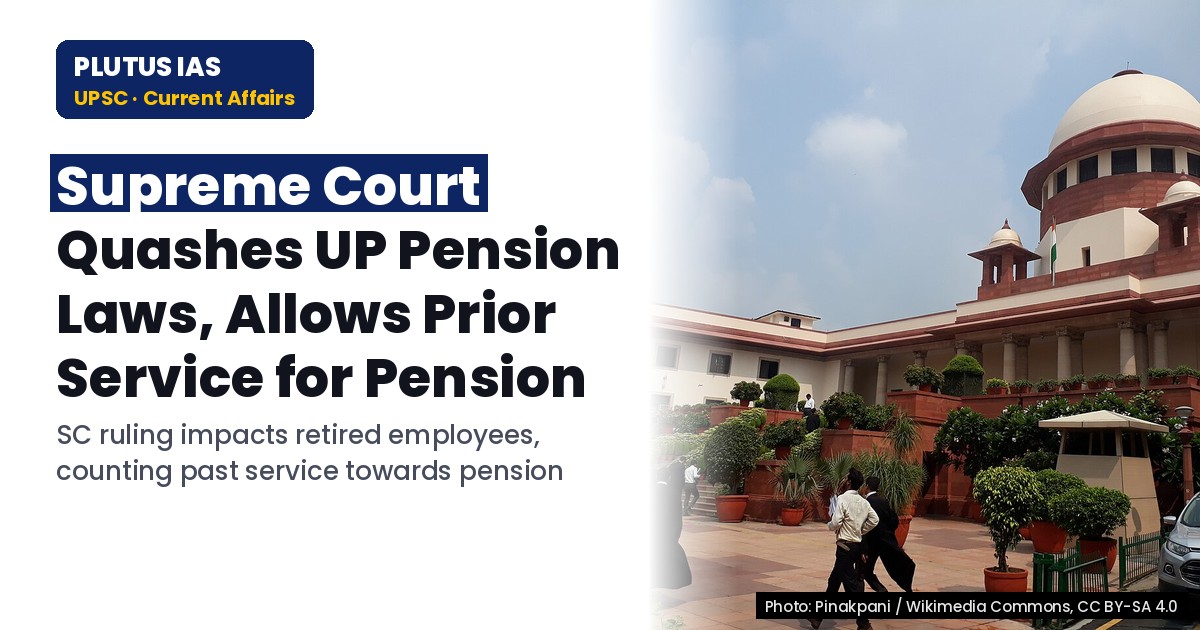
26 Nov SC Quashes UP Pension Laws: Relief for Retired Employees
✎ The Supreme Court's decision reinforces judicial oversight against retrospective legislative curtailment of established service rights.
Subject Relevance — Where This Topic Fits
- GS Paper II — Indian Polity and Governance: Structure, Functioning, and Conduct of Business of the Judiciary; Government Policies and Interventions for Development in various sectors and Issues arising out of their Design and Implementation; Welfare Schemes for Vulnerable Sections of the Population by the Centre and States and the Performance of these Schemes; Mechanisms, Laws, Institutions and Bodies constituted for the Protection and Betterment of these Vulnerable Sections. | GS Paper IV — Ethics, Integrity, and Aptitude: Public/Civil Service Values and Ethics in Public Administration; Philosophical basis of governance and probity; Information sharing and transparency in government; Right to Information; Codes of Ethics, Codes of Conduct; Citizen’s Charters; Work culture; Quality of service delivery; Utilization of public funds; Challenges of corruption.
- Prelims: Supreme Court of India, Judicial Review, Pension Laws, Service Law, Work-charged employees, Daily wage employees, Regularisation of service, Article 32/226 (Writ Jurisdiction)
- Essay: The Role of Judiciary in Upholding Constitutional Principles and Protecting Citizen Rights., Ensuring Social Security and Dignity for Workers in the Unorganised and Quasi-Organised Sectors.
Quick Revision: The Supreme Court’s decision reinforces judicial oversight against retrospective legislative curtailment of established service rights.
Why is this in the news?
The Supreme Court of India recently nullified two pension laws enacted by the Uttar Pradesh government in 2021 and 2025. These laws had sought to exclude the prior service period of employees, who were initially engaged on a daily wage, muster roll, or work-charged basis and subsequently regularised, from being counted towards their pensionable service.
Background
- Historically, various government departments have employed individuals on temporary, daily wage, or work-charged bases for extended periods before their services were regularised.
- The regularisation of such employees often followed judicial pronouncements or specific government policies aimed at addressing their precarious employment status.
- The issue of counting prior temporary or ad-hoc service for pensionary benefits has been a recurring point of contention between government employees and state authorities across India.
- Several judicial precedents have affirmed the principle that once an employee’s service is regularised, their entire period of service, including the initial temporary phase, should be considered for pensionary benefits, provided the initial service was rendered against a sanctioned post and was continuous.
- The Uttar Pradesh government’s impugned laws of 2021 and 2025 aimed to retrospectively alter these conditions, thereby denying pension benefits for the period of service rendered before regularisation.
- The Supreme Court’s ruling reinforces the principle that legislative amendments cannot nullify the effect of previous judicial decisions that have attained finality, particularly when such amendments infringe upon established service rights.
Understanding Pension Laws and Service Regularisation
- Pension is a social security measure provided to employees upon retirement, typically calculated based on their length of qualifying service and emoluments drawn.
- Qualifying service refers to the period of service that counts towards the calculation of pension benefits, often requiring regular, continuous, and paid employment.
- Work-charged establishments are typically created for the execution of specific projects, and employees engaged therein are paid from the project funds, often on a temporary basis.
- Daily wage employees are those engaged on a day-to-day basis without the benefits and security associated with regular government employment.
- Regularisation of service is the process by which temporary, ad-hoc, or contractual employees are brought onto the permanent establishment, granting them full benefits and security of tenure.
- The principle of ‘equal pay for equal work’ and the dignity of labour often underpin judicial interventions in matters of regularisation and pensionary benefits.
- Judicial review is the power of the Supreme Court and High Courts to examine the constitutionality of legislative enactments and executive orders, ensuring they conform to the provisions of the Constitution.
- The Supreme Court’s decision highlights the judiciary’s role in protecting the rights of employees, particularly those who have rendered long years of service, against arbitrary state action.
Key Features
| Feature | Significance |
|---|---|
| Inclusion of Prior Service | Enables employees who were initially daily wage, muster roll, or work-charged to include their pre-regularisation service for pension calculation, ensuring comprehensive recognition of their governmental tenure. |
| Supreme Court’s Mandate | Reaffirms the judiciary’s role in upholding the rights of employees against retrospective legislative changes that diminish established benefits, asserting judicial supremacy in protecting fundamental entitlements. |
| Time-Bound Resolution | Directs government authorities to decide on pension claims within six months, promoting administrative efficiency and preventing undue delays in disbursing retirement benefits. |
| Interest on Delayed Payments | Stipulates a 9% annual interest rate for payments delayed beyond the six-month period, acting as a deterrent against administrative inertia and compensating beneficiaries for financial losses due to delays. |
| Right to be Heard | Mandates that employees whose claims are rejected must be given an opportunity to present their case, ensuring adherence to principles of natural justice and transparency in administrative decisions. |
Why it Matters
Social Justice
- Ensures equitable treatment for a segment of government employees who rendered substantial service under irregular employment conditions before regularisation, addressing historical disparities in pension entitlements.
- Upholds the principle that all service rendered to the government, irrespective of initial employment status, should contribute to retirement benefits once an employee is regularised, recognising their contribution to public service.
Governance and Administration
- Reinforces the accountability of government agencies in processing pension claims within stipulated timelines, thereby enhancing administrative efficiency and responsiveness.
- Establishes a precedent for state governments to align their pension policies with judicial pronouncements, particularly concerning the rights of employees with varied service histories.
Judicial Precedent
- Affirms the Supreme Court’s authority to invalidate state laws that attempt to nullify or circumvent previous judicial decisions, thereby safeguarding the rule of law and the independence of the judiciary.
- Provides clarity on the scope of legislative power, particularly concerning retrospective application of laws that adversely affect vested rights, ensuring legal certainty for public sector employees.
Challenges
1. Administrative Burden
- Processing a potentially large volume of new and re-opened pension claims from a diverse group of employees with varying service records.
- Verifying old service documents, especially for employees who worked under informal or temporary arrangements, which may be difficult to trace or authenticate.
UPSC Link: Governance: transparency & accountability
2. Financial Implications
- Estimating and allocating the necessary financial resources for increased pension liabilities, including potential arrears and interest payments.
- Managing the fiscal impact on state budgets, especially for states with a large number of such employees, without compromising other developmental expenditures.
UPSC Link: Government Budgeting
3. Policy Harmonisation
- Ensuring that state pension rules are consistently aligned with judicial pronouncements and constitutional principles, preventing future legal challenges.
- Developing clear guidelines for the inclusion of various types of prior service (e.g., daily wage, work-charged) into regular pensionable service.
UPSC Link: Indian Constitution: features
4. Preventing Future Litigation
- Formulating robust and unambiguous pension policies that prevent ambiguities leading to further legal disputes.
- Establishing effective grievance redressal mechanisms to resolve pension-related issues at an administrative level, reducing reliance on judicial intervention.
UPSC Link: Dispute Redressal Mechanisms
Challenges — UPSC Perspective
| Issue | Concern |
|---|---|
| Verification of Past Service | Difficulty in authenticating service records for employees initially engaged on daily wage, muster roll, or work-charged basis, potentially leading to disputes and delays. |
| Fiscal Strain on State | The financial burden of increased pension outlays, including arrears and interest, on state finances, which may necessitate re-prioritisation of budgetary allocations. |
| Uniform Implementation | Ensuring consistent application of the Supreme Court’s ruling across all government departments and entities, avoiding disparate treatment of similarly situated employees. |
| Capacity Building | Training administrative personnel to efficiently process complex pension claims involving historical service records and adhere to the six-month deadline and interest payment mandates. |
| Legal Interpretation | Potential for varying interpretations of ‘eligible scheme’ or ‘regularisation’ criteria, leading to further litigation if not clarified through comprehensive guidelines. |
Way Forward
- Develop comprehensive guidelines for the inclusion of prior service, clearly defining eligibility criteria and acceptable documentation for different categories of temporary employment.
- Establish a dedicated task force or special cell within the state administration to expedite the processing of pension claims arising from this judgment, ensuring adherence to the six-month deadline.
- Implement a robust digital record-keeping system for all government employees, including those in temporary or contractual roles, to streamline future pension calculations and reduce verification complexities.
- Conduct training programs for administrative staff on the nuances of pension regulations and the implications of the Supreme Court’s judgment, to ensure accurate and timely processing of claims.
- Allocate adequate budgetary provisions to meet the increased pension liabilities, including potential arrears and interest payments, through a well-planned financial strategy.
- Set up an accessible and transparent grievance redressal mechanism for employees whose claims are rejected, ensuring their right to be heard and providing clear reasons for rejection.
- Regularly review and update state pension rules to ensure alignment with constitutional principles and judicial pronouncements, preventing future legal challenges and providing certainty to employees.
UPSC Value Addition
Keywords for Mains Answer-Writing
Pension laws · Supreme Court judgments · Service jurisprudence · Qualifying service · Regularisation of employment · Employee welfare · Rule of law · Judicial review · Retirement benefits · Constitutional principles
Constitutional & Policy Linkages
- {‘Article 14’: ‘Equality before law, equal protection.’}
- {‘Article 21’: ‘Right to livelihood, dignified life.’}
- {‘Article 300A’: ‘Right to property (pension as property).’}
- {‘Article 226′: “High Courts’ power to issue writs.”}
- {‘Article 32’: “Supreme Court’s power to issue writs.”}
Concept Flow
Employees serve initially as temporary staff (daily wage, work-charged). → Employees are subsequently regularised into permanent government service. → State laws enacted to exclude prior temporary service from pension calculation. → Supreme Court invalidates these laws, upholding inclusion of prior service. → Eligible retired employees can claim pension for their full service tenure. → Government mandated to process claims within six months, with interest on delays.
Prelims Practice Questions
Q1. Consider the following statements regarding pension benefits for government employees in India:
1. Pension is a statutory right and not a bounty.
2. The Supreme Court has consistently held that past service, even if rendered on a temporary or daily-wage basis, can be counted for pensionary benefits if the employee is subsequently regularised.
3. State governments possess absolute power to enact laws that nullify previous judicial pronouncements without any constitutional limitations.
How many of the above statements are correct?
- Only one
- Only two
- Only three
- None
Answer: Only two — Statement 1 is correct: The Supreme Court has affirmed that pension is a right, not a gratuity. Statement 2 is correct: The Supreme Court’s recent ruling reinforces this principle, ensuring that regularised employees’ prior service is considered. Statement 3 is incorrect: State governments’ legislative powers are subject to constitutional review, and they cannot override Supreme Court judgments without appropriate constitutional amendments or legislative competence.
Q2. Which of the following Articles of the Indian Constitution primarily deals with the power of the Supreme Court to issue directions or orders for the enforcement of fundamental rights and for any other purpose?
- Article 32
- Article 136
- Article 142
- Article 226
Answer: Article 32 — Article 32 grants the right to move the Supreme Court for the enforcement of fundamental rights and empowers the Court to issue appropriate writs, directions, or orders. Article 136 deals with special leave to appeal. Article 142 deals with the Supreme Court’s power to pass decrees and orders for doing complete justice. Article 226 empowers High Courts to issue writs.
Mains Practice Question
✍ Critically examine the Supreme Court’s role in upholding the rights of government employees concerning pensionary benefits, particularly in cases involving regularisation of service. Discuss with reference to recent judgments and the principle of judicial review. (15 Marks)
Approach: Introduction: Briefly define pension as a statutory right and the concept of regularisation of service.
Body Paragraph 1: Explain the Supreme Court’s consistent stance on counting past service for pensionary benefits, even if rendered on a temporary or daily-wage basis, once an employee is regularised. Refer to the ‘doctrine of legitimate expectation’ or ‘equity’.
Body Paragraph 2: Discuss the specific context of the recent judgment, where state laws attempted to nullify this principle. Highlight the Court’s assertion that legislative changes cannot retrospectively annul final judicial pronouncements.
Body Paragraph 3: Elaborate on the principle of judicial review (Articles 13, 32, 226, 142) and its application in safeguarding employee rights against arbitrary executive or legislative action. Mention the ‘basic structure doctrine’ if applicable to legislative overreach.
Body Paragraph 4: Discuss the implications of such judgments for employee welfare, social security, and the rule of law. Emphasise the need for timely compliance by governmental authorities and the provision for interest on delayed payments.
Conclusion: Summarise the Supreme Court’s role as a protector of constitutional values and employee rights, ensuring fairness and justice in service matters.
Source: abplive.com
Generated by AanyaAi for educational purpose.
Related guides on our sites
- Current affairs for upsc 2026
- Best PSIR optional coaching for upsc
- Best PSIR optional teacher for upsc
- Best teacher of PSIR optional for upsc

- SC Quashes UP Pension Laws: Relief for Retired Employees - November 26, 2026
- ओडिशा की जनजातीय आजीविका मिशन: सतत विकास की ओर - November 26, 2026
- Hera Mission Reveals Dimorphos Asteroid Crater: Planetary Defense Implications - November 26, 2026

No Comments