


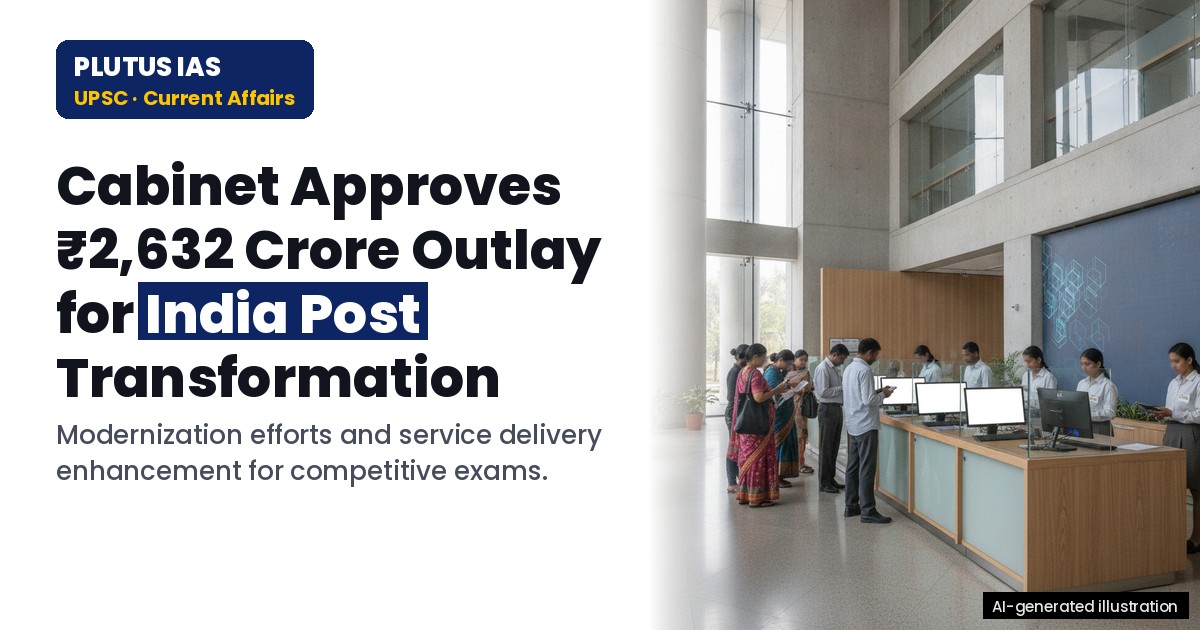
26 Nov India Post Transformation: ₹2,632 Cr Outlay Approved
✎ India Post's digital transformation aims to enhance financial inclusion and modernize postal services across India.
Subject Relevance — Where This Topic Fits
- GS Paper II — Government Policies and Interventions for Development in various sectors and Issues arising out of their Design and Implementation | GS Paper III — Indian Economy and issues relating to Planning, Mobilization of Resources, Growth, Development and Employment; Inclusive Growth and issues arising from it
- Prelims: India Post, Department of Posts, Financial Inclusion, Digital Transformation, Core Banking Solution (CBS), India Post Payments Bank (IPPB), Sukanya Samriddhi Yojana (SSY), Atal Pension Yojana (APY), Pradhan Mantri Jeevan Jyoti Bima Yojana (PMJJBY), Pradhan Mantri Suraksha Bima Yojana (PMSBY)
- Essay: The role of digital infrastructure in fostering inclusive growth and development., Transforming traditional public services for modern governance and citizen welfare.
Quick Revision: India Post’s digital transformation aims to enhance financial inclusion and modernize postal services across India.
Why is this in the news?
The initiative is aimed at modernizing postal operations, enhancing service delivery, and expanding financial inclusion across the nation, particularly in rural and remote areas.
Background
- India Post, under the Department of Posts, Ministry of Communications, is one of the world’s largest postal networks, serving diverse geographical and socio-economic segments.
- Historically, India Post has played a crucial role in communication, financial services, and social security schemes, particularly in regions with limited access to formal banking.
- The advent of digital technology and the ‘Digital India’ initiative necessitated a modernization drive to ensure India Post remains relevant and efficient in the contemporary landscape.
- Previous efforts included the implementation of Core Banking Solution (CBS) across post offices and the establishment of the India Post Payments Bank (IPPB) to leverage its extensive network for financial services.
- The current financial allocation builds upon these foundational efforts, focusing on further technological upgrades, operational streamlining, and expanding the reach of digital services.
- The initiative aligns with the government’s broader agenda of financial inclusion, ensuring that banking and social security benefits reach the last mile.
What is India Post’s Transformation Initiative?
- The transformation initiative is a multi-faceted program designed to modernize India Post’s infrastructure, operations, and service delivery mechanisms through technological integration.
- A primary objective is to enhance financial inclusion by leveraging India Post’s vast physical network and digital capabilities to provide accessible banking and social security services.
- Key components include upgrading IT systems, implementing advanced digital tools for mail processing and delivery, and improving customer interfaces.
- The initiative aims to integrate India Post with various government schemes, facilitating the direct benefit transfer (DBT) mechanism and expanding the reach of social welfare programs.
- It involves training postal employees in digital technologies and customer service to ensure effective implementation and optimal utilization of new systems.
- The transformation seeks to convert post offices into multi-service hubs, offering not only traditional postal services but also a wide array of financial, insurance, and government-to-citizen (G2C) services.
- Emphasis is placed on extending digital services to rural and remote areas, bridging the digital divide and ensuring equitable access to modern amenities.
- The initiative is expected to improve operational efficiency, reduce costs, and enhance the overall quality and speed of services provided by India Post.
Key Features
| Feature | Significance |
|---|---|
| Financial Outlay | Allocation of ₹2,632 Crore for the comprehensive modernisation and transformation of India Post, indicating a significant governmental commitment to enhancing its operational capabilities and service delivery. |
| Cabinet Approval | Endorsement by the Union Cabinet signifies high-level governmental support and strategic prioritisation of India Post’s revitalisation, ensuring coordinated implementation and resource allocation. |
| Accelerated Transformation | The initiative aims to expedite the ongoing modernisation efforts, focusing on technological upgrades, infrastructure development, and service diversification to meet contemporary demands. |
| Enhanced Service Delivery | The transformation seeks to improve the efficiency, accessibility, and quality of postal services, benefiting citizens across various socio-economic strata, particularly in rural and remote areas. |
| Digital Integration | Modernisation efforts are expected to integrate digital solutions, promoting financial inclusion, e-governance services, and seamless connectivity, aligning with broader national digital initiatives. |
Why it Matters
Economic Implications
- The substantial financial outlay stimulates economic activity through investment in technology, infrastructure, and human resources within the postal sector.
- Improved postal services can facilitate trade and commerce, particularly for Micro, Small, and Medium Enterprises (MSMEs) and e-commerce businesses, by enhancing logistics and delivery networks.
- Modernised postal banking and financial services contribute to financial inclusion, especially in unbanked and underbanked regions, by providing accessible financial products.
Social Impact
- Enhanced accessibility of postal services, including banking and insurance, empowers rural populations and reduces the urban-rural service delivery gap.
- The transformation supports social welfare schemes by leveraging India Post’s extensive network for disbursal of benefits and delivery of government services.
- Digitalisation of postal operations promotes digital literacy and inclusion among citizens, fostering greater participation in the digital economy.
Governance and Public Service
- Strengthening India Post reinforces its role as a vital government service provider, ensuring efficient delivery of mail, parcels, and financial services.
- Modernisation enhances the capacity of India Post to act as a front-end for various e-governance initiatives, bringing government services closer to citizens.
- The initiative aligns with the government’s vision of ‘Minimum Government, Maximum Governance’ by optimising public service delivery mechanisms through technological advancements.
Strategic Importance
- India Post’s extensive physical network, coupled with digital integration, provides a strategic advantage for last-mile connectivity, crucial for national development and disaster response.
- The transformation positions India Post as a competitive player in the logistics and financial services sectors, contributing to overall national infrastructure development.
Challenges
1. Technological Adoption and Integration
- Integrating legacy systems with new digital platforms poses significant technical and operational challenges.
- Ensuring uniform technological adoption across a vast and diverse network, including remote areas, requires robust planning and execution.
UPSC Link: GS-III: Science and Technology Developments
2. Human Resource Management
- Training a large workforce in new technologies and operational procedures necessitates extensive capacity building and skill development programs.
- Managing resistance to change among employees and ensuring smooth transition to modern work environments is crucial.
UPSC Link: GS-II: Governance, Human Resource Development
3. Financial Sustainability
- Ensuring the long-term financial viability of the transformed India Post requires diversified revenue streams and efficient cost management.
- Balancing social objectives with commercial imperatives remains a persistent challenge for public service organisations.
UPSC Link: GS-III: Indian Economy, Government Budgeting
4. Competition from Private Players
- India Post faces intense competition from private courier services and financial institutions, necessitating continuous innovation and service differentiation.
- Maintaining market relevance while fulfilling its public service mandate requires strategic positioning and agile responses to market dynamics.
UPSC Link: GS-III: Indian Economy, Liberalisation
5. Infrastructure Development
- Upgrading physical infrastructure, including post offices and logistics hubs, to support modern operations demands substantial investment and logistical coordination.
- Ensuring reliable internet connectivity and power supply, particularly in rural and remote areas, is fundamental for digital service delivery.
UPSC Link: GS-III: Infrastructure, Investment Models
Challenges — UPSC Perspective
| Issue | Concern |
|---|---|
| Digital Divide | Ensuring equitable access to digital postal services across urban and rural areas, mitigating disparities in technological infrastructure and digital literacy. |
| Cybersecurity Risks | Protecting sensitive customer data and financial transactions from cyber threats and ensuring the integrity of digital platforms. |
| Service Quality Consistency | Maintaining uniform standards of service delivery across a vast and diverse network, addressing variations in operational efficiency and customer experience. |
| Regulatory Framework | Adapting existing postal regulations and policies to accommodate new services, technologies, and market dynamics, ensuring a conducive operating environment. |
| Last-Mile Connectivity | Overcoming logistical challenges in reaching remote and inaccessible areas efficiently, ensuring timely and reliable delivery of services. |
Government Initiatives — Must-Memorise for Prelims
- India Post Payments Bank (IPPB)
Way Forward
- Prioritise a phased implementation strategy for technological upgrades, focusing on critical areas first to ensure smooth transition and minimise disruptions.
- Invest significantly in comprehensive training and reskilling programs for postal employees to equip them with necessary digital and operational competencies.
- Develop a robust cybersecurity framework and data protection protocols to safeguard customer information and maintain trust in digital services.
- Foster strategic partnerships with other government departments, financial institutions, and e-commerce platforms to expand service offerings and enhance reach.
- Implement a dynamic feedback mechanism to continuously monitor service quality, address customer grievances, and adapt to evolving user needs.
- Explore innovative revenue generation models and cost-efficiency measures to ensure the long-term financial sustainability of India Post.
- Strengthen the physical infrastructure, including modernising post offices and logistics networks, to complement digital initiatives and improve overall service delivery.
UPSC Value Addition
Keywords for Mains Answer-Writing
India Post transformation · Digital India initiatives · Financial inclusion · Rural connectivity · Modernisation of postal services · Public service delivery · Government schemes implementation · Financial outlay for infrastructure · Last-mile delivery · E-commerce logistics
Concept Flow
Cabinet approval of financial outlay → Investment in technology and infrastructure → Modernisation of India Post operations → Enhanced service delivery and efficiency → Improved public access to postal and financial services → Contribution to financial inclusion and e-governance
Prelims Practice Questions
Q1. Consider the following statements regarding the India Post Payments Bank (IPPB):
1. It was launched with the vision to build the most accessible, affordable, and trusted bank for the common man in India.
2. It operates under the Department of Financial Services, Ministry of Finance.
3. It leverages the vast network of India Post to provide banking services at the doorstep.
How many of the above statements are correct?
- Only one
- Only two
- Only three
- None
Answer: Only two — Statement 1 is correct. IPPB’s vision aligns with financial inclusion and accessibility. Statement 2 is incorrect; IPPB operates under the Department of Posts, Ministry of Communications. Statement 3 is correct. IPPB utilizes the extensive postal network for doorstep banking services.
Q2. Which of the following initiatives are part of the broader modernisation efforts of India Post?
1. Expansion of Post Office Savings Bank (POSB) services.
2. Integration with Aadhaar-enabled Payment System (AePS).
3. Development of e-commerce logistics solutions.
4. Providing passport application services.
Select the correct answer using the code given below:
- 1, 2 and 3 only
- 2, 3 and 4 only
- 1, 3 and 4 only
- 1, 2, 3 and 4
Answer: 1, 2, 3 and 4 — All four initiatives listed are indeed part of the broader modernisation and diversification efforts of India Post. POSB services are being digitised, AePS is integrated for financial transactions, e-commerce logistics are being developed, and passport services are offered through Post Office Passport Seva Kendras.
Mains Practice Question
✍ Examine the significance of the recent financial outlay for the transformation of India Post in enhancing financial inclusion and last-mile delivery services. Discuss the challenges that persist in achieving comprehensive modernisation of postal services across diverse geographical terrains in India. (15 Marks)
Approach: INTRODUCTION: Briefly introduce India Post’s role and the recent financial outlay for its transformation.
PART 1: SIGNIFICANCE OF FINANCIAL OUTLAY (approx. 75-80 words)
– Financial Inclusion: Mention leveraging the postal network for banking services (e.g., IPPB), reaching unbanked populations, direct benefit transfer (DBT) facilitation.
– Last-Mile Delivery: Discuss enhanced logistics, e-commerce integration, improved parcel services, and connectivity to remote areas.
– Digitalisation: Reference automation of postal operations, IT infrastructure upgrades, and citizen-centric services.
PART 2: CHALLENGES IN MODERNISATION (approx. 100-110 words)
– Infrastructure Gaps: Address the need for upgrading physical infrastructure, particularly in rural and remote regions.
– Human Resource Training: Discuss the requirement for skill development among postal staff for new technologies and services.
– Digital Divide: Highlight disparities in digital literacy and internet access, affecting service adoption.
– Competition: Acknowledge competition from private logistics players and digital financial service providers.
– Geographical Diversity: Elaborate on the complexities of serving diverse terrains (hilly, tribal, desert areas) with consistent service quality.
– Financial Sustainability: Mention the challenge of balancing public service obligations with financial viability.
CONCLUSION: Summarise the potential of the transformation while acknowledging the ongoing efforts required to overcome challenges and fully realise India Post’s potential as a modern public service provider.
Source: PIB (Press Information Bureau)
Generated by AanyaAi for educational purpose.
Related guides on our sites
- How to prepare for GS paper 1 for UPSC CSE mains exam
- Best UPSC coaching for IFOS exam
- Best mentorship programme for upsc
- UPSC+BA degree

- Nilgiris Wildlife at Risk: Disease Threat from Feral Animals - November 26, 2026
- चंद्रयान-5/ल्यूपेक्स रोवर प्रोटोटाइप का अनावरण: विज्ञान और प्रौद्योगिकी - November 26, 2026
- India Post Transformation: ₹2,632 Cr Outlay Approved - November 26, 2026

No Comments