


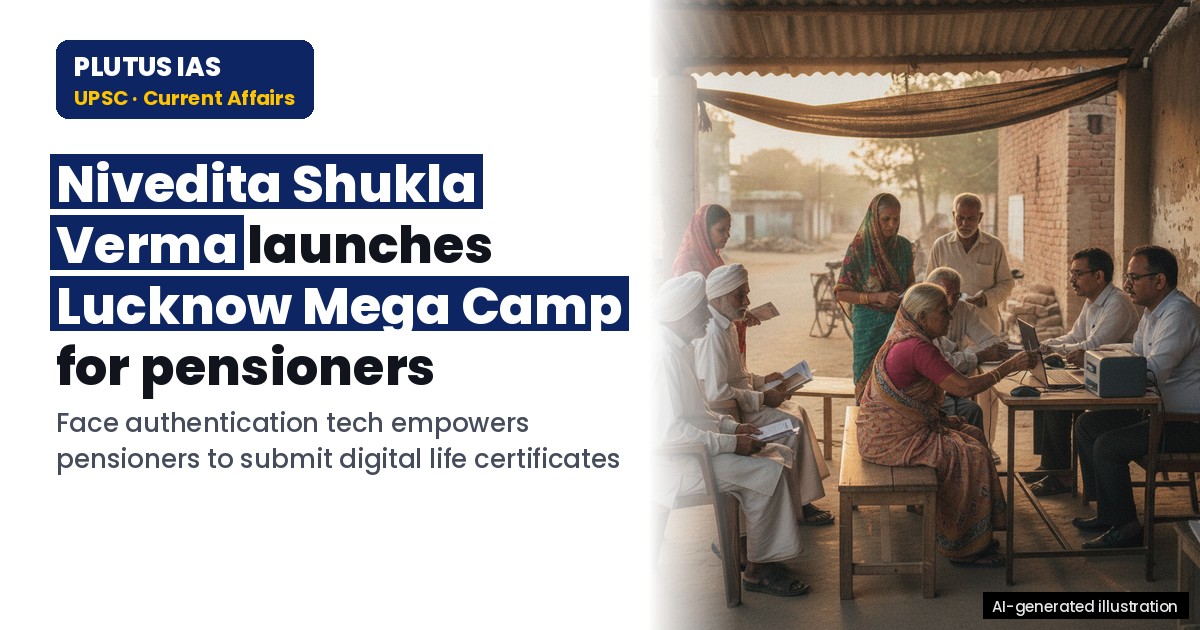
28 Nov Lucknow Mega Camp Empowers Pensioners under DLC Campaign 5
✎ The Digital Life Certificate Campaign enables pensioners to submit life certificates digitally via face authentication technology, ensuring uninterrupted pension disbursement through the Jeevan Pramaan Portal.
Subject Relevance — Where This Topic Fits
- GS Paper II — Governance, Transparency and Accountability | GS Paper III — Technology, Economic Development
- Prelims: Digital Life Certificate (DLC), Face Authentication Technology, Pensioners’ Welfare, Ministry of Personnel, Public Grievances and Pensions, Jeevan Pramaan Portal
- Essay: Digital India: Transforming Governance for Citizen Convenience, Empowering Marginalised Sections Through Technology
Quick Revision: The Digital Life Certificate Campaign enables pensioners to submit life certificates digitally via face authentication technology, ensuring uninterrupted pension disbursement through the Jeevan Pramaan Portal.
Why is this in the news?
The Government of India, through the Department of Pension and Pensioners’ Welfare, organised a mega camp in Lucknow on 26 November 2026 under the fifth edition of the Digital Life Certificate Campaign (DLC-5). The event, held in collaboration with the Uttar Pradesh government, underscores the state’s role in facilitating last-mile delivery of digital pension services and highlights the integration of face authentication technology to simplify life certificate submission for pensioners across India.
Background
- The Digital Life Certificate (DLC) initiative was launched in 2014 under the ‘Jeevan Pramaan’ scheme to enable pensioners to submit their life certificates digitally, thereby eliminating the need for physical submission at pension disbursing agencies.
- The campaign is conducted annually from 1 to 30 November across 2,000 cities and districts nationwide, with the fifth edition in 2026 being the largest to date.
- The Department of Pension and Pensioners’ Welfare operates under the Ministry of Personnel, Public Grievances and Pensions, which oversees civil service governance, pension administration, and grievance redressal mechanisms.
- Face Authentication Technology, introduced in recent years, allows pensioners to submit their life certificates via smartphone using Aadhaar-based biometric verification, enhancing accessibility for elderly and remote beneficiaries.
- The campaign aligns with the broader ‘Digital India’ initiative, which aims to leverage technology for inclusive governance, reducing bureaucratic hurdles and improving service delivery to citizens.
- Collaborative efforts involve multiple stakeholders, including central and state governments, public sector banks, UIDAI, and pension disbursing agencies, to ensure seamless service integration.
What is the Digital Life Certificate Campaign?
- The Digital Life Certificate (DLC) Campaign is a nationwide initiative to enable pensioners to submit their life certificates digitally, ensuring uninterrupted pension disbursement without physical verification.
- Life certificates are mandatory annual verifications for pensioners to confirm their survival, traditionally submitted in person at banks or government offices, which posed challenges for elderly and remote beneficiaries.
- The campaign utilises the Jeevan Pramaan Portal, a digital platform integrated with Aadhaar authentication, to facilitate secure and paperless submission of life certificates.
- Face Authentication Technology, a key feature of DLC-5, allows pensioners to submit certificates using smartphone-based Aadhaar-linked biometric verification, reducing dependency on intermediaries or physical visits.
- Stakeholders include the Department of Pension and Pensioners’ Welfare, UIDAI, public sector banks (e.g., SBI, PNB), state governments, and pensioners’ welfare associations, ensuring multi-agency coordination.
- Mega camps, like the one in Lucknow, serve as one-stop service hubs offering additional facilities such as health check-ups, Aadhaar updates, and grievance redressal, enhancing the overall pensioner experience.
- The initiative exemplifies the government’s commitment to ‘Minimum Government, Maximum Governance’ by leveraging technology to simplify administrative processes and improve citizen convenience.
Key Features
| Feature | Significance |
|---|---|
| Facial Authentication Technology (Face Auth) | Enables contactless, paperless submission of Digital Life Certificate (DLC) using smartphone cameras, reducing physical dependency and enhancing accessibility for remote pensioners. |
| Nationwide Mega Camp Model | Centralised facilitation hubs in 2,000 cities/districts to provide on-site support, health checks, Aadhaar updates, and grievance redressal, ensuring last-mile delivery of services. |
| Multi-Stakeholder Collaboration | Involves pension disbursing banks (SBI, PNB, etc.), UIDAI, state treasuries, EPFO, and postal services to streamline DLC processing and reduce bureaucratic friction. |
| Digital Empowerment Focus | Encourages pensioners to become ‘digital ambassadors’ by sharing experiences and adopting Face Auth, fostering peer-driven adoption of digital governance tools. |
| Integration with Government Initiatives | Aligns with ‘Whole-of-Government’ approach under ‘Utsav’ framework, leveraging existing digital infrastructure (DigiLocker, UMANG, Aadhaar) for seamless service delivery. |
Why it Matters
Governance & Public Service Delivery
- Demonstrates a scalable model for last-mile delivery of welfare services, reducing procedural delays and enhancing transparency in pension verification processes.
- Leverages emerging technologies (Face Auth) to modernise legacy systems, aligning with the Digital India vision for inclusive digital governance.
- Strengthens inter-departmental coordination, ensuring convergence of pension disbursement, identity verification, and grievance redressal mechanisms.
Economic & Fiscal Impact
- Reduces operational costs for pension disbursing agencies by minimising physical verification requirements, thereby optimising public expenditure.
- Enhances financial inclusion by enabling remote pensioners—particularly in rural and tribal areas—to access digital services without travel burdens.
- Supports macroeconomic stability by ensuring timely pension disbursement, which has multiplier effects on rural consumption and local economies.
Social Equity & Inclusion
- Prioritises marginalised pensioners, including those in remote or conflict-affected regions, by eliminating geographical barriers to service access.
- Promotes digital literacy among senior citizens, fostering intergenerational knowledge transfer and reducing digital divide in governance.
- Recognises and rewards senior citizens’ contributions through public acknowledgment, reinforcing social dignity and inclusion.
Administrative Efficiency
- Centralises service delivery, reducing fragmentation across pension disbursing agencies and simplifying compliance for beneficiaries.
- Facilitates real-time grievance redressal and Aadhaar updates, improving responsiveness of pension administration systems.
- Provides a replicable template for other welfare schemes requiring periodic verification (e.g., ration cards, MNREGA wages).
Challenges
1. Digital Literacy & Accessibility
- Limited smartphone penetration and digital literacy among elderly pensioners, particularly in rural areas, may hinder adoption of Face Auth technology.
- Language barriers and lack of regional language support in digital interfaces could exclude non-Hindi/English speakers.
UPSC Link: GS-II: Welfare schemes for vulnerable sections
2. Infrastructure & Connectivity Gaps
- Unreliable internet connectivity in remote regions may disrupt real-time facial authentication processes.
- Inadequate last-mile digital infrastructure (e.g., absence of Common Service Centres) in certain districts could limit participation.
UPSC Link: GS-III: Science & Technology; Infrastructure
3. Data Privacy & Security
- Risk of biometric data breaches or misuse, necessitating robust cybersecurity protocols and compliance with data protection laws.
- Potential for identity fraud if facial authentication systems are compromised, requiring multi-factor verification layers.
UPSC Link: GS-II: Government policies & interventions for development
4. Inter-Agency Coordination
- Synchronising operations across 2,000+ locations, multiple banks, and state governments demands high-level coordination and standardised protocols.
- Differences in IT systems and data formats among pension disbursing agencies may create integration challenges.
UPSC Link: GS-II: Issues relating to development and management of Social Sector/Services
5. Sustainability of Digital Adoption
- Ensuring long-term behavioural change among pensioners to adopt digital methods over traditional processes.
- Addressing resistance from beneficiaries accustomed to in-person verification due to trust deficits in digital systems.
UPSC Link: GS-IV: Ethics and Human Interface
Challenges — UPSC Perspective
| Issue | Concern |
|---|---|
| Smartphone Penetration | Low adoption of smartphones among elderly pensioners in rural areas limits Face Auth usage. |
| Language Barriers | Digital interfaces lack regional language support, excluding non-Hindi speakers. |
| Connectivity Gaps | Unreliable internet in remote regions disrupts real-time authentication. |
| Data Privacy Risks | Biometric data exposure could lead to identity theft or misuse. |
| Inter-Agency Delays | Differences in IT systems across agencies slow down service integration. |
| Trust Deficit | Skepticism among pensioners towards digital processes due to unfamiliarity or past failures. |
Government Initiatives — Must-Memorise for Prelims
- Digital Life Certificate (DLC) Scheme
- Aadhaar-enabled Payment System (AePS)
- UMANG App
- DigiLocker
Way Forward
- Scale up digital literacy programmes for senior citizens through partnerships with NGOs, local bodies, and community centres.
- Expand Common Service Centre (CSC) networks to provide on-ground assistance for Face Auth submissions in remote areas.
- Develop regional language interfaces for digital portals and mobile apps to ensure inclusivity.
- Strengthen cybersecurity frameworks with encryption, multi-factor authentication, and regular audits of biometric data systems.
- Standardise IT protocols across pension disbursing agencies to ensure seamless interoperability and reduce coordination delays.
- Launch targeted awareness campaigns using mass media, helplines, and pensioner associations to build trust in digital processes.
- Pilot blockchain-based verification for DLCs to enhance tamper-proofing and reduce fraud risks.
- Institutionalise feedback mechanisms from pensioners to continuously refine service delivery and address grievances.
UPSC Value Addition
Keywords for Mains Answer-Writing
Digital Life Certificate (DLC) · Pension and Pensioners’ Welfare Department · Face Authentication Technology · e-governance for senior citizens · Digital empowerment of pensioners · Aadhaar-enabled services · Pension Payment Orders (PPOs) · Pensioners’ welfare schemes · Union Government initiatives for pensioners · Digital India Mission · Pension disbursement reforms · Citizen-centric governance · Facial recognition for identity verification · Pensioners’ grievance redressal
Concept Flow
Pension disbursement → Annual verification requirement → Physical DLC submission → Digital transformation (Face Auth) → Nationwide mega camps → Multi-stakeholder collaboration → Last-mile service delivery → Inclusive pensioner empowerment.
Prelims Practice Questions
Q1. Consider the following statements regarding the Digital Life Certificate (DLC) initiative in India:
1. The DLC initiative is aimed at facilitating the submission of life certificates by pensioners through digital means.
2. The initiative exclusively relies on biometric authentication using fingerprint technology.
3. The Department of Pension and Pensioners’ Welfare is the nodal agency for this campaign.
4. The campaign is conducted annually across the country, including in remote areas.
How many of the above statements are correct?
- Only one
- Only two
- Only three
- All four
Answer: All four — Statements 1, 3, and 4 are correct. Statement 2 is incorrect as the initiative also utilises face authentication technology, not exclusively fingerprint biometrics.
Q2. Assertion (A): The Digital Life Certificate (DLC) campaign is part of the broader Digital India Mission aimed at reducing bureaucratic delays in pension disbursement.
Reason (R): The DLC initiative leverages Aadhaar-enabled face authentication to enable pensioners to submit life certificates from their homes, thereby enhancing efficiency and accessibility.
In the context of the above two statements, which one of the following is correct?
- Both A and R are true, and R is the correct explanation of A
- Both A and R are true, but R is not the correct explanation of A
- A is true, but R is false
- A is false, but R is true
Answer: Both A and R are true, but R is not the correct explanation of A — Both the Assertion (A) and Reason (R) are true. The DLC campaign is indeed a component of the Digital India Mission, and the use of Aadhaar-enabled face authentication directly addresses bureaucratic inefficiencies by enabling remote submission of life certificates.
Q3. Match the following initiatives with their respective nodal agencies:
Initiative Nodal Agency
A. Digital Life Certificate (DLC) Campaign 1. Department of Telecommunications
B. Aadhaar-enabled services 2. Unique Identification Authority of India (UIDAI)
C. Pension disbursement reforms 3. Department of Pension and Pensioners’ Welfare
D. Digital infrastructure for senior citizens 4. Ministry of Electronics and Information Technology
Select the correct match:
- A-3, B-2, C-1, D-4
- A-2, B-3, C-4, D-1
- A-3, B-2, C-4, D-1
- A-1, B-3, C-2, D-4
Answer: A-2, B-3, C-4, D-1 — The correct matches are: A-3 (DLC Campaign is under the Department of Pension and Pensioners’ Welfare), B-2 (Aadhaar-enabled services are managed by UIDAI), C-1 (Pension disbursement reforms involve the Department of Telecommunications for connectivity), and D-4 (Digital infrastructure for senior citizens is under the Ministry of Electronics and Information Technology).
Mains Practice Question
✍ The Digital Life Certificate (DLC) campaign, launched under the aegis of the Department of Pension and Pensioners’ Welfare, represents a significant stride in leveraging technology for citizen-centric governance. Critically examine the institutional, technological, and socio-economic dimensions of this initiative. Also, evaluate its alignment with the broader objectives of the Digital India Mission and the challenges in ensuring equitable access for all pensioners, particularly those in remote and marginalised communities. (15 Marks)
Approach: MODEL-ANSWER SKELETON:
1. **Institutional Framework and Governance** (4 Marks):
– Role of the Department of Pension and Pensioners’ Welfare as the nodal agency.
– Inter-ministerial and inter-departmental collaboration (e.g., UIDAI, Ministry of Electronics and IT, State Governments, Banks).
– Institutional mechanisms for monitoring and grievance redressal.
2. **Technological Dimensions** (4 Marks):
– Utilisation of Aadhaar-enabled face authentication technology for remote life certificate submission.
– Integration with existing digital infrastructure (e.g., Pension Payment Orders (PPOs), Aadhaar, and bank databases).
– Data security and privacy concerns in biometric authentication.
3. **Socio-Economic and Equity Considerations** (4 Marks):
– Accessibility for pensioners in remote, rural, and tribal areas lacking digital literacy or infrastructure.
– Socio-economic barriers: affordability of smartphones, internet connectivity, and digital literacy.
– Inclusivity measures: awareness campaigns, helplines, and physical camps in underserved regions.
4. **Alignment with Digital India Mission** (2 Marks):
– Contribution to the vision of a digitally empowered society and knowledge economy.
– Reduction in bureaucratic delays and corruption in pension disbursement.
– Promotion of e-governance and citizen-centric service delivery.
5. **Challenges and Way Forward** (1 Mark):
– Need for continuous upskilling of pensioners in digital literacy.
– Strengthening of last-mile connectivity and infrastructure in rural areas.
– Periodic evaluation and feedback mechanisms to address gaps.
Source: PIB (Press Information Bureau)
Uttar Pradesh PCS (UPPSC) — State PCS Practice
Prelims: Under the DLC Abhiyan 5 campaign, a mega camp was organized in Lucknow to empower which of the following groups?
- A. Farmers
- B. Pensioners
- C. Women entrepreneurs
- D. Students
Answer: B. Pensioners — The mega camp was specifically organized to empower pensioners by addressing their grievances and providing related services under the DLC Abhiyan 5 initiative.
Mains: Discuss the significance of the mega camp organized in Lucknow under the DLC Abhiyan 5 for pensioners in Uttar Pradesh. Highlight its impact on administrative efficiency, citizen welfare, and the role of district-level authorities in ensuring last-mile delivery of services.
Generated by AanyaAi for educational purpose.
Related guides on our sites
- Current affairs for upsc 2026
- Best PSIR optional coaching for upsc
- Best PSIR optional teacher for upsc
- Best teacher of PSIR optional for upsc

- Rajasthan HC Directs Filling of Women Commission Vacancies in 2 Months - November 28, 2026
- लोकसभा सीटों में 50% वृद्धि: केंद्र सरकार का बड़ा फैसला, जानें क्या होगा असर - November 28, 2026
- RBI to Auction ₹23,000 Crore Treasury Bills: Key Details for UPSC & State PCS - November 28, 2026

No Comments