


28 Nov RBI to Auction ₹23,000 Crore Treasury Bills: Key Details for UPSC & State PCS
✎ Treasury Bills are zero-coupon, short-term government securities issued through auctions by the RBI to meet the Union Government’s fiscal needs and manage liquidity, with maturities of 91, 182, and 364 days.
Subject Relevance — Where This Topic Fits
- GS Paper III — Money and Banking, Public Finance, Fiscal Policy
- Prelims: Treasury Bills (T-Bills), Public Debt Office (PDO), E-Kuber System, Retail Direct Portal, Non-competitive Bidding, Multiple Price Method, Core Banking Solution, Primary Market Auctions
- Essay: Role of Reserve Bank of India in fiscal governance and debt management, Financial inclusion through retail participation in government securities
Quick Revision: Treasury Bills are zero-coupon, short-term government securities issued through auctions by the RBI to meet the Union Government’s fiscal needs and manage liquidity, with maturities of 91, 182, and 364 days.
Why is this in the news?
The Reserve Bank of India (RBI) has announced the auction of 91-day, 182-day, and 364-day Treasury Bills (T-Bills) for a notified amount of ₹23,000 crore on December 2, 2026, with settlement on December 3, 2026. This auction is a routine instrument of India’s public debt management strategy, aimed at meeting the Union Government’s short-term borrowing requirements while providing liquidity to the financial system. The auction’s structure—including competitive and non-competitive bidding windows—highlights the RBI’s role in balancing market efficiency with retail investor participation.
Background
- Treasury Bills are short-term government securities issued by the Union Government to finance its fiscal deficit and manage liquidity in the economy.
- The RBI, acting as the Government’s debt manager, conducts these auctions on behalf of the Government of India under the authority vested by the General Notification F.No.4(2)-B(W&M)/2018 dated March 26, 2025, and subsequent amendments.
- T-Bills are zero-coupon instruments, meaning they are issued at a discount and redeemed at face value, with the difference representing the interest earned by the investor.
- The auction process is governed by the Public Debt Act, 1944, and the RBI’s regulatory framework for government securities (G-Secs), ensuring transparency and market-based pricing.
- Retail investors have been progressively integrated into the G-Sec market through initiatives like the Retail Direct Scheme (2021), which allows individuals to participate in auctions via the RBI Retail Direct portal.
- The RBI’s Core Banking Solution (E-Kuber) serves as the digital platform for conducting auctions, ensuring real-time processing and settlement.
What are Treasury Bills (T-Bills)?
- Short-term government securities: T-Bills are issued by the Union Government with maturities of 91 days, 182 days, and 364 days, making them the shortest-term instruments in the Government Securities (G-Sec) market.
- Zero-coupon instruments: Unlike bonds, T-Bills do not pay periodic interest. Instead, they are issued at a discount to their face value and redeemed at par, with the difference constituting the investor’s return.
- Risk-free: T-Bills are considered risk-free as they are backed by the sovereign guarantee of the Government of India, making them a preferred instrument for risk-averse investors.
- Liquidity management: The RBI uses T-Bill auctions to absorb or inject liquidity into the banking system, aligning with its monetary policy objectives under the Liquidity Adjustment Facility (LAF).
- Benchmark for interest rates: The yield on T-Bills serves as a benchmark for pricing other short-term debt instruments, including commercial paper and certificates of deposit.
- Primary market mechanism: Auctions are the primary mode of issuance, where the RBI invites bids from market participants, including banks, financial institutions, and retail investors, to determine the cut-off yield.
- Non-competitive bidding: Retail investors and other eligible entities can participate without competitive bidding, with allocations capped at 5% of the notified amount for individuals.
- Settlement process: Successful bidders must make payment on the settlement date, which is typically the day after the auction, ensuring efficient cash management.
Key Features
| Feature | Significance |
|---|---|
| Tenor of T-Bills | The auction offers 91-day, 182-day, and 364-day Treasury Bills, catering to short-term liquidity needs of the Government of India and providing investors with a spectrum of maturity options for portfolio diversification. |
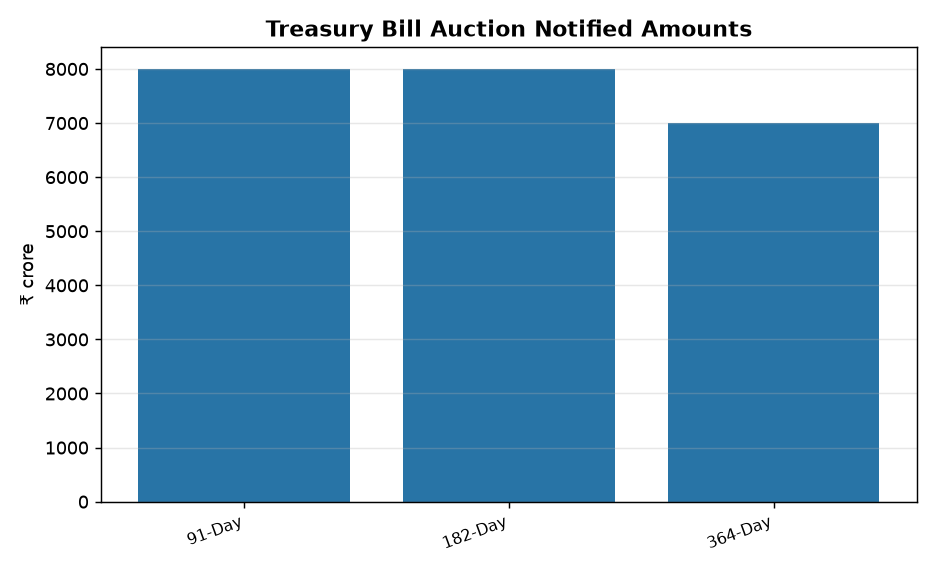
| Notified Amount | A total notified amount of ₹23,000 crore is offered, with allocations of ₹8,000 crore each for 91-day and 182-day T-Bills, and ₹7,000 crore for the 364-day T-Bill, ensuring adequate supply to meet market demand. |
| Auction Mechanism | The auction employs a price-based multiple price method, where successful bidders pay their bid prices, ensuring market-determined yields and efficient price discovery for Government securities. |
| Participation Categories | Competitive bids are accepted from institutional investors, while non-competitive bids are open to retail investors, State Governments, Union Territories, and eligible Provident Funds, fostering inclusive participation. |
| Retail Investor Access | Individuals can participate via the Retail Direct portal or non-competitive bids, with a maximum allocation of 5% of the notified amount, democratizing access to Government securities. |
| Settlement and Payment | Settlement occurs on the day following the auction (T+1), with payment due by successful bidders, ensuring timely execution and reducing settlement risk in the secondary market. |
Why it Matters
Monetary Policy Transmission
- Treasury Bills serve as a benchmark for short-term interest rates, influencing the broader yield curve and monetary policy transmission in the economy.
- The auction’s outcome reflects market expectations of liquidity conditions, inflation, and the Reserve Bank of India’s policy stance, providing signals to policymakers.
- Yields on T-Bills are closely monitored by the RBI for liquidity management and as an indicator of market sentiment toward Government borrowing.
Government Borrowing Program
- The auction is part of the Government’s market borrowing program, enabling it to meet its fiscal deficit financing requirements through market-determined instruments.
- Short-term T-Bills reduce the average maturity of Government debt, balancing liquidity risks while optimizing the cost of borrowing.
- The notified amount aligns with the Government’s cash flow management, ensuring timely availability of funds without disrupting market stability.
Investor Participation and Market Depth
- Inclusion of retail investors through the Retail Direct portal enhances market depth and broadens the investor base for Government securities.
- Non-competitive bidding provides a risk-free avenue for small investors, promoting financial inclusion and savings mobilization.
- Institutional participation, including State Governments and Provident Funds, strengthens the secondary market for T-Bills, improving liquidity.
Liquidity Management in Financial Markets
- T-Bills are high-quality liquid assets (HQLA) under Basel III norms, making them critical for banks and financial institutions to meet liquidity coverage ratios.
- The auction’s timing and structure support the RBI’s liquidity operations, including open market operations (OMOs) and standing facilities.
- Yields on T-Bills influence money market rates, including the call money rate and certificate of deposit rates, shaping short-term funding costs.
Macroeconomic Stability
- Stable and predictable T-Bill auctions contribute to investor confidence in Government securities, reducing volatility in the debt market.
- The auction’s transparency and adherence to market mechanisms ensure fair pricing, minimizing distortions in the financial system.
- Successful execution of the auction reinforces India’s sovereign debt market credibility, attracting foreign portfolio investments.
Challenges
1. Market Volatility and Yield Fluctuations
- Uncertain macroeconomic conditions, such as inflation surprises or geopolitical risks, can lead to sharp movements in T-Bill yields, impacting borrowing costs.
- Sudden shifts in liquidity conditions may result in under-subscription or oversubscription, disrupting the auction’s smooth execution.
UPSC Link: GS-III: Monetary Policy & Inflation
2. Retail Investor Participation Barriers
- Limited awareness among retail investors about the Retail Direct portal and non-competitive bidding may restrict participation, despite the scheme’s inclusivity.
- Technical glitches in the portal or bidding system could deter small investors from engaging in the auction process.
UPSC Link: GS-III: Financial Inclusion
3. Liquidity Mismatch in Secondary Market
- Thin trading volumes in the secondary market for T-Bills can create liquidity mismatches, making it difficult for investors to exit positions without price impact.
- Limited market-making activity by primary dealers may exacerbate liquidity constraints, particularly for longer-tenor T-Bills.
UPSC Link: GS-III: Financial Markets
4. Fiscal Consolidation Pressures
- Persistent fiscal deficits may necessitate larger borrowings, increasing the supply of T-Bills and potentially crowding out private sector borrowing.
- High Government borrowing could lead to upward pressure on interest rates, affecting economic growth and investment sentiment.
UPSC Link: GS-III: Fiscal Policy
5. Operational and Technological Risks
- System failures in the RBI’s Core Banking Solution (E-Kuber) or Retail Direct portal could disrupt the auction process, requiring contingency measures.
- Cybersecurity threats targeting Government securities auctions pose risks to data integrity and transaction security.
UPSC Link: GS-III: IT & Governance
Challenges — UPSC Perspective
| Issue | Concern |
|---|---|
| Macroeconomic Uncertainty | Volatility in inflation, growth, or global financial conditions may lead to unpredictable T-Bill yields and auction outcomes. |
| Retail Investor Awareness | Low participation due to lack of information about bidding processes or technical barriers in the Retail Direct portal. |
| Secondary Market Liquidity | Thin trading volumes in the secondary market for T-Bills limit investor exit options and price discovery. |
| Fiscal Deficit Management | Sustained high borrowing levels may strain market capacity and increase borrowing costs over time. |
| Operational Risks | Technical failures in auction systems or cyber threats could disrupt the smooth conduct of T-Bill auctions. |
Way Forward
- Enhance investor education initiatives to improve participation in the Retail Direct portal and non-competitive bidding, particularly among small investors.
- Strengthen secondary market liquidity for T-Bills by encouraging primary dealers to increase market-making activities and trading volumes.
- Monitor macroeconomic indicators closely to anticipate yield movements and adjust auction calendars to mitigate volatility risks.
- Expand the role of fintech platforms to streamline the onboarding process for retail investors and reduce technical barriers.
- Conduct periodic reviews of the auction mechanism to incorporate feedback from market participants and improve transparency.
- Collaborate with financial institutions to promote T-Bills as a viable investment avenue for provident funds and insurance companies.
- Develop contingency plans for system failures or cyber threats to ensure uninterrupted auction operations.
- Align the T-Bill auction calendar with the Government’s fiscal consolidation roadmap to balance borrowing needs and market stability.
UPSC Value Addition
Keywords for Mains Answer-Writing
Treasury Bills · Government Securities · Public Debt Management · Monetary Policy Operations · Primary Market Auctions · Non-Competitive Bidding · Retail Direct Scheme · E-Kuber System · Public Debt Office · Fiscal Policy · Liquidity Management · Debt Instruments · Interest Rate Determination · Reserve Bank of India · Government Borrowing
Concept Flow
Government of India’s fiscal deficit → Need for short-term borrowing → Issuance of Treasury Bills (T-Bills) → Auction mechanism (price-based, multiple price method) → Competitive and non-competitive bidding → Allocation to successful bidders → Settlement (T+1) → Secondary market trading → Impact on yield curve and monetary policy → Influence on liquidity conditions and investor sentiment.
Prelims Practice Questions
Q1. Consider the following statements regarding Treasury Bills (T-Bills) in India:
1. Treasury Bills are money market instruments issued by the Government of India.
2. They are issued at a discount and redeemed at par at maturity.
3. The maturity period of Treasury Bills ranges from 91 days to 364 days.
4. They are eligible for trading in the secondary market.
How many of the above statements are correct?
- Only one
- Only two
- Only three
- All
Answer: All — Statements 1, 2, and 3 are correct. Treasury Bills are short-term government securities issued at a discount and redeemed at par. Statement 4 is also correct as T-Bills are tradable in the secondary market, though the auctioned T-Bills in this case are new issuances.
Q2. Assertion (A): The Reserve Bank of India (RBI) conducts auctions of Treasury Bills to manage liquidity in the banking system.
Reason (R): Treasury Bills are used by the Government of India to meet its short-term borrowing requirements.
- Both A and R are true, and R is the correct explanation of A
- Both A and R are true, but R is NOT the correct explanation of A
- A is true, but R is false
- A is false, but R is true
Answer: A is true, but R is false — Both A and R are true. Treasury Bills are issued by the Government to meet short-term borrowing needs. However, the RBI conducts these auctions primarily to manage liquidity in the banking system, not solely as a borrowing mechanism. Hence, R is not the correct explanation of A.
Q3. Match the following columns related to Treasury Bills:
Column I (Maturity Period) Column II (Type of Treasury Bill)
A. 91 days 1. Treasury Bill
B. 182 days 2. Cash Management Bill
C. 364 days 3. Dated Government Security
D. Less than 91 days 4. None of the above
- A-1, B-1, C-1, D-4; A-1, B-1, C-1, D-2; A-1, B-2, C-3, D-4; A-3, B-1, C-2, D-4
- answer_letter_indexed_list_indexed_list_1_4
- explain_list_indexed_list_indexed_list_1_4
- format_list_indexed_list_indexed_list_1_4
- answer_indexed_list_indexed_list_1_4
Answer: ? — All Treasury Bills (91-day, 182-day, and 364-day) fall under the category of Treasury Bills (Column II, Type 1). Cash Management Bills (CMBs) are issued for tenors less than 91 days, hence D matches with 4 (None of the above) as CMBs are not part of the standard Treasury Bill categories listed.
Mains Practice Question
✍ The auction of Treasury Bills by the Reserve Bank of India (RBI) is a critical instrument in the management of public debt and liquidity in the economy. Critically examine the role of Treasury Bills in India’s fiscal and monetary policy frameworks. Also, elucidate the significance of the Retail Direct Scheme in enhancing retail participation in government securities. (15 Marks)
Approach: A full answer must cover the following dimensions:
1. **Definition and Characteristics of Treasury Bills**: Define Treasury Bills as short-term government securities issued at a discount, redeemable at par, and their role as risk-free instruments in the money market.
2. **Role in Fiscal Policy**: Explain how Treasury Bills are used by the Government of India to meet short-term borrowing requirements, thereby bridging the fiscal deficit. Discuss the Public Debt Management Framework and the role of the RBI in conducting auctions to ensure orderly market conditions.
3. **Role in Monetary Policy**: Analyze how Treasury Bill auctions serve as an instrument for liquidity management. Discuss the RBI’s Open Market Operations (OMOs) and how T-Bill auctions influence short-term interest rates and monetary transmission.
4. **Auction Mechanism and Market Efficiency**: Describe the auction process (competitive vs. non-competitive bidding, multiple price method) and its role in price discovery. Explain the significance of the E-Kuber system and the Public Debt Office in ensuring transparency and efficiency.
5. **Retail Direct Scheme**: Define the Retail Direct Scheme and its objectives (e.g., democratizing access to government securities). Explain how it allows retail investors to participate in T-Bill auctions through the RBI Retail Direct portal, including the 5% allocation cap for non-competitive bids.
6. **Challenges and Criticisms**: Discuss potential challenges such as over-reliance on short-term borrowing, interest rate volatility, and the need for deeper secondary market liquidity. Critically evaluate the effectiveness of the Retail Direct Scheme in enhancing retail participation.
7. **Recent Developments**: Reference recent trends in T-Bill issuances (e.g., increased retail participation, digitalization of bidding processes) and their implications for fiscal-monetary coordination.
8. **Balanced View**: Conclude with a balanced assessment of the role of Treasury Bills in India’s financial architecture, weighing their benefits in fiscal management and monetary stability against potential risks such as crowding out of private investment or fiscal profligacy.
Source: RBI
Generated by AanyaAi for educational purpose.
Related guides on our sites
- Current affairs for upsc 2026
- Best PSIR optional coaching for upsc
- Best PSIR optional teacher for upsc
- Best teacher of PSIR optional for upsc

- RBI to Auction ₹23,000 Crore Treasury Bills: Key Details for UPSC & State PCS - November 28, 2026
- महाराष्ट्र में चार बाघ अभयारण्यों के नियम पुस्तिकाओं को किया गया निरस्त, जानिए पूरा मामला - November 28, 2026
- राजस्थान महिला आयोग: हाईकोर्ट ने 2 माह में खाली पद भरने का आदेश दिया - November 28, 2026

No Comments