


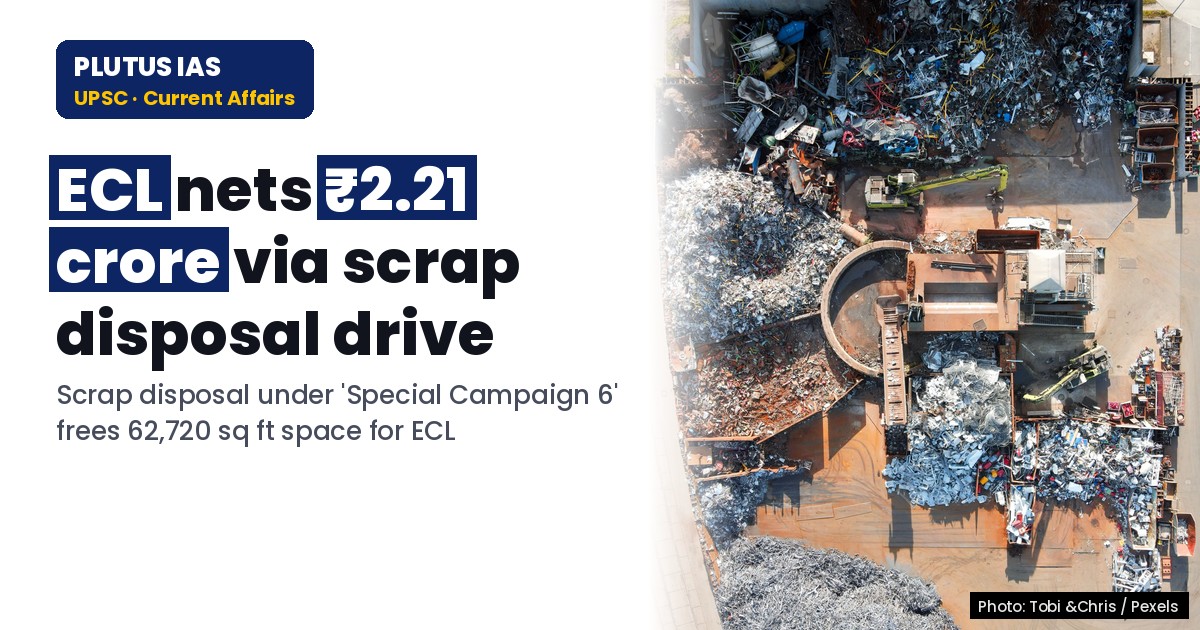
17 Oct ECL earns ₹2.21 crore via ‘Special Campaign 6’ scrap disposal
✎ ‘Special Campaign 6’ under ‘Swachhata Hi Seva’ aims to institutionalise cleanliness, efficiency, and resource optimisation in government establishments, with Eastern Coalfields Limited generating ₹2.21 crore from scrap disposal…
Subject Relevance — Where This Topic Fits
- GS Paper III — Environment, Ecology, Bio-diversity and Disaster Management | GS Paper III — Indian Economy and Issues Relating to Planning, Mobilisation of Resources, Growth, Development and Employment | GS Paper III — Government Budgeting and Financial Management
- Prelims: Special Campaign 6, Eastern Coalfields Limited (ECL), Public Sector Undertakings (PSUs), Waste management in PSUs, Revenue from scrap disposal, Digital file management, Administrative efficiency, Coal India Limited, Ministry of Coal
- Essay: Administrative reforms and efficiency in governance, Resource optimisation in public sector enterprises, Sustainable waste management practices in industrial units
Quick Revision: ‘Special Campaign 6’ under ‘Swachhata Hi Seva’ aims to institutionalise cleanliness, efficiency, and resource optimisation in government establishments, with Eastern Coalfields Limited generating ₹2.21 crore from scrap disposal and freeing up 62,720 sq. ft. of space.
Why is this in the news?
The Eastern Coalfields Limited (ECL), a subsidiary of Coal India Limited under the Ministry of Coal, has achieved significant progress under ‘Special Campaign 6’ by disposing of scrap and generating ₹2.21 crore in revenue. The campaign, conducted from 2 to 16 October 2026, also freed up 62,720 square feet of space and reviewed over 3,000 physical and digital files, underscoring the broader national thrust on administrative efficiency, resource optimisation, and sustainable waste management in public sector undertakings.
Background
- Public Sector Undertakings (PSUs) in India, particularly in the coal sector, generate substantial volumes of scrap and obsolete materials due to operational activities, necessitating structured waste management and disposal mechanisms.
- The Government of India has been promoting ‘Special Campaigns’ under the ‘Swachhata Hi Seva’ initiative to institutionalise cleanliness, efficiency, and resource optimisation across government establishments, including PSUs.
- Coal India Limited (CIL), a Maharatna PSU, operates through eight subsidiaries, including Eastern Coalfields Limited (ECL), which manages coal mining operations in the eastern region.
- Administrative inefficiencies, including redundant record-keeping and underutilised office space, have been identified as key areas for reform to enhance operational efficiency in PSUs.
- The disposal of scrap and obsolete materials not only generates revenue but also contributes to environmental sustainability by reducing landfill waste and promoting circular economy principles.
- Digital transformation initiatives in government offices, including the review and closure of redundant e-files, align with the broader ‘Digital India’ mission to modernise administrative processes.
What is ‘Special Campaign 6’ and its relevance to Eastern Coalfields Limited (ECL)?
- ‘Special Campaign 6’ is part of the Government of India’s ‘Swachhata Hi Seva’ initiative, launched to institutionalise cleanliness, efficiency, and resource optimisation across government departments and public sector undertakings.
- The campaign focuses on three core objectives: (a) improving workplace cleanliness, (b) enhancing resource utilisation, and (c) strengthening administrative efficiency through systematic waste disposal and record management.
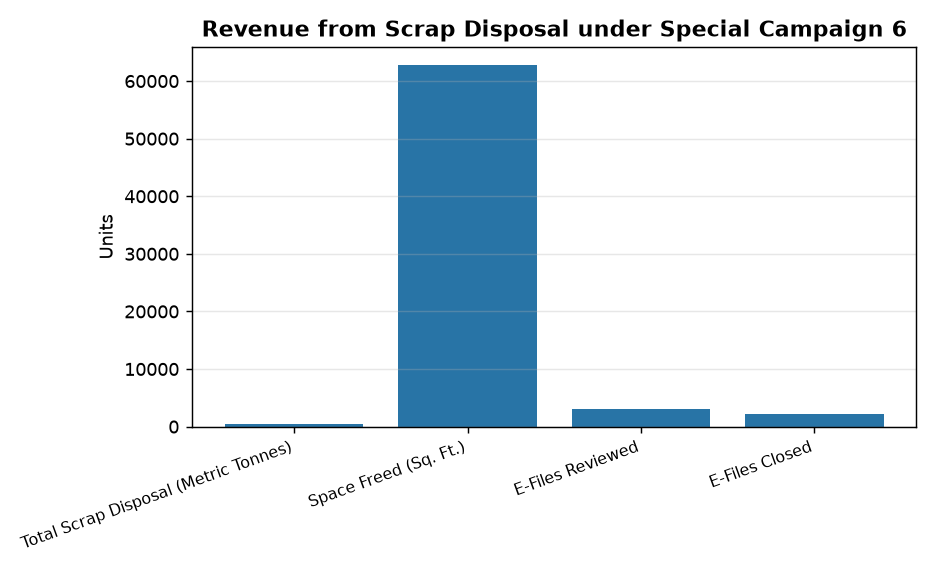
- Eastern Coalfields Limited (ECL), a subsidiary of Coal India Limited, participated in the campaign by disposing of 413.5 metric tonnes of scrap out of a targeted 850 metric tonnes, generating ₹2.21 crore in revenue from the sale of iron scrap.
- The campaign also involved freeing up 62,720 square feet of space across 10 designated locations, contributing to better utilisation of office and operational areas.
- Administrative reforms included the review of 647 physical files (against a target of 1,200) and the closure of 567 redundant files, alongside the review of 3,098 e-files (81% of the target) and closure of 2,148 e-files (60% of the target).
- The initiative aligns with the broader policy framework of the Ministry of Coal and Coal India Limited to promote sustainable and efficient operations in the coal sector.
- Such campaigns are designed to instil a culture of accountability, transparency, and efficiency in public sector governance, contributing to long-term institutional strengthening.
- The revenue generated from scrap disposal and the optimisation of physical and digital resources demonstrate the tangible benefits of administrative reforms in PSUs.
Key Features
| Feature | Significance |
|---|---|
| Revenue generation from scrap disposal | Monetisation of waste materials enhances financial efficiency and contributes to the organisation’s revenue stream. |
| Physical space reclamation | Liberation of 62,720 sq ft of space optimises real estate utilisation and reduces clutter in operational areas. |
| Administrative file review | Systematic elimination of redundant physical records streamlines record-keeping and reduces administrative overheads. |
| Digital file management | Review and closure of 2,148 redundant e-files improves digital record-keeping efficiency and compliance with data governance norms. |
| Multi-location implementation | Execution across 10 designated sites ensures uniform application of cleanliness and efficiency protocols across the organisation. |
Why it Matters
Economic Efficiency
- Demonstrates the viability of circular economy principles within public sector undertakings by converting waste into revenue.
- Reduces long-term storage and maintenance costs associated with redundant physical and digital records.
- Enhances asset utilisation by freeing up space for productive use in coal mining and administrative operations.
Administrative Reforms
- Aligns with the government’s broader agenda of ‘Minimum Government, Maximum Governance’ by reducing bureaucratic redundancy.
- Strengthens compliance with the Right to Information Act, 2005, by ensuring efficient record management and retrieval.
- Promotes transparency and accountability in public sector operations through systematic disposal of obsolete materials.
Sustainability and Resource Management
- Supports India’s commitments under the Sustainable Development Goals (SDG 12: Responsible Consumption and Production) by promoting waste reduction and resource recovery.
- Contributes to the circular economy framework by ensuring the reuse or recycling of scrap materials, particularly metals.
Operational Excellence
- Enhances workplace safety and hygiene by reducing clutter and hazardous materials in operational areas.
- Improves employee productivity by creating a cleaner and more organised work environment.
Challenges
1. Resource Mobilisation for Large-Scale Scrap Disposal
- Ensuring adequate logistics, manpower, and regulatory compliance for the transportation and processing of scrap materials.
- Balancing the cost of disposal with revenue generation to ensure economic viability.
UPSC Link: Economic Survey: Circular Economy
2. Digital Transformation and Legacy Data Migration
- Risk of data loss or corruption during the migration and closure of redundant digital files.
- Ensuring interoperability between legacy and modern digital record-keeping systems.
UPSC Link: Digital India: E-Governance
3. Stakeholder Coordination and Behavioural Change
- Overcoming resistance to change among employees accustomed to traditional record-keeping practices.
- Ensuring participation from all levels of the organisation in cleanliness and efficiency drives.
UPSC Link: Organisational Behaviour
4. Regulatory and Environmental Compliance
- Adherence to environmental norms for the disposal of hazardous or non-recyclable waste materials.
- Ensuring compliance with the Solid Waste Management Rules, 2016, and other relevant regulations.
UPSC Link: Environmental Governance
Challenges — UPSC Perspective
| Issue | Concern |
|---|---|
| Logistical constraints | High transportation and processing costs for scrap disposal may offset revenue gains. |
| Data integrity risks | Potential loss of critical information during digital file closure and migration. |
| Cultural resistance | Reluctance among staff to adopt new record-keeping and cleanliness practices. |
| Regulatory hurdles | Complexity in complying with environmental and waste management regulations for scrap disposal. |
| Resource allocation | Need for significant upfront investment in manpower and technology for effective implementation. |
| Monitoring and evaluation | Challenges in tracking progress and ensuring sustained adherence to cleanliness and efficiency protocols. |
Way Forward
- Institutionalise the ‘Special Campaign 6’ model as a quarterly or bi-annual initiative to sustain momentum in waste reduction and space optimisation.
- Develop a digital dashboard to monitor real-time progress in scrap disposal, file review, and space reclamation across all sites.
- Conduct periodic training programmes for employees on efficient record-keeping, digital file management, and waste segregation.
- Collaborate with external agencies (e.g., municipal corporations, recycling firms) to enhance the efficiency and sustainability of scrap disposal processes.
- Integrate the principles of the campaign into the organisation’s Standard Operating Procedures (SOPs) to ensure long-term adherence.
- Leverage technology (e.g., IoT sensors, AI-driven inventory systems) to automate waste tracking and optimise resource utilisation.
- Publish annual sustainability reports to highlight achievements, challenges, and future targets in waste management and administrative efficiency.
UPSC Value Addition
Keywords for Mains Answer-Writing
Eastern Coalfields Limited (ECL) · Special Campaign 6 · Government of India’s Special Campaign for disposal of scrap · Resource efficiency in PSUs · Administrative reforms in public sector undertakings · Revenue generation through scrap disposal · Office space optimization · Digital file management · Public sector efficiency · Government asset monetisation · Sustainable administrative practices · Government of India’s cleanliness drives
Concept Flow
Public sector undertakings accumulate redundant physical and digital records over time due to operational and administrative inefficiencies → → Government initiates ‘Special Campaign 6’ to systematically dispose of waste and optimise administrative processes → → Campaign identifies and categorises scrap materials and redundant files for disposal → → Scrap materials are monetised through sale or recycling, generating revenue → → Physical and digital space is reclaimed, improving operational efficiency and workplace hygiene → → Sustained implementation of the campaign institutionalises cleanliness and efficiency as core organisational values → → Broader economic and environmental benefits are realised through circular economy principles and reduced bureaucratic waste.
Prelims Practice Questions
Q1. Consider the following statements regarding the Government of India’s ‘Special Campaign 6’ initiative:
1. It is a pan-India campaign aimed at disposal of scrap and waste materials in government offices.
2. The campaign is conducted under the aegis of the NITI Aayog.
3. The primary objective is to generate revenue through sale of scrap.
4. The campaign also includes digitisation and review of physical and e-files to optimise office space.
How many of the above statements are correct?
- Only one
- Only two
- Only three
- All four
Answer: All four — Statements 1, 2, and 4 are correct. Statement 3 is incorrect as the primary objective is to improve cleanliness, resource efficiency, and administrative efficiency, though revenue generation is a secondary outcome.
Q2. Assertion (A): The disposal of scrap under the Government of India’s ‘Special Campaign 6’ is limited to metallic waste.
Reason (R): The campaign primarily focuses on revenue generation as its core objective.
Options:
A. Both A and R are true, and R is the correct explanation of A.
B. Both A and R are true, but R is not the correct explanation of A.
C. A is true, but R is false.
D. A is false, but R is true.
Answer: ? — Assertion (A) is false because the campaign includes disposal of various types of scrap, not just metallic waste. Reason (R) is false because the core objective is to improve cleanliness, resource efficiency, and administrative efficiency, not revenue generation.
Q3. Match the following initiatives with their respective objectives:
Initiative Objective
1. Disposal of scrap A. Revenue generation and resource recovery
2. Review of physical files B. Reduction of unnecessary records
3. Digitisation of e-files C. Office space optimization
4. Cleanliness drives D. Administrative efficiency and transparency
Options:
A. 1-A, 2-B, 3-C, 4-D
B. 1-A, 2-C, 3-B, 4-D
C. 1-B, 2-A, 3-D, 4-C
D. 1-C, 2-D, 3-A, 4-B
Answer: ? — 1-A: Disposal of scrap aims at revenue generation and resource recovery. 2-B: Review of physical files aims at reducing unnecessary records. 3-C: Digitisation of e-files aims at office space optimization. 4-D: Cleanliness drives aim at administrative efficiency and transparency.
Mains Practice Question
✍ The Government of India’s ‘Special Campaign 6’ is an institutionalised initiative aimed at enhancing administrative efficiency, resource optimisation, and cleanliness in public sector undertakings. Critically examine the significance of such campaigns in the context of India’s public sector reform agenda. (15 Marks)
Approach: MODEL-ANSWER SKELETON:
1. **Introduction (2 marks)**
– Define ‘Special Campaign 6’ as a government-wide initiative under the Department of Administrative Reforms and Public Grievances (DARPG).
– State its objectives: disposal of scrap, digitisation of records, office space optimisation, and cleanliness drives.
2. **Significance in Public Sector Reform (5 marks)**
– **Resource Efficiency**: Discuss how such campaigns align with the government’s broader agenda of ‘Minimum Government, Maximum Governance’ and asset monetisation.
– **Administrative Reforms**: Highlight the role of these campaigns in reducing bureaucratic inertia, improving transparency, and enhancing citizen-centric governance.
– **Sustainability and Circular Economy**: Link to India’s commitments under the SDGs (e.g., SDG 12 on responsible consumption and production).
– **Digital Transformation**: Emphasise the importance of digitisation in reducing physical footprints and improving service delivery.
3. **Challenges and Criticisms (4 marks)**
– **Sustainability of Impact**: Discuss whether such campaigns are one-off events or part of a sustained reform process.
– **Implementation Gaps**: Highlight potential challenges in scaling such initiatives across diverse public sector undertakings.
– **Cultural Resistance**: Address the need for behavioural change in bureaucratic practices.
4. **Comparative Perspective (2 marks)**
– Compare with similar initiatives in other countries (e.g., Japan’s ‘Cool Biz’ campaign, Singapore’s ‘Green Mark’ certification).
5. **Conclusion (2 marks)**
– Summarise the importance of institutionalising such campaigns as part of a long-term public sector reform strategy.
– Suggest measures for ensuring continuity and impact assessment.
Source: PIB (Press Information Bureau)
Generated by AanyaAi for educational purpose.
Related guides on our sites
- Best PSIR optional coaching for upsc
- Best PSIR optional teacher for upsc
- Best teacher of PSIR optional for upsc
- Best PSIR optional coaching in delhi for UPSC

- ECL earns ₹2.21 crore via ‘Special Campaign 6’ scrap disposal - October 17, 2026
- पीएम-अजय योजना: 18,093 गांवों को ‘आदर्श ग्राम’ का दर्जा, जानिए कैसे मिल रहा लाभ - October 17, 2026
- Canada-Karnataka Tech Partnership: Quantum, AI, Aerospace Boost for UPSC - October 17, 2026

No Comments