


27 Jul Kerala’s 25-Year Solar Power Deal: ₹2.93/Unit with Storage for UPSC Exam
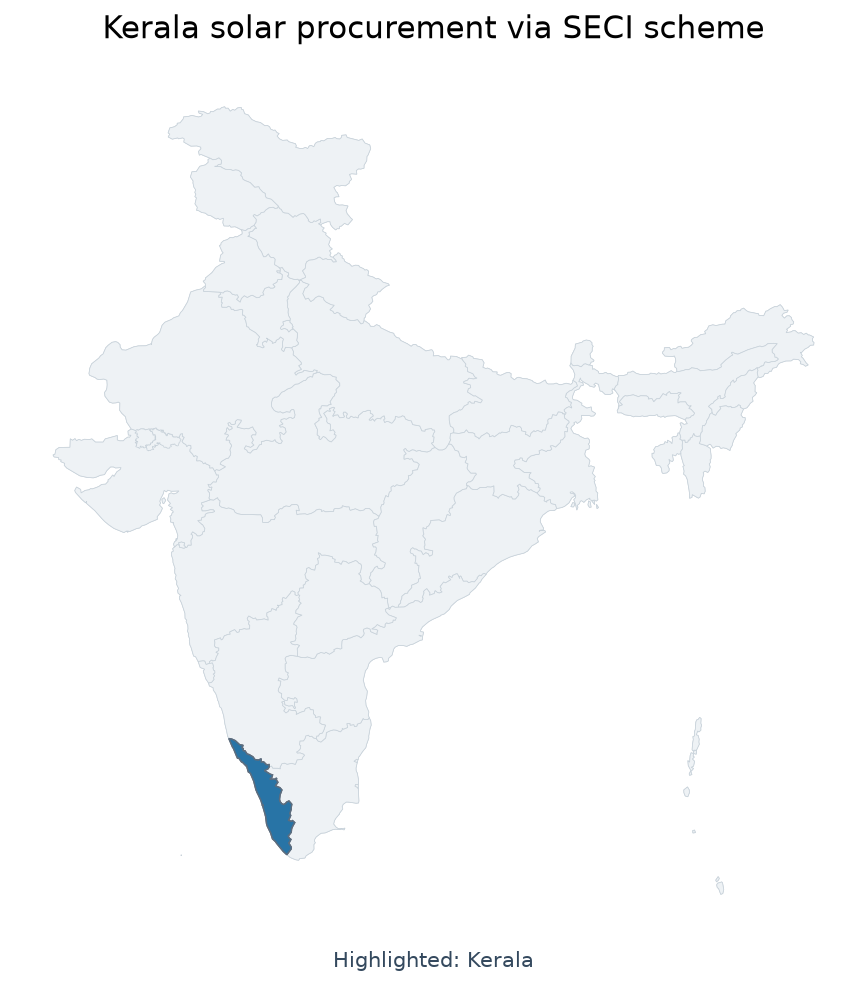
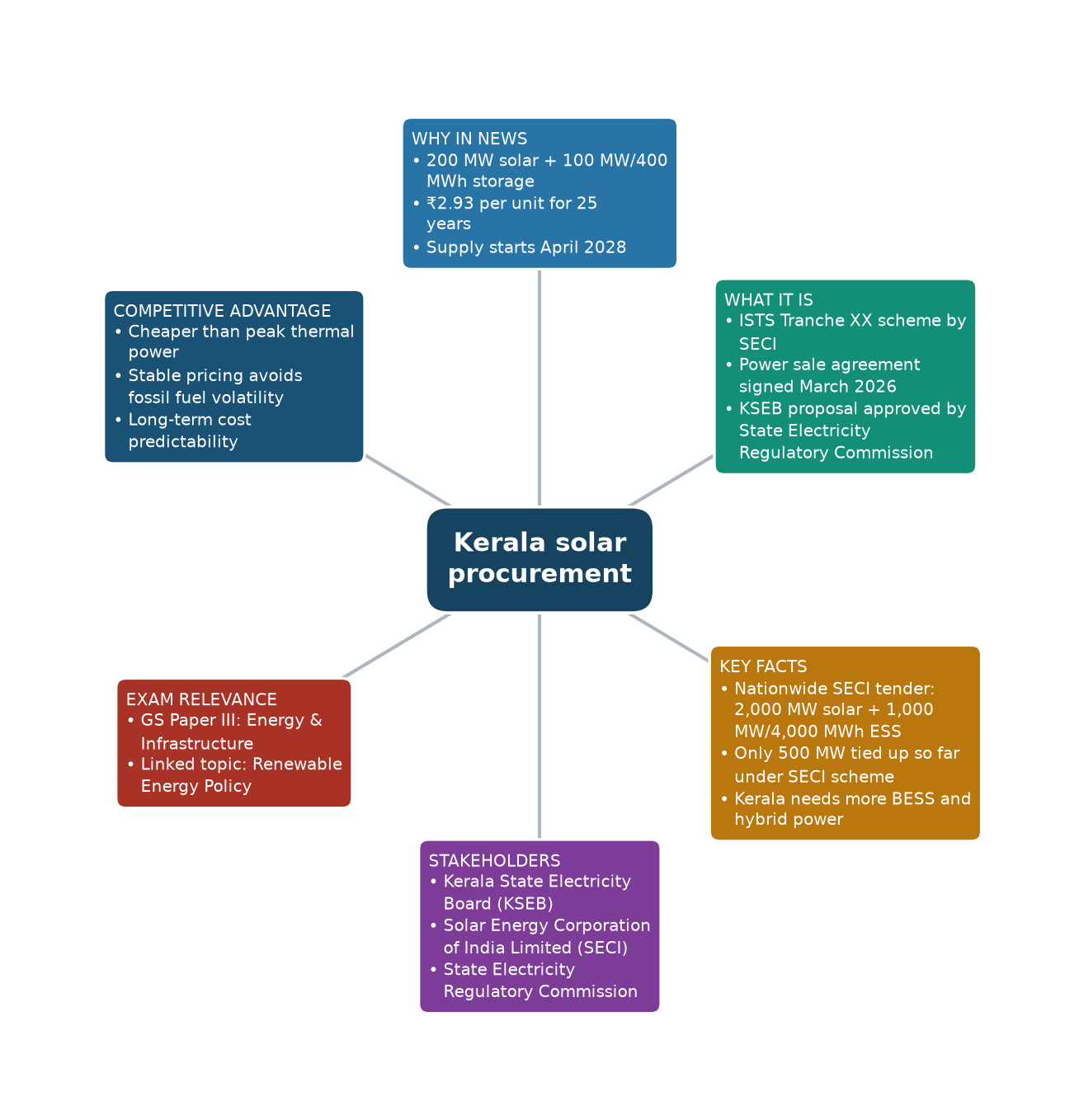
Map & concept mind-map: Kerala solar procurement via SECI scheme
Subject Relevance — Where This Topic Fits
- GS Paper III — Environment, Disaster Management and Climate Change | GS Paper III — Infrastructure: Energy
- Prelims: Renewable Purchase Obligation (RPO), Battery Energy Storage Systems (BESS), Inter-State Transmission System (ISTS), Solar Energy Corporation of India (SECI), Average Pooled Cost of Power Purchase (APPC), Net Metering, Prosumers, Peak Load Management
- Essay: The Role of State Governments in India’s Energy Transition, Balancing Economic Growth and Environmental Sustainability in Energy Policy
Quick Revision: The SECI ISTS Tranche XX scheme enables states to procure long-term, cost-stable solar-plus-storage power at competitive tariffs (e.g., ₹2.93/unit for Kerala), addressing peak demand and reducing reliance on volatile fossil fuels.
Why is this in the news?
The State Electricity Regulatory Commission of Kerala has approved a landmark 25-year power purchase agreement (PPA) between the Kerala State Electricity Board (KSEB) and the Solar Energy Corporation of India (SECI) for 200 MW of solar power coupled with 100 MW/400 MWh of battery energy storage. The tariff of ₹2.93 per unit, fixed for a quarter-century, represents a cost-effective alternative to volatile fossil-fuel-based peak power and underscores Kerala’s strategic pivot toward long-term renewable energy integration. The decision also signals a regulatory endorsement of hybrid renewable-storage models to address peak demand, a critical challenge for India’s energy transition.
Background
- SECI, a CPSE under the Ministry of New and Renewable Energy, operates the ISTS scheme to facilitate inter-state renewable energy procurement, with Tranche XX specifically targeting solar-plus-storage projects.
- Kerala’s peak demand is projected to grow at 5-6% annually, necessitating 10-12 GW of additional capacity by 2030, with solar-storage hybrids emerging as a viable solution to reduce reliance on costlier peak thermal plants.
- The APPC rate, used for settling net-banked energy, is a weighted average of power purchase costs across utilities, and its revision (₹3.26/unit in Kerala) has sparked disputes among prosumers and regulators.
- State Electricity Regulatory Commissions (SERCs) play a pivotal role in approving PPAs, tariffs, and grid integration norms, ensuring alignment with national renewable energy targets while addressing local demand-supply dynamics.
What is the SECI ISTS Tranche XX Solar-Plus-Storage Scheme?
- The ISTS (Inter-State Transmission System) scheme, launched by SECI, enables states to procure renewable energy from geographically diverse projects connected to the central grid, reducing transmission losses and enhancing supply reliability.
- Tranche XX, a specific bidding round under ISTS, invites developers to set up solar PV projects coupled with Battery Energy Storage Systems (BESS) to supply firm, dispatchable power during peak hours.
- The scheme’s design includes a 25-year PPA with fixed tariffs, providing long-term price stability for procuring entities like KSEB, while developers benefit from assured offtake and viability gap funding where applicable.
- The storage component (100 MW/400 MWh in Kerala’s case) ensures four hours of peak supply, addressing the state’s evening peak demand when solar generation wanes but consumption peaks.
- SECI aggregates demand from multiple states to achieve economies of scale, reducing per-unit costs; Kerala’s allocation of 200 MW solar + 100 MW/400 MWh storage is part of a larger 2,000 MW tender with only 500 MW currently tied up.
- The tariff of ₹2.93/unit for Kerala is competitive against peak thermal power (₹4.5–5.5/unit) and short-term exchange power (₹3.5–4.2/unit), offering a hedge against fossil fuel price volatility.
- Regulatory oversight by SERCs ensures compliance with grid codes, environmental norms, and financial safeguards, while facilitating dispute resolution between developers and procuring entities.
Key Features
| Feature | Significance |
|---|---|
| Long-term Power Purchase Agreement (PPA) duration (25 years) | Ensures price stability and mitigates risk of fuel price volatility, aligning with India’s renewable energy transition goals. |
| Solar power coupled with 100 MW/400 MWh Battery Energy Storage System (BESS) | Enables dispatchability during peak demand hours, reducing reliance on expensive peak thermal power and grid fluctuations. |
| Competitive tariff of ₹2.93 per unit | Provides a cost-effective alternative to conventional power sources, enhancing energy security and reducing long-term fiscal burden on the state exchequer. |
| Integration under SECI’s ISTS Tranche XX scheme | Facilitates interstate transmission of renewable energy, leveraging national grid infrastructure for optimal resource allocation. |
| Procurement under SECI’s nationwide tender (2,000 MW ISTS-connected solar PV with 1,000 MW/4000 MWh ESS) | Demonstrates scale and scalability of India’s renewable energy storage ecosystem, fostering private sector participation and technological advancement. |
Why it Matters
Economic
- Reduces Kerala’s dependence on expensive short-term power exchanges and peak thermal generation, lowering the Average Pooled Cost of Power Purchase (APPC) over time.
- Locks in a fixed tariff for 25 years, shielding the state from fossil fuel price volatility and inflation in conventional energy markets.
- Enhances long-term fiscal predictability for KSEB, enabling better budgetary planning and reduced subsidy outflows.
- Stimulates investment in solar and storage infrastructure, creating employment in renewable energy value chains.
Strategic/Environmental
- Advances Kerala’s renewable energy targets under the National Solar Mission and state-level climate action plans.
- Reduces carbon emissions by displacing fossil-fuel-based peak power generation, contributing to India’s NDC commitments.
- Demonstrates the viability of large-scale solar-plus-storage systems for grid stability, setting a precedent for other states.
- Aligns with India’s energy transition goals, reducing the peak demand-supply gap through flexible, renewable-based solutions.
Regulatory/Governance
- Highlights the role of State Electricity Regulatory Commissions (SERCs) in approving long-term PPAs for renewable energy storage, ensuring regulatory oversight.
- Showcases SECI’s role as a nodal agency for aggregating and facilitating interstate renewable energy procurement.
- Reinforces the importance of competitive bidding in achieving cost-effective renewable energy solutions.
Challenges
1. Grid Integration and Storage Challenges
- High upfront capital costs for BESS infrastructure, despite long-term cost benefits, may deter immediate adoption by smaller utilities.
- Technical challenges in integrating large-scale solar-plus-storage systems with the grid, including frequency regulation and voltage stability.
- Limited domestic manufacturing capacity for advanced battery storage systems, leading to import dependence and supply chain vulnerabilities.
UPSC Link: GS-III: Energy Storage Technologies
2. Regulatory and Policy Constraints
- Variability in state-level renewable energy policies and tariff structures may create inconsistencies in long-term PPAs.
- Delays in regulatory approvals or land acquisition for solar and storage projects can derail timelines, as seen in past renewable energy tenders.
- Disputes over net metering and prosumer tariffs (e.g., rejection of ₹4.34/unit petition) highlight regulatory fragmentation in renewable energy governance.
UPSC Link: GS-II: Federalism and Energy Governance
3. Financial and Market Risks
- Long-term PPAs expose utilities to counterparty risks, particularly if SECI or other central agencies face financial constraints.
- Market volatility in conventional energy prices may reduce the perceived urgency for renewable energy adoption by some states.
- Subsidies or cross-subsidies for conventional energy sources may distort market signals, delaying the transition to renewables.
UPSC Link: GS-III: Energy Subsidies and Market Distortions
4. Technological and Infrastructure Gaps
- Limited grid-scale battery storage capacity in India (current ~10 GWh) compared to projected needs (100 GWh by 2030), necessitating rapid scaling.
- Inadequate transmission infrastructure for interstate renewable energy flows, leading to congestion and curtailment risks.
- Dependence on imported battery technologies raises concerns about energy security and geopolitical risks.
UPSC Link: GS-III: Energy Storage and Grid Modernization
Challenges — UPSC Perspective
| Issue | Concern |
|---|---|
| High capital expenditure for BESS | Increases initial project costs, requiring innovative financing models (e.g., viability gap funding, green bonds). |
| Grid intermittency and variability | Demands advanced forecasting tools and demand-response mechanisms to balance supply and demand. |
| Regulatory delays in approvals | Undermines investor confidence and delays project commissioning, as seen in past solar tenders. |
| Limited domestic manufacturing of batteries | Raises import dependency and supply chain vulnerabilities, particularly for critical minerals. |
| Cross-subsidies for conventional energy | Distorts market signals, delaying the economic case for renewable energy adoption. |
| Counterparty risks in long-term PPAs | Exposes utilities to financial instability if central agencies face fiscal constraints. |
Government Initiatives — Must-Memorise for Prelims
- ISTS Tranche XX scheme (Solar Energy Corporation of India Limited)
- National Solar Mission (Ministry of New and Renewable Energy)
Way Forward
- Accelerate domestic manufacturing of battery storage systems through Production-Linked Incentive (PLI) schemes to reduce import dependence.
- Strengthen grid infrastructure with smart grid technologies and advanced metering to integrate large-scale renewables and storage.
- Develop state-specific renewable energy roadmaps with clear timelines for solar-plus-storage adoption, aligning with SECI’s ISTS schemes.
- Enhance regulatory frameworks for long-term PPAs, including dispute resolution mechanisms and standardized contracts.
- Promote public-private partnerships (PPPs) for large-scale battery storage projects to share financial and technical risks.
- Invest in research and development for next-generation storage technologies (e.g., flow batteries, green hydrogen) to diversify solutions.
- Conduct state-level energy audits to identify peak demand patterns and optimize storage capacity planning.
- Foster skill development in renewable energy and storage sectors through vocational training and university programs.
UPSC Value Addition
Keywords for Mains Answer-Writing
Renewable Energy Policy Framework · Solar Power Procurement · Energy Storage Systems · State Electricity Regulatory Commission (SERC) · Kerala State Electricity Board (KSEB) · Solar Energy Corporation of India (SECI) · Inter-State Transmission System (ISTS) · Long-term Power Purchase Agreement (PPA) · Peak Demand Management · Battery Energy Storage Systems (BESS) · Average Pooled Cost of Power Purchase (APPC) · Hybrid Renewable Energy Projects
Concept Flow
Rising peak demand in Kerala → State explores cost-effective alternatives to thermal power → KSEB proposes long-term solar-plus-storage procurement → SECI’s ISTS Tranche XX scheme enables interstate renewable energy aggregation → State Electricity Regulatory Commission approves 25-year PPA at ₹2.93/unit → Project commissioning (2028) enhances grid stability and reduces carbon emissions → Success demonstrates scalability of solar-plus-storage models → Other states replicate Kerala’s approach, accelerating India’s energy transition.
Prelims Practice Questions
Q1. Which of the following statements is correct regarding the recent Kerala State Electricity Board (KSEB) proposal approved by the State Electricity Regulatory Commission?
- The proposal includes procurement of 200 MW of solar power with 100 MW/400 MWh of energy storage at ₹3.26 per unit for 25 years.
- The supply is facilitated under the ISTS Tranche XX scheme of SECI and will commence from April 1, 2027.
- The energy storage system will provide 100 MW for four hours to meet peak demand, while solar power will supply 200 MW during daytime.
- The proposal was rejected by the Commission due to high cost, and KSEB was directed to explore alternative sources.
Answer: The energy storage system will provide 100 MW for four hours to meet peak demand, while solar power will supply 200 MW during daytime. — The approved proposal includes 200 MW solar power with 100 MW/400 MWh storage at ₹2.93 per unit for 25 years, commencing from April 1, 2028. The storage system will supply 100 MW for four hours to meet peak demand, while solar power will provide 200 MW during daytime.
Q2. Which of the following is NOT a feature of the ISTS Tranche XX scheme under SECI?
- It is a nationwide tender for 2,000 MW of ISTS-connected solar PV projects with 1,000 MW/4000 MWh of energy storage.
- The scheme allows states to procure solar power with storage at competitive rates for long-term supply.
- The scheme mandates the use of only thermal power plants for meeting peak demand.
- Only 500 MW of the 2,000 MW capacity under the scheme has been tied up so far.
Answer: The scheme mandates the use of only thermal power plants for meeting peak demand. — The ISTS Tranche XX scheme facilitates long-term procurement of solar power with energy storage, not thermal power plants. The scheme is designed for renewable energy integration and peak demand management.
Q3. What is the primary objective of the State Electricity Regulatory Commission’s recent directive to Kerala State Electricity Board (KSEB) regarding additional procurement?
- To reduce the Average Pooled Cost of Power Purchase (APPC) rate for prosumers.
- To explore additional supplies under the SECI scheme to meet increasing peak demand.
- To reject the petition filed by prosumers seeking higher rates for net banked energy.
- To prioritize fossil fuel-based power plants over renewable energy sources.
Answer: To explore additional supplies under the SECI scheme to meet increasing peak demand. — The Commission has directed KSEB to explore additional procurement under the SECI scheme to meet the rising peak demand in Kerala, as only 500 MW of the 2,000 MW capacity has been tied up so far.
Mains Practice Question
✍ Critically examine the role of State Electricity Regulatory Commissions (SERCs) in facilitating the transition to renewable energy in India. How does the recent Kerala State Electricity Board (KSEB) proposal for long-term solar power procurement with energy storage reflect this role? Substantiate your answer with reference to regulatory mechanisms and policy frameworks.
Approach: Begin by outlining the constitutional and statutory framework governing SERCs, including their mandate under the Electricity Act, 2003. Discuss their role in promoting renewable energy through tariff determination, open access regulations, and approval of power purchase agreements. Analyze the Kerala case to illustrate how SERCs balance cost-effectiveness, energy security, and sustainability. Highlight the significance of long-term PPAs and energy storage in achieving India’s renewable energy targets, while addressing challenges such as regulatory delays, financial viability, and grid integration.
Source: The Hindu
Generated by AanyaAi for educational purpose.

- किशाऊ परियोजना विवाद: पंजाब सुप्रीम कोर्ट पहुंचेगा, जानें पूरा मामला - September 22, 2026
- Punjab to Challenge Kishau Project in Supreme Court: Key Polity & Governance Issue for UPSC - September 22, 2026
- दिल्ली हाईकोर्ट ने बदले ‘वरिष्ठ अधिवक्ता’ के नियम, 100-प्वाइंट प्रणाली हुई खत्म - September 22, 2026

No Comments