


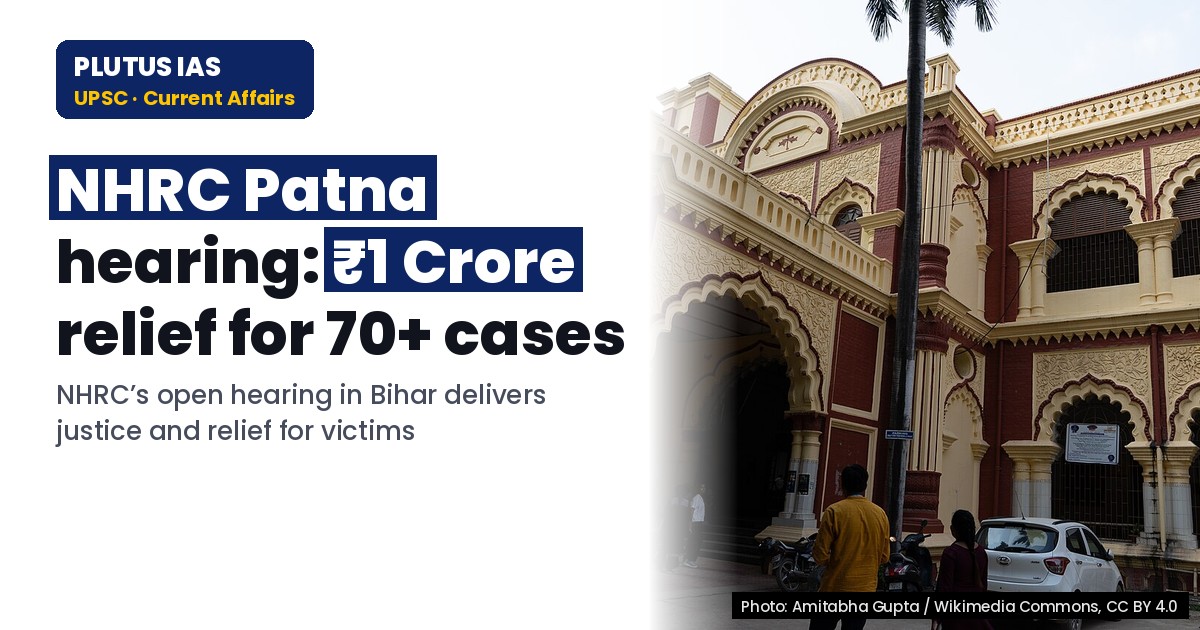
09 Oct NHRC Bihar Open Hearing: 70+ Cases, ₹1 Crore Relief Disbursed
✎ The NHRC, established under the Protection of Human Rights Act, 1993, functions as a statutory watchdog to investigate human rights violations, recommend relief, and ensure state accountability under constitutional and statutory…
Subject Relevance — Where This Topic Fits
- GS Paper II — Fundamental Rights and DPSP (Articles 21, 39, 41, 42) | GS Paper III — Role of Institutions in Human Rights Protection (NHRC, Judiciary, Police Reforms)
- Prelims: NHRC, Fundamental Rights, Article 21, Article 32, Human Rights Protection Act 1993, Judicial Custody, Bonded Labour System (Abolition) Act 1976, Child Labour (Prohibition and Regulation) Act 1986
- Essay: Human rights as a cornerstone of democratic governance, Institutional mechanisms for justice delivery in India
Quick Revision: The NHRC, established under the Protection of Human Rights Act, 1993, functions as a statutory watchdog to investigate human rights violations, recommend relief, and ensure state accountability under constitutional and statutory frameworks.
Why is this in the news?
The National Human Rights Commission (NHRC), India, concluded a two-day open hearing and camp in Patna, Bihar, on 8 October 2026, addressing over 70 human rights violation cases, including bonded labour, custodial deaths, and sexual violence. The NHRC issued relief recommendations exceeding ₹1.5 crore, underscored institutional lapses, and facilitated coordination with civil society to strengthen human rights protection mechanisms in the state.
Background
- The NHRC was established under the Protection of Human Rights Act, 1993, as a statutory body to investigate human rights violations by public servants or failure in prevention by the state.
- Bihar has historically reported high incidences of bonded labour, child labour, and custodial deaths, necessitating proactive institutional interventions.
- The NHRC conducts open hearings and camps to enhance accessibility of justice for marginalised communities and ensure timely redressal of grievances.
- The Protection of Human Rights Act, 1993, empowers the NHRC to recommend interim relief, monetary compensation, and initiate suo motu inquiries into human rights violations.
- State governments are constitutionally obligated under Article 21 (Right to Life and Personal Liberty) and Directive Principles (Articles 39, 41, 42) to protect citizens from exploitation and ensure humane treatment.
- The NHRC’s open hearing model aligns with the principles of participatory justice and decentralised governance, fostering trust between citizens and state institutions.
What is the National Human Rights Commission (NHRC), India?
- The NHRC is a statutory body constituted under the Protection of Human Rights Act, 1993, to protect and promote human rights in India.
- Its mandate includes inquiring into complaints of human rights violations, recommending relief to victims, and undertaking research and awareness programmes.
- The NHRC can investigate cases suo motu or on petitions filed by victims, NGOs, or concerned citizens, covering violations by public servants or state inaction.
- It has the power to summon witnesses, examine documents, and direct state governments to provide reports on human rights violations.
- The NHRC’s recommendations are advisory but carry moral and institutional weight, often leading to state compliance and policy reforms.
- The Commission works in coordination with state human rights commissions, judiciary, police, and civil society to ensure holistic human rights protection.
- The NHRC’s open hearing model is a participatory mechanism to address grievances directly, ensuring transparency and accessibility in justice delivery.
Key Features
| Feature | Significance |
|---|---|
| Two-day Open Hearing and Camp in Patna | Provides a direct, participatory platform for victims of human rights violations to present grievances before NHRC, bypassing procedural delays and ensuring immediate redressal. |
| Presence of Senior State Officials | Demonstrates institutional commitment to accountability, as the Chief Secretary, DGP, and other senior officials attended, facilitating real-time compliance with NHRC recommendations. |
| Review of Bonded Labour Cases | Highlights systemic failure in enforcement of the Bonded Labour System (Abolition) Act, 1976, and underscores NHRC’s role in identifying and addressing such violations. |
| Compensation Distribution Mechanism | Ensures tangible relief to victims through verified payments, reinforcing the principle of reparative justice under international human rights law. |
| Interaction with NGOs and Civil Society | Strengthens multi-stakeholder engagement, enabling NHRC to incorporate grassroots insights into policy recommendations and systemic reforms. |
Why it Matters
Institutional Accountability
- NHRC’s open hearings serve as a check on executive and judicial inaction, ensuring that human rights violations do not remain unaddressed due to bureaucratic inertia.
- The presence of senior officials during hearings accelerates decision-making, reducing the time lag between violation and redress.
- The distribution of compensation within a short span demonstrates the effectiveness of NHRC’s quasi-judicial function in providing immediate relief.
Legal and Policy Framework
- The hearing underscores the role of NHRC in monitoring compliance with constitutional guarantees under Articles 21 (Right to Life and Personal Liberty) and 39 (Directive Principles of State Policy).
- Cases of custodial deaths and sexual violence highlight the need for stricter implementation of the Protection of Women Against Sexual Harassment at Workplace Act, 2013, and the Protection of Children from Sexual Offences Act, 2012.
- The bonded labour cases reiterate the obligation of the state under the Bonded Labour System (Abolition) Act, 1976, and the International Labour Organization’s Forced Labour Convention, 1930.
Human Rights Jurisprudence
- The NHRC’s recommendations in cases of custodial deaths and sexual violence align with the Supreme Court’s guidelines in DK Basu v. State of West Bengal (1997) and Vishaka Guidelines (1997).
- The establishment of dedicated helplines and SITs in response to threats to victims reflects the principle of ‘positive obligations’ under the European Court of Human Rights’ jurisprudence.
State-Society Interface
- The interaction with NGOs and civil society organizations facilitates the integration of ground-level data into policy formulation, enhancing the efficacy of human rights protection mechanisms.
- Such engagements also empower marginalized communities by providing them with a voice in governance processes.
Challenges
1. Systemic Enforcement Gaps in Bonded Labour Abolition
- Despite legal abolition in 1976, bonded labour persists due to weak enforcement, lack of awareness among victims, and collusion between employers and local authorities.
- The hearing revealed that many cases involve intergenerational debt bondage, indicating deep-rooted socio-economic vulnerabilities.
- NHRC’s directive for on-ground investigation by its Director General (Investigation) underscores the need for proactive monitoring.
UPSC Link: Directive Principles of State Policy (Art. 39(e))
2. Custodial Deaths and Police Brutality
- The cases of judicial and police custody deaths highlight systemic failures in adherence to the Supreme Court’s guidelines in DK Basu v. State of West Bengal (1997).
- Lack of timely medical examinations, inadequate training on humane treatment, and delayed FIRs contribute to such violations.
- NHRC’s recommendation of compensation and SIT formation is a step toward ensuring accountability, but structural reforms in police and prison administration remain critical.
UPSC Link: Right to Life (Art. 21)
3. Sexual Violence Against Women and Children
- The cases of sexual violence against women and minors underscore the persistent challenge of gender-based violence despite legislative frameworks like POCSO and POSH Act.
- Delayed reporting, lack of forensic infrastructure, and societal stigma impede justice delivery.
- NHRC’s directives for dedicated helplines and SITs aim to address immediate safety concerns, but long-term prevention requires community sensitization and institutional reforms.
UPSC Link: Right to Dignity (Art. 21 and POCSO Act)
4. Delayed Compliance with NHRC Recommendations
- While compensation was disbursed in some cases, many recommendations remain pending, indicating a gap between NHRC’s directives and their implementation by state agencies.
- Lack of a centralized monitoring mechanism for NHRC recommendations hampers accountability.
- Strengthening the institutional capacity of state human rights commissions and ensuring periodic follow-ups could improve compliance.
UPSC Link: NHRC Act, 1993
5. Marginalization of Victims in Legal Processes
- Victims often lack legal literacy, financial resources, and social support to navigate the justice system, leading to underreporting and delayed justice.
- NHRC’s open hearings provide a platform for victims, but sustained support through legal aid and counseling is essential for meaningful redress.
UPSC Link: Legal Services Authorities Act, 1987
Challenges — UPSC Perspective
| Issue | Concern |
|---|---|
| Enforcement of Bonded Labour Abolition Act, 1976 | Persistent intergenerational debt bondage and weak local enforcement mechanisms. |
| Custodial Deaths and Police Brutality | Systemic failures in adherence to Supreme Court guidelines and lack of accountability in police and prison administration. |
| Sexual Violence Against Women and Children | Delayed justice, lack of forensic infrastructure, and societal stigma despite legislative protections. |
| Delayed Compliance with NHRC Recommendations | Gap between NHRC directives and state implementation due to lack of centralized monitoring. |
| Marginalization of Victims in Legal Processes | Lack of legal literacy, financial resources, and social support impeding access to justice. |
| Coordination with Civil Society Organizations | Need for sustained engagement to integrate grassroots insights into policy formulation. |
Government Initiatives — Must-Memorise for Prelims
- Bonded Labour System (Abolition) Act, 1976
- Protection of Women Against Sexual Harassment at Workplace Act, 2013
- Protection of Children from Sexual Offences (POCSO) Act, 2012
- Legal Services Authorities Act, 1987
Way Forward
- Strengthen the institutional capacity of state human rights commissions to ensure timely compliance with NHRC recommendations.
- Establish a centralized digital dashboard for real-time tracking of NHRC directives and their implementation by state agencies.
- Conduct periodic training programs for police, prison officials, and judicial officers on human rights standards and Supreme Court guidelines.
- Expand the scope of NHRC’s open hearings to cover more districts and thematic issues like child labor, gender-based violence, and custodial deaths.
- Enhance collaboration with NGOs and civil society organizations to identify and address human rights violations at the grassroots level.
- Introduce mandatory human rights modules in police and administrative training academies to inculcate a rights-based approach.
- Ensure timely disbursement of compensation and legal aid to victims through streamlined processes and dedicated helplines.
- Promote awareness campaigns on bonded labor, sexual violence, and custodial rights among vulnerable communities.
UPSC Value Addition
Keywords for Mains Answer-Writing
National Human Rights Commission (NHRC) · NHRC open hearings · Human rights violations in Bihar · Bonded labour redressal · Compensation for victims · NHRC recommendations enforcement · Custodial deaths relief · NHRC statutory functions · Human rights redressal mechanisms · NHRC-Bihar coordination · Protection of Women and Children against Crime · NHRC camp proceedings · NHRC judicial activism · NHRC role in state compliance · Human rights institutions in India
Constitutional & Policy Linkages
- Article 21: Right to Life and Personal Liberty (includes right to dignity and protection from torture)
- Article 39(e): Directive Principle mandating state to ensure health and strength of workers not abused
Concept Flow
Violation of Human Rights (e.g., bonded labour, custodial deaths, sexual violence) → Reporting to NHRC via open hearings → NHRC conducts hearings with victims and officials → Identification of systemic gaps and issuance of recommendations → State agencies implement recommendations (e.g., compensation, SIT formation) → Monitoring of compliance by NHRC → Feedback loop to civil society and policy reforms → Strengthening of human rights jurisprudence and institutional accountability
Prelims Practice Questions
Q1. Consider the following statements regarding the National Human Rights Commission (NHRC) of India:
1. The NHRC is a constitutional body established under Article 338 of the Constitution of India.
2. The Chairperson of the NHRC must be a former Chief Justice of India.
3. The NHRC has the power to inquire into complaints of human rights violations by public servants only.
4. The NHRC can recommend payment of compensation to victims of human rights violations.
How many of the above statements are correct?
- Only one
- Only two
- Only three
- All
Answer: Only three — Statements 2 and 4 are correct. The NHRC is a statutory body established under the Protection of Human Rights Act, 1993, not a constitutional body under Article 338. Statement 3 is incorrect as the NHRC can inquire into violations by both public servants and private individuals. Statement 1 is incorrect as the Chairperson need not necessarily be a former CJI but must be a former Supreme Court judge or Chief Justice of a High Court.
Q2. Assertion (A): The National Human Rights Commission (NHRC) can suo motu take cognizance of human rights violations.
Reason (R): The NHRC derives suo motu powers from the Protection of Human Rights Act, 1993, which empowers it to investigate complaints on its own motion.
Options:
A. Both A and R are true, and R is the correct explanation of A.
B. Both A and R are true, but R is NOT the correct explanation of A.
C. A is true, but R is false.
D. A is false, but R is true.
Answer: ? — Both Assertion (A) and Reason (R) are true, and Reason (R) correctly explains Assertion (A). The Protection of Human Rights Act, 1993, grants the NHRC suo motu powers to take cognizance of human rights violations, as seen in its open hearings and camps.
Q3. Match the following functions of the National Human Rights Commission (NHRC) with their corresponding provisions under the Protection of Human Rights Act, 1993:
Column I (Function)
A. Inquiry into complaints of human rights violations
B. Recommendation of interim relief to victims
C. Review of constitutional and legal safeguards for human rights
D. Submission of annual reports to the Parliament
Column II (Provision)
1. Section 12(c)
2. Section 12(d)
3. Section 12(e)
4. Section 18
Options:
A. A-1, B-2, C-3, D-4
B. A-2, B-1, C-4, D-3
C. A-3, B-4, C-1, D-2
D. A-4, B-3, C-2, D-1
Answer: ? — Correct matching: A-2 (Section 12(d) empowers NHRC to inquire into complaints), B-1 (Section 12(c) allows recommendation of interim relief), C-4 (Section 18 requires NHRC to review safeguards), D-3 (Section 12(e) mandates submission of annual reports).
Mains Practice Question
✍ The National Human Rights Commission (NHRC) has, through its recent two-day open hearing and camp in Patna, Bihar, demonstrated a proactive role in addressing human rights violations, including bonded labour, custodial deaths, and crimes against women and children. Critically examine the constitutional and statutory framework governing the NHRC, highlighting its strengths and limitations in ensuring effective redressal of human rights violations. Also, analyse the significance of NHRC’s open hearings and camps in the context of India’s federal structure. (15 Marks)
Approach: MODEL-ANSWER SKELETON:
1. **Constitutional and Statutory Framework of NHRC** (4 Marks)
– NHRC is a statutory body established under the Protection of Human Rights Act, 1993 (not constitutional; contrast with Article 338 for Scheduled Castes).
– Composition: Chairperson (former CJI or HC Chief Justice), members (former SC/HC judges, human rights experts), and ex-officio members (Chairpersons of NCSC, NCST, NCW).
– Functions: Inquiry into complaints (Section 12(d)), review of safeguards (Section 18), research and awareness (Section 12(f)), and recommendation of relief (Section 12(c)).
– Powers: Summoning witnesses, requisitioning documents, but no power to punish or prosecute (limitation).
2. **Strengths of NHRC** (4 Marks)
– Proactive mechanisms: Open hearings, camps, and suo motu cognizance enable direct engagement with victims and local authorities.
– Recommendations enforceable: Compensation orders (e.g., ₹1 crore+ in Bihar camp) and relief payments demonstrate tangible outcomes.
– Coordination with stakeholders: Engagement with NGOs, civil society, and state officials strengthens implementation.
– Judicial activism: Directives to state authorities (e.g., SIT formation, helpline provision) reflect quasi-judicial authority.
3. **Limitations and Challenges** (4 Marks)
– Lack of constitutional status: NHRC cannot issue binding orders; recommendations are advisory (e.g., no power to enforce suo motu investigations).
– Limited jurisdiction: Excludes matters under military custody or those pending in courts (Section 19).
– Resource constraints: Understaffing and financial limitations hinder comprehensive investigations.
– Federal tensions: State governments may resist NHRC directives, as seen in delays in compliance (e.g., non-submission of reports).
4. **Significance of Open Hearings and Camps** (3 Marks)
– Grassroots access: Direct interaction with victims bypasses bureaucratic delays and ensures immediate relief (e.g., bonded labour cases in Bihar).
– Accountability: Public scrutiny of state actions fosters transparency and deters violations.
– Federal synergy: Camps facilitate coordination between NHRC and state agencies, aligning with the cooperative federalism principle.
– Symbolic justice: Symbolic yet critical in building trust in marginalised communities (e.g., women, children, Dalits).
5. **Conclusion** (1 Mark)
– NHRC’s open hearings and camps are vital tools for human rights redressal but require stronger statutory backing and resource augmentation to overcome limitations.
Source: PIB (Press Information Bureau)
Bihar PCS (BPSC) — State PCS Practice
Prelims: With reference to the National Human Rights Commission (NHRC) of India’s recent two-day open hearing and camp in Patna, Bihar, which of the following statements is/are correct? 1. The camp was organized to address human rights violations in Bihar. 2. The NHRC is a statutory body under the Protection of Human Rights Act, 1993. 3. The camp included a public hearing where aggrieved individuals could present their grievances directly to the NHRC. 4. The NHRC can only investigate human rights violations by government agencies, not private entities.
- 1, 2, and 3 are correct
- 2 and 4 are correct
- 1, 3, and 4 are correct
- All statements are correct
Answer: 1, 2, and 3 are correct — The NHRC is a statutory body under the Protection of Human Rights Act, 1993, and its camps include public hearings for grievance redressal. It investigates violations by both government and private entities.
Mains: Discuss the significance of the National Human Rights Commission (NHRC) of India’s recent two-day open hearing and camp in Patna, Bihar. Highlight how such initiatives contribute to the protection and promotion of human rights in the state. (Expected points: Role of NHRC in Bihar, objectives of the camp, impact on grievance redressal, and challenges faced in implementation.)
Generated by AanyaAi for educational purpose.

- सीएक्यूएम ने दिल्ली में धूल प्रदूषण नियंत्रण के लिए उठाए कदम, एमसीडी को मिले निर्देश - October 22, 2026
- India-Australia AUSTRAHIND 2026 Exercise: Key Highlights for UPSC & State PCS - October 22, 2026
- एससीओ बैठक में भारत का आतंकवाद विरोध: क्षेत्रीय सहयोग पर जोर - October 22, 2026

No Comments