


11 Aug SGB 2018-19 Series VI: ₹15,102 Redemption Price on Aug 12, 2026
✎ Premature redemption of SGBs is permitted after five years from the issue date, with the redemption price determined as the simple average of the closing gold price over the three preceding business days, as published by IBJA.
Subject Relevance — Where This Topic Fits
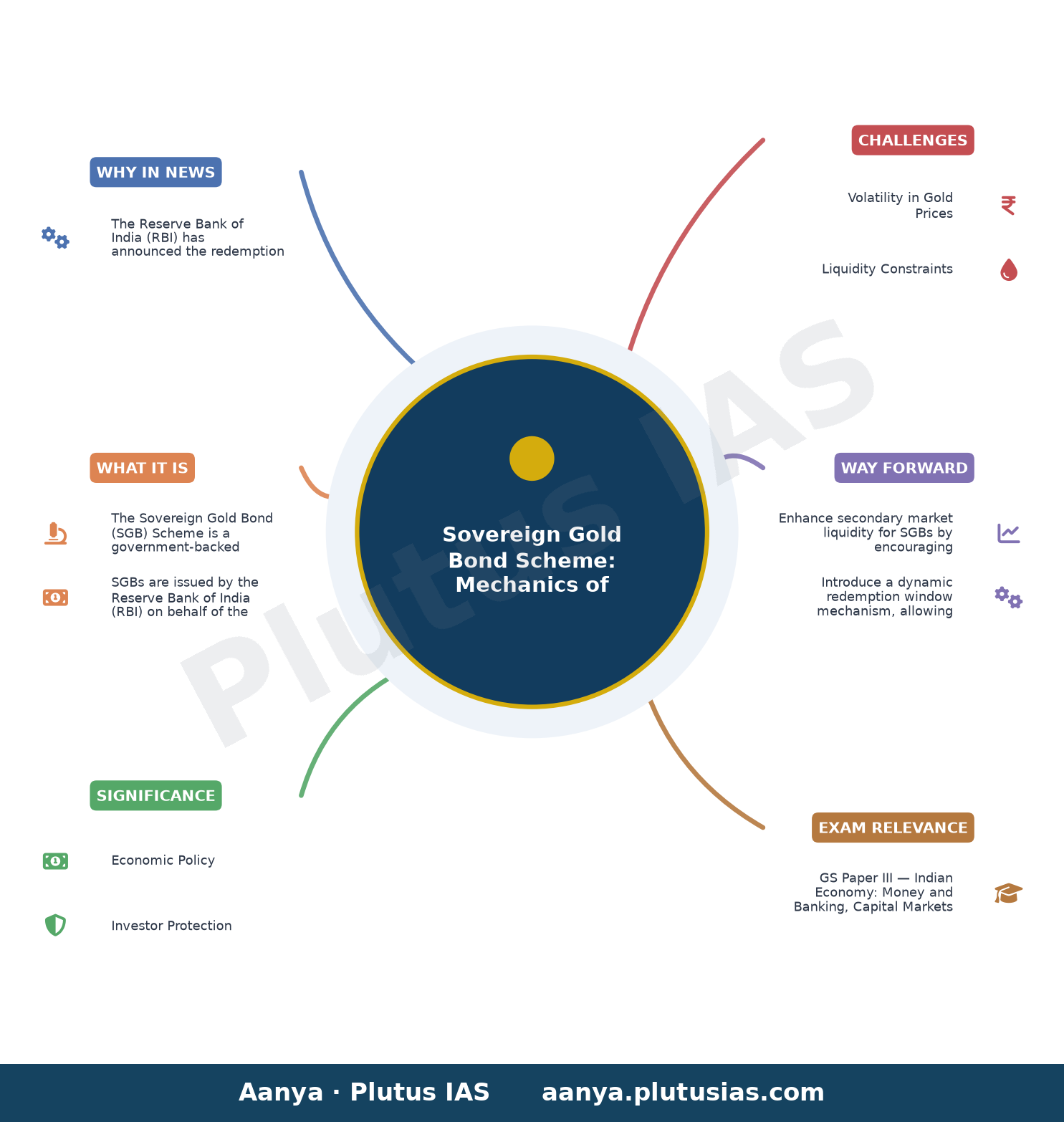
- GS Paper III — Indian Economy: Money and Banking, Capital Markets
- Prelims: Sovereign Gold Bond Scheme (SGB), premature redemption, redemption price, IBJA, gold pricing mechanism, RBI press release, financial instruments
- Essay: Role of gold in India’s financial ecosystem and its impact on household savings and monetary policy
Quick Revision: Premature redemption of SGBs is permitted after five years from the issue date, with the redemption price determined as the simple average of the closing gold price over the three preceding business days, as published by IBJA.
Why is this in the news?
The Reserve Bank of India (RBI) has announced the redemption price for premature redemption of the Sovereign Gold Bond (SGB) 2018-19 Series VI, scheduled for August 12, 2026. This development is significant for investors holding SGBs, as it clarifies the process and pricing mechanism for early exit from the scheme, which is governed by the terms of the Government of India notification dated October 8, 2018.
Background
- The Sovereign Gold Bond (SGB) Scheme was launched in 2015 by the Government of India in collaboration with the Reserve Bank of India (RBI) to reduce the demand for physical gold and shift a portion of household savings into financial assets.
- SGBs are government securities denominated in grams of gold, offering an alternative to holding physical gold with added benefits such as interest income and capital gains tax exemptions.
- Premature redemption is permitted under the SGB Scheme after the completion of five years from the date of issue, subject to the terms specified in the Government of India notification.
- The redemption price for SGBs is determined based on the simple average of the closing price of gold of 999 purity for the three business days preceding the redemption date, as published by the India Bullion and Jewellers Association Ltd (IBJA).
What is the Sovereign Gold Bond (SGB) Scheme?
- The Sovereign Gold Bond (SGB) Scheme is a government-backed financial instrument introduced to encourage investors to hold gold in a dematerialised form, thereby reducing the economic burden of importing physical gold.
- SGBs are issued by the Reserve Bank of India (RBI) on behalf of the Government of India and are denominated in grams of gold, with a minimum investment of one gram and a maximum of four kilograms for individuals.
- Investors in SGBs receive a fixed annual interest rate of 2.5% on the issue price, payable semi-annually, in addition to the capital appreciation based on gold prices.
- The bonds have a maturity period of eight years, but premature redemption is permitted after the fifth year from the date of issue, subject to the terms specified in the Government of India notification.
- The redemption price for SGBs is calculated as the simple average of the closing price of gold of 999 purity for the three business days preceding the redemption date, as published by the India Bullion and Jewellers Association Ltd (IBJA).
- SGBs offer tax benefits, including exemption from capital gains tax upon redemption if held until maturity, and are exempt from wealth tax and GST on the issue price.
- The scheme aims to mobilise household savings into productive financial assets, reduce the current account deficit by lowering gold imports, and provide a secure investment avenue for retail investors.
Key Features
| Feature | Significance |
|---|---|
| Premature Redemption Eligibility | Permits redemption after the fifth year from the issue date, subject to interest payment dates, providing liquidity flexibility to investors. |
| Redemption Price Calculation | Based on the simple average of the closing price of 999 purity gold over the three preceding business days, as published by IBJA, ensuring market-linked valuation. |
| Series VI (2018-19) Specifics | Issued on February 12, 2019, with premature redemption due on August 12, 2026, marking a seven-year cycle from issue to maturity. |
| Government Notification Basis | Grounded in GOI notification F.No.4(22)-B(W&M)/2018 dated October 8, 2018, which outlines the operational framework for premature redemptions under the SGB Scheme. |
| Price Determination Mechanism | Uses IBJA’s gold price benchmark, a standardised and transparent process, reducing valuation disputes and ensuring fairness in redemption. |
Why it Matters
Economic Policy
- Enhances investor confidence in sovereign-backed instruments by providing an exit option after five years, balancing long-term investment with liquidity needs.
- Aligns with the Government of India’s objective of reducing physical gold demand and promoting financial savings through market-linked gold investments.
- Demonstrates the operational maturity of the Sovereign Gold Bond Scheme, introduced in 2015, as a viable alternative to physical gold ownership.
Investor Protection
- Ensures fair valuation through a transparent, market-based redemption price mechanism, mitigating risks of arbitrary pricing by issuers.
- Provides a structured exit route, reducing the need for premature liquidation in secondary markets, which may suffer from illiquidity or price volatility.
- Incorporates safeguards such as eligibility after the fifth year and linkage to interest payment dates, preventing speculative or opportunistic redemptions.
Market Development
- Strengthens the secondary market for gold bonds by establishing a clear precedent for redemption pricing and timelines, fostering investor participation.
- Supports the development of a benchmark gold price index (IBJA) in India, which is critical for pricing derivatives and other financial products tied to gold.
- Encourages broader adoption of gold as an asset class in financial portfolios, diversifying investment avenues beyond traditional instruments.
Fiscal Policy
- Contributes to the Government’s fiscal strategy by reducing the fiscal burden of maintaining large gold reserves, while still leveraging gold as a strategic asset.
- Supports the objective of monetising gold holdings held by households, thereby improving the efficiency of gold utilisation in the economy.
Challenges
1. Volatility in Gold Prices
- Gold prices are subject to global and domestic market fluctuations, which may result in redemption prices that are lower than expected at the time of investment.
- Investors face timing risk, as the redemption price is determined by the average of the three preceding business days, which may not align with peak price periods.
UPSC Link: GS3: Commodity Markets & Price Volatility
2. Liquidity Constraints
- While premature redemption is permitted after five years, secondary market liquidity for SGBs may be limited, potentially forcing investors to accept suboptimal prices.
- The absence of a guaranteed buyback mechanism from the Government or RBI may deter risk-averse investors from participating in the scheme.
UPSC Link: GS3: Financial Market Liquidity
3. Interest Rate Sensitivity
- Changes in domestic interest rates may influence the attractiveness of SGBs relative to other fixed-income instruments, affecting investor participation and redemption patterns.
- If interest rates rise significantly, investors may prefer liquid instruments, reducing demand for long-term gold bonds despite their sovereign backing.
UPSC Link: GS3: Monetary Policy & Interest Rates
4. Operational Delays
- Processing delays in redemption, particularly around peak redemption dates, may lead to dissatisfaction among investors, especially if payments are not disbursed promptly.
- Technical or administrative bottlenecks in the banking or depository systems could disrupt the seamless execution of redemption requests.
UPSC Link: GS2: Governance & Service Delivery
Challenges — UPSC Perspective
| Issue | Concern |
|---|---|
| Price Volatility | Exposure to market-driven redemption prices may result in lower-than-expected returns for investors. |
| Secondary Market Liquidity | Limited trading volumes in the secondary market may constrain exit options for investors. |
| Interest Rate Dynamics | Rising interest rates could reduce the relative attractiveness of gold bonds compared to fixed-income instruments. |
| Redemption Processing | Potential delays in payment disbursement due to operational or systemic inefficiencies. |
| Benchmark Reliance | Dependence on IBJA’s gold price benchmark may introduce systemic risks if the benchmark is manipulated or inaccurately reported. |
Government Initiatives — Must-Memorise for Prelims
- Sovereign Gold Bond (SGB) Scheme, 2015
Way Forward
- Enhance secondary market liquidity for SGBs by encouraging participation from institutional investors and market-makers to reduce redemption pressure.
- Introduce a dynamic redemption window mechanism, allowing investors to choose the optimal redemption date within a specified period, subject to market conditions.
- Strengthen investor awareness campaigns to educate potential subscribers about the risks and benefits of premature redemption, including price volatility and liquidity constraints.
- Explore the feasibility of a partial redemption option, enabling investors to redeem a portion of their holdings while retaining the remainder, to balance liquidity and investment objectives.
- Develop a real-time price tracking system for gold bonds, integrated with financial literacy initiatives, to help investors make informed redemption decisions.
- Collaborate with depository participants (e.g., NSDL, CDSL) to streamline redemption processing and reduce operational bottlenecks.
- Conduct periodic reviews of the redemption pricing mechanism to assess its alignment with market realities and investor expectations.
UPSC Value Addition
Keywords for Mains Answer-Writing
Sovereign Gold Bond Scheme · SGB premature redemption · Reserve Bank of India · gold price determination · India Bullion and Jewellers Association Ltd · SGB 2018-19 Series VI · financial inclusion · capital market instruments · government securities · monetary policy instruments · gold monetisation scheme · investment avenues for individuals
Concept Flow
Introduction of Sovereign Gold Bond Scheme (2015) → Provision for premature redemption after fifth year (2018 notification) → Issue of SGB 2018-19 Series VI (February 2019) → Maturation of fifth year (February 2024) → Eligibility for premature redemption (August 2026) → Redemption price determination via IBJA benchmark → Disbursement of redemption proceeds to investors.
Prelims Practice Questions
Q1. Consider the following statements regarding the Sovereign Gold Bond (SGB) Scheme:
1. Premature redemption is permitted after the fifth year from the date of issue.
2. The redemption price is based on the average closing price of gold of 999 purity over the previous three business days, as published by the India Bullion and Jewellers Association Ltd (IBJA).
3. The SGB Scheme was launched by the Government of India in collaboration with the World Gold Council.
How many of the above statements are correct?
- Only one
- Only two
- All three
- None
Answer: Only two — Statement 1 and 2 are correct as per the RBI notification and scheme guidelines. Statement 3 is incorrect; the SGB Scheme is a Government of India initiative, not in collaboration with the World Gold Council.
Q2. Assertion (A): The Sovereign Gold Bond (SGB) Scheme allows premature redemption only after the fifth year from the date of issue.
Reason (R): Premature redemption is permitted to provide liquidity to investors while ensuring long-term investment in gold.
In the context of the above two statements, which one of the following is correct?
- (A) is correct and (R) is the correct explanation of (A)
- (A) is correct but (R) is not the correct explanation of (A)
- (A) is incorrect but (R) is correct
- (A) and (R) are both incorrect
Answer: (A) is correct and (R) is the correct explanation of (A) — Both (A) and (R) are correct, and (R) is the correct explanation of (A). Premature redemption after the fifth year is a feature of the SGB Scheme to balance liquidity and long-term investment.
Q3. Which of the following institutions is responsible for publishing the closing price of gold of 999 purity used for determining the redemption price of Sovereign Gold Bonds (SGBs)?
- A. Securities and Exchange Board of India (SEBI)
- B. Reserve Bank of India (RBI)
- C. India Bullion and Jewellers Association Ltd (IBJA)
- D. Ministry of Finance, Government of India
Answer: C. India Bullion and Jewellers Association Ltd (IBJA) — The closing price of gold of 999 purity for SGB redemption is published by the India Bullion and Jewellers Association Ltd (IBJA), as per the RBI notification.
Mains Practice Question
✍ Critically examine the rationale behind the Sovereign Gold Bond (SGB) Scheme as a financial instrument for investors. Also, discuss the significance of the redemption price mechanism in ensuring transparency and investor protection. (15 Marks)
Approach: MODEL-ANSWER SKELETON:
1. **Introduction (2 marks)**: Define the SGB Scheme—its objective as a government-backed alternative to physical gold, aimed at reducing import dependency, mobilising gold for productive use, and providing a secure investment avenue. Mention its launch in 2015 under the Gold Monetisation Scheme framework.
2. **Rationale of SGB (5 marks)**:
– **Investor Perspective**: Highlight features such as fixed interest rate (2.5% p.a.), capital gains tax exemption on redemption, and sovereign guarantee reducing default risk. Compare with physical gold (storage costs, purity concerns) and gold ETFs (management fees, market risks).
– **Macroeconomic Perspective**: Reduce gold imports, current account deficit mitigation, and mobilise idle household gold into the formal economy. Cite data on India’s gold demand and import figures (e.g., ~700-800 tonnes annually).
– **Fiscal Perspective**: Lower fiscal burden compared to direct subsidies for gold imports; aligns with the Gold Monetisation Scheme.
3. **Redemption Price Mechanism (5 marks)**:
– **Transparency**: Explain the use of IBJA’s 999 purity gold price average over three business days to determine redemption value—ensures market-linked pricing and reduces manipulation risks.
– **Investor Protection**: Prevents arbitrary pricing by issuers; provides a benchmark for fair valuation. Contrast with physical gold redemption, which may suffer from purity disputes or lower market prices.
– **Liquidity Provision**: Premature redemption after the fifth year (as in SGB 2018-19 Series VI) balances long-term investment with liquidity needs, enhancing scheme attractiveness.
4. **Critique and Challenges (3 marks)**:
– **Market Risks**: Exposure to gold price volatility despite sovereign backing.
– **Liquidity Constraints**: Secondary market liquidity is limited compared to gold ETFs or physical gold.
– **Awareness Gaps**: Low financial literacy in rural areas may limit participation; need for targeted awareness campaigns.
5. **Conclusion (2 marks)**: Summarise the SGB Scheme’s dual role—promoting financial inclusion and macroeconomic stability—while acknowledging its limitations. Emphasise the redemption price mechanism as a cornerstone of transparency and investor confidence.
Source: RBI
Generated by AanyaAi for educational purpose.

- Madras HC slams petitioner for expecting instant POCSO probe - September 30, 2026
- एनएचएआई करेगा असामान्य बोली वाली परियोजनाओं की गुणवत्ता जाँच, जानिए कैसे - September 30, 2026
- Madras HC on Veeramani POCSO Case: Let SIT Work Without Interference - September 30, 2026

No Comments