


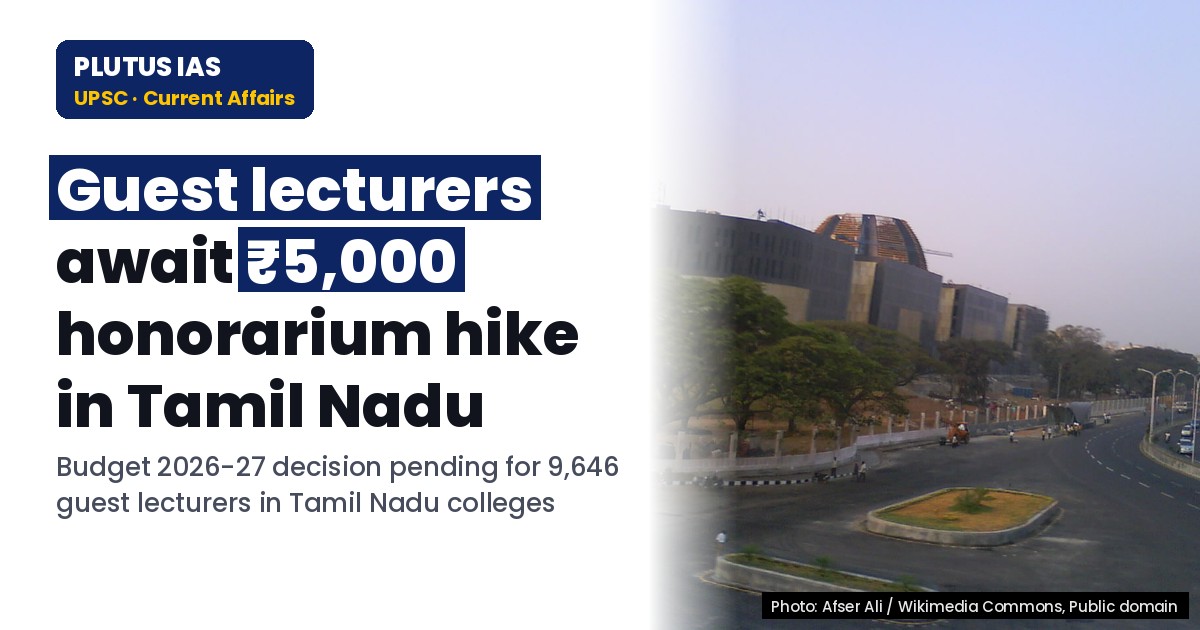
21 Oct Tamil Nadu Guest Lecturers Await ₹5,000 Honorarium Hike in Budget
✎ Guest lecturers in Tamil Nadu’s government colleges are awaiting the disbursement of a ₹5,000 increase in their honorarium to ₹35,000, announced in August 2026, which remains pending due to procedural dependencies in policy…
Subject Relevance — Where This Topic Fits
- GS Paper II — Governance, Transparency and Accountability | GS Paper III — Human Resource Development in Education
- Prelims: Guest lecturers, Honorarium, Consolidated remuneration, Demand for Grants, Tamil Nadu Collegiate Education Department
- Essay: The role of contractual faculty in India’s higher education system: Challenges and reforms, Public policy implementation: Bridging the gap between announcement and execution
Quick Revision: Guest lecturers in Tamil Nadu’s government colleges are awaiting the disbursement of a ₹5,000 increase in their honorarium to ₹35,000, announced in August 2026, which remains pending due to procedural dependencies in policy execution.
Why is this in the news?
The delay in disbursing the announced ₹5,000 hike in honorarium for 8,741 guest lecturers in Tamil Nadu’s government colleges highlights systemic challenges in public policy implementation, particularly in translating legislative or executive announcements into tangible administrative action. This issue underscores the importance of fiscal planning, inter-departmental coordination, and transparency in governance, especially in the context of contractual employment in the higher education sector.
Background
- Guest lecturers form a critical component of the teaching workforce in India’s higher education system, particularly in government-run institutions where regular faculty positions are limited.
- In Tamil Nadu, the Collegiate Education Department employs guest lecturers across 181 government arts and science colleges and 7 government colleges of education, with additional staff in engineering and polytechnic institutions.
- The honorarium for guest lecturers has historically been a consolidated remuneration, distinct from the structured pay scales of regular faculty, reflecting their contractual and temporary nature of employment.
- The announcement of a ₹5,000 increase in honorarium to ₹35,000 was made by the Higher Education Minister during the presentation of the Demand for Grants for the Department on August 24, 2026.
- The Collegiate Education Department has cited the need for a government order to disburse the revised honorarium, indicating procedural dependencies in policy execution.
- The delay has raised concerns among guest lecturers regarding financial stability, particularly during festive seasons, and has prompted petitions to the Chief Minister’s Office for status updates.
What are Guest Lecturers and Their Honorarium Structure?
- Guest lecturers are contractual faculty appointed on a temporary basis to meet teaching requirements in government-run higher education institutions, particularly in disciplines with faculty shortages.
- Their remuneration is typically structured as a consolidated honorarium rather than a salary, reflecting their non-permanent employment status and the absence of benefits such as provident fund, gratuity, or medical allowances.
- The honorarium amount varies across states and institutions, often determined by state government policies, budgetary allocations, and administrative norms.
- In Tamil Nadu, the honorarium for guest lecturers was previously lower than ₹35,000, with the recent announcement marking a 16.67% increase from the prior amount.
- The revised honorarium of ₹35,000 is intended to provide financial relief to guest lecturers, many of whom rely solely on this income for their livelihoods.
- The Collegiate Education Department’s role includes the disbursement of honoraria, coordination with the Finance Department for budgetary approvals, and issuance of government orders for policy implementation.
- Guest lecturers are typically appointed for a fixed tenure, often renewable based on institutional needs and performance, and their services are governed by state-specific rules and regulations.
- The delay in disbursing the revised honorarium highlights the administrative and fiscal challenges in translating policy announcements into actionable disbursements.
Key Features
| Feature | Significance |
|---|---|
| Honorarium hike announcement | Increases financial remuneration for guest lecturers from ₹30,000 to ₹35,000, addressing wage stagnation and improving livelihood security. |
| Government Arts and Science Colleges | Primary employers of guest lecturers in Tamil Nadu, with 181 institutions and 8,741 positions affected. |
| Government Colleges of Education | Additional 7 institutions employing guest lecturers, expanding the scope of impact. |
| Engineering and Polytechnic Colleges | Inclusion of 905 guest lecturers in technical education institutions, broadening the beneficiary base. |
| Government Order (GO) requirement | Formal administrative step pending for disbursement, highlighting procedural delays in implementation. |
Why it Matters
Economic
- Direct income enhancement for 9,646 guest lecturers, stimulating local economies in regions where these colleges are located.
- Mitigates wage compression in the higher education sector, ensuring parity with other academic roles.
- Reduces financial precarity among contract-based faculty, potentially improving teaching quality through reduced attrition.
Administrative
- Demonstrates the state government’s commitment to human resource management in public higher education institutions.
- Highlights the procedural lag between policy announcement and implementation, a common governance challenge in public sector wage revisions.
- Reflects the administrative burden of coordinating disbursements across multiple departments (Collegiate Education, Technical Education).
Social
- Supports the livelihoods of guest lecturers, many of whom may belong to economically vulnerable sections.
- Enhances the attractiveness of teaching roles in government colleges, addressing faculty shortages in higher education.
- Indirectly benefits students through potentially improved teaching continuity and morale among faculty.
Challenges
1. Implementation Delay
- Government Order (GO) pending for over two months since the announcement, causing uncertainty among beneficiaries.
- Risk of further delays due to fiscal year-end constraints or competing budgetary priorities.
- Potential administrative bottlenecks in processing disbursements across 188+ institutions.
UPSC Link: Public Administration – Implementation of Policies
2. Fiscal Constraints
- Additional financial burden on the state exchequer, requiring reallocation or supplementary budgetary provisions.
- Opportunity cost: funds allocated to this hike could have been used for infrastructure or research in higher education.
- Long-term sustainability concerns if such hikes become recurrent without corresponding revenue growth.
UPSC Link: Economic Survey – State Finances
3. Contractual Ambiguity
- Guest lecturers operate under temporary contracts, raising questions about job security and future hikes.
- Lack of formal career progression pathways for guest lecturers compared to permanent faculty.
- Potential for disputes over entitlements if the hike is not uniformly applied across all institutions.
UPSC Link: Labour Economics – Contractual Employment
4. Equity Concerns
- Disparities in remuneration between guest lecturers and permanent faculty may persist despite the hike.
- Regional variations in cost of living may not be adequately addressed by a uniform honorarium increase.
- Limited bargaining power of guest lecturers due to their temporary employment status.
UPSC Link: Social Justice – Inclusive Growth
Challenges — UPSC Perspective
| Issue | Concern |
|---|---|
| Delay in Government Order | Uncertainty and financial hardship for 9,646 guest lecturers awaiting remuneration. |
| Fiscal Sustainability | Strain on state finances due to recurrent expenditure on non-permanent staff. |
| Contractual Insecurity | Lack of career progression or job security for guest lecturers in higher education. |
| Administrative Coordination | Complexity in disbursing funds across multiple departments and institutions. |
| Equity Gaps | Persistent wage disparities between guest lecturers and permanent faculty in public colleges. |
Way Forward
- The Tamil Nadu government must expedite the issuance of the Government Order (GO) to formalise the honorarium hike.
- Establish a dedicated task force to oversee the disbursement process and address grievances from guest lecturers.
- Conduct a cost-benefit analysis to assess the long-term fiscal impact of recurring honorarium hikes on state finances.
- Introduce structured career pathways for guest lecturers, including eligibility for permanent positions or promotions based on performance.
- Explore mechanisms for indexation of honoraria to inflation, ensuring periodic reviews to maintain purchasing power.
- Strengthen data systems to track the employment and remuneration of guest lecturers across all government colleges.
- Engage with stakeholders, including guest lecturers’ associations, to address concerns and improve policy design.
- Align the honorarium hike with broader reforms in higher education governance to enhance faculty stability and teaching quality.
UPSC Value Addition
Keywords for Mains Answer-Writing
Guest lecturers · honorarium · Tamil Nadu government · higher education policy · contractual faculty · budgetary allocation · government colleges · academic workforce · fiscal federalism · public sector employment · wage fixation · Constitutional provisions for education · Department of Collegiate Education · fiscal devolution · State List (7th Schedule) · remuneration disparities · academic governance · fiscal prudence vs. welfare · contractual employment in higher education · public expenditure management
Concept Flow
State Assembly announces honorarium hike for guest lecturers → → Department of Higher Education processes proposal → → Government Order (GO) awaits approval → → GO issued; funds allocated in revised budget → → Disbursement coordinated across 188+ institutions → → Honorarium credited to guest lecturers’ accounts → → Impact on livelihoods and teaching quality assessed
Prelims Practice Questions
Q1. Consider the following statements regarding guest lecturers in government colleges in India:
1. Guest lecturers are employed under the administrative control of the State Departments of Higher Education.
2. The honorarium for guest lecturers is determined by the Central Government under the 7th Schedule of the Constitution.
3. The Tamil Nadu government has recently announced a hike in the honorarium for guest lecturers from ₹30,000 to ₹35,000.
How many of the above statements are correct?
- Only one
- Only two
- All three
- None
Answer: Only two — Statement 1 is correct as guest lecturers are typically employed by State Departments of Higher Education. Statement 2 is incorrect because the honorarium for guest lecturers is determined by the respective State governments, not the Central Government. Statement 3 is correct as per the news report.
Q2. Assertion (A): The 7th Schedule of the Indian Constitution places education under the Concurrent List.
Reason (R): The Central Government can legislate on subjects in the Concurrent List, but State governments can also legislate on these subjects, subject to the provisions of the Constitution.
In the context of the above two statements, which one of the following is correct?
- Both A and R are true, and R is the correct explanation of A.
- Both A and R are true, but R is not the correct explanation of A.
- A is true, but R is false.
- A is false, but R is true.
Answer: A is true, but R is false. — Assertion (A) is false because education is listed under the State List (Entry 11) in the 7th Schedule, not the Concurrent List. Reason (R) is true as it correctly describes the nature of the Concurrent List.
Q3. Match the following pairs regarding higher education governance in India:
Column I (Entity) | Column II (Role)
——————————————–|——————————————–
A. University Grants Commission (UGC) | 1. Regulates technical education
B. All India Council for Technical Education (AICTE) | 2. Grants recognition to universities
C. National Council of Educational Research and Training (NCERT) | 3. Develops curriculum and textbooks
D. National Assessment and Accreditation Council (NAAC) | 4. Assesses and accredits higher education institutions
Choose the correct match:
- A-2, B-1, C-3, D-4
- A-1, B-2, C-3, D-4
- A-4, B-1, C-2, D-3
- A-3, B-1, C-2, D-4
Answer: A-2, B-1, C-3, D-4 — A-2: UGC grants recognition to universities; B-1: AICTE regulates technical education; C-3: NCERT develops curriculum and textbooks; D-4: NAAC assesses and accredits higher education institutions.
Mains Practice Question
✍ The issue of delayed implementation of announced honorarium hikes for guest lecturers in Tamil Nadu’s government colleges reflects broader challenges in public sector employment and fiscal governance. Critically examine the constitutional and administrative dimensions of this problem, and analyse the implications for higher education governance in India. (15 Marks)
Approach: MODEL-ANSWER SKELETON:
1. **Constitutional Framework (2 Marks)**
– Education is a State Subject under Entry 11 of the State List (7th Schedule).
– The Union government’s role is limited to coordination and funding under Article 299 (Contracts) and Article 282 (Grants-in-aid).
– Fiscal federalism: States must balance welfare commitments with fiscal prudence (e.g., FRBM Act, 2003).
2. **Administrative and Procedural Delays (3 Marks)**
– Government order (GO) process: Announcements in Assembly (August 24) require subsequent administrative approvals, budgetary allocations, and gazette notifications.
– Inter-departmental coordination: Collegiate Education Department’s submission to the government for consideration highlights bureaucratic bottlenecks.
– Data: 8,741 guest lecturers in Tamil Nadu’s government colleges (9,646 including engineering/polytechnic) underscore the scale of fiscal impact.
3. **Public Sector Employment Challenges (4 Marks)**
– Guest lecturers as contractual faculty: Lack of job security, disparities in remuneration compared to permanent faculty, and reliance on temporary appointments.
– Policy inconsistency: Frequent delays in honouring commitments erode trust in governance.
– Comparative perspective: Similar issues exist in other states (e.g., UGC’s ad-hoc appointments in central universities).
4. **Implications for Higher Education Governance (3 Marks)**
– Quality of education: Guest lecturers’ morale and financial stability affect teaching standards.
– Fiscal sustainability: States must align wage revisions with revenue receipts (e.g., GST compensation, devolution).
– Legal recourse: Petitions to CMO highlight the role of judicial oversight in ensuring executive accountability.
5. **Way Forward (3 Marks)**
– Institutional reforms: Time-bound implementation of announcements via e-governance (e.g., Tamil Nadu’s e-Governance initiatives).
– Policy coherence: Integrate contractual faculty policies with the National Education Policy (NEP) 2020’s emphasis on faculty welfare.
– Centre-State collaboration: Use of centrally sponsored schemes (e.g., RUSA) to supplement state budgets for higher education.
Source: The Hindu
Generated by AanyaAi for educational purpose.
Related guides on our sites
- Current affairs for upsc 2026
- Best economics optional coaching for upsc
- Best economics optional teacher for upsc
- How to prepare for GS paper 1 for UPSC CSE mains exam

- India-Australia AUSTRAHIND 2026 Exercise: Key Highlights for UPSC & State PCS - October 22, 2026
- एससीओ बैठक में भारत का आतंकवाद विरोध: क्षेत्रीय सहयोग पर जोर - October 22, 2026
- SEC Directs Strict SC Order Compliance for Andhra ULB Polls - October 22, 2026

No Comments