


31 Aug Tamil Nadu to Launch ₹175 Cr Semiconductor Park in Kancheepuram for UPSC
✎ The Semiconductor and Electronics Manufacturing Park in Tamil Nadu is a state-led initiative to establish a global-standard R&D and manufacturing hub, aimed at attracting investments, generating employment, and reducing import…
Subject Relevance — Where This Topic Fits
- GS Paper III — Indian Economy: Infrastructure, Industrial Policy, and Employment | GS Paper III — Science and Technology: Electronics Manufacturing and R&D | GS Paper II — Federalism and State Policies in Economic Development
- Prelims: Semiconductor Manufacturing Park, Electronics Manufacturing Clusters (EMC), State Industries Promotion Corporation of Tamil Nadu (SIPCOT), Public-Private Partnership (PPP), Multi-Modal Logistics Hub (MMLH), FinTech Hub, Tamil Nadu Industrial Development Corporation (TIDCO), Make in India 2.0, Production-Linked Incentive (PLI) Scheme for Electronics, National Policy on Electronics (NPE) 2019
- Essay: The role of state-led industrialisation in India’s economic growth, Balancing infrastructure development with environmental sustainability in industrial parks
Quick Revision: The Semiconductor and Electronics Manufacturing Park in Tamil Nadu is a state-led initiative to establish a global-standard R&D and manufacturing hub, aimed at attracting investments, generating employment, and reducing import dependence in the electronics sector.
Why is this in the news?
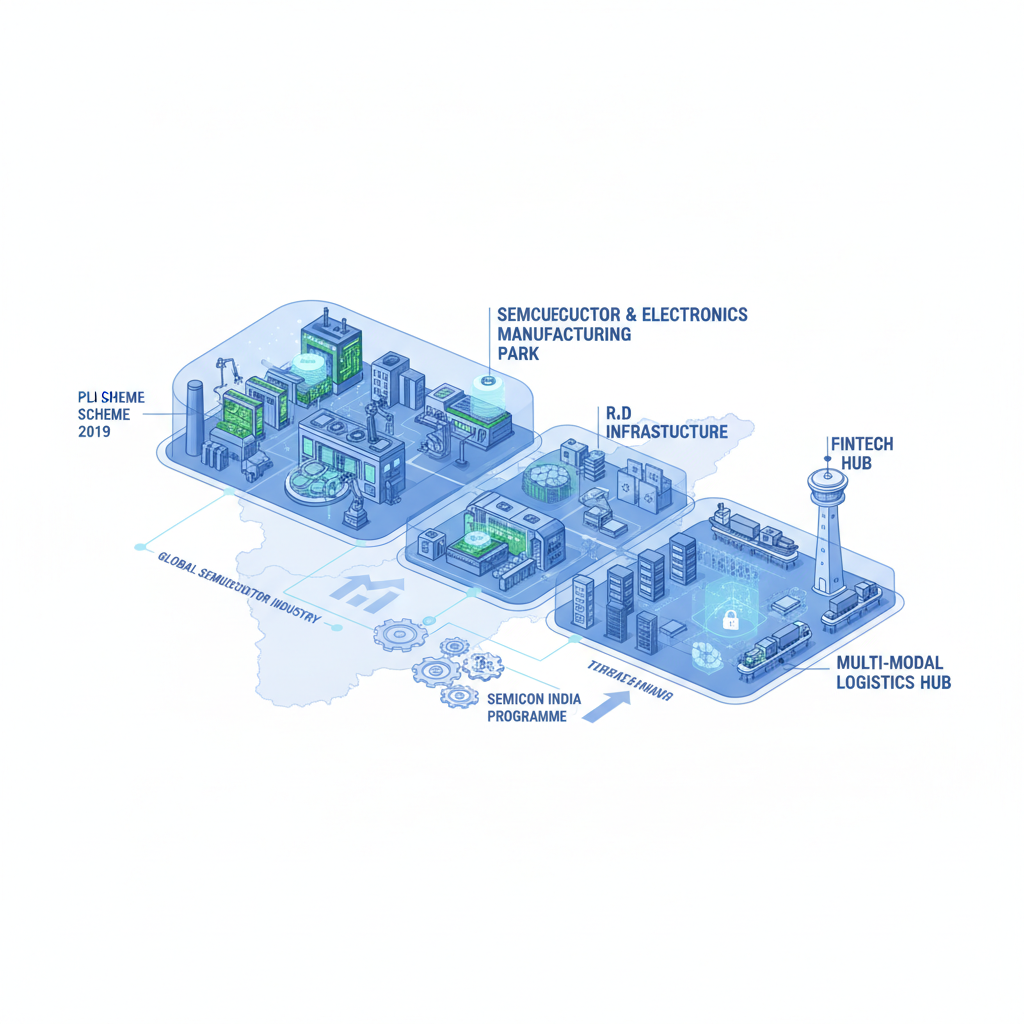
The announcement of a Semiconductor and Electronics Manufacturing Park at Maduramangalam in Kancheepuram district, Tamil Nadu, alongside a FinTech Hub in Coimbatore and a Multi-Modal Logistics Hub in Tiruchi, underscores the state’s strategic push to position itself as a key node in India’s electronics and digital economy. The initiatives align with national policies such as the Production-Linked Incentive (PLI) Scheme for Electronics and the National Policy on Electronics (NPE) 2019, while addressing gaps in R&D infrastructure, employment generation, and logistics efficiency in Tamil Nadu.
Background
- The global semiconductor industry is projected to reach USD 1 trillion by 2030, with India aiming to capture a 10% share by 2030 under the Semicon India Programme (2021).
- Tamil Nadu, a traditional hub for automobile and textile industries, is diversifying into high-technology sectors to sustain economic growth and employment.
- The state’s existing industrial infrastructure includes SIPCOT and TIDCO, which have historically facilitated industrial corridors and public-private partnerships.
- The National Policy on Electronics (NPE) 2019 emphasises the development of semiconductor manufacturing, display fabrication, and electronics assembly units in India.
- The Production-Linked Incentive (PLI) Scheme for Electronics (2020) offers financial incentives to boost domestic manufacturing of electronics and semiconductor components.
- Tamil Nadu’s proximity to ports (Chennai, Ennore) and its robust road and rail networks provide a logistical advantage for multi-modal hubs.
What is the Semiconductor and Electronics Manufacturing Park in Tamil Nadu?
- The park is proposed at Maduramangalam in Kancheepuram district, Tamil Nadu, with an estimated investment of ₹175 crore by the State Industries Promotion Corporation of Tamil Nadu (SIPCOT).
- The park is designed to provide a global-standard research and development (R&D) facility to support semiconductor manufacturing units, including fabrication plants (fabs), assembly, testing, marking, and packaging (ATMP) units.
- The project aims to attract investments of ₹2,000 crore and generate direct and indirect employment for 5,000 people, thereby contributing to Tamil Nadu’s employment ecosystem.
- The park aligns with India’s Semicon India Programme (2021), which seeks to reduce import dependence in semiconductor manufacturing and enhance self-reliance in critical technologies.
- The initiative is part of Tamil Nadu’s broader strategy to integrate into global supply chains, particularly in high-technology sectors such as electronics and semiconductors.
- The park will complement existing industrial corridors in Tamil Nadu, such as the Chennai-Bengaluru Industrial Corridor and the Coimbatore-Tiruchi-Madurai corridor.
- The project is expected to leverage the state’s existing industrial infrastructure, including SEZs, industrial estates, and skill development centres.
- The park will also facilitate technology transfer and collaboration with global semiconductor firms, aligning with the government’s ‘Atmanirbhar Bharat’ vision.
Key Features
| Feature | Significance |
|---|---|
| Semiconductor and Electronics Manufacturing Park at Maduramangalam, Kancheepuram | Establishes Tamil Nadu as a critical node in India’s semiconductor supply chain, attracting high-value investments and fostering indigenous R&D capabilities in a globally strategic sector. |
| Global-standard R&D facility within the Semiconductor Park | Enables collaboration between industry and academia, accelerates innovation in semiconductor design and manufacturing, and reduces dependence on imported technology. |
| Coimbatore FinTech Hub (₹400 crore, PPP model) | Promotes digital financial innovation, enhances financial inclusion, and positions Tamil Nadu as a hub for FinTech startups and global investment in financial technologies. |
| Multi-Modal Logistics Hub in Tiruchi | Improves connectivity for industries in central Tamil Nadu, reduces logistics costs, and integrates road, rail, and air transport to enhance export competitiveness. |
| State-led implementation via SIPCOT and TIDCO | Leverages existing institutional frameworks to ensure efficient project execution, resource allocation, and stakeholder coordination under the state’s industrial development policy. |
Why it Matters
Economic Growth and Industrialisation
- Enhances Tamil Nadu’s manufacturing output by integrating high-technology sectors like semiconductors and FinTech, diversifying the state’s industrial base beyond traditional industries.
Employment Generation
- Direct and indirect employment generation of 5,000 jobs in the semiconductor park alone, with multiplier effects across ancillary industries and skill development initiatives.
Strategic Autonomy and Supply Chain Resilience
- Reduces reliance on imported semiconductors, strengthens India’s position in the global semiconductor value chain, and aligns with national policies for self-reliance in critical technologies.
Regional Development
- Balances industrial growth across Tamil Nadu by locating facilities in Kancheepuram, Coimbatore, and Tiruchi, addressing regional disparities and promoting inclusive development.
Global Investment Attraction
- Demonstrates Tamil Nadu’s investor-friendly ecosystem, attracting foreign direct investment (FDI) in high-tech sectors and positioning the state as a preferred destination for global manufacturers.
Challenges
1. Land Acquisition and Regulatory Clearances
- Complexities in land acquisition for large-scale industrial parks, delays in environmental and forest clearances, and coordination challenges with local authorities.
UPSC Link: Land Reforms and R&R policies
2. Skilled Manpower Shortage
- Shortage of specialised talent in semiconductor design, FinTech, and logistics management, necessitating robust skill development and industry-academia partnerships.
UPSC Link: Skill Development and Education Policy
3. Infrastructure Bottlenecks
- Inadequate power supply, water scarcity, and suboptimal transport connectivity in proposed hub locations, requiring significant investment in utilities and logistics infrastructure.
UPSC Link: Infrastructure Development and PPPs
4. Global Competition and Market Volatility
- Intense competition from established semiconductor hubs (e.g., Taiwan, South Korea) and fluctuations in global demand for semiconductors and FinTech solutions.
UPSC Link: Globalisation and Trade Policies
5. Sustainability and Environmental Concerns
- Potential environmental degradation from semiconductor manufacturing (e.g., e-waste, chemical pollution) and the need for green manufacturing practices.
UPSC Link: Environmental Governance and Pollution Control
Challenges — UPSC Perspective
| Issue | Concern |
|---|---|
| Land Acquisition | Delays in securing land titles, resistance from local communities, and environmental compliance hurdles. |
| Regulatory Approvals | Overlapping jurisdictions between state and central agencies, bureaucratic inefficiencies, and compliance with environmental and labour laws. |
| Skill Gap | Mismatch between industry requirements and educational curricula, lack of vocational training in emerging technologies. |
| Infrastructure Gaps | Inadequate power, water, and transport connectivity in proposed hub locations, increasing project costs. |
| Global Market Risks | Dependence on volatile global semiconductor demand and competition from established manufacturing hubs. |
| Environmental Sustainability | Need for strict adherence to environmental norms, waste management, and adoption of circular economy principles. |
Government Initiatives — Must-Memorise for Prelims
- State Industries Promotion Corporation of Tamil Nadu (SIPCOT) schemes for industrial parks
- Tamil Nadu Industrial Development Corporation (TIDCO) infrastructure development schemes
Way Forward
- Establish a dedicated project management unit under SIPCOT/TIDCO to expedite land acquisition, regulatory clearances, and infrastructure development.
- Collaborate with premier engineering and technical institutions (e.g., IITs, NITs) to design skill development programs aligned with semiconductor and FinTech industry needs.
- Invest in green infrastructure for the semiconductor park, including renewable energy sources, water recycling systems, and zero-liquid discharge facilities.
- Facilitate public-private partnerships (PPPs) to attract global investors and ensure technology transfer and knowledge sharing.
- Develop a state-level semiconductor and FinTech innovation ecosystem by incentivising R&D collaborations between industry and academia.
- Strengthen multi-modal connectivity in Tiruchi by integrating road, rail, and air transport hubs with dedicated freight corridors.
- Conduct periodic reviews of project progress with stakeholders to address bottlenecks and ensure timely implementation.
- Promote Tamil Nadu’s semiconductor and FinTech hubs through global roadshows and investment summits to attract FDI.
UPSC Value Addition
Keywords for Mains Answer-Writing
Semiconductor and Electronics Manufacturing Park · State Industries Promotion Corporation of Tamil Nadu (SIPCOT) · Kancheepuram district · Public-Private Partnership (PPP) model · Tamil Nadu Industrial Development Corporation (TIDCO) · Multi-Modal Logistics Hub · Tiruchi district · Coimbatore FinTech Hub · Digital financial services · Electronic components manufacturing · Employment generation through industrial parks · State-led industrial policy
Concept Flow
State government identifies semiconductor and electronics manufacturing as a priority sector for industrialisation and employment generation. → Tamil Nadu’s industrial policy frameworks (e.g., SIPCOT, TIDCO) are leveraged to design and implement the Semiconductor Park and associated hubs. → Land acquisition and regulatory clearances are secured through state and central government coordination under existing land and environmental laws. → Infrastructure development (power, water, transport) is prioritised to meet the requirements of high-tech industries. → Skill development initiatives are launched in partnership with educational institutions to bridge the talent gap. → Global investors are attracted through policy incentives, ease of doing business reforms, and demonstration of project viability. → The hubs become operational, generating employment, driving innovation, and integrating Tamil Nadu into global supply chains. → Continuous monitoring and policy adjustments ensure sustainability, competitiveness, and alignment with national strategic goals.
Prelims Practice Questions
Q1. Consider the following statements regarding the Semiconductor and Electronics Manufacturing Park announced in Tamil Nadu:
1. The park is to be established at Maduramangalam in Kancheepuram district.
2. The park will be developed through the State Industries Promotion Corporation of Tamil Nadu (SIPCOT).
3. The park is expected to attract investments of ₹2,000 crore and provide employment to 5,000 people.
4. The park will exclusively focus on software development and not on semiconductor manufacturing.
How many of the above statements are correct?
- Only one
- Only two
- Only three
- All four
Answer: Only three — Statements 1, 2, and 3 are correct. Statement 4 is incorrect as the park is designed to facilitate semiconductor manufacturing, not exclusively software development.
Q2. Assertion (A): The Coimbatore FinTech Hub is being established under the Public-Private Partnership (PPP) model.
Reason (R): The hub aims to promote digital financial services through innovations in FinTech.
Options:
A. Both A and R are true, and R is the correct explanation of A.
B. Both A and R are true, but R is not the correct explanation of A.
C. A is true, but R is false.
D. A is false, but R is true.
Answer: ? — Both the assertion and reason are true. The hub is indeed being established under the PPP model (A), and its objective is to promote digital financial services (R). The reason correctly explains the assertion as the PPP model is a means to achieve the stated objective.
Q3. Match the following industrial hubs announced in Tamil Nadu with their respective locations:
Column I (Hub) | Column II (Location)
1. Semiconductor and Electronics Manufacturing Park | A. Tiruchi
2. Coimbatore FinTech Hub | B. Coimbatore
3. Multi-Modal Logistics Hub | C. Kancheepuram
Options:
A. 1-C, 2-B, 3-A
B. 1-A, 2-B, 3-C
C. 1-B, 2-C, 3-A
D. 1-C, 2-A, 3-B
Answer: ? — The Semiconductor and Electronics Manufacturing Park is at Maduramangalam in Kancheepuram district (1-C). The Coimbatore FinTech Hub is in Coimbatore (2-B). The Multi-Modal Logistics Hub is in Tiruchi (3-A).
Mains Practice Question
✍ Evaluate the role of state-led industrial parks in fostering economic growth and employment generation in India. Refer to the recent announcement of the Semiconductor and Electronics Manufacturing Park in Tamil Nadu and analyse how such initiatives align with national policies like the ‘Make in India’ initiative and the Production-Linked Incentive (PLI) scheme. (15 Marks)
Approach: MODEL-ANSWER SKELETON:
1. **Introduction (2 marks)**: Define state-led industrial parks and their role in economic development. Briefly introduce the Tamil Nadu Semiconductor Park as a case study.
2. **Economic Growth and Employment Generation (4 marks)**:
– Explain how industrial parks attract investment, boost local industries, and create direct and indirect employment (reference to Tamil Nadu park: ₹2,000 crore investment, 5,000 jobs).
– Discuss the multiplier effect on ancillary industries and skill development.
3. **Alignment with National Policies (5 marks)**:
– Link the park to ‘Make in India’ (2014) and PLI scheme (2020) for electronics and semiconductors.
– Highlight the strategic importance of semiconductors (e.g., supply chain resilience, Atmanirbhar Bharat).
– Reference the role of state corporations like SIPCOT and TIDCO in implementing such schemes.
4. **Challenges and Criticisms (3 marks)**:
– Discuss potential challenges: land acquisition, environmental concerns, competition with other states, and sustainability of employment.
– Mention the need for continuous R&D and global collaboration (reference to IGSS and Foxconn MoUs in Tamil Nadu).
5. **Conclusion (1 mark)**: Summarise the significance of state-led industrial parks in India’s industrial policy framework.
Source: The Hindu
Tamil Nadu PCS (TNPSC) — State PCS Practice
Prelims: Which district of Tamil Nadu has been selected by the state government to establish a Semiconductor Park, as announced by Chief Minister M.K. Stalin?
- A. Coimbatore
- B. Kancheepuram
- C. Tiruchirappalli
- D. Madurai
Answer: B. Kancheepuram — The Tamil Nadu government, led by Chief Minister M.K. Stalin, announced the establishment of a Semiconductor Park in Kancheepuram district to boost the state’s electronics and semiconductor manufacturing ecosystem.
Mains: Discuss the significance of establishing a Semiconductor Park in Tamil Nadu, particularly in Kancheepuram district, for the state’s industrial growth and employment generation. Also, analyze the potential challenges in its implementation.
Generated by AanyaAi for educational purpose.
Related guides on our sites
- Current affairs for upsc 2026
- How to prepare for GS paper 1 for UPSC CSE mains exam
- Best UPSC coaching for IFOS exam
- Best mentorship programme for upsc

- India-Australia AUSTRAHIND 2026 Exercise: Key Highlights for UPSC & State PCS - October 22, 2026
- एससीओ बैठक में भारत का आतंकवाद विरोध: क्षेत्रीय सहयोग पर जोर - October 22, 2026
- SEC Directs Strict SC Order Compliance for Andhra ULB Polls - October 22, 2026

No Comments