


27 Jul कोसी-मेची अंतर-राज्यीय लिंक परियोजना: UPSC के लिए महत्वपूर्ण जानकारी

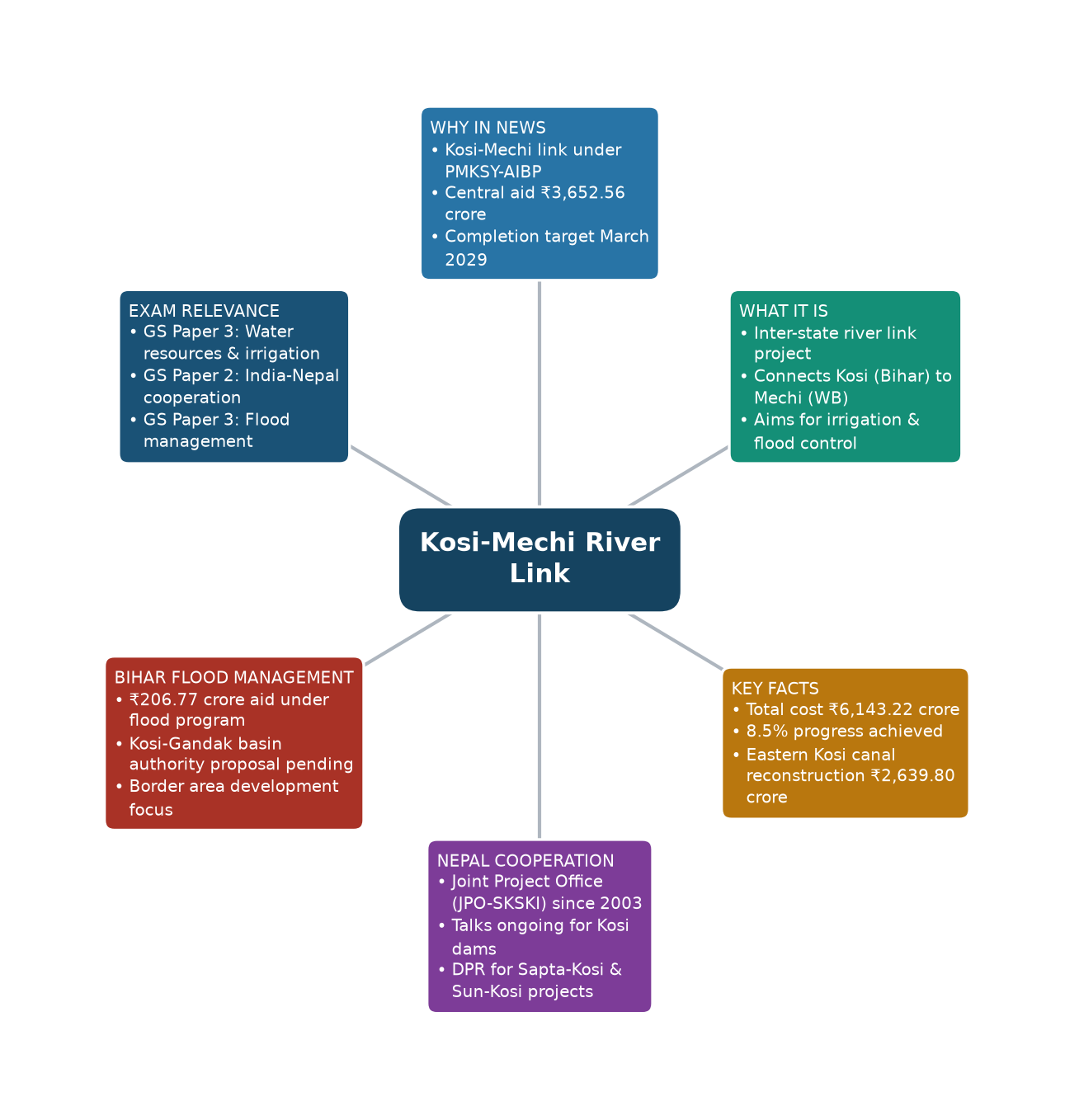
Map & concept mind-map: Kosi-Mechi Inter-State Link Project
Subject Relevance — Where This Topic Fits
- GS Paper II — India and its Neighbourhood (India-Nepal Relations) | GS Paper III — Agriculture, Water Resources, and Infrastructure
- Prelims: Koshi-Mechi Link Project, PMKSY-AIBP, Inter-State River Linking, Bihar Flood Management, India-Nepal Joint Projects Office (JPO-SKS&KI), GLOF Studies, Bihar Flood Management and Border Area Programme
- Essay: Water Security and Sustainable Development: The Case of India’s River Linking Projects, India-Nepal Cooperation in Transboundary Water Management: Challenges and Opportunities
Quick Revision: The Koshi-Mechi Link Project, funded under PMKSY-AIBP with ₹3,652.56 crore central assistance, aims to link the Koshi and Mechi basins to enhance irrigation and mitigate floods in Bihar, with 8.5% progress achieved by July 2026.
Why is this in the news?
The Koshi-Mechi Inter-State Link Project has been included under the Pradhan Mantri Krishi Sinchayee Yojana-Accelerated Irrigation Benefits Programme (PMKSY-AIBP) with a central assistance of ₹3,652.56 crore for a total project cost of ₹6,143.22 crore. The project, scheduled for completion by March 2029, aims to enhance irrigation, mitigate floods, and ensure water security in Bihar and adjoining regions. The inclusion underscores the government’s commitment to accelerating irrigation infrastructure development while addressing cross-border water management challenges with Nepal.
Background
- The Koshi-Mechi Link Project is part of India’s broader strategy for inter-state and international river linking initiatives to address water scarcity and flood risks in the eastern region.
- The Koshi River, originating in Nepal, is a major tributary of the Ganga and is prone to recurrent floods, causing significant damage to life and property in Bihar.
- The project aligns with the objectives of the National Perspective Plan (NPP) for inter-linking of rivers, which was formulated in 1980 to address water deficits and surplus regions in India.
- Bihar, a flood-prone state, has historically faced challenges in water management due to the erratic flow of rivers like the Koshi, Gandak, and Mahananda.
- The India-Nepal Joint Projects Office (JPO-SKS&KI), established in 2003, has been instrumental in coordinating transboundary water projects, including the Sapta-Koshi and Sun-Koshi-Kamala Diversion multipurpose projects.
- The Pradhan Mantri Krishi Sinchayee Yojana (PMKSY), launched in 2015, aims to enhance water-use efficiency and expand irrigation coverage through schemes like the Accelerated Irrigation Benefits Programme (AIBP).
What is the Koshi-Mechi Inter-State Link Project?
- The Koshi-Mechi Link Project is an inter-state river linking initiative aimed at connecting the Koshi River basin (Bihar) with the Mechi River basin to address water scarcity and flood mitigation in the eastern region.
- The total estimated cost of the project is ₹6,143.22 crore, with ₹3,652.56 crore provided as central assistance under the PMKSY-AIBP, ensuring financial viability and timely execution.
- The project includes the reconstruction of the Eastern Koshi Main Canal, with 8.5% physical progress achieved as of July 2026, and a contract awarded for ₹2,639.80 crore covering a stretch of 41.30 km.
- The project is designed to provide irrigation benefits to approximately 2.5 lakh hectares of land, thereby boosting agricultural productivity and rural livelihoods in the region.
- The initiative is part of a broader strategy to integrate water resources management across states, ensuring equitable distribution and reducing the impact of floods and droughts.
- The project also includes measures for environmental safeguards, such as sediment management, fish ladders, and water quality monitoring, to mitigate ecological impacts.
- The project’s completion by March 2029 is critical for aligning with the objectives of the PMKSY and ensuring timely benefits to farmers and communities in the region.
Key Features
| Feature | Significance |
|---|---|
| Total project cost | ₹6,143.22 crore, with ₹3,652.56 crore central assistance under PMKSY-AIBP, ensuring fiscal viability and Centre-state burden-sharing. |
| Timeline | March 2029 completion target, critical for aligning with irrigation and flood-control cycles in Bihar and Nepal. |
| Progress on Eastern Kosi Main Canal | 8.5% physical progress achieved; ₹2,639.80 crore contract awarded for 41.30 km stretch, demonstrating early-stage execution. |
| India-Nepal JPO (Joint Project Office) | Established in 2003 to prepare Detailed Project Reports (DPRs) for Sapta-Kosi and Sun-Kosi-Kamala Diversion projects, institutionalising bilateral cooperation. |
| Flood management initiatives | ₹206.77 crore released to Bihar under Flood Management and Border Areas Programme (FMBAP) over three years, addressing recurring flood risks in the Kosi-Gandak basin. |
Why it Matters
Economic
- Enhances agricultural productivity in Bihar through assured irrigation, reducing crop loss due to erratic monsoons and droughts.
Strategic
- Strengthens India-Nepal water diplomacy by addressing transboundary river management, flood mitigation, and hydro-diplomacy.
Environmental
- Integrates flood control measures with river basin management, reducing siltation and erosion in the Kosi-Gandak system.
Institutional
- Leverages PMKSY-AIBP framework for convergence of irrigation, flood control, and climate resilience under a single programme.
Challenges
1. Transboundary Water Governance
- Delays in finalising DPRs for Sapta-Kosi and Sun-Kosi-Kamala projects due to geological, hydrological, and diplomatic complexities.
UPSC Link: GS-II: India-Nepal relations
2. Geological and Hydrological Risks
- High seismic activity in the Himalayan foothills; glacial lake outburst floods (GLOFs) pose existential threats to dam structures.
UPSC Link: GS-I: Disaster Management
3. Implementation Bottlenecks
- Only 8.5% progress in 2.5 years indicates slow pace; land acquisition, resettlement, and contractor delays likely contributors.
UPSC Link: GS-III: Project Management
4. Funding and Fiscal Constraints
- Remaining ₹2,490.66 crore cost-sharing burden on state; fiscal federalism challenges in Centre-state resource allocation.
UPSC Link: GS-II: Centre-State Relations
5. Climate Change Vulnerabilities
- Altered monsoon patterns and glacial melt may reduce water availability, undermining project efficacy over time.
UPSC Link: GS-III: Climate Change
Challenges — UPSC Perspective
| Issue | Concern |
|---|---|
| DPR finalisation delays | Protracted negotiations on dam designs, environmental clearances, and Nepal’s internal approvals. |
| Seismic vulnerability | High probability of earthquakes in the Himalayan region; requires adherence to stringent construction norms. |
| Land acquisition | Displacement of communities and compensation disputes may stall canal construction. |
| Fiscal federalism | Centre’s 60% funding share may strain Bihar’s budget, necessitating efficient fund utilisation. |
| Monitoring and evaluation | Lack of real-time progress tracking systems may obscure delays until critical stages. |
Way Forward
- Accelerate DPR finalisation for Sapta-Kosi and Sun-Kosi-Kamala projects through bilateral technical teams and expedited clearances.
- Establish a real-time monitoring dashboard for project progress, integrating satellite data and ground reports to track physical and financial milestones.
- Conduct a joint India-Nepal risk assessment for GLOFs and seismic activity to design resilient infrastructure.
- Strengthen institutional capacity of Bihar’s Water Resources Department for post-project O&M and flood forecasting.
- Explore blended financing models (e.g., multilateral loans) to bridge the remaining fiscal gap without overburdening state finances.
- Initiate community consultations for land acquisition and resettlement to minimise social resistance and ensure sustainable implementation.
- Integrate climate projections into project design to future-proof infrastructure against changing hydrological patterns.
UPSC Value Addition
Keywords for Mains Answer-Writing
Kosi-Mechi Inter-State Link Project · Pradhan Mantri Krishi Sinchayee Yojana-Accelerated Irrigation Benefit Programme (PMKSY-AIBP) · Kosi-Gandak Basin · Flood control mechanisms in eastern India · India-Nepal transboundary river projects · Saptakosi Multipurpose Project · Sun-Kosi-Kamala Diversion Multipurpose Project · Joint Project Office (JPO-SKSKI) · Detailed Project Report (DPR) preparation · Hydrological and seismic studies · Glacial Lake Outburst Flood (GLOF) studies · Irrigation infrastructure development
Concept Flow
Kosi-Mechhi Inter-State Link Project announced → Central funding under PMKSY-AIBP (2026) → Project execution begins (Eastern Kosi Main Canal) → Physical progress at 8.5% → Bilateral negotiations with Nepal on transboundary dams → DPRs for Sapta-Kosi and Sun-Kosi-Kamala projects under JPO-SKSKI → Challenges: seismic risks, GLOFs, land acquisition → Way forward: accelerated DPRs, climate resilience, fiscal reforms → Outcome: enhanced irrigation, flood control, and hydro-diplomacy.
Prelims Practice Questions
Q1. Consider the following statements regarding the Kosi-Mechi Inter-State Link Project: (1) It is being implemented under the PMKSY-AIBP with a central assistance of ₹3,652.56 crore. (2) The project aims to link the Kosi and Mechi rivers in Bihar and West Bengal. (3) The project is scheduled for completion by March 2029. Which of the statements given above are correct?
- 1 and 2 only
- 2 and 3 only
- 1 and 3 only
- 1, 2 and 3
Answer: 1, 2 and 3 — All three statements are correct. The Kosi-Mechi Inter-State Link Project is funded under PMKSY-AIBP with central assistance of ₹3,652.56 crore, aims to link the Kosi and Mechi rivers, and is scheduled for completion by March 2029.
Q2. Which of the following studies have been completed for the Saptakosi Multipurpose Project as per the latest updates?
- Topographic survey, hydrological studies, and seismic studies only
- Topographic survey, hydrological studies, seismic studies, and Glacial Lake Outburst Flood (GLOF) studies
- Topographic survey, hydrological studies, seismic studies, and inland navigation studies only
- All studies including drilling, communication survey, and GLOF studies
Answer: ? — For the Saptakosi Multipurpose Project, all studies including topographic survey, hydrological studies, seismic studies, drilling (1,258 meters), communication survey, and Glacial Lake Outburst Flood (GLOF) studies have been completed.
Q3. The Joint Project Office (JPO-SKSKI) was established in 2003 for which of the following purposes?
- To monitor the implementation of the Kosi-Mechi Inter-State Link Project
- To prepare Detailed Project Reports (DPRs) for the Saptakosi and Sun-Kosi-Kamala Diversion Multipurpose Projects
- To facilitate India-Nepal trade through the Kosi river
- To conduct flood management studies in the Kosi-Gandak basin
Answer: To facilitate India-Nepal trade through the Kosi river — The Joint Project Office (JPO-SKSKI) was established in 2003 to prepare Detailed Project Reports (DPRs) for the Saptakosi Multipurpose Project and the Sun-Kosi-Kamala Diversion Multipurpose Project.
Mains Practice Question
✍ Analyze the significance of the Kosi-Mechi Inter-State Link Project in the context of India’s irrigation and flood management strategies. Discuss the challenges associated with transboundary river projects, using the Kosi-Mechi project as a case study.
Approach: Begin by outlining the objectives of the Kosi-Mechi Inter-State Link Project, emphasizing its role in enhancing irrigation coverage and mitigating flood risks in eastern India. Highlight the project’s integration under the PMKSY-AIBP and its phased implementation. Discuss the transboundary nature of the Kosi river, necessitating cooperation with Nepal, and the geopolitical challenges involved. Address technical challenges such as hydrological and seismic studies, and environmental concerns like Glacial Lake Outburst Floods (GLOFs). Conclude by evaluating the project’s potential socio-economic benefits and the importance of sustained bilateral engagement for its success.
Source: PIB (Press Information Bureau)
Generated by AanyaAi for educational purpose.


No Comments