


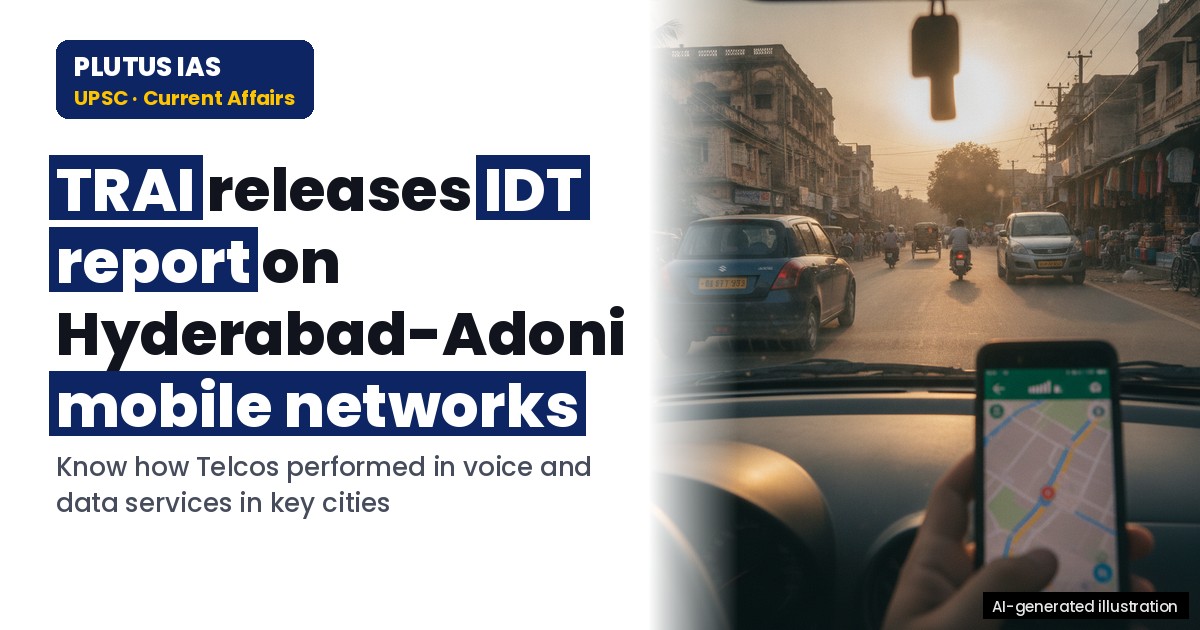
30 Oct ट्राई ने आईडीटी रिपोर्ट जारी: हैदराबाद-अदोनी में मोबाइल नेटवर्क गुणवत्ता का आकलन
✎ Independent Drive Tests (IDT) by TRAI are field-based assessments to independently verify the real-time Quality of Service (QoS) of mobile networks across 2G/3G/4G/5G technologies, ensuring transparency and accountability in…
Subject Relevance — Where This Topic Fits
- GS Paper II — Governance, Transparency and Accountability | GS Paper III — Science and Technology (Telecom Sector) and Infrastructure
- Prelims: Independent Drive Test (IDT), TRAI, QoS parameters, Call Drop Rate (CDR), Call Setup Success Rate (CSSR), Throughput, Latency, Telecom Regulatory Authority of India, Telecom Service Providers (TSPs), Licensed Service Area (LSA), 2G/3G/4G/5G networks
- Essay: Role of regulatory bodies in ensuring public service quality: A case study of TRAI’s telecom audits, Technology and governance: Balancing innovation with consumer protection in digital infrastructure
Quick Revision: Independent Drive Tests (IDT) by TRAI are field-based assessments to independently verify the real-time Quality of Service (QoS) of mobile networks across 2G/3G/4G/5G technologies, ensuring transparency and accountability in telecom service delivery.
Why is this in the news?
The Telecom Regulatory Authority of India (TRAI) released the findings of its Independent Drive Tests (IDT) conducted in September 2026 across the Adoni-Mantralayam and Hyderabad regions in Andhra Pradesh. These tests, conducted by an appointed agency under TRAI’s supervision, evaluated the real-time quality of mobile network services (voice and data) provided by Telecom Service Providers (TSPs) across diverse urban and semi-urban environments. The release underscores TRAI’s role in independent quality assessment, consumer empowerment, and regulatory oversight in India’s telecom sector, particularly in ensuring transparency and accountability in service delivery.
Background
- The Telecom Regulatory Authority of India (TRAI) was established in 1997 under the Telecom Regulatory Authority of India Act, 1997, as an independent regulator to oversee the telecom sector in India.
- TRAI’s mandate includes ensuring quality of service (QoS) for telecom consumers by monitoring and publishing performance metrics of Telecom Service Providers (TSPs).
- The Independent Drive Test (IDT) is a proactive regulatory tool used by TRAI to assess the actual ground-level performance of mobile networks, distinct from self-reported data by TSPs.
- India’s telecom sector operates under a Licensed Service Area (LSA) framework, where service providers are licensed to operate in specific geographic zones, such as Andhra Pradesh LSA.
- The proliferation of mobile networks, including 2G, 3G, 4G, and 5G technologies, has necessitated robust mechanisms to evaluate service quality, especially in diverse urban and rural landscapes.
- Regulatory bodies like TRAI play a critical role in bridging the gap between technological advancements and consumer expectations, ensuring equitable access and service reliability.
What is an Independent Drive Test (IDT) and its role in telecom regulation?
- Independent Drive Test (IDT) is a field-based assessment conducted by TRAI or its appointed agency to evaluate the real-time performance of mobile networks provided by TSPs in specific geographic areas.
- The primary objective of IDT is to measure and verify the Quality of Service (QoS) parameters as experienced by end-users, ensuring transparency and accountability in telecom service delivery.
- IDT assesses key QoS metrics such as coverage, call drop rate (CDR), call setup success rate (CSSR), data download/upload throughput, latency, jitter, and packet drop rate across 2G, 3G, 4G, and 5G networks.
- The tests are conducted using advanced testing handsets and software systems that simulate real-world usage scenarios, including urban drives, hotspots, public transport hubs, and pedestrian routes.
- IDT results are published to inform consumers about the actual performance of TSPs in their regions, enabling informed decision-making while selecting telecom services.
- TRAI’s IDT methodology ensures that performance data is collected under controlled conditions, minimizing biases that may arise from self-reported metrics by TSPs.
- The findings of IDT serve as a basis for regulatory interventions, including directives for service improvements, penalties for non-compliance, or recommendations for policy reforms in the telecom sector.
- IDT complements other regulatory tools such as consumer complaints redressal mechanisms, tariff regulations, and spectrum management policies.
Key Features
| Feature | Significance |
|---|---|
| Independent Drive Test (IDT) | Ensures unbiased evaluation of mobile network service quality by a regulator, eliminating provider self-assessment biases. |
| Coverage Gap Analysis | Identifies areas with inadequate signal strength, guiding infrastructure planning and spectrum allocation. |
| Call Setup Success Rate (CSSR) | Measures the reliability of initiating voice calls, critical for emergency services and user experience. |
| Call Drop Rate (CDR) | Quantifies the frequency of prematurely terminated calls, reflecting network stability and congestion. |
| Throughput Metrics (DL/UL) | Evaluates real-time data speeds, essential for digital services, remote work, and IoT applications. |
| Latency and Jitter | Assesses network responsiveness and consistency, vital for real-time applications like video conferencing and online gaming. |
Why it Matters
Regulatory Governance
- Establishes transparent benchmarks for telecom service providers (TSPs) to ensure fair competition and consumer protection.
- Demonstrates TRAI’s role in enforcing Quality of Service (QoS) standards under the Telecom Regulatory Authority of India Act, 1997.
- Provides empirical data to guide policy interventions, such as spectrum auctions or licence conditions.
Consumer Rights
- Empowers users with objective data on network performance, enabling informed choices among TSPs.
- Highlights disparities in service quality across regions, prompting corrective measures in underserved areas.
- Supports grievance redressal mechanisms by providing verifiable evidence of service deficiencies.
Economic Impact
- Enhances digital inclusion by identifying and addressing connectivity gaps in rural and semi-urban areas.
- Boosts investor confidence in India’s telecom sector by demonstrating regulatory oversight and quality assurance.
- Facilitates the growth of digital economy sectors (e.g., e-commerce, fintech) by ensuring robust network infrastructure.
Technological Advancement
- Encourages TSPs to invest in next-generation technologies (e.g., 5G, VoNR) to meet QoS benchmarks.
- Drives innovation in network monitoring tools and methodologies for real-time performance tracking.
- Supports India’s vision of a ‘Digital India’ by ensuring seamless connectivity across diverse terrains.
Challenges
1. Infrastructure Deficits in Rural Areas
- Limited last-mile connectivity in regions like Adoni-Mantralayam due to geographical and logistical constraints.
- High cost of deploying telecom towers in sparsely populated or hilly areas reduces TSP incentives.
- Delays in Right of Way (RoW) clearances hinder timely network expansion.
UPSC Link: Geographical challenges in telecom expansion
2. Spectrum Scarcity and Allocation Bottlenecks
- Inadequate spectrum availability for high-demand services (e.g., 5G) limits network capacity and performance.
- Complex auction processes and high reserve prices deter smaller players, reducing competition.
- Cross-border interference and international spectrum coordination remain unresolved issues.
UPSC Link: Spectrum management in India
3. Quality of Service (QoS) Compliance
- Inconsistent enforcement of TRAI’s QoS regulations across TSPs leads to service disparities.
- Lack of standardized testing protocols for emerging technologies (e.g., 5G, NB-IoT).
- Delayed or inadequate penalties for non-compliance undermine regulatory effectiveness.
UPSC Link: Regulatory oversight in telecom sector
4. Digital Divide and Affordability
- High data costs and limited affordability restrict access to advanced services in lower-income segments.
- Urban-rural divide persists due to unequal investment in network infrastructure.
- Digital literacy gaps hinder optimal utilisation of available services.
UPSC Link: Digital divide in India
5. Interoperability and Multi-Operator Challenges
- Seamless handover between networks (e.g., 4G to 5G) remains a technical hurdle for users.
- Roaming agreements and interconnection disputes between TSPs affect service continuity.
- Lack of unified standards for IoT and machine-to-machine (M2M) communications.
UPSC Link: Telecom interoperability issues
Challenges — UPSC Perspective
| Issue | Concern |
|---|---|
| Coverage Gaps | Inadequate signal strength in rural and semi-urban areas, particularly in Adoni-Mantralayam. |
| Network Congestion | High call drop rates and latency in densely populated urban areas like Hyderabad. |
| Spectrum Limitations | Scarcity of spectrum bands for 5G and other high-capacity services. |
| Regulatory Enforcement | Inconsistent penalties for QoS violations across TSPs. |
| Infrastructure Costs | High capital expenditure for deploying telecom towers in remote or challenging terrains. |
| Consumer Awareness | Limited understanding among users about their rights and redressal mechanisms. |
Way Forward
- Strengthen TRAI’s monitoring mechanisms with AI-driven real-time analytics for proactive issue identification.
- Expand the scope of IDTs to include IoT and M2M services for comprehensive network evaluation.
- Introduce performance-linked incentives for TSPs in underserved regions to accelerate infrastructure deployment.
- Enhance public-private partnerships for shared infrastructure (e.g., tower sharing, fibre backhaul).
- Simplify spectrum allocation processes and explore options like spectrum trading to improve efficiency.
- Mandate universal service obligations (USOs) for TSPs in identified coverage-deficient areas.
- Promote digital literacy campaigns to improve user engagement and service utilisation.
- Establish a grievance redressal portal with verifiable metrics to track TSP compliance.
UPSC Value Addition
Keywords for Mains Answer-Writing
Telecom Regulatory Authority of India (TRAI) · Independent Drive Test (IDT) · Quality of Service (QoS) parameters · Telecom Service Providers (TSPs) · Mobile network performance · Call Drop Rate (CDR) · Call Setup Success Rate (CSSR) · Throughput in data services · Telecom Disputes Settlement and Appellate Tribunal (TDSAT) · Consumer protection in telecom sector · Universal Service Obligation Fund (USOF) · Right of Way (RoW) rules · Telecom infrastructure sharing · 5G rollout challenges · Regulatory oversight in telecom sector
Concept Flow
Regulatory Framework (TRAI Act, 1997) → Independent Drive Tests (IDTs) → QoS Benchmarks → Data Collection → Performance Analysis → Policy Interventions → Infrastructure Development → Consumer Benefits
Prelims Practice Questions
Q1. Consider the following statements regarding the Independent Drive Test (IDT) conducted by TRAI:
1. IDT assesses the real-time quality of mobile network services provided by Telecom Service Providers (TSPs).
2. IDT evaluates parameters such as Call Drop Rate (CDR), Call Setup Success Rate (CSSR), and data throughput.
3. IDT is conducted exclusively in urban areas to ensure high signal strength.
4. IDT results are published to inform consumers and encourage TSPs to improve their services.
How many of the above statements are correct?
- Only one
- Only two
- Only three
- All four
Answer: All four — Statements 1, 2, and 4 are correct as per TRAI’s IDT objectives. Statement 3 is incorrect because IDT is conducted in diverse environments including urban areas, hotspots, and public transport hubs.
Q2. Assertion (A): The Telecom Regulatory Authority of India (TRAI) conducts Independent Drive Tests (IDTs) to evaluate the real-time performance of mobile networks across different technologies (2G, 3G, 4G, and 5G).
Reason (R): TRAI aims to ensure that Telecom Service Providers (TSPs) adhere to prescribed Quality of Service (QoS) benchmarks and publish the findings to enhance consumer awareness and service quality.
Options:
A. Both A and R are true, and R is the correct explanation of A.
B. Both A and R are true, but R is NOT the correct explanation of A.
C. A is true, but R is false.
D. A is false, but R is true.
Answer: ? — Both Assertion (A) and Reason (R) are true. The Reason (R) correctly explains the purpose of IDTs conducted by TRAI, which is to assess QoS parameters and publish findings for consumer awareness and TSP improvement.
Q3. Match the following Quality of Service (QoS) parameters with their respective definitions:
Column I (QoS Parameter)
A. Call Drop Rate (CDR)
B. Call Setup Success Rate (CSSR)
C. Throughput (Data Services)
D. Latency
Column II (Definition)
1. The percentage of successfully established calls out of the total call attempts.
2. The time delay between the initiation of a data request and its completion.
3. The rate at which data is successfully transmitted over a network, measured in bits per second.
4. The percentage of calls that are terminated prematurely before the intended duration.
- A-4, B-1, C-3, D-2
- A-1, B-4, C-2, D-3
- A-3, B-2, C-1, D-4
- A-2, B-3, C-4, D-1
Answer: A-4, B-1, C-3, D-2 — The correct matching is: A-4 (CDR measures premature call termination), B-1 (CSSR measures successful call establishment), C-3 (Throughput measures data transmission rate), and D-2 (Latency measures time delay in data transmission).
Mains Practice Question
✍ The Telecom Regulatory Authority of India (TRAI) conducts Independent Drive Tests (IDTs) to assess the real-time performance of mobile networks across diverse environments. Critically examine the significance of such regulatory oversight in ensuring consumer protection and service quality in the telecom sector. Also, discuss the challenges faced in achieving uniform QoS across India’s diverse geographical and demographic landscape. (15 Marks)
Approach: MODEL-ANSWER SKELETON:
1. **Introduction (2 Marks)**
– Define IDTs and their purpose as per TRAI’s mandate under the Telecom Regulatory Authority of India Act, 1997.
– Mention the key QoS parameters assessed: CDR, CSSR, throughput, latency, and coverage gaps.
2. **Significance of Regulatory Oversight (5 Marks)**
– **Consumer Protection**: IDTs empower consumers by providing transparent data on network performance, enabling informed choices (cite TRAI’s consumer-centric approach).
– **Accountability of TSPs**: Public disclosure of IDT results incentivizes TSPs to improve infrastructure and service quality (reference to TRAI’s penalty mechanisms under QoS regulations).
– **Benchmarking and Competition**: IDTs create a level playing field for TSPs to compete on service quality rather than solely on pricing or marketing.
– **Legal and Policy Framework**: Highlight TRAI’s powers under Section 11 of the TRAI Act to issue directions and recommendations to the government on telecom sector reforms.
3. **Challenges in Achieving Uniform QoS (5 Marks)**
– **Geographical Diversity**: Varying terrain (urban vs. rural, hilly vs. plain regions) impacts signal propagation and infrastructure deployment (e.g., Right of Way (RoW) challenges).
– **Demographic Factors**: High-density urban areas vs. low-density rural areas create disparities in network demand and resource allocation.
– **Technological Divide**: Uneven adoption of 4G/5G networks across regions due to cost, spectrum availability, and infrastructure readiness.
– **Regulatory and Policy Gaps**: Delays in spectrum allocation, disputes over RoW permissions, and lack of uniform QoS standards across states.
– **Infrastructure Bottlenecks**: Limited fiber optic backhaul, inadequate tower infrastructure, and power supply issues in remote areas.
4. **Way Forward (3 Marks)**
– **Policy Interventions**: Strengthening USOF to bridge the digital divide and incentivize TSPs to deploy infrastructure in underserved areas.
– **Technological Solutions**: Promoting infrastructure sharing (towers, fiber) among TSPs to reduce costs and improve coverage.
– **Regulatory Reforms**: Harmonizing QoS standards across states and expediting RoW clearances to accelerate network expansion.
– **Consumer Awareness**: Leveraging IDT data to educate consumers on network performance and encourage TSPs to adopt best practices.
**Balanced View**: Acknowledge TRAI’s efforts while highlighting systemic challenges that require multi-stakeholder collaboration (government, TSPs, and consumers).
Source: PIB (Press Information Bureau)
Telangana PCS (TGPSC (TSPSC)) — State PCS Practice
Prelims: As per the Telecom Regulatory Authority of India (TRAI)’s Independent Drive Test (IDT) conducted in September 2026, which of the following regions in Telangana was NOT included in the test coverage?
- A. Adoni
- B. Mandalapuram
- C. Hyderabad
- D. Malkajgiri
Answer: B. Mandalapuram — The IDT conducted by TRAI in September 2026 covered Adoni, Mandalayam (Mandala Mandal in Mahbubnagar district), and areas around Hyderabad, but not Mandalapuram.
Mains: Examine the significance of TRAI’s Independent Drive Test (IDT) for 5G network performance in Telangana, particularly in Adoni-Mandalayam and Hyderabad regions, and discuss its implications for digital governance and public service delivery in the state.
Generated by AanyaAi for educational purpose.

- Finance Commission Grant: Kochi Panel’s ₹84 Crore Lapse Raises Questions - October 31, 2026
- दिल्ली उच्च न्यायालय के न्यायाधीशों के बीच बेल देने में अंतर क्यों? जानिए कारण और प्रभाव - October 31, 2026
- ISRO launches NVS-03 satellite to strengthen India’s NavIC GPS system - October 31, 2026

No Comments