


21 Jul राज्यसभा समिति ने CCI विनियमों पर 257वीं रिपोर्ट प्रस्तुत की: प्रमुख सिफारिशें
Subject Relevance — Where This Topic Fits
- GS Paper II — Governance, Constitution, Polity, Social Justice and International Relations (Regulatory Bodies and Statutory Committees) | GS Paper III — Indian Economy (Competition Policy, Regulatory Frameworks, and MSMEs)
- Prelims: Competition Commission of India (CCI), Subordinate Legislation Committee, MSMEs, Digital Markets, Competition Law
- Essay: The role of regulatory bodies in fostering fair competition and innovation in a digital economy, Balancing regulatory oversight and ease of doing business: Lessons from competition law enforcement
Quick Revision: The 257th Report of the Rajya Sabha’s Standing Committee on Subordinate Legislation emphasizes the need for periodic review of CCI regulations, enhanced stakeholder consultations, and targeted awareness campaigns—particularly for MSMEs and startups—to strengthen competition law enforcement and voluntary compliance in India.
Why is this in the news?
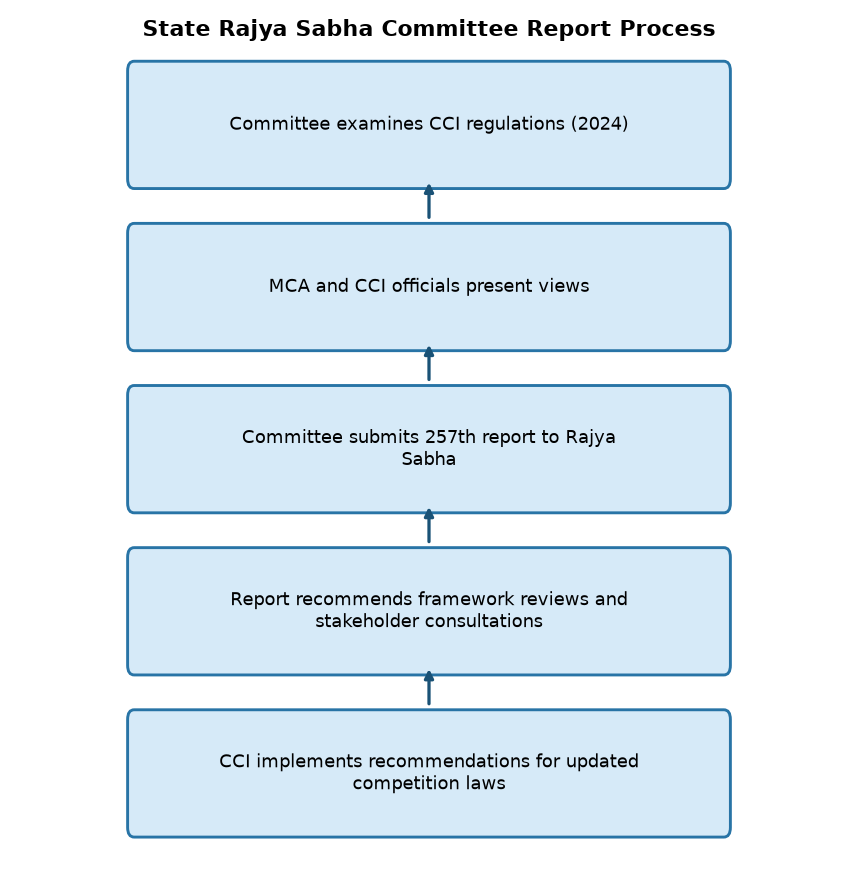
On 21 July 2026, the Rajya Sabha’s Standing Committee on Subordinate Legislation presented its 257th Report to the Rajya Sabha, examining four key regulations issued by the Competition Commission of India (CCI) in 2024: (i) Commitment Regulations, (ii) Determination Regulations, (iii) Turnover or Income Regulations, and (iv) Guidelines on Monetary Penalties. The report underscores the necessity for periodic review of India’s competition law framework, enhanced stakeholder consultations, and robust awareness campaigns, particularly targeting MSMEs and startups, to ensure effective enforcement and voluntary compliance in a rapidly evolving digital market landscape.
Background
- The Competition Commission of India (CCI), established under the Competition Act, 2002, is the statutory authority responsible for enforcing competition law, preventing anti-competitive practices, and promoting fair competition in India.
- The CCI periodically issues regulations and guidelines to operationalise the provisions of the Competition Act, 2002, including those related to commitments, penalties, and procedural aspects such as determination of turnover or income.
- The Competition Act, 2002, was amended in 2023 to introduce provisions for settlement and commitment mechanisms, aimed at reducing litigation and expediting resolution of competition law violations.
- The digital economy has introduced new challenges in competition law enforcement, including issues related to data dominance, platform economies, and algorithmic collusion, necessitating dynamic regulatory updates.
- The Standing Committee on Subordinate Legislation examines subordinate legislation, including rules and regulations framed by regulatory bodies, to ensure they align with the parent Act and serve public interest.
- MSMEs and startups form the backbone of India’s economy, contributing significantly to employment and innovation, but often face challenges in navigating complex regulatory frameworks.
What are the CCI Regulations under Review?
- The **Competition Commission of India (Commitment) Regulations, 2024** provide the procedural framework for companies to offer commitments to address competition concerns raised by the CCI, thereby avoiding or settling investigations.
- The **Competition Commission of India (Determination) Regulations, 2024** lay down the methodology for determining penalties, including the calculation of turnover or income for imposing monetary fines under the Competition Act, 2002.
- The **Competition Commission of India (Turnover or Income) Regulations, 2024** specify the basis for computing the relevant turnover or income of enterprises, which is critical for determining the quantum of penalties in competition law violations.
- These regulations were introduced following the **Competition (Amendment) Act, 2023**, which introduced settlement and commitment mechanisms to reduce litigation and expedite resolution of competition law cases.
- The regulations aim to balance deterrence with ease of doing business by providing clear procedural safeguards and reducing uncertainty in enforcement actions.
- The CCI’s regulatory framework is designed to address both traditional anti-competitive practices (e.g., cartels, abuse of dominance) and emerging issues in the digital economy (e.g., data monopolies, platform neutrality).
- The Standing Committee’s report highlights the need for these regulations to be periodically reviewed to align with global best practices and evolving market dynamics.
Key Features
| Feature | Significance |
|---|---|
| Regulatory Review Mechanism | Mandates periodic comprehensive reviews of the competition law framework by CCI and the Ministry to ensure alignment with global best practices and domestic market needs. |
| Stakeholder Consultation | Emphasises extensive consultations with all relevant stakeholders during regulatory reviews to incorporate diverse perspectives and enhance regulatory efficacy. |
| Digital Era Adaptation | Highlights the necessity of updating competition laws to address emerging challenges in the digital economy, including rapid technological changes and new forms of market dominance. |
| Public Awareness Campaigns | Recommends intensified efforts to raise awareness about competition law among businesses, particularly MSMEs, start-ups, and the general public, to foster voluntary compliance. |
| Self-Initiated Action Powers | Advocates for the continued use of suo motu powers by CCI to address anti-competitive practices proactively, even in the absence of formal complaints. |
Why it Matters
Competition Policy Framework
- Ensures a fair, competitive, and innovation-driven market ecosystem by regulating anti-competitive practices such as cartels, abuse of dominance, and anti-competitive mergers.
- Aligns domestic regulations with global standards, enhancing India’s attractiveness as a destination for foreign investment and fostering a level playing field for domestic and international firms.
- Supports the growth of MSMEs and start-ups by preventing monopolistic or oligopolistic practices that could stifle their market entry and expansion.
Economic Governance
- Promotes consumer welfare by ensuring competitive pricing, better product quality, and innovation through fair market practices.
- Enhances allocative efficiency by preventing market distortions, thereby improving resource utilisation and economic productivity.
- Contributes to macroeconomic stability by curbing practices that could lead to inflationary pressures or supply chain inefficiencies.
Digital Economy Regulation
- Addresses unique challenges posed by digital platforms, such as network effects, data monopolies, and algorithmic collusion, ensuring fair competition in the digital marketplace.
- Facilitates innovation and entrepreneurship in the tech sector by preventing anti-competitive practices by dominant digital players.
Regulatory Governance
- Strengthens the institutional capacity of CCI by mandating periodic reviews and stakeholder consultations, ensuring adaptive and responsive regulation.
- Encourages voluntary compliance through awareness campaigns, reducing the burden on formal enforcement mechanisms and fostering a culture of compliance.
Challenges
1. Digital Market Dominance
- Rapid technological advancements and network effects in digital markets can lead to the emergence of monopolies or oligopolies, stifling competition.
- Algorithmic collusion and data-driven exclusionary practices pose new challenges for traditional competition law frameworks.
- Ensuring a balance between fostering innovation and preventing anti-competitive behaviour in digital ecosystems remains a critical challenge.
UPSC Link: GS-III: Indian Economy – Issues relating to IPR, Competition
2. Regulatory Lag
- The pace of technological and market changes often outstrips the speed of regulatory updates, leading to gaps in enforcement and compliance.
- Frequent amendments to competition laws may create uncertainty for businesses, particularly MSMEs and start-ups, impacting their growth and investment decisions.
UPSC Link: GS-II: Functions and responsibilities of the Union and the States
3. Public Awareness Deficit
- Limited awareness among businesses, particularly MSMEs and start-ups, about competition law principles and regulatory processes hinders effective compliance.
- Low public awareness of anti-competitive practices and the role of CCI in addressing them reduces the effectiveness of enforcement and voluntary compliance.
UPSC Link: GS-II: Government policies and interventions for development in various sectors
4. Enforcement Bottlenecks
- The suo motu powers of CCI, while valuable, may lead to over-reach or resource constraints if not exercised judiciously, potentially overwhelming the regulatory body.
- Lengthy legal proceedings and high compliance costs for businesses may deter reporting of anti-competitive practices, undermining the enforcement mechanism.
UPSC Link: GS-II: Statutory, regulatory and various quasi-judicial bodies
5. Global Alignment Challenges
- Diverging global competition law frameworks and standards may create conflicts or inconsistencies in cross-border enforcement, particularly for multinational corporations.
- Adapting domestic regulations to align with global best practices while addressing unique domestic market conditions requires careful balancing.
UPSC Link: GS-II: Bilateral, regional and global groupings and agreements involving India
Challenges — UPSC Perspective
| Issue | Concern |
|---|---|
| Digital Market Dominance | Risk of monopolies forming due to network effects and data control, stifling competition and innovation. |
| Regulatory Lag | Gap between rapid technological changes and slow regulatory updates, leading to enforcement gaps. |
| Public Awareness Deficit | Low awareness among businesses and the public about competition law, reducing voluntary compliance and reporting. |
| Enforcement Bottlenecks | Potential over-reach of suo motu powers and lengthy legal proceedings that deter reporting and compliance. |
| Global Alignment Challenges | Conflicts between domestic and global competition law frameworks, complicating cross-border enforcement. |
Way Forward
- Conduct periodic and comprehensive reviews of the competition law framework, incorporating global best practices and stakeholder feedback.
- Launch targeted awareness campaigns for MSMEs, start-ups, and the general public to enhance understanding of competition law principles and regulatory processes.
- Strengthen collaboration between CCI and industry associations, trade unions, and professional bodies to foster a culture of voluntary compliance.
- Develop digital tools and platforms to simplify compliance processes for businesses, particularly MSMEs and start-ups.
- Ensure judicious use of suo motu powers by CCI to address anti-competitive practices proactively without overburdening the regulatory body.
- Streamline legal proceedings and reduce compliance costs to encourage reporting of anti-competitive practices and enhance enforcement efficacy.
- Establish a dedicated mechanism for monitoring and addressing emerging challenges in digital markets, including algorithmic collusion and data monopolies.
UPSC Value Addition
Keywords for Mains Answer-Writing
Competition Law · Competition Commission of India (CCI) · Subordinate Legislation Committee · Regulatory Framework · Digital Markets · Voluntary Compliance · MSMEs · Market Competition · Competition Policy · Regulatory Review · Consumer Welfare · Anti-Competitive Practices · Corporate Governance · Stakeholder Consultation
Concept Flow
Digital transformation and rapid technological changes → Emergence of new forms of market dominance and anti-competitive practices → Need for updated competition laws and regulations. → Inadequate public awareness and regulatory lag → Reduced voluntary compliance and ineffective enforcement → Increased risk of market distortions and consumer harm. → Periodic regulatory reviews and stakeholder consultations → Alignment with global best practices and domestic market needs → Enhanced regulatory efficacy and market fairness. → Strengthened collaboration between CCI and industry associations → Increased awareness and voluntary compliance → Fostering a culture of fair competition and innovation. → Judicious use of suo motu powers → Proactive addressing of anti-competitive practices → Reduced burden on formal enforcement mechanisms and improved market governance.
Prelims Practice Questions
Q1. Which of the following is NOT a regulatory instrument under the purview of the Competition Commission of India (CCI) as per the 257th Report of the Rajya Sabha Committee?
- A. Competition Commission of India (Commitment) Regulations, 2024
- B. Competition Commission of India (Determination of Turnover or Income) Regulations, 2024
- C. Competition Commission of India (Fines) Guidelines, 2024
- D. Competition Commission of India (Merger Control) Act, 2002
Answer: D. Competition Commission of India (Merger Control) Act, 2002 — The Competition Commission of India (Merger Control) Act, 2002 is a primary legislation, whereas the other three are subordinate regulations or guidelines framed under it, as highlighted in the 257th Report.
Q2. The 257th Report of the Rajya Sabha Committee emphasizes the need for time-bound updates in competition laws primarily to address:
- A. Traditional market monopolies in manufacturing sectors
- B. Emerging challenges in digital markets and rapid technological changes
- C. Agricultural price distortions
- D. Labour market rigidities
Answer: B. Emerging challenges in digital markets and rapid technological changes — The report explicitly states that competition laws must be updated to address rapid changes in digital markets and emerging challenges, ensuring alignment with global best practices.
Q3. Which stakeholder group does the 257th Report of the Rajya Sabha Committee identify as requiring heightened awareness of competition law principles?
- A. Large multinational corporations
- B. Public sector undertakings
- C. Micro, Small, and Medium Enterprises (MSMEs) and start-ups
- D. Government procurement agencies
Answer: C. Micro, Small, and Medium Enterprises (MSMEs) and start-ups — The report highlights that MSMEs, start-ups, and emerging businesses need greater awareness of competition law principles to participate effectively in competitive markets.
Mains Practice Question
✍ Critically examine the recommendations of the 257th Report of the Rajya Sabha Committee on the regulatory framework governing the Competition Commission of India (CCI). How do these recommendations align with the broader objectives of competition policy in India? Substantiate your answer with reference to the role of CCI in promoting market efficiency and consumer welfare.
Approach: The answer should begin by outlining the key recommendations of the 257th Report, such as the need for periodic regulatory reviews, stakeholder consultations, and alignment with global best practices. Next, discuss the role of CCI in enforcing competition law, including its powers under the Competition Act, 2002, and its mandate to prevent anti-competitive practices. Then, analyze how the recommendations enhance market efficiency by addressing challenges in digital markets and ensuring fair competition. Finally, evaluate the impact on consumer welfare, emphasizing the importance of voluntary compliance, public awareness, and the deterrent effect of CCI’s enforcement actions. Conclude by assessing the overall effectiveness of these recommendations in achieving the objectives of competition policy in India.
Source: PIB (Press Information Bureau)
Generated by AanyaAi for educational purpose.

- यूपीएससी तैयारी: आरबीआई द्वारा 91, 182 और 364 दिनों के ट्रेजरी बिलों की नीलामी - September 19, 2026
- RBI to Auction ₹24,000 Crore T-Bills: Key Dates & Process for UPSC Aspirants - September 19, 2026
- संयुक्त राष्ट्र महासभा अध्यक्ष का Rohingya संकट से सीख: विश्वास और AI पर बल - September 19, 2026

No Comments