


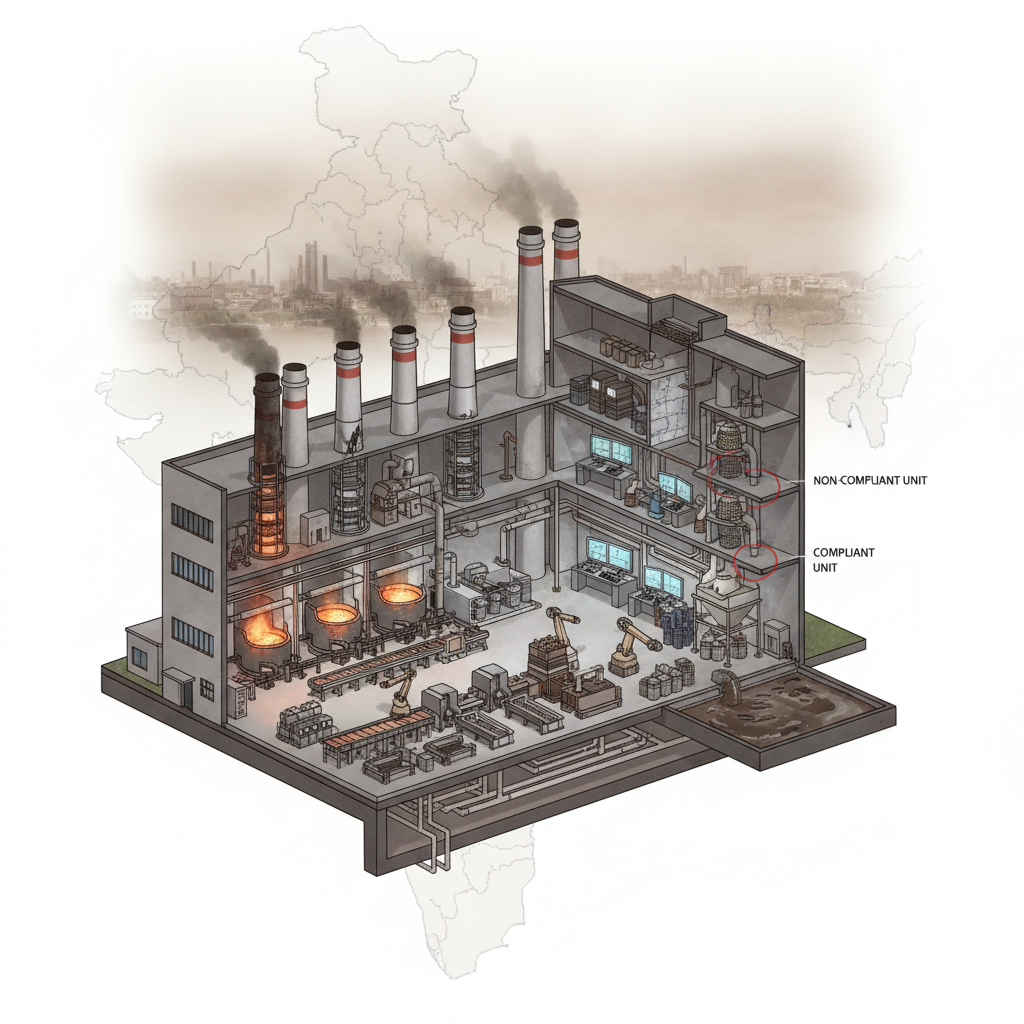
05 Sep सीएक्यूएम’s NCR Inspection Drive: 17 of 35 Units in Haryana’s Nuh Violated Pollution Norms
✎ The Air Quality Management Commission (CAQM) enforces industrial compliance through 'Consent to Operate' (CTO) and mandatory pollution control systems like OCEMS, ESPs, and Wet Scrubbers to mitigate air pollution in the NCR.
Subject Relevance — Where This Topic Fits
- GS Paper III — Environment and Pollution Control | GS Paper III — Industrial Regulations and Compliance | GS Paper II — Federalism and State-Level Governance
- Prelims: Air Quality Management Commission (CAQM), Consent to Operate (CTO), Online Continuous Emission Monitoring System (OCEMS), National Capital Region (NCR), Haryana State Pollution Control Board (HSPCB), Fugitive Dust, Electrostatic Precipitator (ESP), Wet Scrubber, Stack Emission Monitoring
- Essay: Environmental Governance and Sustainable Industrialization, Balancing Economic Growth with Environmental Protection in India
Quick Revision: The Air Quality Management Commission (CAQM) enforces industrial compliance through ‘Consent to Operate’ (CTO) and mandatory pollution control systems like OCEMS, ESPs, and Wet Scrubbers to mitigate air pollution in the NCR.
Why is this in the news?
The Air Quality Management Commission (CAQM) conducted a special industrial inspection drive in Nuh, Haryana, on 3 September 2026, as part of its ongoing efforts to reduce air pollution in the National Capital Region (NCR). The inspection revealed that 17 out of 35 industrial units inspected were non-compliant with environmental regulations, highlighting systemic gaps in enforcement, emission control mechanisms, and regulatory adherence. This underscores the challenges in balancing industrial growth with environmental safeguards in pollution-prone regions.
Background
- The National Capital Region (NCR), comprising parts of Delhi, Haryana, Uttar Pradesh, and Rajasthan, is a major hub for industrial and vehicular activity, contributing significantly to air pollution.
- Industrial units in the NCR are required to obtain a ‘Consent to Operate’ (CTO) from the State Pollution Control Boards, which imposes strict conditions on emissions, fuel usage, and pollution control measures.
- The CAQM has been conducting periodic inspection drives to ensure compliance with environmental norms, particularly in areas like Nuh, which are prone to high levels of industrial pollution.
- The inspection drive aligns with the broader national and international commitments to reduce air pollution, including the National Clean Air Programme (NCAP) and the Paris Agreement.
- State-level agencies such as the Haryana State Pollution Control Board (HSPCB) play a critical role in enforcing environmental regulations at the ground level.
What is the Air Quality Management Commission (CAQM) and its role in industrial regulation?
- Its mandate includes formulating strategies to reduce air pollution, monitoring compliance with environmental norms, and coordinating with state governments and pollution control boards.
- The CAQM operates through a multi-stakeholder approach, involving central and state agencies, industry representatives, and civil society.
- The commission conducts regular inspection drives, including ‘flying squads,’ to assess compliance with environmental regulations in industrial units.
- Industrial units in the NCR are required to install and maintain pollution control devices such as Electrostatic Precipitators (ESPs), Wet Scrubbers, and Online Continuous Emission Monitoring Systems (OCEMS).
- The CAQM enforces the ‘Consent to Operate’ (CTO) mechanism, which mandates industrial units to adhere to specific environmental conditions for operation.
- The commission also monitors fugitive dust emissions, stack emissions, and fuel usage to ensure holistic air quality management.
Key Features
| Feature | Significance |
|---|---|
| Special Industrial Inspection Drive | A focused enforcement mechanism by CAQM to assess compliance of industrial units with environmental norms in NCR, particularly in high-pollution zones like Nuh. |
| Flying Squads Deployment | Multi-agency teams comprising CAQM officials, HSPCB, and state administration for real-time monitoring and rapid assessment of industrial units. |
| Consent to Operate (CTO) Compliance | Legal requirement under the Air (Prevention and Control of Pollution) Act, 1981, mandating industrial units to obtain prior approval for operations and adhere to stipulated environmental safeguards. |
| Online Continuous Emission Monitoring System (OCEMS) | Mandatory real-time monitoring of stack emissions to ensure compliance with permissible pollution limits, with data transmitted to regulatory authorities. |
| Fugitive Dust Control Measures | Critical for reducing particulate matter emissions from industrial operations, including covered conveyors, water sprinkling, windbreakers, and paved roads within premises. |
Why it Matters
Environmental Governance
- Demonstrates the enforcement of the Air (Prevention and Control of Pollution) Act, 1981, and the National Green Tribunal (NGT) directives in the NCR region to curb industrial air pollution.
- Highlights the role of CAQM as a statutory body under the Commission for Air Quality Management (CAQM) Act, 2021, in coordinating multi-state air quality management efforts.
- Emphasises the need for strict adherence to emission standards and pollution control measures to mitigate the adverse impact of industrial activities on public health and air quality.
Regulatory Compliance
- Reinforces the importance of obtaining and maintaining Consent to Operate (CTO) under the Water (Prevention and Control of Pollution) Act, 1974, and the Air Act, 1981, for industrial units.
- Underscores the mandatory installation and operation of OCEMS for real-time monitoring of stack emissions, as per the Environmental (Protection) Act, 1986, and NGT guidelines.
- Illustrates the consequences of non-compliance, including potential penalties, closure orders, or legal action under environmental laws.
Public Health and Air Quality
- Industrial emissions, particularly from units in NCR, contribute significantly to air pollution, exacerbating respiratory and cardiovascular diseases in urban populations.
- Fugitive dust and unregulated emissions from industrial units pose a direct threat to ambient air quality, necessitating stringent enforcement of pollution control measures.
- The inspection drive aligns with the National Clean Air Programme (NCAP) objectives to reduce particulate matter (PM2.5 and PM10) concentrations by 20-30% by 2024.
Inter-State Coordination
- CAQM’s role in coordinating air quality management across NCR states (Haryana, Delhi, Uttar Pradesh, Rajasthan) to address transboundary air pollution issues.
- The inspection drive in Nuh, Haryana, highlights the need for collaborative enforcement efforts to ensure uniform compliance with environmental norms across the region.
Challenges
1. Non-Compliance with Environmental Norms
- 17 out of 35 inspected units in Nuh were found non-compliant with environmental regulations, indicating systemic gaps in enforcement and compliance.
- Common violations include inadequate emission control systems (wet scrubbers, ESPs), improper stack height, and unapproved fuel usage.
- Non-compliance with CTO conditions and failure to install OCEMS undermine regulatory oversight and exacerbate air pollution.
UPSC Link: Environmental Pollution: Causes, Effects and Control
2. Fugitive Dust Emissions
- Insufficient measures to control fugitive dust, such as uncovered conveyors, lack of water sprinkling, and absence of windbreakers, contribute to particulate matter pollution.
- Unpaved roads within industrial premises exacerbate dust generation, particularly in arid and semi-arid regions like Nuh.
- Fugitive dust is a significant contributor to PM10 and PM2.5 levels, posing health risks to nearby communities.
UPSC Link: Particulate Matter Pollution: Sources and Mitigation
3. Regulatory Enforcement Gaps
- Delayed or inadequate implementation of environmental norms due to weak monitoring, limited resources, and bureaucratic hurdles.
- Lack of real-time data from OCEMS and outdated emission monitoring reports hinder effective enforcement and policy formulation.
- Inconsistent application of penalties and closure orders for non-compliant units undermines deterrence.
UPSC Link: Environmental Governance and Regulatory Frameworks
4. Transboundary Air Pollution
- Industrial emissions in NCR, particularly in Nuh, contribute to regional air pollution, affecting multiple states and necessitating coordinated action.
- Variations in enforcement stringency across states complicate efforts to address air quality challenges uniformly.
- Cross-border pollution requires harmonised regulatory frameworks and joint enforcement mechanisms.
UPSC Link: Air Quality Management in NCR
5. Public Awareness and Stakeholder Engagement
- Limited awareness among industrial operators about environmental norms, CTO requirements, and emission control technologies.
- Insufficient engagement with local communities to report violations and demand compliance from industrial units.
- Need for capacity-building initiatives to train industrial stakeholders on pollution control measures and regulatory compliance.
UPSC Link: Environmental Awareness and Community Participation
Challenges — UPSC Perspective
| Issue | Concern |
|---|---|
| Non-Compliance with CTO Conditions | Failure to adhere to stipulated environmental safeguards, leading to unchecked industrial emissions and air pollution. |
| Inadequate Emission Control Systems | Malfunctioning or absent wet scrubbers, ESPs, and stack monitoring systems, resulting in elevated pollutant levels. |
| Unapproved Fuel Usage | Use of non-compliant fuels (e.g., unapproved liquid fuels, wood burning) in boilers and heaters, exacerbating air pollution. |
| Lack of OCEMS Installation | Absence of real-time emission monitoring systems, hindering regulatory oversight and data-driven enforcement. |
| Fugitive Dust Emissions | Insufficient measures to control dust from conveyors, roads, and storage areas, contributing to particulate matter pollution. |
| Delayed Enforcement Actions | Protracted legal and administrative processes for penalising non-compliant units, reducing deterrence. |
Way Forward
- Strengthen multi-agency coordination between CAQM, HSPCB, and state administrations to conduct regular and surprise inspections in high-pollution industrial zones.
- Mandate the installation and real-time operation of OCEMS in all industrial units, with data transmitted to regulatory authorities for continuous monitoring.
- Enhance enforcement of Consent to Operate (CTO) conditions by imposing stricter penalties, temporary closures, or revocations for non-compliant units.
- Promote the adoption of fugitive dust control measures, including covered conveyors, water sprinkling systems, windbreakers, and paved roads within industrial premises.
- Conduct capacity-building programmes for industrial operators on environmental norms, emission control technologies, and regulatory compliance.
- Leverage community participation by establishing grievance redressal mechanisms and encouraging local reporting of violations.
- Develop a regional air quality management plan for NCR, integrating enforcement, monitoring, and public health interventions.
- Ensure harmonised enforcement across NCR states to address transboundary air pollution and prevent regulatory arbitrage.
UPSC Value Addition
Keywords for Mains Answer-Writing
Air Quality Management Commission (CAQM) · National Capital Region (NCR) air pollution · industrial inspection drives · Consent to Operate (CTO) · Continuous Emission Monitoring System (CEMS) · electrostatic precipitators · wet scrubbers · fugitive dust control · DG sets compliance · stack height regulations · industrial air pollution regulation · Haryana State Pollution Control Board (HSPCB) · environmental enforcement mechanisms · industrial emission norms · pollution control in NCR · regulatory compliance in industrial units
Constitutional & Policy Linkages
- Article 48A (Directive Principles of State Policy) – Protection and improvement of environment and safeguarding of forests and wildlife.
- Article 51A(g) (Fundamental Duties) – Duty of every citizen to protect and improve the natural environment.
Concept Flow
Industrial activities in NCR → Emission of pollutants (PM, SOx, NOx) → Non-compliance with environmental norms → Fugitive dust generation → Degradation of ambient air quality → Public health risks (respiratory diseases) → Regulatory enforcement (CAQM inspection drive) → Identification of non-compliant units → Imposition of penalties/closure orders → Implementation of corrective measures → Improvement in air quality → Long-term environmental governance and compliance.
Prelims Practice Questions
Q1. Consider the following statements regarding the Air Quality Management Commission (CAQM):
1. CAQM is a statutory body established under the Environment (Protection) Act, 1986.
2. It is responsible for coordinating actions for air quality management in the National Capital Region (NCR).
3. CAQM has the power to impose penalties on industries violating environmental norms.
4. The Commission operates under the administrative control of the Ministry of Environment, Forest and Climate Change.
How many of the above statements are correct?
- Only one
- Only two
- Only three
- All
Answer: All — Statements 1, 2, and 4 are correct. CAQM is a statutory body under the Environment (Protection) Act, 1986, and coordinates air quality management in the NCR under the Ministry of Environment, Forest and Climate Change. While CAQM can recommend actions, it does not have the power to impose penalties directly; enforcement is handled by state pollution control boards and other agencies.
Q2. Which of the following is NOT a statutory requirement for industries in the National Capital Region (NCR) as per environmental norms?
- Installation of Online Continuous Emission Monitoring System (OCEMS)
- Maintaining stack height as per consent conditions
- Using only approved fuels in boilers
- Ensuring 100% compliance with all state pollution control board directives
Answer: Ensuring 100% compliance with all state pollution control board directives — While industries in the NCR are required to use only approved fuels, the directive does not mandate 100% compliance with all state pollution control board directives. Compliance is enforced through mechanisms like consent conditions and penalties for violations, but absolute compliance is not a statutory requirement.
Q3. Assertion (A): The Air Quality Management Commission (CAQM) conducts special inspection drives to assess compliance with environmental norms in industrial units.
Reason (R): These drives are part of CAQM’s mandate to coordinate air quality management and enforcement in the National Capital Region (NCR).
Options:
A. Both A and R are true, and R is the correct explanation of A.
B. Both A and R are true, but R is NOT the correct explanation of A.
C. A is true, but R is false.
D. A is false, but R is true.
Answer: ? — Both Assertion (A) and Reason (R) are true, and R correctly explains A. CAQM conducts special inspection drives as part of its mandate to coordinate air quality management and enforcement in the NCR, ensuring compliance with environmental norms in industrial units.
Mains Practice Question
✍ The Air Quality Management Commission (CAQM) has recently conducted a special industrial inspection drive in Nuh, Haryana, identifying widespread non-compliance with environmental norms among industrial units. Critically examine the effectiveness of existing regulatory mechanisms for industrial air pollution control in the National Capital Region (NCR). Also, suggest measures to strengthen enforcement and ensure compliance with environmental norms. (15 Marks)
Approach: MODEL-ANSWER SKELETON:
1. **Introduction (2 Marks)**
– Briefly introduce CAQM and its mandate under the Environment (Protection) Act, 1986.
– Contextualize the inspection drive in Nuh, Haryana, as part of NCR air quality management.
2. **Regulatory Mechanisms for Industrial Air Pollution Control (5 Marks)**
– **Statutory Framework**:
– Environment (Protection) Act, 1986: Empowers the central government to take measures for environmental protection.
– Air (Prevention and Control of Pollution) Act, 1981: Provides for the prevention, control, and abatement of air pollution.
– Consent to Operate (CTO) under the Water (Prevention and Control of Pollution) Act, 1974 and Air Act, 1981: Mandatory for industrial units.
– **Institutional Arrangements**:
– Role of State Pollution Control Boards (SPCBs) like HSPCB in enforcement.
– CAQM’s coordination role in the NCR, including issuing directions and conducting inspections.
– **Technical Standards**:
– Stack height regulations under the Air Act.
– Mandatory use of pollution control devices like electrostatic precipitators (ESP), wet scrubbers, and Online Continuous Emission Monitoring Systems (OCEMS).
– Fugitive dust control measures (e.g., covered conveyer belts, water sprinkling systems).
3. **Challenges in Enforcement and Compliance (4 Marks)**
– **Structural Issues**:
– Limited manpower and resources for SPCBs to conduct regular inspections.
– Delayed legal processes for penalizing violations.
– **Operational Gaps**:
– Non-compliance with CTO conditions (e.g., unauthorized fuel use, unapproved DG sets).
– Inadequate maintenance of pollution control devices (e.g., leaky wet scrubbers, non-functional ESPs).
– Poor implementation of fugitive dust control measures.
– **Data and Monitoring**:
– Lack of real-time monitoring and reporting of emissions.
– Inadequate penalties and weak deterrence.
4. **Measures to Strengthen Enforcement (4 Marks)**
– **Institutional Reforms**:
– Strengthening SPCBs with adequate staffing, technology, and financial resources.
– Empowering CAQM to impose penalties directly for severe violations.
– **Technological Interventions**:
– Mandatory installation of OCEMS in all industrial units with real-time data sharing with regulatory authorities.
– Use of drones and satellite imagery for remote monitoring of fugitive emissions.
– **Legal and Procedural Reforms**:
– Expedited legal processes for environmental violations with higher penalties.
– Regular third-party audits of industrial units.
– **Awareness and Capacity Building**:
– Training programs for industrial operators on compliance with environmental norms.
– Public disclosure of non-compliant units to enhance transparency and accountability.
5. **Conclusion (2 Marks)**
– Summarize the need for a multi-pronged approach combining regulatory reforms, technological interventions, and institutional strengthening to ensure effective air pollution control in the NCR.
Source: PIB (Press Information Bureau)
Haryana PCS (HPSC / HCS) — State PCS Practice
Prelims: As part of a special industrial inspection drive conducted by the Central Pollution Control Board (CPCB) in Nuh, Haryana, how many industrial units out of 35 were found non-compliant with environmental norms?
- 17
- 18
- 20
- 25
Answer: 17 — The CPCB’s special inspection drive in Nuh, Haryana, identified 17 out of 35 industrial units as non-compliant with environmental regulations.
Mains: Discuss the significance of the Central Pollution Control Board’s (CPCB) special industrial inspection drive in Nuh, Haryana, highlighting the challenges in enforcing environmental compliance in industrial units. Suggest measures to improve regulatory oversight and ensure sustainable industrial growth in the region.
Generated by AanyaAi for educational purpose.
Related guides on our sites
- Current affairs for upsc 2026
- How to prepare for GS paper 1 for UPSC CSE mains exam
- Best UPSC coaching for IFOS exam
- Best mentorship programme for upsc

- India-Australia AUSTRAHIND 2026 Exercise: Key Highlights for UPSC & State PCS - October 22, 2026
- एससीओ बैठक में भारत का आतंकवाद विरोध: क्षेत्रीय सहयोग पर जोर - October 22, 2026
- SEC Directs Strict SC Order Compliance for Andhra ULB Polls - October 22, 2026

No Comments