


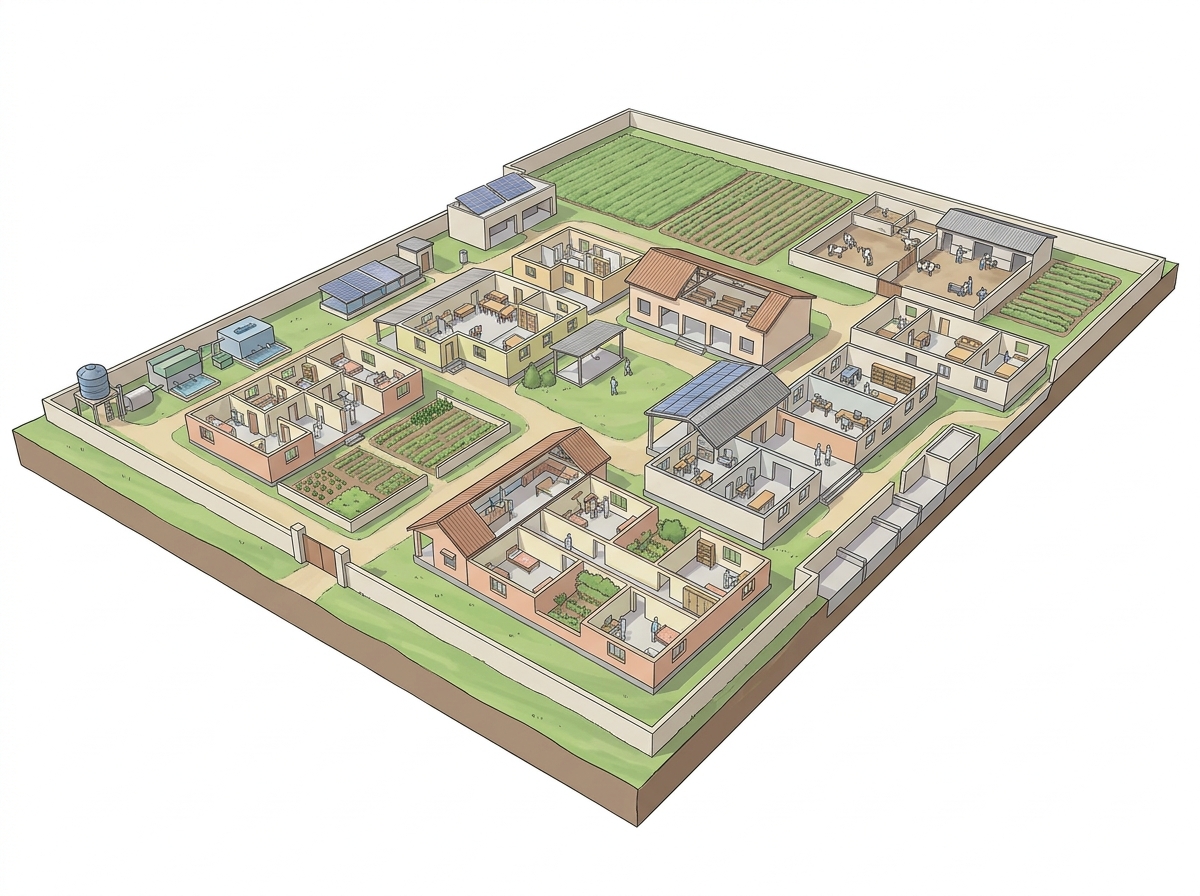
24 Sep झारखंड हाईकोर्ट ने खुली जेलों पर उठाए सवाल, सरकार से मांगी रिपोर्ट
✎ Open prisons operate on the principle of rehabilitation through trust and self-discipline, governed by the Model Prison Manual, 2016, and are subject to judicial scrutiny to ensure adherence to constitutional and statutory…
Subject Relevance — Where This Topic Fits
- GS Paper II — Governance, Constitution, and Polity | GS Paper III — Issues Relating to Development and Management of Social Sector/Services relating to Health, Education, Human Resources
- Prelims: Open Prison System, Prison Reforms, Judicial Review of Executive Actions, Article 21 (Right to Life and Personal Liberty), Prison Act, 1894, Model Prison Manual, 2016, NCRB Data on Prisons, Judicial Activism
- Essay: Prison Reforms: Balancing Justice and Human Dignity, Judicial Activism and Governance: Strengthening Institutional Accountability
Quick Revision: Open prisons operate on the principle of rehabilitation through trust and self-discipline, governed by the Model Prison Manual, 2016, and are subject to judicial scrutiny to ensure adherence to constitutional and statutory provisions.
Why is this in the news?
The Jharkhand High Court has taken suo motu cognisance of the state’s open prison system, directing the government to submit a detailed status report by 3 November 2026 on the availability of basic facilities and expansion plans. The court’s intervention follows Supreme Court directives emphasizing the need for improved infrastructure and expanded coverage of open prisons across states. This development underscores the judiciary’s role in ensuring adherence to constitutional and statutory provisions governing prison administration and rehabilitation.
Background
- Open prisons, also known as ‘open jails’ or ‘probation asylums’, are correctional facilities where inmates are granted greater freedom of movement and work opportunities compared to conventional prisons, aiming to facilitate reintegration into society.
- The concept of open prisons is rooted in the philosophy of rehabilitation rather than mere punishment, aligning with the constitutional mandate under Article 21 (Right to Life and Personal Liberty) to ensure humane treatment of prisoners.
- The Supreme Court of India has underscored the need for prison reforms, including the establishment of open prison systems.
- The Model Prison Manual, 2016, provides guidelines for the establishment and management of open prisons, including infrastructure, security, and rehabilitation measures.
- Jharkhand, like other states, has been expanding its open prison infrastructure, with four central prisons approved for open barracks and 32 acres of land earmarked in Hazaribagh for further development.
What are Open Prisons?
- Open prisons are non-custodial correctional institutions where inmates are allowed to work outside the prison premises during the day and return in the evening, fostering self-reliance and reducing recidivism.
- The primary objective is rehabilitation, achieved through vocational training, employment opportunities, and gradual reintegration into society, thereby addressing the limitations of conventional incarceration.
- Inmates in open prisons are typically low-risk offenders, including those serving sentences for minor offences, undertrials granted bail with conditions, or prisoners nearing the end of their sentences.
- Security in open prisons relies on trust, self-discipline, and minimal physical restraints, with inmates often required to adhere to strict behavioural guidelines to maintain their status.
- Open prisons are governed by state-specific rules framed under the Model Prison Manual, 2016, which outline eligibility criteria, infrastructure standards, and rehabilitation protocols.
- The system includes provisions for women inmates, with separate facilities being developed in states like Jharkhand to address gender-specific needs and ensure safety and dignity.
- Open prisons contribute to reducing prison overcrowding by offering an alternative to high-security incarceration for eligible prisoners.
- Judicial oversight, as seen in the Jharkhand High Court’s intervention, ensures that state governments comply with constitutional and statutory mandates, thereby upholding the rights of prisoners.
Key Features
| Feature | Significance |
|---|---|
| Swatantra (Open) Prisons | Provides a reformative incarceration model allowing inmates to work outside prison premises during the day while returning at night, promoting rehabilitation and reducing recidivism. |
| State-wise Expansion | Demonstrates Jharkhand’s commitment to adopting progressive correctional policies aligned with Supreme Court directives for humane prison conditions. |
| Quarterly Progress Reports | Institutionalises accountability by mandating regular updates on the implementation and expansion of open prison facilities. |
| Land Allocation (Hazaribagh) | 32 acres of government land earmarked for open prison expansion, enabling physical infrastructure development and scalability. |
| Gender-Sensitive Provisions | Plans for separate open prisons for women inmates reflect adherence to gender-responsive correctional policies and constitutional guarantees of equality. |
Why it Matters
Judicial Governance
- The High Court’s suo motu cognisance underscores the judiciary’s proactive role in ensuring compliance with constitutional and statutory mandates on prison reforms.
- Judicial oversight transforms policy directives into enforceable timelines, accelerating institutional reforms in correctional administration.
Rehabilitative Justice
- Open prisons align with the rehabilitative philosophy of justice, emphasising skill development, social reintegration, and reduced institutionalisation trauma.
- Supreme Court’s emphasis on humane prison conditions reinforces the constitutional principle of dignity (Article 21) in incarceration.
Administrative Efficiency
- Mandating detailed reports and quarterly reviews enhances transparency and administrative responsiveness in public service delivery.
- Land allocation and infrastructure planning demonstrate inter-departmental coordination between judiciary, prisons, and land revenue authorities.
Challenges
1. Resource Allocation and Infrastructure Gaps
- Inadequate funding for prison infrastructure may delay the establishment of open prison facilities despite land availability.
- Ensuring equitable distribution of resources across districts to prevent concentration of facilities in select areas.
UPSC Link: Prison Reforms (Mulla Committee)
2. Security and Risk Management
- Balancing inmate mobility with stringent security protocols to prevent escapes or misuse of open prison privileges.
- Training of prison staff in modern correctional techniques and community-based supervision models.
UPSC Link: Prison Security Guidelines
3. Social Stigma and Reintegration
- Overcoming societal prejudice against ex-convicts to facilitate smooth reintegration into communities.
- Providing vocational training and employment linkages to ensure sustainable post-release livelihoods.
UPSC Link: Rehabilitation Policies
4. Gender-Specific Challenges
- Designing secure yet humane facilities for women inmates, including childcare provisions where applicable.
- Addressing underrepresentation of women in open prison schemes due to socio-cultural barriers.
UPSC Link: Women in Prison (UN Rules)
5. Monitoring and Evaluation
- Developing robust metrics to assess the effectiveness of open prisons in reducing recidivism and promoting reform.
- Ensuring third-party audits to maintain objectivity in performance reviews.
UPSC Link: Prison Statistics India
Challenges — UPSC Perspective
| Issue | Concern |
|---|---|
| Land Acquisition Delays | Protracted legal and administrative processes may hinder timely allocation of land for prison expansion. |
| Staff Training Deficits | Inadequate training of prison officials in modern correctional practices may undermine open prison objectives. |
| Public Perception | Negative stereotypes about open prisons could lead to community resistance or political opposition. |
| Budgetary Constraints | Limited fiscal resources may restrict the scale and pace of infrastructure development. |
| Data Disparities | Lack of disaggregated data on inmate demographics and facility utilisation complicates targeted interventions. |
Government Initiatives — Must-Memorise for Prelims
- Model Prison Manual 2016 (Ministry of Home Affairs)
Way Forward
- Finalise and submit the detailed status report by 3 November 2026, including timelines for land allocation, construction, and staff training.
- Constitute a multi-stakeholder committee comprising judiciary, prison authorities, and civil society to oversee implementation and address bottlenecks.
- Develop standardised security protocols for open prisons, balancing inmate mobility with risk mitigation measures.
- Launch gender-responsive vocational training programmes for women inmates to enhance employability post-release.
- Conduct baseline and impact assessments of existing open prison facilities to identify best practices and areas for improvement.
- Organise awareness campaigns to sensitise communities and employers about the rehabilitative model of open prisons.
- Establish a grievance redressal mechanism for inmates and their families to report concerns related to facility conditions or security.
UPSC Value Addition
Keywords for Mains Answer-Writing
Open prisons in India · Prison reforms · Judicial activism in prison administration · Article 21 of the Constitution · Prisoners’ rights · Judicial oversight of executive actions · Right to life and personal liberty · Judicial review of prison policies · Model Prison Manual 2016 · Rehabilitation of prisoners · Judicial activism vs. separation of powers · State responsibility for prison conditions · Judicial directions for prison reforms · Prisoners’ welfare and dignity
Constitutional & Policy Linkages
- Article 21 (Protection of Life and Personal Liberty) — Ensures humane treatment of prisoners.
- Article 39A (Equal Justice and Free Legal Aid) — Mandates equitable access to justice and correctional reforms.
Concept Flow
Supreme Court directives on prison reforms → Jharkhand High Court suo motu cognisance → State government’s commitment to open prison expansion → Land allocation and infrastructure planning → Judicial oversight via quarterly reports → Implementation challenges (security, stigma, funding) → Long-term impact on recidivism and social reintegration.
Prelims Practice Questions
Q1. Consider the following statements regarding open prisons in India:
1. Open prisons are designed to provide a controlled environment where inmates can work outside the prison premises during the day.
2. The Model Prison Manual 2016 mandates the establishment of open prisons in every state.
3. Open prisons are primarily aimed at facilitating the reintegration of prisoners into society.
4. The Supreme Court of India has not issued any directives regarding the establishment of open prisons.
How many of the above statements are correct?
- Only one
- Only two
- Only three
- All four
Answer: Only three — Statements 1 and 3 are correct. Open prisons allow inmates to work outside under supervision during the day and aim at reintegration. Statement 2 is incorrect as the Model Prison Manual 2016 recommends but does not mandate open prisons in every state. Statement 4 is incorrect as the Supreme Court has issued directives (e.g., in Ramamurthy v. State of Karnataka, 2010) emphasizing prison reforms, including open prisons.
Q2. Assertion (A): The judiciary can direct the executive to improve prison conditions under Article 21 of the Constitution.
Reason (R): Article 21 guarantees the right to life and personal liberty, and the judiciary has the power of judicial review over executive actions.
Options:
A. Both A and R are true, and R is the correct explanation of A.
B. Both A and R are true, but R is not the correct explanation of A.
C. A is true, but R is false.
D. A is false, but R is true.
Answer: ? — Both Assertion (A) and Reason (R) are true. The judiciary has repeatedly directed the executive to improve prison conditions under Article 21, as seen in cases like Re-Inhuman Conditions in 1382 Prisons (2016). R correctly explains A, as judicial review is the mechanism through which such directives are issued.
Mains Practice Question
✍ Critically examine the constitutional and judicial framework governing open prisons in India. How far has the judicial activism in this domain succeeded in ensuring humane conditions for prisoners? Also, discuss the role of the state governments in implementing these directives. (15 Marks)
Approach: MODEL-ANSWER SKELETON:
1. **Constitutional Framework**:
– Article 21 (Right to Life and Personal Liberty) as the foundation for humane prison conditions.
– Article 39A (equal justice and free legal aid) and Article 47 (duty of the state to raise the level of nutrition and public health).
– Directive Principles of State Policy (DPSP) as guiding principles for prison reforms.
2. **Judicial Framework and Landmark Cases**:
– **Ramamurthy v. State of Karnataka (2010)**: Supreme Court directed states to establish open prisons and improve conditions.
– **Re-Inhuman Conditions in 1382 Prisons (2016)**: Court took suo motu cognizance of overcrowding and inhuman conditions, issuing comprehensive directives.
– **Sunil Batra v. Delhi Administration (1978)**: Recognized prisoners’ rights under Article 21.
– **Hussainara Khatoon v. State of Bihar (1979)**: Emphasized speedy trials and decongestion of prisons.
3. **Judicial Activism and its Success**:
– **Positive Outcomes**:
– Increased establishment of open prisons (e.g., in Rajasthan, Maharashtra, and now Jharkhand).
– Improved infrastructure, vocational training, and rehabilitation programs.
– Greater transparency and accountability in prison administration.
– **Challenges**:
– Slow implementation by state governments due to resource constraints.
– Lack of uniformity in prison policies across states.
– Inadequate monitoring mechanisms to ensure compliance.
4. **Role of State Governments**:
– **Implementation**: States are responsible for establishing and managing open prisons, as seen in Jharkhand’s recent directives.
– **Challenges**: Land acquisition, funding, and coordination between prison departments and other agencies.
– **Best Practices**: Examples from states like Rajasthan (open prisons in Sanganer and Jaipur) and Maharashtra (open prisons in Yerwada).
5. **Conclusion**:
– Judicial activism has been pivotal in driving prison reforms, but its success depends on proactive implementation by state governments.
– A balance between judicial directives and executive action is essential for sustainable reforms.
Source: amarujala.com
Jharkhand PCS (JPSC) — State PCS Practice
Prelims: Recently, the Jharkhand High Court directed the state government to submit a detailed report by 3rd November regarding the functioning of open prisons. Which of the following is NOT a key feature of Jharkhand’s open prison system?
- A. Inmates are allowed to work outside the prison premises under supervision
- B. Open prisons are exclusively for female inmates to ensure gender-specific rehabilitation
- C. The system aims to reduce recidivism by promoting self-discipline and trust
- D. Inmates are permitted to live with their families in designated open prison colonies
Answer: B. Open prisons are exclusively for female inmates to ensure gender-specific rehabilitation — Open prisons in Jharkhand are not gender-specific; they are designed for all eligible inmates, including both men and women, to facilitate rehabilitation.
Mains: Critically analyze the role of open prisons in Jharkhand’s correctional system. How does this model align with the state’s socio-cultural ethos, particularly in the context of tribal rehabilitation and reintegration? Suggest measures to strengthen the system while addressing challenges like overcrowding and resource constraints.
Generated by AanyaAi for educational purpose.
Related guides on our sites
- Best PSIR optional coaching for upsc
- Best economics optional coaching for upsc
- Best PSIR optional teacher for upsc
- Best teacher of PSIR optional for upsc

- सितंबर 2026 में SEBI बोर्ड की बैठक में लिए गए प्रमुख निर्णय - September 24, 2026
- SEBI Board Meeting 2026: Key Decisions for UPSC & State PCS Exam - September 24, 2026
- उत्तराखंड फिल्म नीति: 5 साल में 1759 करोड़ निवेश, राज्य बना फिल्म निर्माण केंद्र - September 24, 2026

No Comments