


27 Jul कोसी-मेची अंतरराज्यीय लिंक परियोजना: UPSC के लिए महत्वपूर्ण जानकारी
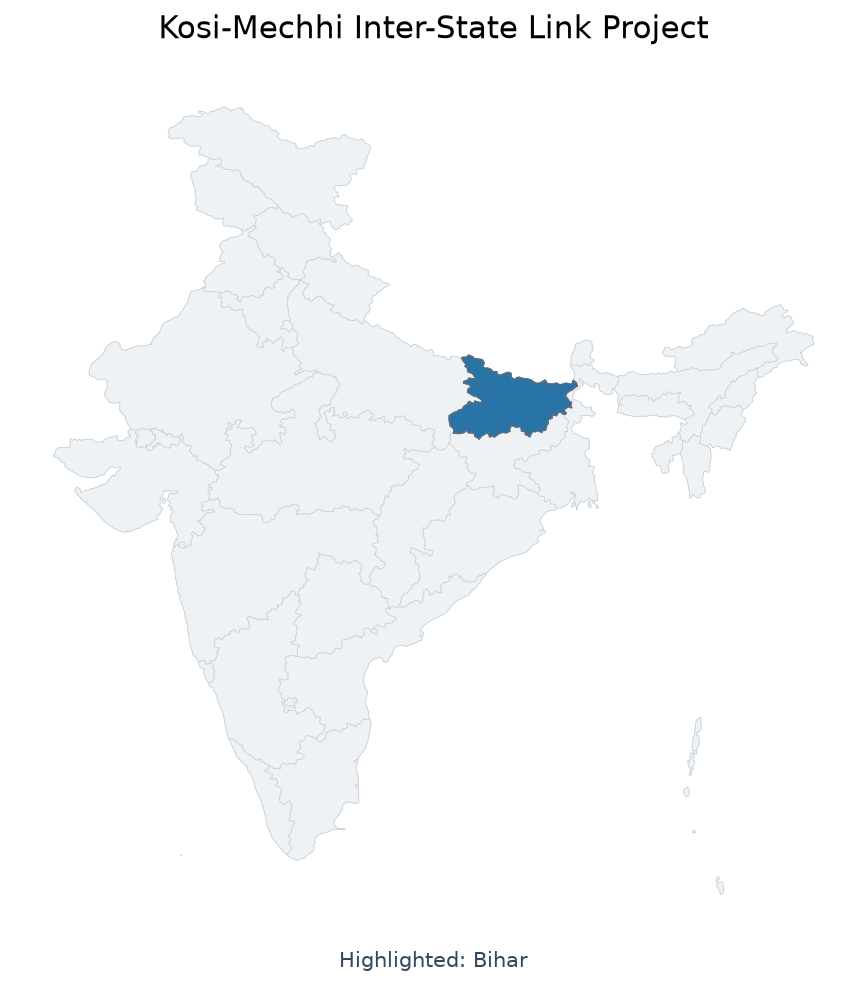
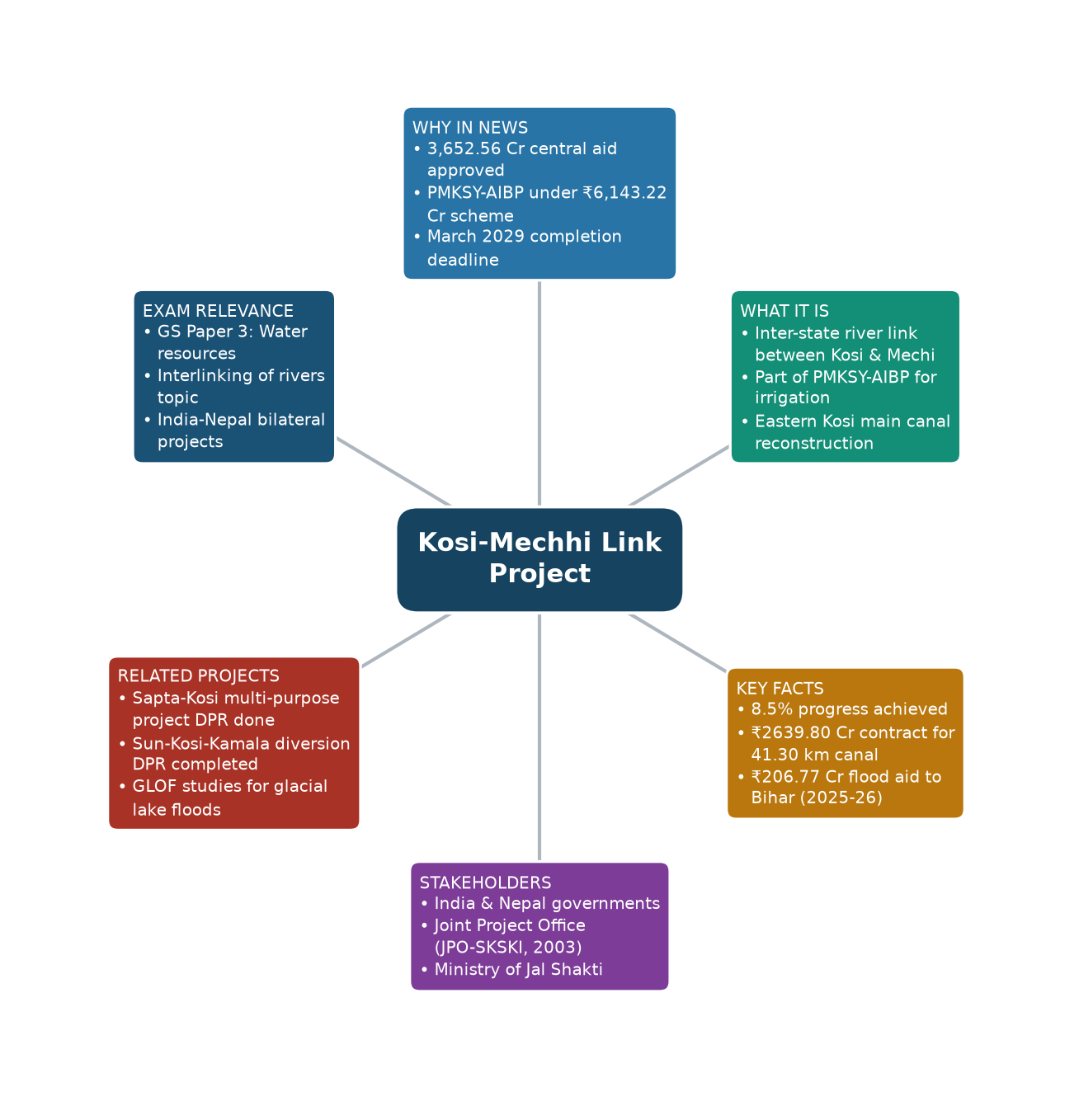
Map & concept mind-map: Kosi-Mechhi Inter-State Link Project
Subject Relevance — Where This Topic Fits
- GS Paper II — International Relations (India-Nepal water diplomacy) | GS Paper III — Agriculture (Irrigation and water resource management) | GS Paper III — Environment and Disaster Management (Flood control and climate resilience)
- Prelims: Kosi-Mechi Inter-State Link Project, PMKSY-AIBP, Saptakosi Multipurpose Project, Sun-Kosi-Kamala Diversion Multipurpose Project, Joint Project Office (JPO-SKSKI), GLOF studies, Flood Management Programme (FMP), Bihar Flood Control
- Essay: Water security and sustainable development in South Asia: The case of India-Nepal river basin cooperation, Climate change, transboundary rivers, and the imperative of cooperative governance
Quick Revision: The Kosi-Mechi Inter-State Link Project is an initiative under PMKSY-AIBP for the remaining cost of ₹6,143.22 crore to link the Kosi and Mechi rivers in Bihar, with completion targeted by March 2029.
Why is this in the news?
The Kosi-Mechi Inter-State Link Project has been included under the Pradhan Mantri Krishi Sinchayee Yojana-Accelerated Irrigation Benefits Programme (PMKSY-AIBP) for the remaining cost of ₹6,143.22 crore with a central assistance of ₹3,652.56 crore, aimed at enhancing irrigation, flood control, and water security in Bihar. The project is scheduled for completion by March 2029.
Background
- The Kosi-Mechi Inter-State Link Project is part of India’s broader strategy to address water scarcity and flood vulnerability in the eastern region, particularly Bihar, which faces recurrent floods and inadequate irrigation infrastructure.
- The Kosi River, originating in Nepal, is a major transboundary river with significant sediment load, causing frequent floods in downstream areas, including Bihar.
- India and Nepal have a long-standing history of cooperation on water resources, formalised through the 1954 Kosi Agreement and subsequent joint initiatives, including the 2003 establishment of the Joint Project Office (JPO-SKSKI) for multipurpose projects.
What is the Kosi-Mechi Inter-State Link Project?
- The Kosi-Mechi Inter-State Link Project is an inter-state water transfer initiative aimed at diverting surplus waters from the Kosi River to the Mechi River basin in Bihar, thereby enhancing irrigation potential and mitigating flood risks in the region.
- The project involves the reconstruction of the Eastern Kosi Main Canal from 0.00 to 41.30 km to link the Kosi and Mechi rivers, facilitating water transfer across basins.
- The project is being implemented under the PMKSY-AIBP, which provides central financial assistance for major and medium irrigation projects to ensure timely completion and utilisation of irrigation potential.
- The project is part of a larger framework of India-Nepal cooperation on water resources, including the Saptakosi Multipurpose Project and Sun-Kosi-Kamala Diversion Project, which are under various stages of development.
- The project incorporates climate-resilient design elements, including studies on Glacial Lake Outburst Floods (GLOF) and seismic activity, to ensure long-term sustainability and disaster resilience.
Key Features
| Feature | Significance |
|---|---|
| Total Project Cost | ₹6,143.22 crore with ₹3,652.56 crore central assistance under PMKSY-AIBP, ensuring fiscal viability and resource allocation for inter-state irrigation linkage. |
| Implementation Timeline | Completion by March 2029, with the Eastern Kosi Main Canal reconstruction (₹2,639.80 crore) already underway, demonstrating phased execution. |
| Progress Status | 8.5% physical progress achieved in the Eastern Kosi Main Canal work, indicating early-stage development with potential for accelerated execution. |
| Nepal-India Cooperation | Ongoing bilateral consultations with Nepal for Koshi River dam construction to address flood control and mutual benefits, underscoring transboundary water governance. |
| Joint Project Office (JPO-SKSKI) | Established in 2003 to prepare Detailed Project Reports (DPRs) for multi-purpose projects like Sapta-Koshi and Sun-Koshi-Kamala Diversion, highlighting institutionalized cooperation. |
Why it Matters
Economic
- Augments irrigation potential in Bihar and adjoining states, enhancing agricultural productivity and rural incomes through reliable water supply for kharif and rabi crops.
- Reduces dependency on monsoon rainfall, mitigating drought risks and stabilizing food security for over 20 million people in the Koshi-Gandak basin.
- Boosts local economies via employment generation in construction, maintenance, and ancillary sectors during project execution and post-completion phases.
Strategic
- Strengthens India’s transboundary water diplomacy with Nepal, ensuring equitable sharing of Koshi River waters for flood control and hydropower generation.
- Enhances regional connectivity by integrating water resource management with flood mitigation, reducing cross-border flood-induced displacement.
Environmental
- Promotes sustainable water resource utilization by optimizing inter-basin water transfer, reducing over-extraction of groundwater in eastern India.
- Incorporates floodplain management and glacial lake outburst flood (GLOF) studies to mitigate climate-induced disasters in the Himalayan foothills.
Institutional
- Demonstrates the efficacy of the PMKSY-AIBP framework in accelerating irrigation infrastructure development through central funding and state-level execution.
- Highlights the role of joint mechanisms like JPO-SKSKI in fostering bilateral trust and technical collaboration for multi-purpose river projects.
Challenges
1. Transboundary Water Governance
- Negotiating equitable water-sharing agreements with Nepal amid competing demands for irrigation, hydropower, and flood control.
- Addressing historical mistrust and sovereignty concerns while ensuring mutual benefits from Koshi River projects.
UPSC Link: GS Paper 2: IR, GS Paper 3: Water Resources
2. Technical and Geological Risks
- High seismic vulnerability in the Himalayan foothills necessitates rigorous earthquake-resistant design for dams and canals.
- Uncertainty in glacial lake outburst flood (GLOF) predictions requires adaptive engineering solutions to safeguard infrastructure.
UPSC Link: GS Paper 3: Disaster Management
3. Financial and Administrative Bottlenecks
- Delays in land acquisition and forest clearance for canal alignments may disrupt project timelines and escalate costs.
- Coordination challenges between central, state, and local agencies in executing multi-state projects under PMKSY-AIBP.
UPSC Link: GS Paper 3: Infrastructure
4. Climate Change Impacts
- Increased frequency of extreme weather events (e.g., floods, droughts) threatens the long-term viability of water infrastructure and irrigation schedules.
- Altered monsoon patterns may reduce water availability in the Koshi basin, necessitating adaptive water management strategies.
UPSC Link: GS Paper 3: Climate Change
5. Social and Environmental Concerns
- Displacement of communities and loss of livelihoods due to canal construction and reservoir submergence require robust rehabilitation and resettlement (R&R) plans.
- Potential ecological disruption to riverine ecosystems and biodiversity in the Koshi-Gandak basin demands environmental impact assessments (EIAs) and mitigation measures.
UPSC Link: GS Paper 3: Environment
6. Bilateral Diplomatic Hurdles
- Lack of recent meetings (since 2025-26) between the India-Nepal Joint Committee may slow progress on DPRs for Sapta-Koshi and Sun-Koshi-Kamala projects.
- Geopolitical sensitivities, including Nepal’s internal political dynamics, may influence bilateral cooperation on water projects.
UPSC Link: GS Paper 2: IR
Challenges — UPSC Perspective
| Issue | Concern |
|---|---|
| Equitable Water Sharing | Nepal’s demand for higher water allocation for irrigation conflicts with India’s flood control and hydropower priorities. |
| Seismic Vulnerability | High earthquake risk in the Himalayan foothills necessitates costly retrofitting of dams and canals. |
| Land Acquisition Delays | Protracted clearance processes for canal alignments in Bihar and Nepal may derail project timelines. |
| Climate Variability | Unpredictable monsoon patterns and GLOF events threaten water availability and infrastructure safety. |
| Community Displacement | Inadequate R&R plans may lead to social unrest and legal challenges, delaying project implementation. |
| Bilateral Trust Deficit | Historical grievances and lack of recent high-level engagement may hinder progress on joint projects. |
Way Forward
- Accelerate bilateral negotiations with Nepal to finalize DPRs for Sapta-Koshi and Sun-Koshi-Kamala projects, ensuring alignment with PMKSY-AIBP timelines.
- Conduct comprehensive seismic and GLOF risk assessments for Koshi River dams and canals, incorporating adaptive engineering designs.
- Streamline land acquisition and forest clearance processes in Bihar and Nepal through digital governance tools and stakeholder consultations.
- Develop a climate-resilient water management plan to address altered monsoon patterns and extreme weather events in the Koshi-Gandak basin.
- Strengthen institutional capacity at the Joint Project Office (JPO-SKSKI) to enhance technical collaboration and project oversight.
- Implement robust R&R frameworks with transparent grievance redressal mechanisms to mitigate social resistance.
- Integrate floodplain zoning and early warning systems to enhance disaster preparedness and reduce cross-border flood risks.
- Establish a dedicated monitoring cell under the Ministry of Jal Shakti to track progress and address bottlenecks in real time.
UPSC Value Addition
Keywords for Mains Answer-Writing
Kosi-Mechi Inter-State Link Project · PMKSY-AIBP · Flood control and irrigation · Bihar-Nepal water cooperation · Kosi-Gandak basin management · Saptakoshi Multipurpose Project · Sun-Kosi-Kamala Diversion Project · Glacial Lake Outburst Flood (GLOF) studies · Inter-basin water transfer · River basin authorities in India · Bihar flood management · Central assistance to states
Concept Flow
Koshi River’s transboundary nature → Bilateral negotiations for water-sharing agreements → Joint Project Office (JPO-SKSKI) for DPR preparation → PMKSY-AIBP funding approval → Construction of dams and canals → Enhanced irrigation and flood control → Agricultural productivity gains → Rural economic upliftment → Strengthened India-Nepal water diplomacy → Regional stability and climate resilience.
Prelims Practice Questions
Q1. Consider the following statements regarding the Kosi-Mechi Inter-State Link Project: 1) It is funded under the Pradhan Mantri Krishi Sinchayee Yojana-Accelerated Irrigation Benefit Programme. 2) The project aims to link the Kosi and Mechi rivers for irrigation and flood control. 3) The project is expected to be completed by 2029. Which of the statements given above are correct?
- 1 and 2 only
- 2 and 3 only
- 1 and 3 only
- 1, 2 and 3
Answer: 1, 2 and 3 — All three statements are correct. The Kosi-Mechi Inter-State Link Project is funded under PMKSY-AIBP, aims to link the Kosi and Mechi rivers, and is scheduled for completion by March 2029.
Q2. Which of the following projects is NOT part of the joint India-Nepal initiatives mentioned in the context of the Kosi-Mechi Inter-State Link Project?
- Saptakoshi Multipurpose Project
- Sun-Kosi-Kamala Diversion Project
- Kosi-Gandak Basin Authority
- GLOF studies on Kosi basin
Answer: Kosi-Gandak Basin Authority — The Kosi-Gandak Basin Authority is not mentioned in the provided context. The other three options—Saptakoshi Multipurpose Project, Sun-Kosi-Kamala Diversion Project, and GLOF studies—are explicitly referenced.
Q3. The Kosi-Mechi Inter-State Link Project includes the reconstruction of the Eastern Kosi Main Canal. What is the estimated cost of this reconstruction work?
- ₹2,639.80 crore
- ₹3,652.56 crore
- ₹6,143.22 crore
- ₹206.77 crore
Answer: ₹2,639.80 crore — The reconstruction of the Eastern Kosi Main Canal is awarded at an estimated cost of ₹2,639.80 crore, as per the provided data.
Mains Practice Question
✍ Discuss the significance of the Kosi-Mechi Inter-State Link Project in the context of India’s water resource management and bilateral cooperation with Nepal. Examine the challenges associated with inter-basin water transfer projects and suggest measures to address them.
Approach: Begin by outlining the objectives and components of the Kosi-Mechi Inter-State Link Project, emphasizing its role in irrigation, flood control, and water security. Highlight India-Nepal cooperation in transboundary river management, including joint studies like GLOF assessments. Critically analyze the challenges such as ecological impacts, displacement, and geopolitical sensitivities. Conclude with policy recommendations, including integrated basin management, stakeholder consultations, and technological interventions to mitigate risks.
Source: PIB (Press Information Bureau)
Generated by AanyaAi for educational purpose.


No Comments