


27 Jul कोसी-मेची अंतरराज्यीय लिंक परियोजना: UPSC के लिए महत्वपूर्ण जानकारी
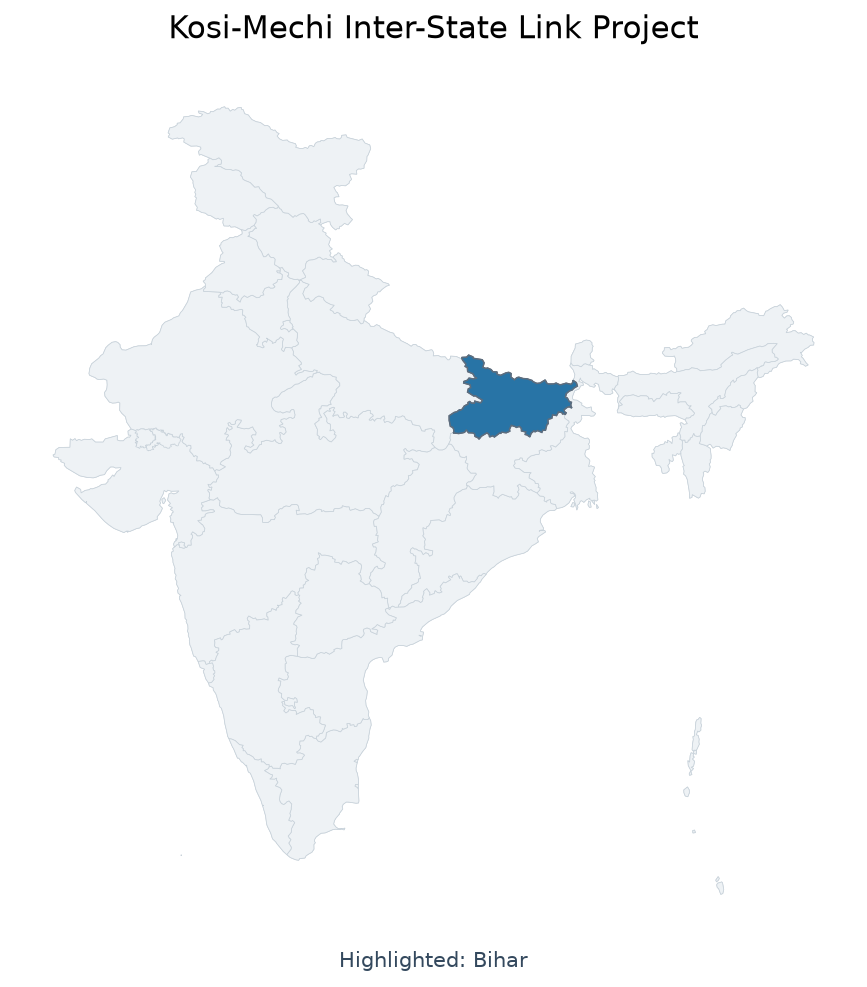
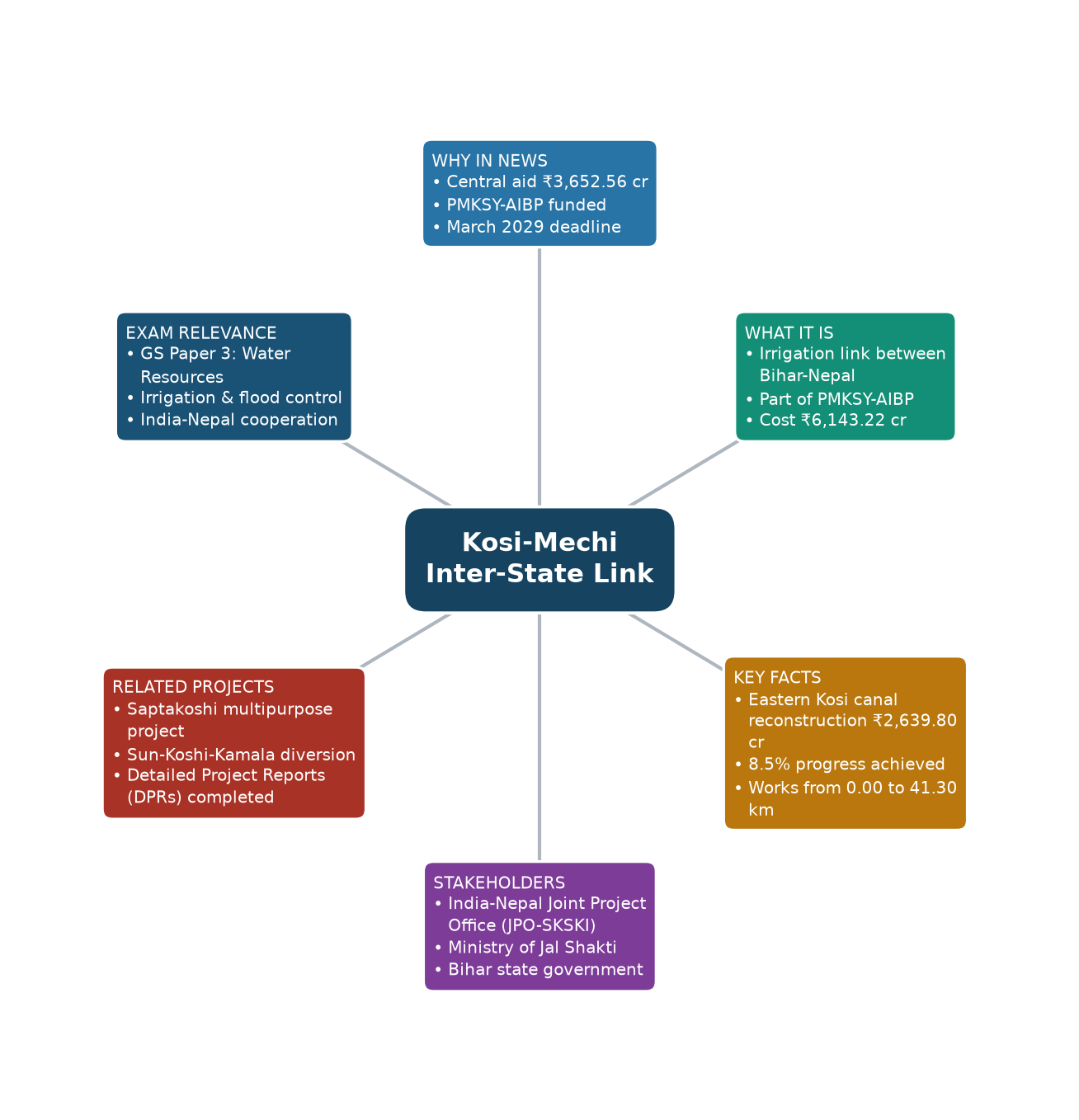
Map & concept mind-map: Kosi-Mechi Inter-State Link Project
Subject Relevance — Where This Topic Fits
- GS Paper II — International Relations (India-Nepal bilateral water cooperation, transboundary river management) | GS Paper III — Agriculture (irrigation infrastructure, PMKSY-AIBP), Environment and Disaster Management (flood control, glacial lake outburst floods) | GS Paper IV — Ethics in Governance (inter-state and international coordination, sustainable development)
- Prelims: Koshi-Mechi Link Project, PMKSY-AIBP, JPO-SKSKI, Saptakoshi Multipurpose Project, Sun-Koshi-Kamala Diversion Project, GLOF studies, Bihar Flood Management Programme
- Essay: Water diplomacy: India-Nepal cooperation in transboundary river basins, Sustainable infrastructure development: Balancing irrigation, flood control, and ecological conservation
Quick Revision: The Koshi-Mechi Link Project is a ₹6,143.22 crore inter-state irrigation and flood control initiative under PMKSY-AIBP, aimed at mitigating floods in Bihar, with completion targeted for March 2029.
Why is this in the news?
The Koshi-Mechi Inter-State Link Project has been included under the Pradhan Mantri Krishi Sinchayee Yojana-Accelerated Irrigation Benefits Programme (PMKSY-AIBP) with a central assistance of ₹3,652.56 crore, marking a significant step toward enhancing irrigation and flood resilience in Bihar and eastern Nepal. The project, with a total estimated cost of ₹6,143.22 crore, is slated for completion by March 2029. This initiative underscores India’s commitment to cooperative water resource management with Nepal, while addressing critical agricultural and disaster mitigation needs in the region.
Background
- The Koshi-Mechi Link Project is part of India’s broader strategy to develop inter-state and international river linkages for irrigation, flood control, and hydroelectric power generation.
- The Koshi River, originating in Nepal, is a major tributary of the Ganges and has been a focal point of India-Nepal water cooperation since the 1950s, including the 1954 Koshi Agreement.
- The project aligns with the objectives of the PMKSY-AIBP, which aims to enhance irrigation coverage and efficiency through major and medium irrigation projects.
- The project also addresses the recurring floods in Bihar, which have historically caused significant loss of life and property, necessitating robust flood management infrastructure.
- The Joint Project Office (JPO-SKSKI), established in 2003, has been instrumental in preparing Detailed Project Reports (DPRs) for multipurpose projects like the Saptakoshi and Sun-Koshi-Kamala Diversion schemes.
- The project is situated within the broader context of India’s Act East Policy and its emphasis on sub-regional cooperation, particularly with Nepal and Bangladesh.
What is the Koshi-Mechi Inter-State Link Project?
- The Koshi-Mechi Link Project is an inter-state irrigation and flood control initiative.
- The project includes the reconstruction of the Eastern Koshi Main Canal, with an awarded contract worth ₹2,639.80 crore covering a 41.30 km stretch, and is currently at 8.5% physical progress.
- The project is being implemented under the PMKSY-AIBP, with central assistance of ₹3,652.56 crore, and is expected to be completed by March 2029.
- The project also incorporates flood control measures to mitigate the impact of recurrent floods in Bihar.
- The project involves extensive studies such as topographic surveys, hydrological studies, seismic assessments, and glacial lake outburst flood (GLOF) analyses to ensure technical feasibility and environmental sustainability.
- The project is part of a broader framework of India-Nepal cooperation on transboundary rivers, including the Saptakoshi Multipurpose Project and the Sun-Koshi-Kamala Diversion Project, which aim to harness water resources for irrigation, hydropower, and flood control.
- The project is expected to generate significant employment opportunities during construction and operation, contributing to local economic development in the region.
Key Features
| Feature | Significance |
|---|---|
| Total Project Cost | ₹6,143.22 crore, with ₹3,652.56 crore central assistance under PMKSY-AIBP, ensuring financial viability and accelerated implementation. |
| Completion Timeline | March 2029, providing a structured timeline for execution and resource allocation. |
| Progress on Eastern Koshi Main Canal | 8.5% physical progress achieved; ₹2,639.80 crore contract awarded for 41.30 km stretch, indicating phased development. |
| Inter-State Linkage | Connects Koshi (Bihar) and Mechi (West Bengal) rivers, enhancing irrigation and water security across state boundaries. |
| Nepal Engagement | Regular bilateral consultations on Koshi river dams for mutual flood control and water resource management. |
Why it Matters
Economic
- Augments irrigation potential in drought-prone regions of Bihar and West Bengal, boosting agricultural productivity.
- Reduces dependency on monsoon rainfall, stabilising farm incomes and rural economies.
- Central funding under PMKSY-AIBP ensures fiscal efficiency and prioritises water-scarce areas.
Strategic
- Strengthens inter-state water cooperation, reducing conflicts over transboundary river resources.
- Enhances flood resilience in the Koshi-Gandak basin, a high-risk flood-prone zone.
- Supports India’s Act East Policy by improving regional connectivity and water security in the eastern Himalayan foothills.
Environmental
- Promotes sustainable water management through integrated basin planning and flood mitigation.
- Incorporates glacier lake outburst flood (GLOF) studies to address climate-induced risks in the Himalayan region.
Challenges
1. Geopolitical Coordination with Nepal
- Delays in finalising Koshi dam agreements due to differing priorities on water sharing and flood control.
- Absence of India-Nepal Joint Committee meetings in 2025-26 reflects stagnation in bilateral negotiations.
UPSC Link: GS-II: India-Nepal relations
2. Technical and Geological Risks
- Complex terrain and seismic activity in the Himalayan foothills pose construction challenges.
- Inadequate geological data may lead to unforeseen delays in dam and canal construction.
UPSC Link: GS-III: Disaster Management
3. Financial and Administrative Bottlenecks
- High project cost necessitates efficient fund utilisation and monitoring to prevent cost overruns.
- Land acquisition and rehabilitation delays could hinder canal construction progress.
UPSC Link: GS-III: Infrastructure Development
4. Climate Variability and Hydrological Uncertainty
- Changing precipitation patterns and glacial melt dynamics may alter river flow projections.
- Inadequate long-term hydrological data increases the risk of overestimation or underestimation of water availability.
UPSC Link: GS-III: Climate Change
Challenges — UPSC Perspective
| Issue | Concern |
|---|---|
| Bilateral Negotiations | Stalled India-Nepal discussions on Koshi dam projects due to divergent priorities. |
| Seismic Activity | High earthquake risk in the Himalayan region threatens structural integrity of dams and canals. |
| Fund Utilisation | Risk of cost overruns and delays in financial disbursement under PMKSY-AIBP. |
| Land Acquisition | Potential delays in acquiring right-of-way for canal alignment and ancillary structures. |
| Climate Change | Uncertainty in river flow due to glacial retreat and erratic monsoon patterns. |
Way Forward
- Convene urgent India-Nepal Joint Committee meetings to finalise Koshi dam agreements and address bilateral concerns.
- Accelerate geological and hydrological surveys to mitigate technical risks in construction.
- Strengthen institutional frameworks for real-time water data sharing between India and Nepal.
- Enhance monitoring mechanisms under PMKSY-AIBP to ensure timely fund disbursement and progress tracking.
- Integrate climate resilience measures in project design, including adaptive flood management strategies.
- Prioritise land acquisition and rehabilitation policies to minimise construction delays.
- Establish a dedicated inter-ministerial task force for Koshi-Mechi project oversight and coordination.
UPSC Value Addition
Keywords for Mains Answer-Writing
Inter-State River Linking Projects · Kosi-Mechi Link Project · PMKSY-AIBP · Flood control mechanisms · India-Nepal water diplomacy · Kosi-Gandak Basin · Multi-purpose river valley projects · National Irrigation Policy · Trans-boundary river basins · Hydrological studies · Glacial Lake Outburst Floods (GLOF) · Irrigation infrastructure development · Bihar flood management · Joint Project Offices (JPO)
Concept Flow
Transboundary Water Disputes → India-Nepal Bilateral Negotiations → Koshi River Basin Development → Flood Control and Irrigation Enhancement → Agricultural Productivity Gains → Rural Economic Stability → Climate Change → Glacial Retreat and Erratic Monsoons → Hydrological Uncertainty → Project Design Adaptation → Resilient Infrastructure Development → Central Assistance (PMKSY-AIBP) → Financial Viability → Accelerated Implementation → Timely Completion (March 2029) → Inter-State River Linking → Koshi-Mechi Canal Construction → Water Security for Bihar and West Bengal → State-Level Coordination → Geological Surveys → Seismic Risk Assessment → Structural Design Modifications → Disaster-Resilient Infrastructure
Prelims Practice Questions
Q1. Which of the following statements about the Kosi-Mechi Inter-State Link Project is correct?
- A. The project is funded entirely by the Government of Nepal.
- B. The project is part of the Pradhan Mantri Krishi Sinchayee Yojana-An accelerated Irrigation Benefits Programme (PMKSY-AIBP).
- C. The project aims to divert water from the Ganga to the Yamuna basin.
- D. The project is expected to be completed by 2030.
Answer: B. The project is part of the Pradhan Mantri Krishi Sinchayee Yojana-An accelerated Irrigation Benefits Programme (PMKSY-AIBP). — The Kosi-Mechi Inter-State Link Project is funded under PMKSY-AIBP, as stated in the PIB release. The project does not involve diversion between the Ganga and Yamuna basins, nor is its completion timeline 2030.
Q2. The Joint Project Office (JPO-SKS&KI) was established in 2003 to prepare Detailed Project Reports (DPRs) for which of the following projects?
- A. Kosi-Mechi Link Project and Gandak-Bagmati Link Project
- B. Kosi-Mechi Link Project and Sun-Kosi-Kamala Diversion Multipurpose Project
- C. Sun-Kosi-Kamala Diversion Multipurpose Project and Sapta-Kosi Multipurpose Project
- D. Gandak-Bagmati Link Project and Sapta-Kosi Multipurpose Project
Answer: C. Sun-Kosi-Kamala Diversion Multipurpose Project and Sapta-Kosi Multipurpose Project — The JPO-SKS&KI was formed to prepare DPRs for the Sapta-Kosi Multipurpose Project and the Sun-Kosi-Kamala Diversion Multipurpose Project, as explicitly mentioned in the PIB release.
Q3. Which of the following studies has NOT been completed for the Sapta-Kosi Multipurpose Project as per the given data?
- A. Topographical survey
- B. Glacial Lake Outburst Flood (GLOF) studies
- C. Construction material survey
- D. Feasibility study for inter-basin water transfer to peninsular rivers
Answer: D. Feasibility study for inter-basin water transfer to peninsular rivers — The PIB release lists completed studies for the Sapta-Kosi Multipurpose Project, including topographical survey, GLOF studies, and construction material survey. No mention is made of feasibility studies for inter-basin water transfer to peninsular rivers.
Mains Practice Question
✍ Analyse the significance of the Kosi-Mechi Inter-State Link Project in the context of India’s National Irrigation Policy and India-Nepal bilateral water diplomacy. How does the project address the challenges of flood control, irrigation, and ecological sustainability in the Kosi-Gandak Basin?
Approach: The candidate should examine the project’s dual objectives of irrigation and flood control within the Kosi-Gandak Basin, highlighting its alignment with the National Irrigation Policy’s emphasis on water resource development. Discuss the project’s role in strengthening India-Nepal water diplomacy, particularly through joint studies and the establishment of the JPO-SKS&KI. Address the ecological challenges posed by glacial lake outburst floods (GLOFs) and the project’s mitigation strategies. Conclude by evaluating the project’s potential to enhance agricultural productivity and socio-economic stability in Bihar while ensuring environmental sustainability.
Source: PIB (Press Information Bureau)
Generated by AanyaAi for educational purpose.


No Comments