


27 Jul कोसी-मेची अंतरराज्यीय लिंक परियोजना: जानें UPSC के लिए महत्वपूर्ण तथ्य
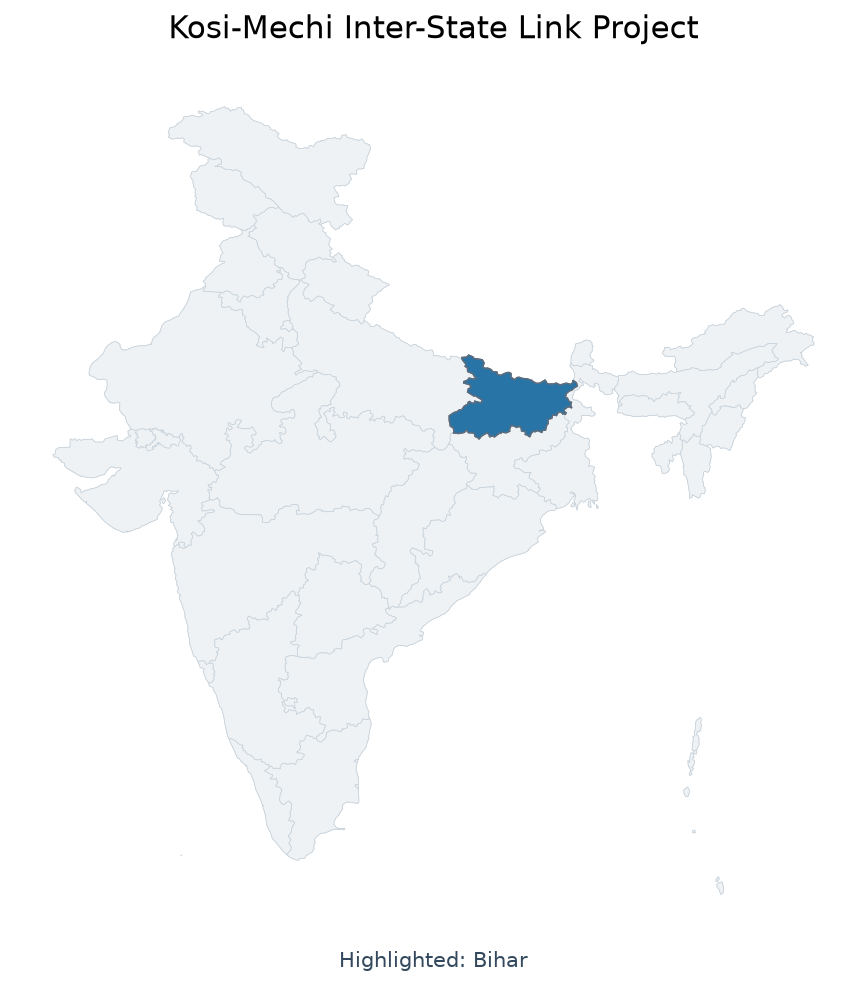
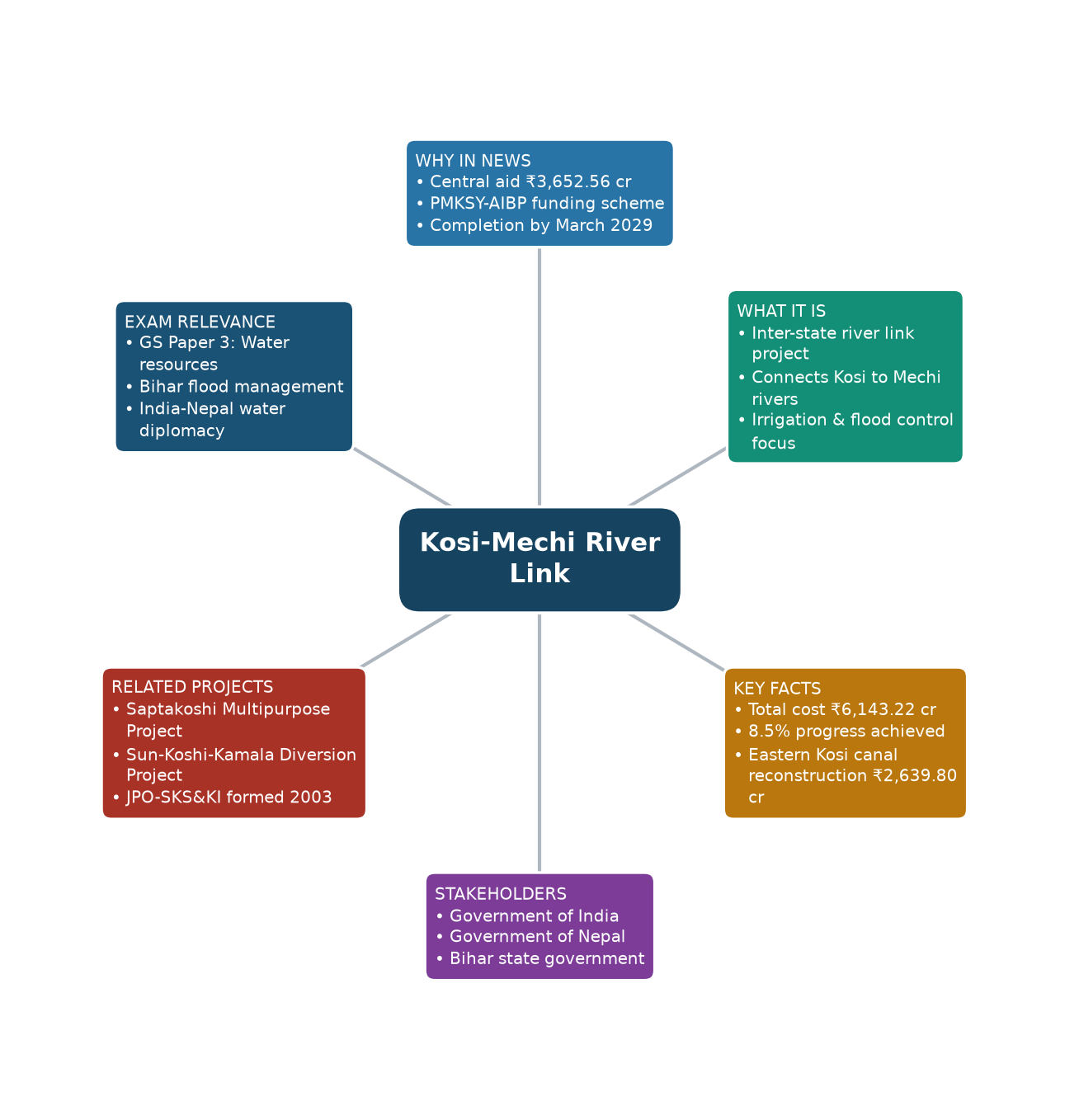
Map & concept mind-map: Kosi-Mechi Inter-State Link Project
Subject Relevance — Where This Topic Fits
- GS Paper II — India and its Neighbourhood | GS Paper III — Water Resources and Irrigation Management
- Prelims: Kosi-Mechi Inter-State Link Project, PMKSY-AIBP, Joint Project Office (JPO-SKSKI), Bihar Flood Management Programme, GLOF studies, Nepal-India Joint Committee on Water Resources
- Essay: Water diplomacy in South Asia: Cooperation and conflict in transboundary river basins, Sustainable irrigation and agricultural productivity in eastern India
Quick Revision: The Kosi-Mechi Inter-State Link Project, funded under PMKSY-AIBP, aims to enhance irrigation and flood control in Bihar by diverting Kosi waters to the Mechi basin, with completion targeted by March 2029.
Why is this in the news?
The Kosi-Mechi Inter-State Link Project has been included under the Pradhan Mantri Krishi Sinchayee Yojana-Accelerated Irrigation Benefits Programme (PMKSY-AIBP) with a central assistance of ₹3,652.56 crore, indicating renewed focus on inter-state and cross-border water resource development. The project, scheduled for completion by March 2029, aims to enhance irrigation in Bihar while fostering bilateral cooperation with Nepal on the Kosi basin. The inclusion of the project in PMKSY-AIBP underscores the government’s commitment to accelerate irrigation infrastructure development in eastern India, a region prone to both floods and water scarcity.
Background
- The Kosi River, originating in Nepal, is a major tributary of the Ganga and is notorious for its high sediment load and frequent floods, causing extensive damage to life and property in Bihar.
- The Kosi-Mechi Inter-State Link Project is part of a broader initiative to harness the waters of the Kosi River for irrigation, flood control, and hydroelectric power generation in Bihar and adjoining states.
- The Kosi basin has been a focal point of bilateral discussions due to its potential for multi-purpose river valley development, including irrigation, flood mitigation, and navigation.
- The PMKSY-AIBP, launched in 2015, aims to enhance physical access to irrigation through minor and medium irrigation projects, with a focus on completing ongoing projects.
- Bihar has historically received significant central assistance for flood management, including ₹206.77 crore over the past three years under the Flood Management and Border Areas Programme.
What is the Kosi-Mechi Inter-State Link Project?
- The Kosi-Mechi Inter-State Link Project is an inter-state irrigation and flood control initiative aimed at diverting surplus waters from the Kosi River to the Mechi River basin in Bihar, thereby enhancing agricultural productivity in the region.
- The project is being implemented under the PMKSY-AIBP, with a total estimated cost of ₹6,143.22 crore, of which ₹3,652.56 crore is provided as central assistance.
- The project includes the reconstruction of the Eastern Kosi Main Canal, with a contract worth ₹2,639.80 crore awarded for a 41.30 km stretch, and 8.5% physical progress achieved to date.
- The project is expected to be completed by March 2029, aligning with the broader objectives of the PMKSY to enhance irrigation coverage and reduce water stress in eastern India.
- The project is part of a larger ecosystem of inter-state and cross-border water resource development initiatives, including the proposed Sapta-Kosi Multi-Purpose Project and Sun-Kosi-Kamala Diversion Multi-Purpose Project.
- The project underscores the importance of multi-disciplinary studies, including topographical surveys, hydrological assessments, seismic studies, and Glacial Lake Outburst Flood (GLOF) analyses, to ensure technical feasibility and disaster resilience.
Key Features
| Feature | Significance |
|---|---|
| Total Project Cost | The project is sanctioned at ₹6,143.22 crore, with ₹3,652.56 crore provided by the Central Government under PMKSY-AIBP, reducing the financial burden on state exchequers. |
| Completion Timeline | The project is scheduled for completion by March 2029, ensuring timely augmentation of irrigation and flood mitigation infrastructure. |
| Progress of Eastern Kosi Main Canal | Reconstruction work on the 41.30 km stretch of the Eastern Kosi Main Canal has commenced with a contract value of ₹2,639.80 crore, achieving 8.5% physical progress as of the latest update. |
| Nepal-India Bilateral Engagement | Regular diplomatic consultations between India and Nepal are ongoing for the construction of dams on the Kosi River to address mutual benefits, including flood control and irrigation. |
| Joint Project Office (JPO-SKSKI) | Established in 2003, the JPO-SKSKI is tasked with preparing Detailed Project Reports (DPRs) for the Sapta-Kosi Multi-Purpose Project and Sun-Kosi-Kamala Diversion Multi-Purpose Project, ensuring technical and hydrological feasibility. |
Why it Matters
Economic
- Augments irrigation capacity in Bihar and adjoining regions, enhancing agricultural productivity and farmer incomes through reliable water supply.
- Reduces dependency on monsoon rainfall, mitigating crop losses due to drought and improving food security in eastern India.
- Creates employment opportunities during construction and post-completion phases, including in allied sectors such as logistics and maintenance.
Strategic
- Strengthens India-Nepal bilateral cooperation on transboundary river management, fostering regional stability and mutual trust.
- Enhances flood control mechanisms in the Kosi-Gandak basin, reducing the socio-economic impact of recurrent floods in Bihar and Nepal.
Environmental
- Integrates modern hydrological and seismic studies to ensure structural resilience against glacial lake outburst floods (GLOFs) and seismic activity.
- Promotes sustainable water resource management through inter-basin water transfer, balancing ecological needs with developmental priorities.
Institutional
- Leverages the PMKSY-AIBP framework to ensure convergence of central and state resources, accelerating project implementation.
- Facilitates capacity-building through joint technical studies and surveys, enhancing institutional expertise in river basin management.
Challenges
1. Geopolitical Coordination
- Requires sustained diplomatic engagement with Nepal to finalize agreements on dam construction and water-sharing protocols.
- Delays in bilateral consultations, as evidenced by no India-Nepal Joint Committee meetings in 2025-26, pose risks to project timelines.
UPSC Link: GS II: India-Nepal Relations
2. Technical and Hydrological Risks
- Complexity of inter-basin water transfer necessitates precise hydrological modeling to avoid downstream water scarcity in Nepal.
- Seismic and GLOF risks require robust engineering solutions to ensure long-term structural integrity of dams and canals.
UPSC Link: GS I: Geographical Features
3. Financial and Administrative Bottlenecks
- High project cost demands efficient fund utilization and monitoring to prevent cost overruns and delays.
- Coordination between multiple agencies (Central, State, and local) is critical to avoid bureaucratic hurdles in land acquisition and construction.
UPSC Link: GS III: Infrastructure
4. Environmental and Ecological Concerns
- Inter-basin water transfer may disrupt local ecosystems and biodiversity, necessitating Environmental Impact Assessments (EIAs) and mitigation measures.
- Sediment deposition and waterlogging risks require proactive management to sustain irrigation benefits over time.
UPSC Link: GS III: Environmental Conservation
5. Land Acquisition and Rehabilitation
- Large-scale infrastructure projects often face resistance from local communities due to displacement and inadequate compensation.
- Ensuring fair rehabilitation policies and transparent land acquisition processes is essential for social harmony.
UPSC Link: GS II: Government Policies
Challenges — UPSC Perspective
| Issue | Concern |
|---|---|
| Bilateral Diplomacy | Delays in India-Nepal consultations may stall project implementation and water-sharing agreements. |
| Hydrological Modeling | Precise water balance calculations are required to prevent downstream water deficits in Nepal. |
| Seismic and GLOF Risks | Structural designs must account for high seismic activity and glacial lake outburst flood scenarios. |
| Fund Utilization | Efficient financial management is critical to avoid cost overruns and ensure timely completion. |
| Ecosystem Disruption | Inter-basin water transfer may alter local hydrology, requiring ecological safeguards. |
Way Forward
- Convene high-level India-Nepal Joint Committee meetings at regular intervals to expedite bilateral consultations and finalize dam construction agreements.
- Accelerate Detailed Project Report (DPR) preparation for the Sapta-Kosi and Sun-Kosi-Kamala projects to ensure technical and financial viability.
- Strengthen institutional mechanisms for real-time monitoring of project progress and fund utilization under PMKSY-AIBP.
- Conduct comprehensive Environmental Impact Assessments (EIAs) and public consultations to address ecological and social concerns.
- Enhance inter-state coordination between Bihar and other beneficiary states to streamline land acquisition and rehabilitation processes.
- Invest in advanced hydrological and seismic studies to refine engineering designs and mitigate disaster risks.
- Establish a dedicated grievance redressal mechanism for local communities to address displacement and compensation issues promptly.
UPSC Value Addition
Keywords for Mains Answer-Writing
Inter-State River Linking Projects (ILR) · Kosi-Mechi Link Project · Pradhan Mantri Krishi Sinchayee Yojana-Accelerated Irrigation Benefit Programme (PMKSY-AIBP) · Bihar irrigation infrastructure · India-Nepal water cooperation · Sapta-Kosi Multi-Purpose Project · Sun-Kosi-Kamala Diversion Multi-Purpose Project · Flood management in Bihar · Joint Project Office (JPO-SKSKI) · GLOF (Glacial Lake Outburst Flood) studies · Himalayan river basin management · Central assistance for inter-state projects
Concept Flow
Transboundary River Basin (Kosi) → Bilateral Diplomacy (India-Nepal) → Project Sanctioning (PMKSY-AIBP) → Technical Feasibility Studies (DPRs) → Infrastructure Development (Dams & Canals) → Irrigation & Flood Control Benefits → Socio-Economic Development (Agriculture & Employment) → Environmental & Ecological Impact Assessment → Sustainable Water Resource Management
Prelims Practice Questions
Q1. Consider the following statements regarding the Kosi-Mechi Inter-State Link Project:
1. The project is being implemented under the PMKSY-AIBP with central assistance of ₹3,652.56 crore.
2. The project aims to link the Kosi and Mechi rivers to mitigate floods in Bihar.
3. The project is expected to be completed by March 2029.
4. The Eastern Kosi Main Canal reconstruction is part of this project.
Which of the statements given above are correct?
- 1 and 2 only
- 1, 2, and 3 only
- 1, 2, 3, and 4
- 2 and 4 only
Answer: 1, 2, 3, and 4 — All four statements are correct. The Kosi-Mechi Link Project is funded under PMKSY-AIBP with central assistance of ₹3,652.56 crore, aims to link Kosi and Mechi rivers for flood mitigation, includes Eastern Kosi Main Canal reconstruction, and is scheduled for completion by March 2029.
Q2. Which of the following projects is NOT associated with the India-Nepal water cooperation framework mentioned in the PIB release?
- Sapta-Kosi Multi-Purpose Project
- Sun-Kosi-Kamala Diversion Multi-Purpose Project
- Kosi-Mechi Inter-State Link Project
- National Mission for Clean Ganga
Answer: National Mission for Clean Ganga — The Kosi-Mechi Inter-State Link Project is an inter-state project within India, while the other three are part of India-Nepal water cooperation frameworks. The National Mission for Clean Ganga is unrelated to the India-Nepal framework.
Mains Practice Question
✍ Examine the significance of the Kosi-Mechi Inter-State Link Project in the context of India’s inter-linking of rivers (ILR) initiative. How does this project address the challenges of flood management and irrigation in Bihar? Discuss the role of international cooperation in its implementation.
Approach: The answer should highlight the Kosi-Mechi Link Project as a key component of India’s ILR initiative, aimed at mitigating floods and enhancing irrigation in Bihar. Discuss its alignment with PMKSY-AIBP, the inclusion of Eastern Kosi Main Canal reconstruction, and the project’s timeline. Address the role of India-Nepal cooperation in managing transboundary rivers like the Kosi, including the Joint Project Office (JPO-SKSKI) and studies like GLOF. Conclude by emphasizing the project’s potential to reduce flood risks and improve agricultural productivity in Bihar.
Source: PIB (Press Information Bureau)
Generated by AanyaAi for educational purpose.


No Comments